THE SHORT VERSION
What a commercial HVAC replacement includes
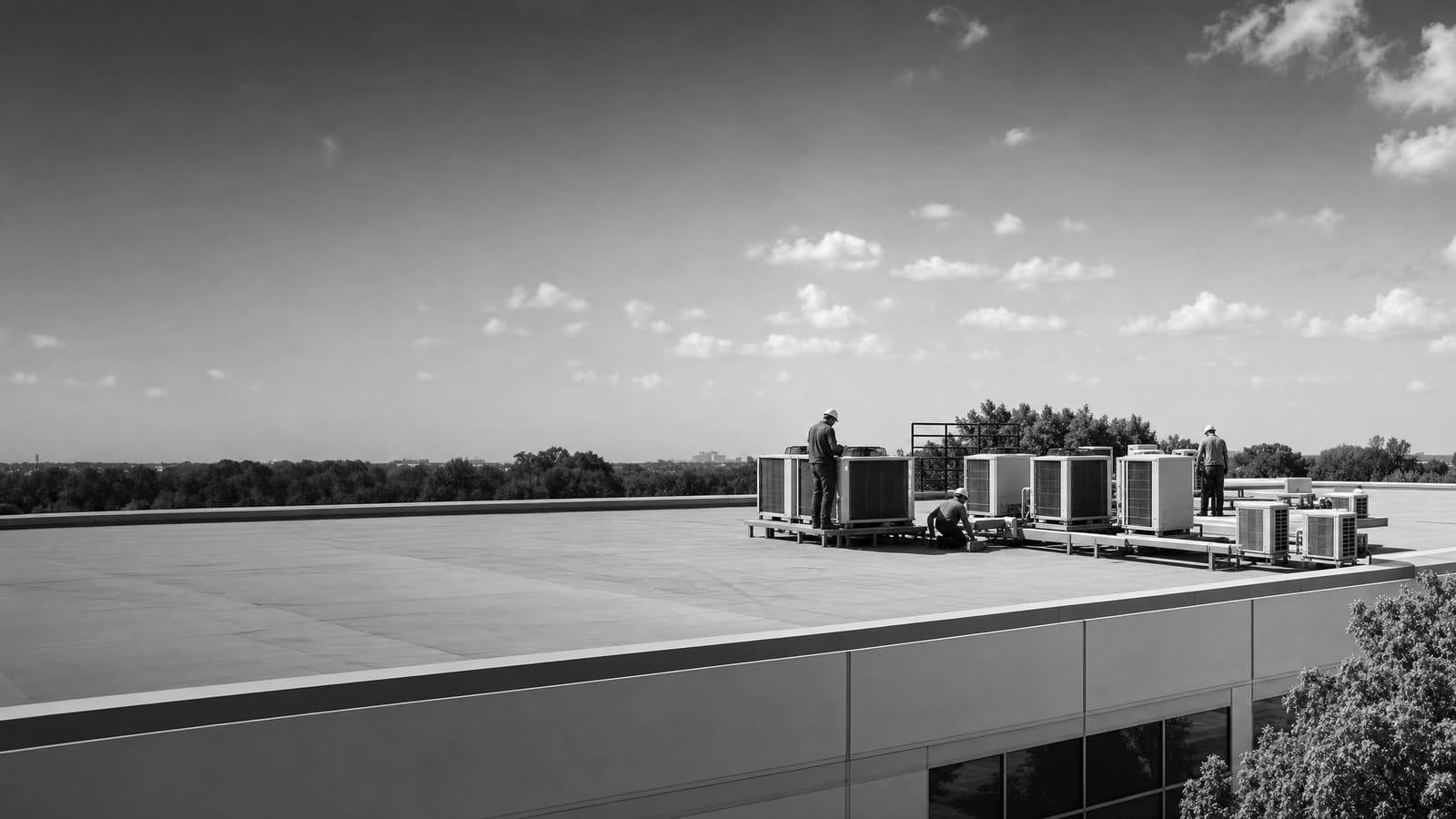
A commercial HVAC replacement means confirming the building load, selecting equipment against real availability, setting the unit, tying in power, gas, ducts, and controls, then commissioning the system so it performs to spec instead of just turning on.
Replacement usually beats one more repair once a rooftop unit passes fifteen years, because old, inefficient units waste roughly $900 to $3,700 each per year in energy.
A site review still has to verify the actual load, the curb and roof structure, available electrical capacity and gas service, and crane access before any of that becomes a real price.
THE REAL DECISION
Three ways buildings handle a tired rooftop unit
Most owners pick one of three paths, usually without meaning to. Waiting for the unit to quit is a choice, and it is the expensive one: you buy whatever is on the shelf, pay premium labor, and lose the space while the order ships.
Planned replacement at end of life is the common middle. Department of Energy guidance treats units past fifteen years as candidates, because the energy penalty compounds every season a tired unit keeps running.
The third path is proactive replacement with a better unit than the one coming off. Federal work with manufacturers produced rooftop equipment designed to cut energy use by up to half against the older standard, and more than twenty models now exceed that specification. The premium only pays back if the unit runs enough hours to earn it, so this belongs to how the building actually operates. Long retail and office hours make the case. A lightly used warehouse bay often does not.
WHAT MOVES THE NUMBER
The lines that separate two quotes
No two roofs price the same, so compare bids line by line instead of on the bottom number. These are the lines that move most between contractors, and the ones where a low quote is usually a missing scope item rather than a better price.
EQUIPMENT
Picking the equipment, not just the tonnage
Rooftop units condition close to half of all commercial floor space in the country, which is why most replacement conversations start and end with a packaged unit on a curb. The real decision inside that category is what kind of heat the unit makes and how efficient the cooling side is.
Gas-heat packaged units remain the straightforward swap when gas service is already on the roof. Heat pump rooftop units are the same basic machine with reverse-cycle heating added, and Department of Energy guidance describes three types: dual fuel, all-electric, and cold climate. Heat pump heating efficiency drops as outdoor temperatures fall, so these units suit mild-to-moderate winter heating best. That guidance puts most of the South and West, which includes Fresno, in the range where today's heat pump rooftop units can carry most or all of the winter heating demand.
That does not make the choice automatic. The same guidance ties the decision to local electricity and gas prices, the building's electrical capacity, physical constraints on the roof, existing gas lines, contractor familiarity with the equipment, and whatever incentives are open when you buy. Settle those before the unit is ordered, not after it lands.
SIDE BY SIDE
Simple swaps and hard ones
Two replacements a block apart can differ by weeks of schedule and a large multiple in price. What separates them is rarely the equipment. It is what the building makes the crew do to get that equipment in place and running.
LOWER COMPLEXITY
A straight curb swap
Same tonnage, same fuel, an existing curb in sound condition, an open lot for the crane, and controls that already speak a standard protocol. Permits are routine and the unit runs the day it lands.
HIGHER COMPLEXITY
Anything that changes the building
More tonnage, a new roof opening, structural reinforcement, a switch from gas heat to all-electric, tight access that needs a street closure, or ductwork that was never balanced. Each one adds engineering, review, and schedule.
SCOPING
What the site review has to settle
A quote written from a nameplate photo is a starting point, not a price. The nameplate says what went on the roof twenty years ago. It says nothing about whether that size still matches the building.
The review should confirm the load against how the space is used today: current occupancy, plug loads, lighting, operating hours, and any envelope work done since the original install. Oversized equipment short-cycles, dehumidifies poorly, and costs more to buy and to run. Undersized equipment never satisfies, and the complaint gets blamed on the installation.
Then come the physical questions. Is the existing curb sound, and does the new unit match it, or is an adapter needed? Will the roof structure carry the new weight? Is there enough electrical capacity at the panel, and is gas service staying or going? Where does the crane set up, how far does it have to reach, and how many stalls close for how long?
Every one of those answers becomes a line on the quote. The missing ones are why change orders show up after the crane leaves.
Ask for this before you sign
A load calculation based on today's use, a documented curb and roof condition note, confirmed electrical and gas capacity, and a rigging plan with lot closure hours. A bidder who skips these is handing you an estimate wearing a quote's clothes.
OWNERSHIP
Two decisions that outlive the install
The visible install is one morning. The choices inside it stay with the building for the next fifteen or twenty years, through every service call, parts order, and utility bill.
Two of those choices rarely appear as a line item, which is exactly why they get skipped. Both are cheap to handle while the order is still open and expensive to fix once the unit is bolted to the curb and the contract is signed. Raise them with the bidder before you sign, not at startup.
REFRIGERANT
Service and compliance
EPA rules under Section 608 of the Clean Air Act govern how refrigerant is handled and recycled in commercial cooling and heat pump equipment. New units ship on newer refrigerants, so a mixed fleet means two sets of parts, tools, and training.
FLEET
Standardize where you can
If you run several units, matching equipment and controls across replacements lowers the cost of every future service call. A one-off unit is cheap on install day and expensive for the rest of its service life.
PLANNING
Phasing a roof full of units
Buildings rarely have one tired unit. They have four or five, installed the same year, aging on the same curve. Replacing them all at once is a capital event most owners cannot absorb, and replacing them one failure at a time is the most expensive schedule there is.
The middle path is a phased plan built on condition and run hours rather than panic. Rank the units by age, service history, and how critical the space each one serves is. Replace the worst two while the crane is already scheduled and mobilization is shared, then take the rest across the next budget cycles. A multi-unit phase prices better than five separate emergencies, and the second and third units on the same day carry far less overhead than the first.
Lifetime cost decides the efficiency tier. A national campaign run with owners and manufacturers has upgraded more than forty-three thousand rooftop units, with participants reporting a combined thirty-seven million dollars a year in energy savings. That is an average across many buildings, not a promise for yours, but it is the reason the efficiency question belongs in the capital plan instead of only in the emergency call.
BEFORE YOU SIGN
Five things a comparable quote shows
Bids only compare when they cover the same scope. Ask every contractor to show these five in writing, on the same page as the price. If one is missing, the gap between two quotes is scope, not value.
01
Equipment and efficiency tier
Make, model, tonnage, heat type, and efficiency rating of the exact unit proposed, plus a confirmed lead time.
02
How the size was set
Whether the tonnage came from a load calculation for current use or was copied off the old nameplate.
03
Curb, roof, and structural scope
Adapter or new curb, any roof opening or reinforcement, and who patches and flashes the roof afterward.
04
Utility connections
Electrical capacity confirmation, panel or feeder work, gas line changes, and any new refrigerant line sets.
05
Rigging, permits, and commissioning
Crane plan, lot closure hours, permits and inspections, plus startup, airflow, charge, and controls verification.
Keep planning locally
Related mechanical pages in Fresno
Get a defensible number
Price the equipment and the building together.
Send the address, operating target, and target opening date. Flux will identify what must be verified before the project can be priced.
Get a free estimateQuestions
Straight answers.
When does replacement beat another repair?
Once a rooftop unit is past fifteen years, the math usually turns. Older, inefficient units waste roughly $900 to $3,700 each per year in energy, and that penalty repeats every season while repair bills climb. A second major component failure on an aging unit is the practical signal.
Should the new unit match the old one?
Confirm the load either way. If occupancy, equipment, and hours have not changed, a like-for-like swap is often correct and it is the fastest path back to cooling. If the space is used differently than it was, matching the old nameplate just repeats a twenty-year-old sizing decision.
Does a heat pump rooftop unit make sense here?
It can. Department of Energy guidance places most of the South and West, Fresno included, where today's heat pump rooftop units handle most or all of the winter heating load. The deciding factors are your electricity and gas prices, available electrical capacity, roof constraints, and current incentives.
What does a commercial HVAC installation cost?
There is no honest universal number, because tonnage, efficiency tier, curb and structural work, electrical capacity, and crane access each move the total independently. Any bidder who quotes before looking at the roof is guessing. Ask for the price broken into those lines so you can compare bids.
What causes the delays on a replacement?
Equipment availability first, then anything the building changes. Larger tonnage, a new roof opening, structural review, or an electrical service upgrade all add time before the crane can be scheduled. This is why availability and permit scope belong on the quote next to the price.
Will new equipment change how we service the fleet?
New units ship on newer refrigerants, and EPA Section 608 rules govern how refrigerant is handled and recycled. Day-to-day operation is unaffected, but a mixed fleet means two sets of parts and technician training. Worth planning into service contracts and spare-parts strategy.
Sources used for this guide
- [1]betterbuildingssolutioncenter.energy.gov — DOE Advanced Rooftop Unit Replacement Guidance
- [2]betterbuildingssolutioncenter.energy.gov — DOE Commercial Heat Pump Rooftop Unit Replacement Guidance
- [3]betterbuildingssolutioncenter.energy.gov — DOE High-Efficiency Commercial Rooftop Unit Toolkit
- [4]energy.gov — DOE Efficient Commercial Rooftop Air Conditioner Program
- [5]epa.gov — EPA Stationary HVAC Refrigerant Management