THE SHORT VERSION
What a commercial HVAC replacement includes
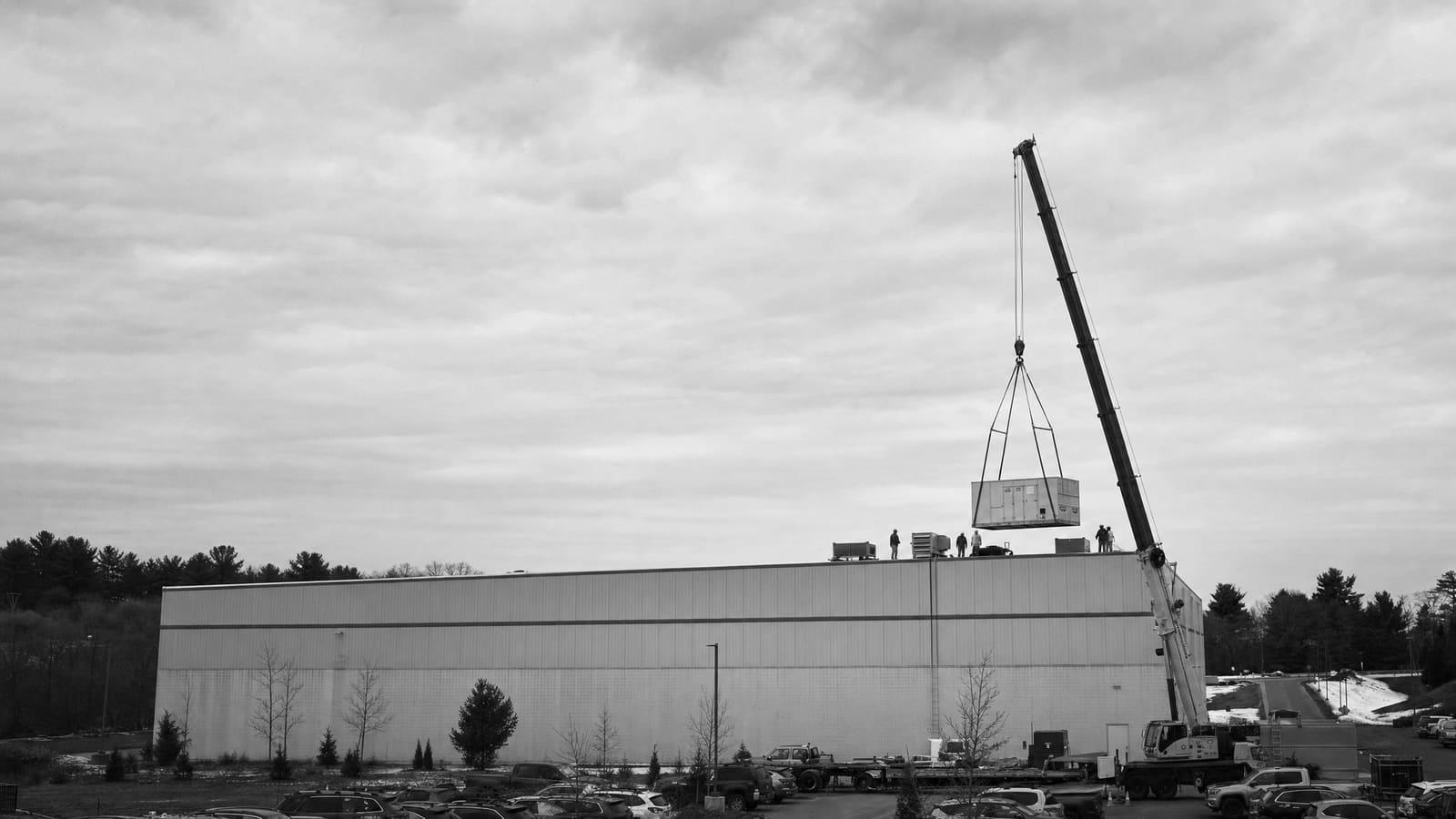
Replacing a commercial rooftop unit means confirming the load the building actually carries, choosing equipment, rigging the old unit off, setting and connecting the new one, then commissioning it to spec. Another repair stops making sense once equipment is past fifteen years, where the waste is built in rather than fixable: an old, inefficient rooftop unit burns roughly $900 to $3,700 a year more than it should. That gap is what funds the replacement.
A site review has to confirm tonnage against current use, curb size and roof structure, electrical service and gas at the unit, crane reach across the lot, and whether an economizer or controls tie-in gets triggered.
THREE WAYS TO GO
Three replacement paths worth pricing
Most buildings have three honest options, and the right one depends on how long you plan to hold the building and what the space does now. A like-for-like swap is the fastest way back to cooling and the cheapest engineering. A high-efficiency unit costs more up front and earns it back through the utility bill; the federal specification behind today's high-efficiency models targeted up to 50% less energy than the standard equipment it replaced, and more than twenty models now exceed it. A heat pump rooftop unit adds reverse-cycle heating and changes the fuel picture entirely. For most of the U.S. South and West, current heat pump rooftop units are capable of most or all of the winter heating demand, which makes them a real option rather than a stretch. Price all three against the same scope so what you are comparing is equipment, not assumptions.
WHAT MOVES THE NUMBER
Where a rooftop replacement budget actually moves
Two quotes for the same roof can differ by more than the equipment. These are the lines that create the spread. Every one of them should be visible on the proposal rather than folded into a lump sum you cannot compare.
IN PRACTICE
How to buy the replacement, not just the box
The mistake that costs the most is treating the nameplate on the old unit as the specification for the new one. A building's load changes over fifteen or twenty years. Occupancy shifts, lighting gets replaced, plug loads grow, and someone walls off half a floor. Sizing from current use is the difference between a unit that holds setpoint quietly and one that short-cycles for the next two decades.
The second decision is timing. Most rooftop units get replaced the week they die, in the season they were working hardest, which is the worst possible position to buy from. Waiting for failure means taking whatever is available and skipping the comparison that would have justified a better unit. Planned replacement is where the efficiency case actually gets made. The organizations that upgraded more than 43,000 rooftop units through the federal Advanced RTU Campaign have saved a combined $37 million a year on energy, and that math only works when the decision gets made before the compressor makes it for you.
The third is who owns the outcome. A quote that ends at set-and-start leaves the parts that generate month-two complaints — charge, airflow, economizer setup, controls mapping — assigned to nobody in particular.
SCOPE CHECK
What makes one replacement simple and another complicated
Before you chase a number, it helps to know which project you actually have. The gap between these two is weeks of schedule and a meaningful share of the budget.
LOWER COMPLEXITY
Same size, same fuel, open lot
The replacement matches the old unit's tonnage and fuel, lands on the existing curb or a simple adapter, and the crane has clear reach from the parking lot. Permits stay mechanical and electrical.
HIGHER COMPLEXITY
New footprint, new fuel, tight site
Tonnage or footprint grows, the roof needs structural review, an economizer gets added, or an all-electric unit asks for more power than the service carries. Add a shared drive or a live tenant below and the crane day becomes a crane night.
BEFORE YOU SIGN
What a real site review has to confirm
A site review is not a look at the roof. It is a list of things that either cost money later or do not. Start at the unit: nameplate tonnage, fuel type, refrigerant, age, and what the maintenance history says about why it is failing. Then the curb — size, condition, and whether the replacement lands on it or needs an adapter and a structural opinion.
Then the infrastructure, which is where heat pump conversions live or die. Federal guidance on heat pump rooftop units puts electrical capacity, physical constraints, and existing gas lines at the center of that decision, alongside equipment availability and whether the local trade is fluent in the technology. An all-electric unit with electric resistance backup can ask for far more power than the gas unit it replaces. That question belongs in the site review, not in a change order.
Last, the removal. Refrigerant in the old unit is regulated under the Clean Air Act, and recovery has to be handled by certified technicians with the right equipment. It is a small line on the quote and a large problem when it is missing.
The five answers to get in writing
Confirmed tonnage from a current load calculation, curb and structural disposition, available electrical capacity at the unit, the crane plan with lot closure hours, and who pulls the permits. If a proposal is missing any of the five, it is an estimate wearing a proposal's clothes.
OWNING THE DECISION
Two things that outlive the install
The install takes a few weeks of your attention. The consequences run for the life of the equipment, and two of them land on a budget line long after the crane leaves. The first is what the unit costs to run every month, which is set the day you pick the efficiency tier and never really renegotiated. The second is what it costs to service, which is set by what ends up on the roof and what is inside it. If you own several buildings, both questions are better answered once, as a standard, than eight separate times under pressure.
OPERATING COST
The efficiency tier is a twenty-year decision
Rooftop systems condition close to half of all U.S. commercial floor space, so their efficiency is most of a building's energy story. The premium for a better unit is paid once. The bill it lowers arrives every month.
FLEET STRATEGY
A mixed roof becomes a service problem
Units bought years apart carry different refrigerants, and every one of them is handled under EPA rules requiring certified technicians and proper recovery. Across a portfolio, that argues for sequencing replacements rather than doing them one emergency at a time.
PLANNING AHEAD
Phasing replacements instead of reacting to them
If you have more than one aging unit, the useful question is not which one to replace but in what order. Rank them by age, run hours, and what each is costing to keep alive. The units past fifteen years with the longest schedules go first, because that is where the annual waste concentrates. Doing one per budget year turns an unpredictable capital risk into a line item you can defend.
Procurement rewards the same discipline. Equipment availability is one of the core considerations in choosing a rooftop unit, and availability is only knowable in advance. A specification set in the spring gets ordered on your terms. The same specification in August gets whatever is still in the warehouse. Standardizing on one or two models across a portfolio shortens that conversation every time it comes up.
Lifetime cost closes the argument. Replacing on failure means buying like-for-like under time pressure, which carries the old unit's sizing mistakes and its efficiency forward for another two decades. The federal push behind higher rooftop efficiency standards rests on exactly that arithmetic: the standard finalized in 2015 was projected to save businesses $167 billion in utility bills over the lifetime of the equipment it covers.
APPLES TO APPLES
Five things a comparable quote shows
If two proposals do not show these five, you are not comparing them. You are guessing which one left more out. Ask for them in the same order from every bidder.
01
The equipment, spelled out
Manufacturer, model, tonnage, efficiency rating, heating type, and refrigerant — not "new rooftop unit."
02
The load it was sized to
A current load calculation, or a written statement that existing tonnage was verified against today's use.
03
Curb, roof, and structural scope
Adapter or new curb, patching, and who pays if structural review adds steel.
04
Rigging and site plan
Crane size, staging area, lot closure hours, and the weather contingency.
05
Permits, startup, and closeout
Which permits are included, commissioning results delivered, and warranty registration completed.
Keep planning locally
Related mechanical pages in Columbus
Get a defensible number
Price the equipment and the building together.
Send the address, operating target, and target opening date. Flux will identify what must be verified before the project can be priced.
Get a free estimateQuestions
Straight answers.
When does replacing a commercial rooftop unit beat repairing it?
Once the unit is past about fifteen years, the losses are built into the equipment rather than fixable. An old, inefficient rooftop unit wastes roughly $900 to $3,700 a year, and no repair recovers that. Before that age, repair usually wins unless the compressor is what failed.
Should we replace like-for-like or resize?
Confirm the load either way. If the space and how it is used have not changed, like-for-like is often the right call. If occupancy, equipment, or layout changed, sizing from current use fixes comfort complaints the old unit was never able to solve.
Is a heat pump rooftop unit worth considering?
For most of the South and West, current heat pump rooftop units are capable of most or all of the winter heating demand. The deciding factors are electrical capacity at the roof, physical constraints, existing gas lines, and equipment availability.
Who handles the crane, the permits, and the old refrigerant?
The installing contractor should own the rigging plan, lot coordination, permits, inspections, and certified refrigerant recovery from the removed unit as part of the installed price. Confirm the quote says so in writing before you sign it.
Why won't anyone quote a price over the phone?
Tonnage, curb condition, electrical capacity, and crane access set the number, and none of them are visible from a phone call. A nameplate photo plus a look at the roof is usually enough to turn that into a real installed price quickly.
Sources used for this guide
- [1]betterbuildingssolutioncenter.energy.gov — DOE Advanced Rooftop Unit Replacement Guidance
- [2]betterbuildingssolutioncenter.energy.gov — DOE Commercial Heat Pump Rooftop Unit Replacement Guidance
- [3]betterbuildingssolutioncenter.energy.gov — DOE High-Efficiency Commercial Rooftop Unit Toolkit
- [4]energy.gov — DOE Efficient Commercial Rooftop Air Conditioner Program
- [5]epa.gov — EPA Stationary HVAC Refrigerant Management