THE SHORT ANSWER
What a commercial HVAC replacement includes
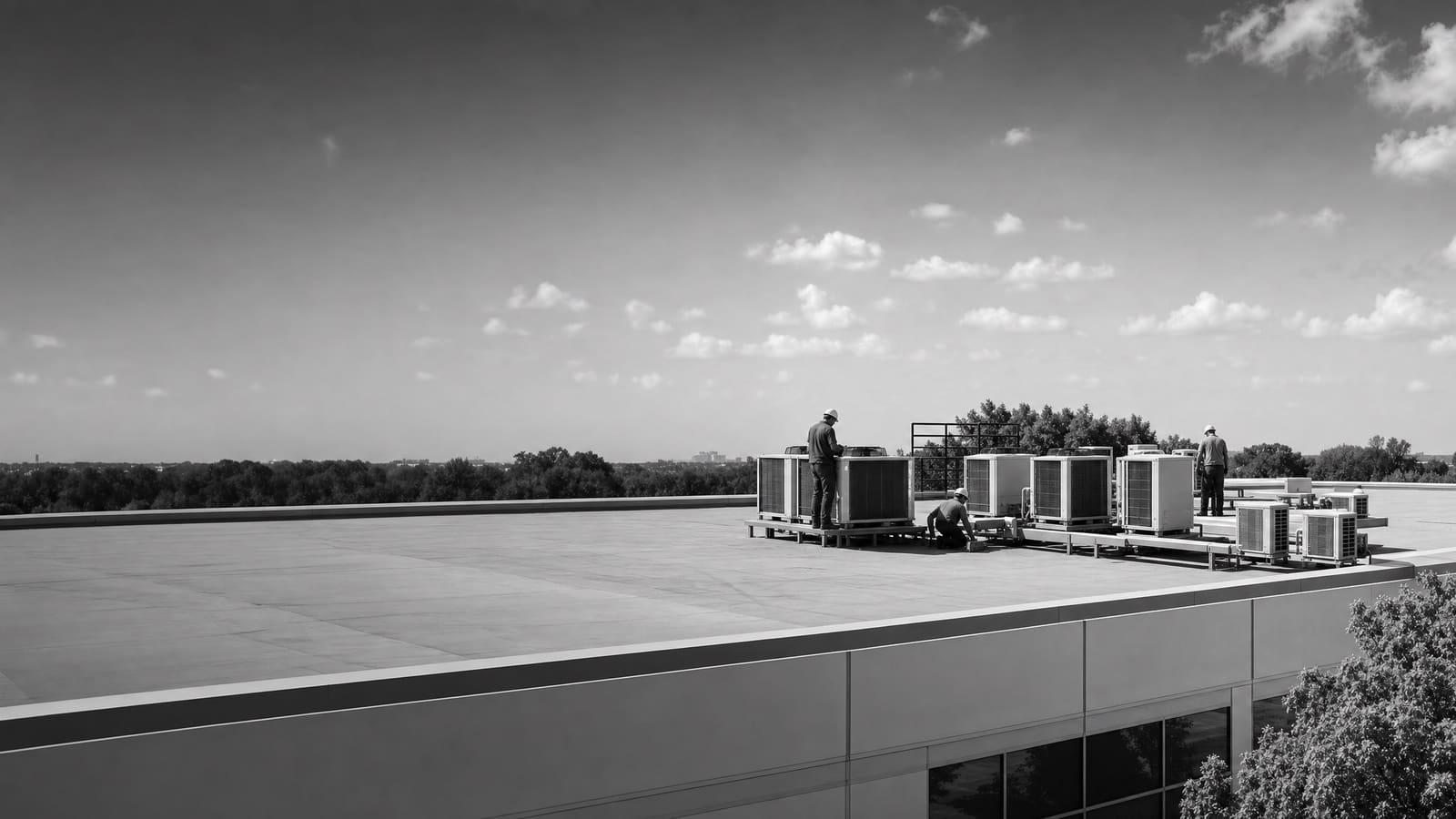
A commercial HVAC replacement covers load verification, equipment selection, rigging and set, mechanical and electrical connections, controls, permits, and commissioning. Rooftop units cool nearly half of all U.S. commercial floor area, so most projects come down to one packaged unit at a time. Replacement beats another repair once a unit is past roughly 15 years and the failures start stacking up. Old, inefficient rooftop units waste an estimated $900 to $3,700 per unit each year.
A site review still has to confirm the actual load, curb and structural condition, roof and crane access, and whether existing gas and electrical service can carry the unit you are buying.
THE EQUIPMENT DECISION
Three ways to replace a rooftop unit
Most buildings replace a packaged rooftop unit with another packaged rooftop unit. The real choice is what kind of heat it uses. Heat pump rooftop units are built much like standard air-conditioning units, so the cabinet, the curb, and the crane day all look familiar. What changes is heating. Heat pump efficiency falls as outdoor temperature drops, and at the coldest hours it trends toward the same efficiency as electric resistance heat. That is why federal guidance treats heat pump rooftops as best suited to mild-to-moderate winter heating, and why buildings with long, cold heating seasons look harder at dual-fuel. Before you pick, four things need checking: electrical capacity at the panel and service, physical space on the roof and curb, what happens to the existing gas line, and whether the contractors bidding have actually installed and commissioned this equipment type. Local electricity and gas prices decide whether the operating bill goes up or down, so run that comparison on your own rates rather than a national average.
WHAT MOVES THE NUMBER
Budget lines that decide the installed price
Nobody can price a rooftop replacement from a tonnage number alone. These are the lines where quotes diverge, and where a low bid is usually hiding something. Ask each bidder to price them separately so you can compare like against like.
BUYING GUIDANCE
Replace on your schedule, not the equipment's
Most rooftop units get replaced the week they die, and that is the most expensive way to buy one. When a unit fails in season, you take whatever is available, on whatever curb fits, at whatever price the market gives you that week. Federal guidance is blunt about this: proactively replacing an inefficient, underperforming unit is usually the smarter business move than replacement-on-failure, and often better than a like-for-like swap at the end of service life.
The savings are not theoretical. A high-efficiency performance specification developed with manufacturers targeted units that cut energy use by up to half compared with the older standard, and more than twenty models now exceed it. Through the national campaign built around those units, more than 200 organizations upgraded over 43,000 rooftop units and cut a combined $37 million a year from their energy bills.
Replacement is not always the answer. The same program treats advanced controls as a legitimate alternative: if a unit has real service life left, retrofitting controls can be the better financial move. The test is simple. Put the age, the repair history, and the annual operating waste on one page, then compare a controls retrofit against a new unit across the years you plan to hold the building.
COMPLEXITY
What makes a swap simple, and what makes it a project
Two replacements at the same tonnage can differ by weeks of schedule and a wide margin in price. The difference is rarely the equipment itself. It is what the building makes you touch on the way to setting it.
LOWER COMPLEXITY
A straight replacement
Same tonnage, same fuel, a curb that is still sound, clear crane reach over an open lot, and electrical service already sized for the unit. Permits stay narrow and the set happens in a single morning.
HIGHER COMPLEXITY
Scope that grows
A larger footprint or added weight, a curb needing an adapter or framing, tight roof access with limited crane setback, a fuel switch, or a service that has to grow before the unit can run. Each one adds review time before anything gets lifted.
SCOPING
What a real site review checks
A quote that arrives without anyone walking the roof is a guess wearing a number. The site review is where the price becomes real.
Start with electrical capacity. Federal heat pump guidance puts this near the top for a reason: if the replacement adds electric heating, the question is whether the panel, the feeder, and the building service can carry it, and what it costs if they cannot. Next come physical constraints — curb dimensions, unit weight and footprint, roof structure, clearances, and how close a crane can actually get. Then the gas line. If the new unit does not use it, someone has to decide whether it stays, gets resized, or is capped, and that is a line on the quote either way.
Two more items belong on the same walk. Equipment availability drives your schedule more than anything else on the list, so lead time should sit next to price on the proposal instead of being discovered later. And the old unit's refrigerant is regulated, so recovery and handling are part of the job rather than an afterthought.
Ask this before you take a bid
Ask every bidder how many units of this exact type they have installed and commissioned in the past year. Federal guidance names contractor familiarity as a real constraint, especially on heat pump equipment, and unfamiliarity shows up later as comfort complaints.
OWNERSHIP
Two things that outlive the install
The install is a week. The decisions made during it govern operating cost and service calls for as long as you own the unit. Two of them deserve attention while you still have leverage with the bidders.
The first is what the unit costs to run in your building, on your rates. The second is what happens to your service program once the roof carries more than one generation of equipment. Neither shows up on the installed price, and both are far easier to settle before the crane is scheduled than after.
OPERATING COST
Model it on your own rates
Whether an electric heating option lowers or raises the bill depends on local electricity and gas prices and how many cold hours the building actually runs. Ask for that comparison using your utility rates and last year's usage, not a national average.
REFRIGERANT PLANNING
Mixed fleets need a plan
Federal rules govern the handling, recycling, and recovery of refrigerants in stationary cooling and heat pump equipment. Once a roof carries units of different ages, your service contract and spare-parts plan have to cover both, and that belongs in the handover documents.
PHASING
When you are buying more than one unit
Most commercial roofs carry several units, and they rarely fail in a convenient order. If you own more than one, sequence them instead of reacting to them. Rank the units by age and by what each one wastes annually — old, inefficient rooftop units run roughly $900 to $3,700 per unit per year — and replace from the top of that list.
Sequencing buys you three things. You order ahead of the season instead of paying for whatever is on the truck. You can standardize on one platform, so filters, boards, and controls are shared across the roof and your service tech stops carrying two parts lists. And you can group the crane days, which is often the largest single fixed cost inside a small replacement.
Lifetime cost is also the right frame for choosing an efficiency tier. A higher-efficiency unit costs more the day it lands and pays back every year you hold the building. If you plan to own the asset for a decade, the operating line matters more than the bid line. If a sale is likely inside two years, a like-for-like swap that gets the building comfortable and properly permitted may be the better business decision. Say which case you are in when you ask for the quote, because it changes what a good proposal looks like.
THE QUOTE
Five things a comparable quote shows
Bids only compare when they cover the same scope. If one is missing any of these, it is not cheaper, it is smaller. Ask for all five in writing before you sign anything.
01
Equipment and efficiency tier
Model number, tonnage, heating type, and efficiency rating, so you are comparing the same machine.
02
Lead time next to price
Quoted availability for that exact model, plus what happens to the schedule if it slips.
03
Curb, structural, and rigging scope
Adapter or new curb, any framing work, crane size, lot closure hours, and who coordinates them.
04
Electrical and gas scope
Panel, feeder, or service work included, and what happens to the existing gas line.
05
Commissioning and refrigerant handling
Startup readings, airflow and charge verification, controls setup, and documented recovery of the old refrigerant.
Keep planning locally
Related mechanical pages in Colorado Springs
Get a defensible number
Price the equipment and the building together.
Send the address, operating target, and target opening date. Flux will identify what must be verified before the project can be priced.
Get a free estimateQuestions
Straight answers.
When does replacement beat another repair?
Once a unit is past roughly fifteen years, repairs stack up and efficiency losses compound. Federal guidance is direct about it: units that old can waste substantial energy and money compared with newer models, and replacing an inefficient one proactively usually beats waiting for the failure. Put age, repair history, and annual operating waste on one page and the answer is generally clear.
Should we switch from gas heat to a heat pump rooftop unit?
It depends on your winter heating hours and your utility rates. Heat pump heating efficiency falls as outdoor temperatures drop, trending toward electric resistance at the coldest hours, so federal guidance points standard heat pump rooftops at mild-to-moderate heating loads. Dual-fuel and cold-climate models exist for buildings with real winter demand. Model the operating cost on your own rates before deciding.
What does the crane day actually involve?
The visible part is a morning. Stalls get coned, the old unit comes off, the new one lands on the curb or adapter, then connections and startup follow. Everything that makes that morning uneventful — rigging plan, curb measurements, structural check, weather call — happened weeks earlier.
Is a controls retrofit an alternative to replacement?
Yes, when the unit still has real service life left. The federal rooftop campaign treats replacing the unit and retrofitting it with advanced controls as two valid paths, chosen by which one makes better financial sense for that specific unit. It is worth pricing both before you commit.
What happens to the refrigerant in the old unit?
It gets recovered, not vented. Federal rules under the Clean Air Act govern the handling and recycling of refrigerants in stationary refrigeration, air-conditioning, and heat pump equipment, so recovery and its documentation belong in the installer's scope and on the quote.
Sources used for this guide
- [1]betterbuildingssolutioncenter.energy.gov — DOE Advanced Rooftop Unit Replacement Guidance
- [2]betterbuildingssolutioncenter.energy.gov — DOE Commercial Heat Pump Rooftop Unit Replacement Guidance
- [3]betterbuildingssolutioncenter.energy.gov — DOE High-Efficiency Commercial Rooftop Unit Toolkit
- [4]energy.gov — DOE Efficient Commercial Rooftop Air Conditioner Program
- [5]epa.gov — EPA Stationary HVAC Refrigerant Management