THE SHORT VERSION
What a commercial HVAC replacement actually includes
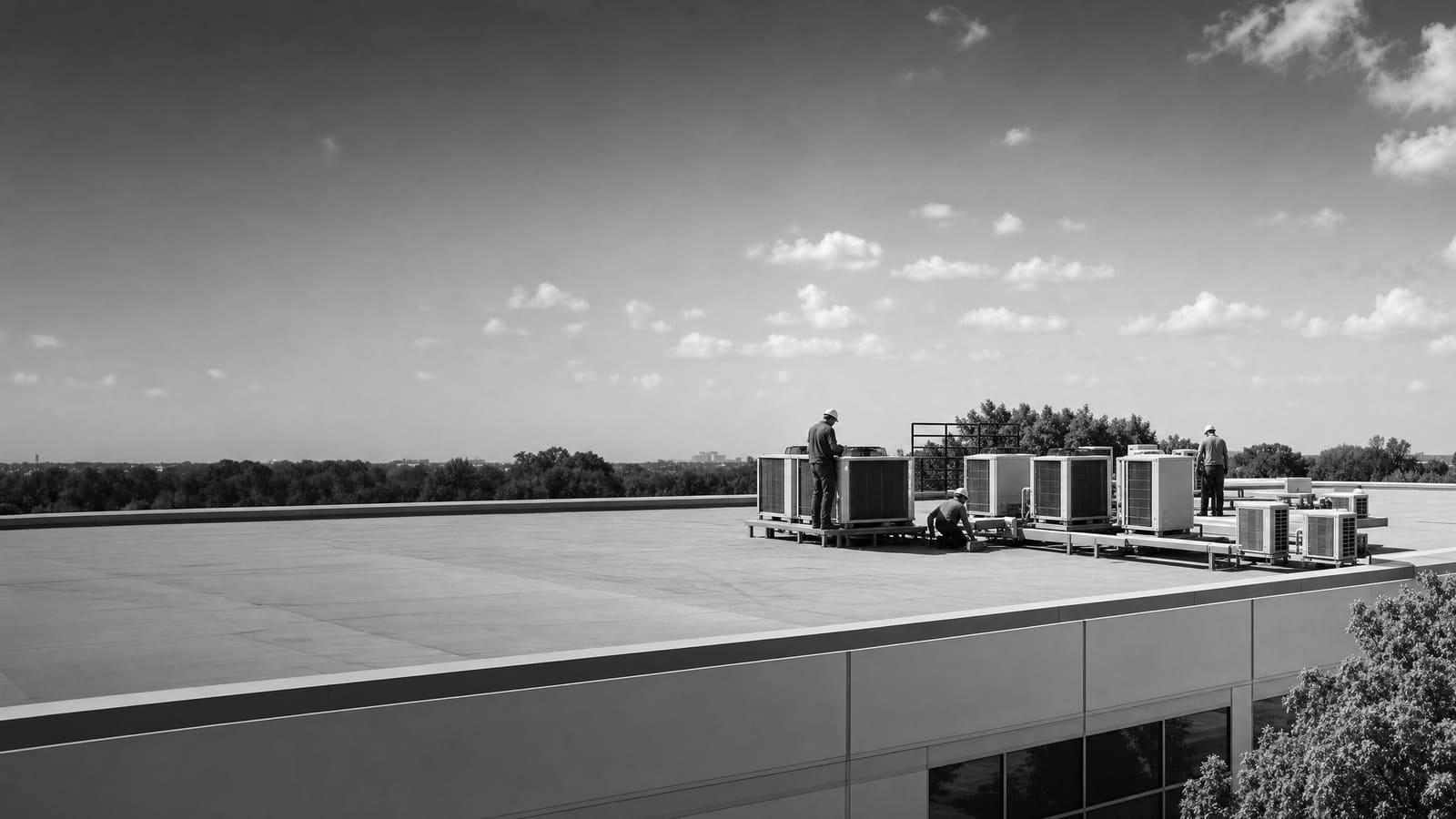
A commercial HVAC replacement means confirming the load the building carries today, selecting equipment against real lead times, setting the unit, and commissioning it so it performs to spec. Rooftop units condition close to half of all U.S. commercial floor space, so this is the most common version of the project. Replacement usually beats another repair once a unit is past about 15 years and the service calls keep coming — an old, inefficient unit wastes an estimated $900 to $3,700 a year in energy alone.
A site review still has to confirm tonnage against how the space is used now, the curb and roof structure under it, available electrical capacity, the gas line at the unit, and how a crane reaches the roof.
THREE WAYS TO GO
Three replacement paths worth pricing
Most commercial buildings replace a rooftop unit one of three ways, and the difference shows up in operating cost rather than on install day. A like-for-like air-conditioning unit is the fastest path back to cooling. A high-efficiency unit costs more up front and cuts energy use — the federal high-performance specification targeted units using up to 50 percent less energy than the standard equipment of the time, and more than 20 models now exceed it. A heat pump rooftop unit adds reverse-cycle heating in the same box, which matters when the building's heat is aging out alongside the cooling.
Federal guidance is direct about the trade-off: waiting for failure and then buying a like-for-like unit is usually the worst financial outcome of the three. Deciding before the unit dies is what lets you price all three against each other. Once it fails in season, availability picks for you.
WHAT MOVES THE NUMBER
Budget lines that decide the price
No two roofs price the same, and the spread comes from a short list. Ask the estimator to break these out so you can see which lines are firm and which are still assumptions.
IN PRACTICE
Choosing the unit before the unit chooses for you
The single biggest lever on a commercial HVAC project is when you make the decision. Facility managers usually delay a new rooftop unit until the old one stops holding the space, needs constant service calls, or quits outright. Federal guidance is blunt about the result: proactively replacing an inefficient unit with a more efficient one generally beats both replacement-on-failure and a like-for-like swap at the end of service life. Units past 15 years are the ones that belong on that list.
The reason is not sentiment about old equipment. An old, inefficient rooftop unit wastes somewhere between $900 and $3,700 a year, every year, before you count emergency service calls. Across a portfolio that number is what funded the upgrades in the federal Advanced RTU Campaign, where more than 200 organizations replaced or retrofitted over 43,000 units and cut a combined $37 million a year in energy spend.
Deciding early also protects the specification. When a unit fails in July, the honest choice narrows to whatever a distributor can put on a truck. When you decide in the shoulder season, you can price a high-efficiency unit against a standard one, ask what the electrical service supports, and confirm the curb before anything is ordered. Same crane day either way. Very different fifteen years.
SCOPE CHECK
What makes one replacement simple and another complicated
Two replacements of the same tonnage can price very differently. The gap is almost always infrastructure and access, not the box itself. Before you compare bids, work out which side of this line your building sits on.
LOWER COMPLEXITY
Same fuel, same footprint
The replacement matches the existing curb and connections, the electrical service already carries it, and the crane has clear reach from the lot. The set happens in a morning, and the quote holds because almost nothing has to be discovered after the roof is opened.
HIGHER COMPLEXITY
New fuel, new footprint, or hard access
Moving to an all-electric or heat pump unit raises electrical capacity questions. A larger unit raises structural ones. Tight lots, tall parapets, and buildings that cannot give up parking push the rigging plan into off-hours work. Each of those is a real line item.
BEFORE YOU BUY
What the site review has to settle
A quote written from a nameplate photo is a starting number, not a price. The site review is where it becomes real, and federal heat pump guidance lists the same checks whether you stay on gas or move to electric: climate and heating load, utility bill impact, building type, equipment availability, and infrastructure.
Infrastructure is where projects get surprised. Electrical capacity comes first, because an all-electric or heat pump unit can need more service than the panel and feeder currently supply, and finding that out after the order is placed is an expensive way to learn it. Physical constraints come next: curb dimensions, roof structure, clearances, and whether a crane can reach the position without closing more of the lot than tenants will tolerate. Gas lines matter in both directions, whether you are keeping them or capping them.
Equipment availability deserves its own line. Lead time is part of the decision, not a footnote to it, and a unit that lands six weeks late is a different project than the one you approved. The review should also confirm the installing contractor has worked with the specific equipment type before, since federal guidance flags contractor familiarity as a genuine barrier on newer rooftop technology.
The four answers to get in writing
Confirmed tonnage from a current load calculation. Available electrical capacity at the unit, in amps. Curb and structural condition, verified on the roof. Equipment lead time with a date attached. If any of the four is still an assumption when you sign, it is a change order waiting to happen.
AFTER THE INSTALL
Two things that outlive the install day
The install is one morning. The two decisions below shape the next fifteen years of operating cost and paperwork, and both are far easier to settle while the specification is still open than after the unit is running.
Neither one is a reason to delay a replacement. They are reasons to ask the questions now, when the answers can still change what gets ordered, who services it, and what the maintenance contract actually covers. A replacement is the one moment when a building's mechanical strategy is genuinely up for revision.
REFRIGERANT
Service planning on a mixed fleet
EPA rules under Section 608 of the Clean Air Act govern how refrigerant is handled in stationary cooling and heat pump equipment. New units ship on newer refrigerants than what is already on your roof. That changes nothing on day one, but it does change parts stocking and what a service contract has to cover across a mixed fleet.
FUEL STRATEGY
Deciding electric now or later
If the building's heat is gas today, a replacement is the natural decision point. Federal guidance frames three options: dual-fuel, all-electric, and cold-climate heat pump units. Southern buildings generally sit where today's units cover most or all of the winter load, though efficiency does fall as outdoor temperature drops. Electrical capacity and local rates decide the rest.
OVER TIME
Phasing, procurement, and the number that matters
If you own more than one unit, the replacements are a program, not an emergency. Sort the fleet by age first. Anything past 15 years belongs on a list with a rough replacement year attached. Then sort that list by which units run the hardest and which spaces generate the most complaints, because those are where an efficiency upgrade pays back fastest.
Phasing has a procurement benefit too. Two or three units bought together on a known schedule get better lead times and better pricing than one unit bought at four o'clock on the hottest Friday of the year. It also spreads capital across budget cycles instead of concentrating it wherever a failure happens to land.
The number that should drive the decision is not the install price. It is the install price plus fifteen years of energy, service calls, and downtime. That is the arithmetic behind the federal finding that proactive high-efficiency replacement usually beats both waiting for failure and swapping like-for-like at end of life. The cheapest unit to install is frequently the most expensive one to own, and the gap does not show up until year three.
COMPARE APPLES TO APPLES
Five things a comparable quote shows
Bids that look far apart usually are not pricing the same job. Ask every bidder to show these five items on the face of the quote, and the real differences become obvious.
01
Tonnage and efficiency tier
The selected unit, its capacity, and its efficiency level, tied to a load calculation rather than the old nameplate.
02
Equipment lead time
A real availability window with a date, listed next to the price. Schedule is part of the bid.
03
Curb, structural, and roof scope
Adapter, any framing work, and roof patching, priced as line items instead of buried in a lump sum.
04
Electrical and gas scope
Panel capacity, feeder or disconnect work, and any gas line change at the unit.
05
Rigging, permits, and commissioning
Who owns the crane day, the permits and inspections, and startup verification of charge, airflow, and controls.
Keep planning locally
Related mechanical pages in Baton Rouge
Get a defensible number
Price the equipment and the building together.
Send the address, operating target, and target opening date. Flux will identify what must be verified before the project can be priced.
Get a free estimateQuestions
Straight answers.
When does replacement beat one more repair?
Once a unit is past about 15 years and needs frequent service, the math usually flips. Federal guidance holds that proactively replacing an inefficient rooftop unit with an efficient one is generally a better business decision than waiting for failure, and an old unit already wastes an estimated $900 to $3,700 a year in energy.
Should you replace like-for-like or resize?
Confirm the load either way. Fifteen or twenty years changes occupancy, plug loads, and sometimes the envelope, so the old nameplate is a data point rather than an answer. If the space and its use genuinely have not changed, like-for-like is often right, and it is the fastest path back to cooling.
Is a heat pump rooftop unit a reasonable option here?
For most buildings in the South, federal guidance says today's heat pump rooftop units can cover most or all of the winter heating demand. The practical gate is infrastructure: electrical capacity at the unit, physical constraints on the roof, and what happens to the existing gas line. Efficiency does drop as outdoor temperatures fall.
How much does commercial HVAC installation cost?
There is no honest universal number, because tonnage, curb work, electrical scope, and crane access move it more than the equipment itself does. What you can pin down before a site visit is the operating side: an old, inefficient rooftop unit wastes roughly $900 to $3,700 per year, and that waste is usually what funds the upgrade.
Who handles the crane and permits?
The installing contractor should own the rigging plan, lot coordination, permits, and inspections as part of the installed price. Confirm that in writing before you sign, because a bid that quietly excludes any of the three will always look cheaper than one that includes all of them.
Does a new unit change refrigerant service?
New commercial equipment ships on newer refrigerants than older rooftop units use, and day-one operation is unaffected. What changes is service planning. EPA Section 608 rules govern refrigerant handling in stationary cooling and heat pump equipment, so a mixed fleet needs its parts stocking and service contract scoped for both generations.
Sources used for this guide
- [1]betterbuildingssolutioncenter.energy.gov — DOE Advanced Rooftop Unit Replacement Guidance
- [2]betterbuildingssolutioncenter.energy.gov — DOE Commercial Heat Pump Rooftop Unit Replacement Guidance
- [3]betterbuildingssolutioncenter.energy.gov — DOE High-Efficiency Commercial Rooftop Unit Toolkit
- [4]energy.gov — DOE Efficient Commercial Rooftop Air Conditioner Program
- [5]epa.gov — EPA Stationary HVAC Refrigerant Management