THE SHORT VERSION
What a commercial HVAC replacement actually covers
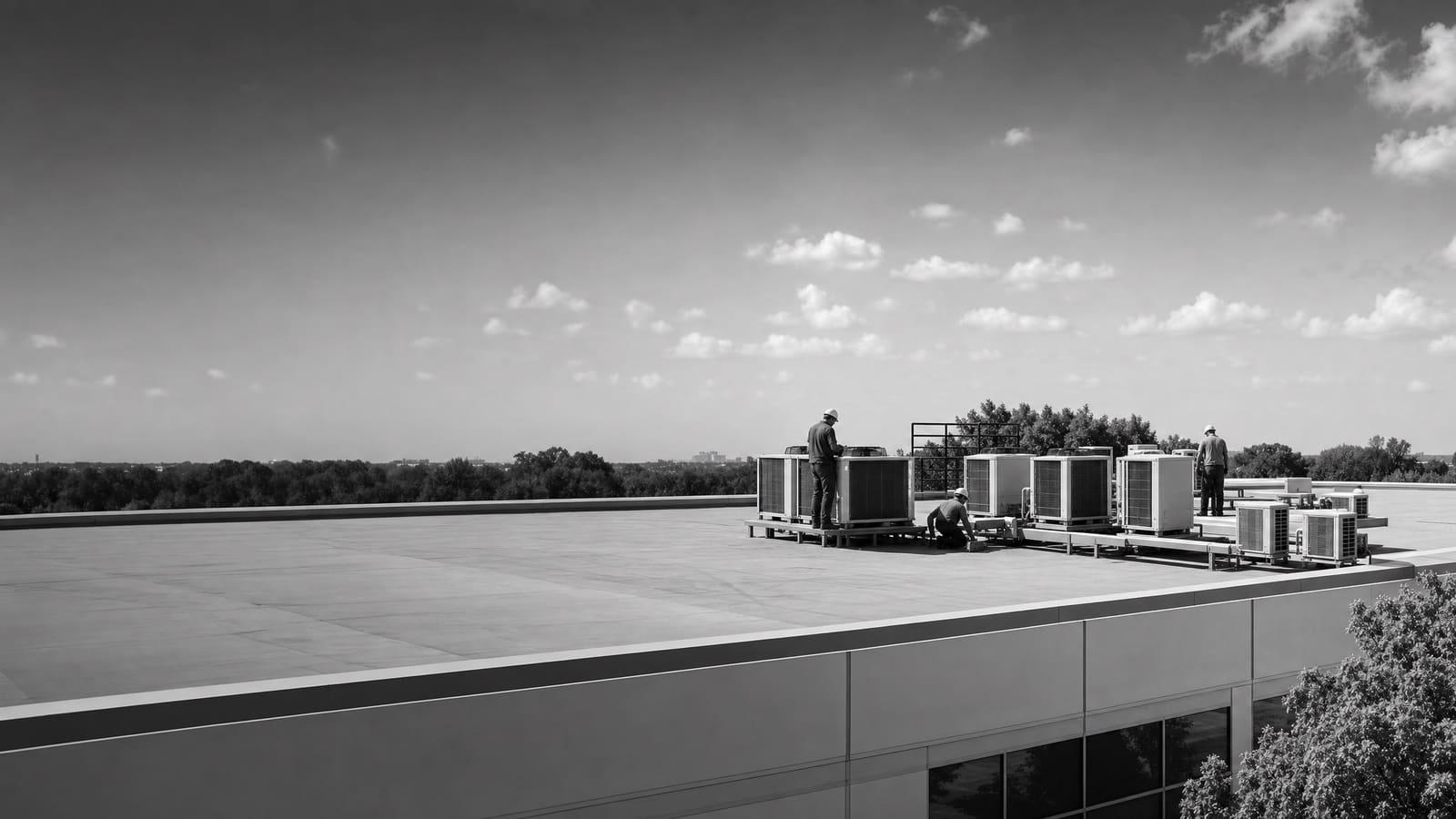
A commercial HVAC replacement covers load verification, equipment selection against real lead times, curb and rigging work, gas, electrical and refrigerant connections, the code items a swap triggers, and commissioning. Replacement beats another repair once the unit is past fifteen years and the waste is structural: an old, inefficient rooftop unit burns roughly $900 to $3,700 a year in avoidable energy. A single failed component on an otherwise sound unit is still a repair.
A site review has to confirm the curb and roof structure, available electrical capacity, gas service, clearance around the unit, and crane access before any of that becomes a real price.
THE CHOICES
Three ways to take the replacement
Most buildings face the same three choices when a rooftop unit reaches the end, and the cheapest one is not automatically the right one. The gap between them does not show up at the crane. It shows up on the utility bill every month for the next fifteen years, and in how often the service truck comes back in year eight.
Replacing on failure is the option that decides itself, usually in the worst week of the season and with whatever equipment happens to sit in a regional warehouse. Deciding early is what puts the other choices on the table at all, because efficiency tier, fuel choice, and incentive paperwork each need lead time before they can matter.
There is also a fourth path worth pricing on a unit that still has life in it: retrofitting advanced controls instead of replacing the equipment. For some units that is the better financial answer, and it is a legitimate result of a good assessment rather than a consolation prize.
WHAT MOVES THE NUMBER
The lines that separate two bids
These are the items that move a rooftop quote the most, roughly in the order they surprise people. Two identical units on two different roofs can land far apart, and the reason is almost never the box. It is what sits under it, what feeds it, and what a crane has to do to reach it.
IN PRACTICE
Buying the replacement before it buys you
The most expensive rooftop replacement is the one you did not choose. Facility teams often wait until a unit stops holding a space, needs constant service, or fails outright, and then buy whatever can be on a truck this week. Replacing an inefficient unit on purpose usually beats replacement on failure, and it often beats a like-for-like swap at the end of service life too, because planning is what gets efficiency and fuel choice onto the table at all.
Age is the cleanest trigger to watch. Units past fifteen years waste a real amount of energy against current equipment, and the high-performance models now on the market were designed to cut rooftop energy use by up to half compared with the old baseline. More than twenty models exceed that specification today, so the efficient choice is no longer a special order with a mystery lead time.
If you run more than one building, treat this as a fleet decision instead of a series of emergencies. Rank units by age, service history, and the hours the space actually runs, then replace on your calendar. Organizations that worked through their rooftops this way have upgraded more than 43,000 units and cut a combined $37 million a year from their energy bills.
SIDE BY SIDE
What makes one roof simple and another complicated
Complexity is not about the size of the unit. It is about how many other systems the replacement touches. Reading your own roof against these two lists is the fastest way to know whether you are looking at a one-morning swap or a project with a design phase in front of it.
LOWER COMPLEXITY
Straight swap conditions
Same tonnage on the existing curb, gas heat staying gas, adequate electrical service already at the unit, an open lot for the crane, and a space whose use has not changed since the last install.
HIGHER COMPLEXITY
Where the scope grows
Fuel switching, a tonnage change, a curb that no longer fits, tight or shared parking, limited panel capacity, occupied space that cannot lose conditioning, and controls that must tie back into an existing building automation system.
SCOPING IT
What a site review has to settle
A quote that arrives without anyone climbing the roof is a guess wearing a number. The review that makes it real is short, but it has to cover the same ground every time.
Start with infrastructure. Electrical capacity is the item that most often changes the plan, especially when the new unit adds electric heating or replaces gas heat entirely. Physical constraints come next: whether the existing curb matches, whether the roof carries the new weight, whether there is service clearance around the unit, and how a crane reaches the spot. Gas lines get a decision either way, since dual fuel keeps them and all-electric means capping and removing them.
Then confirm the equipment itself. Availability is part of the design, not a footnote. The model that fits the roof is worth nothing if it lands in twelve weeks and the building needs cooling in two. Building type belongs in the same conversation, because a warehouse, a restaurant, and a small office put very different loads and runtime hours on the same nominal tonnage.
Finally, confirm the crew. Newer equipment and newer refrigerants both assume a contractor who has installed and commissioned them before.
Ask for the checklist, not just the number
Before you sign, ask which of these were verified in person: curb fit, roof structure, panel capacity, gas disposition, service clearance, and crane reach. Anything answered from the old nameplate is a change order that has not been written yet.
AFTER THE INSTALL
Two things that outlive the crane day
The install takes a week. What you own afterward is a machine that has to be charged, serviced, and eventually retired under rules that attach to the equipment rather than to the building. Both of the considerations below shape what service costs over the next fifteen years, and both are easier to manage when replacements happen in planned batches instead of one emergency at a time. A roof where every unit arrived in a different crisis year tends to be a roof where no two units share parts, controls, or a service procedure. That is a slow, invisible cost, and it gets paid by whoever is up there at two in the afternoon in August trying to get a space back.
REFRIGERANT
Federal rules follow the equipment
Handling, recovery, and recycling of refrigerant in stationary air conditioning and heat pump equipment is regulated under the Clean Air Act. Recovery from the old unit is required work performed by certified technicians, not a line you can value-engineer out.
FLEET MIX
Every new unit is a service decision
Units bought years apart rarely share refrigerant, controls, or parts. A roof that accumulates generations one failure at a time gets harder to stock for and slower to diagnose, which is an argument for standardizing when you replace.
THE LONG VIEW
Phasing, procurement, and the fifteen-year number
Price the project on what it costs to own, not on what it costs to buy. An old unit wasting somewhere between $900 and $3,700 a year is charging you for the privilege of not being replaced, and that meter runs every year you defer. Set that figure against the difference between a like-for-like unit and a high-efficiency one, and the payback question usually answers itself before anyone starts arguing about the bid.
Incentives move the math further, and they need to be checked before the order goes in rather than after. Program incentives are generally tied to the efficiency tier of the specific model, which means the paperwork has to start while the equipment selection is still open. Once the unit is on the roof, that door is closed.
Phasing is the other lever. When several units are near end of life, replacing them in planned groups buys better pricing, one mobilization, one crane, and a single round of permits and inspections instead of three separate ones. It also lets you standardize on a single platform, which pays back quietly for years in service and spare parts. The unit that fails in August will still fail in August. The only question is whether it fails on your plan or on its own.
BEFORE YOU SIGN
Five things a comparable quote must show
Bids only compare when they cover the same scope. Ask every contractor to break out these five, in writing, and most of the price differences between them stop being a mystery.
01
Make, model, tonnage, and efficiency tier
Not just tons. The model number is what an incentive application and a real spec comparison both need.
02
Confirmed lead time
The date the unit actually ships, and what the plan is if that date slips.
03
Curb, structural, and rigging scope
Adapter or new curb, any roof work, crane size, and how long the lot stays closed.
04
Utility connections and triggered code items
Electrical work, gas disposition, and any code item the replacement triggers, priced rather than noted.
05
Startup, commissioning, and documentation
Charge, airflow, and control settings verified against spec, with the readings handed over in writing.
Keep planning locally
Related mechanical pages in Arlington
Get a defensible number
Price the equipment and the building together.
Send the address, operating target, and target opening date. Flux will identify what must be verified before the project can be priced.
Get a free estimateQuestions
Straight answers.
When does replacement beat one more repair?
Once a unit is past fifteen years, the case usually shifts. Old, inefficient rooftop units waste roughly $900 to $3,700 each per year in energy, and that is on top of rising service frequency. A single failed component on an otherwise sound unit is still worth repairing. A unit that has needed several visits this season and cannot hold the space is telling you something else.
Is a heat pump rooftop unit a realistic replacement?
Often yes. Across the South and West, current heat pump rooftop units can cover most or all winter heating demand, and they add reverse-cycle heating to equipment that is otherwise similar to a standard air conditioning unit. The catches are electrical capacity, physical constraints, and the fact that even southern climates see occasional sharp cold snaps, which is why dual fuel exists as a middle option.
Should we replace the unit or retrofit controls?
Both are legitimate. Replacement makes sense when the equipment is old, inefficient, and unreliable. Advanced controls can be the better financial answer on a unit with real service life left, since they improve how the existing equipment runs without the cost of new equipment and rigging. Price both before assuming replacement is the only path.
What does the crane day actually look like?
Short, if the planning was done. Stalls get coned, the old unit comes off, the new one lands on a curb adapter that was measured weeks earlier, and connections are made. Tenants notice the parking, not an outage. The work that makes that morning boring happens in advance: rigging plan, structural check, confirmed connections, and a weather call the day before.
How early should we start if the unit is not dead yet?
Earlier than feels necessary. Equipment availability, incentive paperwork tied to a specific model, and any electrical work all need lead time, and none of them can be compressed once a unit fails in season. Starting while the old unit still runs is the difference between choosing your replacement and accepting whatever is in stock.
Sources used for this guide
- [1]betterbuildingssolutioncenter.energy.gov — DOE Advanced Rooftop Unit Replacement Guidance
- [2]betterbuildingssolutioncenter.energy.gov — DOE Commercial Heat Pump Rooftop Unit Replacement Guidance
- [3]betterbuildingssolutioncenter.energy.gov — DOE High-Efficiency Commercial Rooftop Unit Toolkit
- [4]energy.gov — DOE Efficient Commercial Rooftop Air Conditioner Program
- [5]epa.gov — EPA Stationary HVAC Refrigerant Management