THE DIRECT ANSWER
What a commercial HVAC replacement actually covers
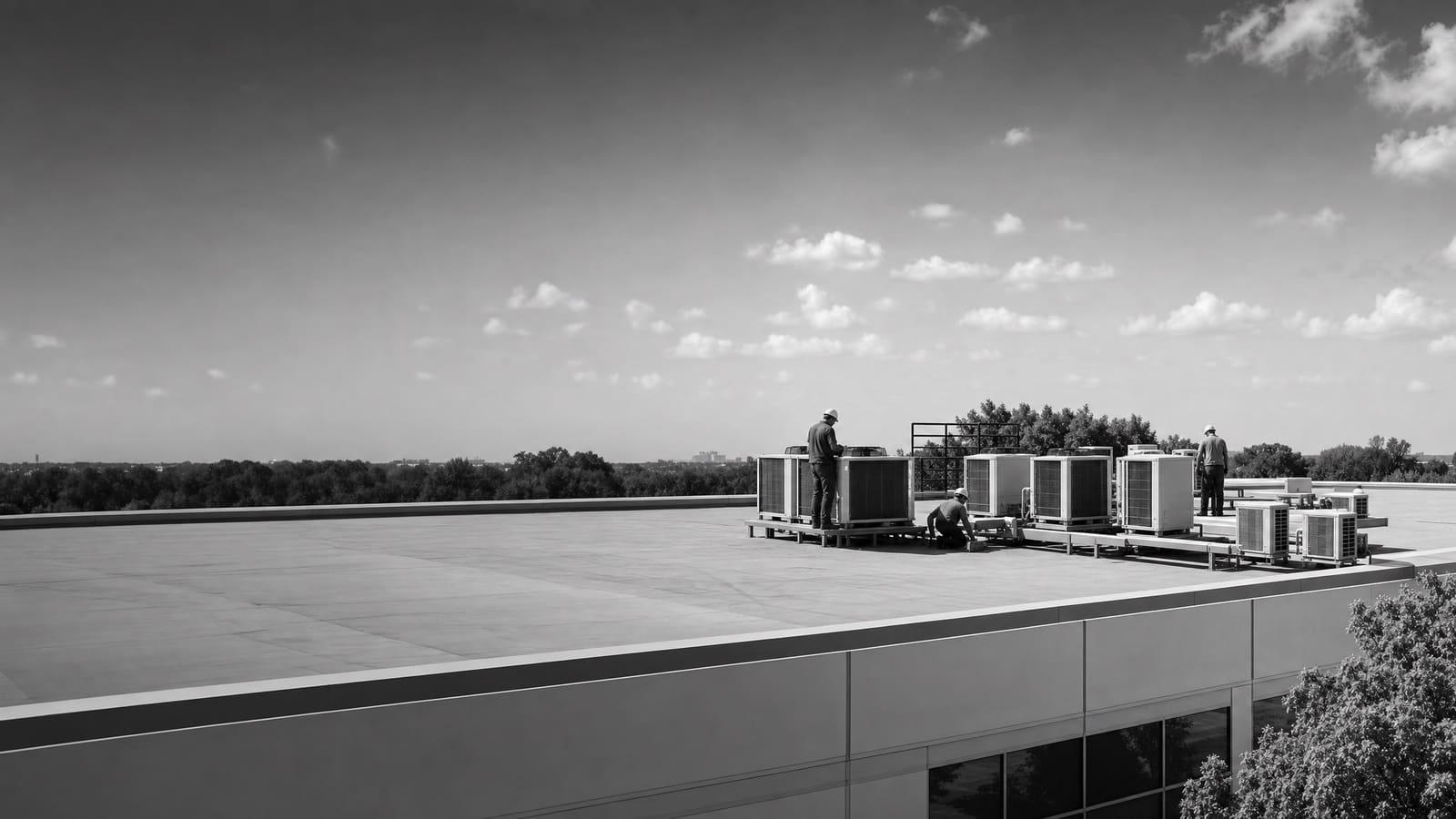
A commercial HVAC replacement covers the load calculation, the unit, curb and structural work, gas or electrical changes, crane rigging, controls integration, permits, and commissioning. Replacement usually beats another repair once a unit passes about fifteen years. DOE puts the annual energy waste of an old commercial rooftop unit at roughly $900 to $3,700 per unit, and that money leaves the building whether or not the compressor holds through another season.
A site review still has to confirm the real load against current occupancy, the curb and roof framing, available electrical capacity, crane reach across the lot, and what the mechanical code requires a replacement to bring current.
THREE PATHS
The three replacement decisions most buildings face
Most commercial buildings land on one of three paths, and the right one depends on how much you know about the load before the unit fails. A like-for-like swap is the fastest way back to conditioned space, and it is an honest choice when the space and its use have not changed. A planned high-efficiency replacement costs more up front but resets the operating number for the next fifteen years. DOE's rooftop unit work with manufacturers targeted units using up to fifty percent less energy than the old standard, and more than twenty models now exceed that specification. A heat pump rooftop unit adds reverse-cycle heating and is worth pricing any time the old unit burned gas. DOE guidance points to the South and West as regions where today's heat pump rooftop units can carry most or all of the winter heating demand, though the case still turns on your own electricity and gas rates.
WHAT MOVES THE NUMBER
The lines that decide what your quote says
No two roofs price the same, so treat these as the lines that move the total rather than a menu. Most of the spread on a replacement lives in three places: the unit itself, what the roof needs before it can carry the unit, and how hard the unit is to reach.
BUYING GUIDANCE
Buy the replacement instead of reacting to it
The most expensive version of this project is the one you did not choose. DOE's own guidance is blunt about it: facility managers commonly delay a new rooftop unit until the old one stops holding the space, needs constant attention, or fails outright. By then the decision is made for you. Whatever is available regionally becomes the equipment, the crane comes at whatever rate is open, and the load never gets recalculated.
The alternative costs one afternoon of attention. Pull the nameplates on your units, note the install year, and sort them into three buckets: fine, watch, and replace next. Anything past fifteen years belongs in the second or third bucket regardless of how it is running today, because the energy waste is already happening quietly.
For the units in the replace bucket, get load calculated against how the space is used now rather than what the old nameplate says. Twenty years changes occupancy, plug loads, lighting heat, and often the envelope. Carrying an old tonnage forward carries the old comfort complaints forward with it. That single step is what separates a replacement that fixes something from a replacement that just restores the status quo at a higher price.
SCOPE CHECK
What makes a replacement simple or complicated
Two replacements of the same tonnage can price very differently. The difference is usually not the unit. It is what the roof, the lot, and the existing service will allow without additional work.
LOWER COMPLEXITY
Straight swap conditions
Same tonnage and footprint, existing curb in good condition, electrical and gas already sized, open lot with clear crane reach, and standalone controls. Set and connected in a morning, inspected within the week.
HIGHER COMPLEXITY
Engineered replacement conditions
Different footprint or added weight, aging curb, a fuel switch that needs new electrical capacity, tight access requiring a larger crane or street closure, and integration into an existing building automation system.
THE SITE REVIEW
What a real scoping visit has to establish
A number quoted from a nameplate photo is a starting point, not a price. Before anyone commits to an installed cost, someone needs to get on the roof and answer a specific set of questions.
First, the load. What is the space used for now, how many people occupy it, and what equipment is running in it? That drives tonnage, and tonnage drives everything downstream. Second, the physical situation. Is the existing curb sound, does the new unit match its footprint, and can the roof structure carry the weight? Third, the infrastructure. Is there electrical capacity for the unit being considered, especially if a heat pump is on the table? DOE's heat pump guidance calls out electrical capacity, physical constraints, and existing gas lines as the three infrastructure items that decide whether a switch is realistic at a given site.
Fourth, access. Where does the crane set up, what does it reach, and how much of the lot goes out of service. Fourth is the one buyers forget and the one that surprises them on the invoice.
Ask for the findings, not just the price
A good scoping visit produces a short written record: measured tonnage basis, curb condition, structural note, available electrical capacity, and the rigging plan. If a quote arrives without any of that behind it, the risk has not been priced. It has been deferred to you.
OWNERSHIP
Two things that outlive the install day
The install is one morning. The consequences run for fifteen to twenty-five years. Two of them are worth settling before you sign, because both are cheap to plan for now and awkward to sort out later. One is regulatory and applies the moment the old unit comes off the roof. The other is strategic and applies to every unit you still own.
REFRIGERANT
Recovery is a compliance step
EPA Section 608 rules govern how refrigerant is handled and recycled in stationary air conditioning and heat pump equipment. The contractor removing your old unit is responsible for proper recovery, and new equipment arriving on newer refrigerants changes how you plan parts and service across a mixed fleet.
FLEET SEQUENCING
Replacement on failure is the costly default
DOE notes that proactively replacing inefficient units often beats both replacement-on-failure and like-for-like swaps at end of life. If you own several units, sequencing them over a few budget years buys better pricing, better timing, and no emergency decisions.
OVER THE LIFETIME
Phasing, procurement, and the number that matters
Equipment lead time is the variable that most often decides how a replacement goes, and it is the one least visible on a price sheet. Ask for availability next to the price on every option. A unit that costs slightly more and ships in three weeks is frequently the better buy over one that saves a few thousand dollars and arrives in ten, especially if the space is occupied and the old unit is limping.
If you own more than one aging unit, phase them. Two or three replacements planned across consecutive budget cycles let you standardize on one manufacturer and one control platform, which simplifies parts, service contracts, and technician familiarity for years afterward. It also means you are never negotiating in an emergency.
On lifetime cost, the arithmetic is usually decided by operating spend rather than purchase price. DOE's Advanced RTU Campaign reported more than 43,000 rooftop units upgraded across participating organizations, saving a combined $37 million a year in energy costs. That is the shape of the return. A higher-efficiency unit or a controls upgrade costs more on day one and then pays back quietly on every utility bill for the rest of its service life. Ask for the operating comparison in writing before choosing on first cost alone.
BEFORE YOU SIGN
Five things a comparable quote has to show
Two quotes are only comparable when they price the same scope. These five items are where the differences hide, and any contractor should be able to put all five in writing without hesitation.
01
The tonnage basis
Whether sizing came from a calculated load or from the old nameplate, stated plainly.
02
Equipment model and lead time
Specific model, efficiency tier, refrigerant, and the actual availability date, not a range.
03
Curb, structural, and roofing work
Adapter, any framing work, and who patches and warranties the roof penetrations.
04
Rigging, permits, and inspections
Crane, lot coordination, mechanical and electrical permits, and inspection scheduling included in the price.
05
Commissioning and documentation
Charge, airflow, and control settings verified against spec, documented, and handed to you at closeout.
Keep planning locally
Related mechanical pages in Albuquerque
Get a defensible number
Price the equipment and the building together.
Send the address, operating target, and target opening date. Flux will identify what must be verified before the project can be priced.
Get a free estimateQuestions
Straight answers.
When is replacing better than repairing a commercial rooftop unit?
Once a unit passes roughly fifteen years, repair economics change. DOE estimates an old commercial rooftop unit wastes somewhere between $900 and $3,700 a year in energy compared to newer models. At that point you are paying for the inefficiency whether or not you also pay for the repair.
How long does the actual installation take?
The on-site set for a single packaged rooftop unit is typically a morning of crane work plus connection and startup. The variable that decides your timeline is equipment lead time, which is why availability belongs on the quote right next to the price.
Should we consider a heat pump rooftop unit instead?
It is worth pricing whenever the old unit burned gas. DOE guidance identifies the South and West as regions where current heat pump rooftop units can handle most or all winter heating demand, but the decision still depends on your electrical capacity, your gas and electricity rates, and the existing infrastructure at that specific building.
Do we need to recalculate the load, or can we match the old unit?
Recalculate it. Occupancy, plug loads, lighting, and sometimes the envelope all change over a twenty-year service life. Matching the old nameplate carries any original sizing mistake forward into a unit you will own for the next two decades.
Who handles refrigerant when the old unit comes off?
The installing contractor. EPA Section 608 regulations govern how refrigerant is handled and recycled in stationary air conditioning and heat pump equipment, and proper recovery during removal is part of that. Confirm it is written into the scope rather than assumed.
Sources used for this guide
- [1]betterbuildingssolutioncenter.energy.gov — DOE Advanced Rooftop Unit Replacement Guidance
- [2]betterbuildingssolutioncenter.energy.gov — DOE Commercial Heat Pump Rooftop Unit Replacement Guidance
- [3]betterbuildingssolutioncenter.energy.gov — DOE High-Efficiency Commercial Rooftop Unit Toolkit
- [4]energy.gov — DOE Efficient Commercial Rooftop Air Conditioner Program
- [5]epa.gov — EPA Stationary HVAC Refrigerant Management