THE SHORT ANSWER
What a commercial HVAC replacement actually covers
A commercial HVAC replacement covers the load calculation, the unit itself, the curb or curb adapter, the crane set, the gas, electrical and refrigerant connections, controls, permits, and commissioning. Replacement starts beating repair once a unit passes about fifteen years and the same fixes keep coming back. Old, inefficient rooftop units can waste $900 to $3,700 each per year in energy — money that leaves the building whether the compressor runs well today or not.
A site review still has to confirm the roof's structural capacity, the electrical service feeding the unit, gas line size, and crane access before anyone commits to a tonnage, a fuel type, or a price.
THREE WAYS TO GO
Like-for-like, right-sized, or heat pump
Almost every commercial replacement lands in one of three lanes, and the right lane depends on what changed since the old unit went up.
Like-for-like is the fastest path back to conditioned air. The curb matches, the connections match, and the engineering is thin. It also carries forward whatever sizing mistake the old unit had.
Right-sized replacement starts with a load calculation against today's occupancy, lighting, plug loads, and envelope. Fifteen or twenty years of tenant changes usually move that number, sometimes down. This is the version that fixes comfort complaints the old unit never could.
A heat pump rooftop unit adds reverse-cycle heating to the same box. The decision turns on climate zone, local electricity and gas prices, and what the building's electrical service can carry. Dual-fuel, all-electric, and cold-climate models exist precisely because one answer does not fit every site. Heat pump heating efficiency drops as outdoor temperatures drop, so a colder heating season points toward dual-fuel or cold-climate equipment rather than a straight all-electric swap.
WHAT MOVES THE NUMBER
Where commercial HVAC installation money goes
There is no universal installed price for a commercial unit, because the box is only part of the job. These are the lines that separate two quotes written on the same roof. Each one should appear on paper before you compare bottom numbers.
IN PRACTICE
You are buying the install, not just the box
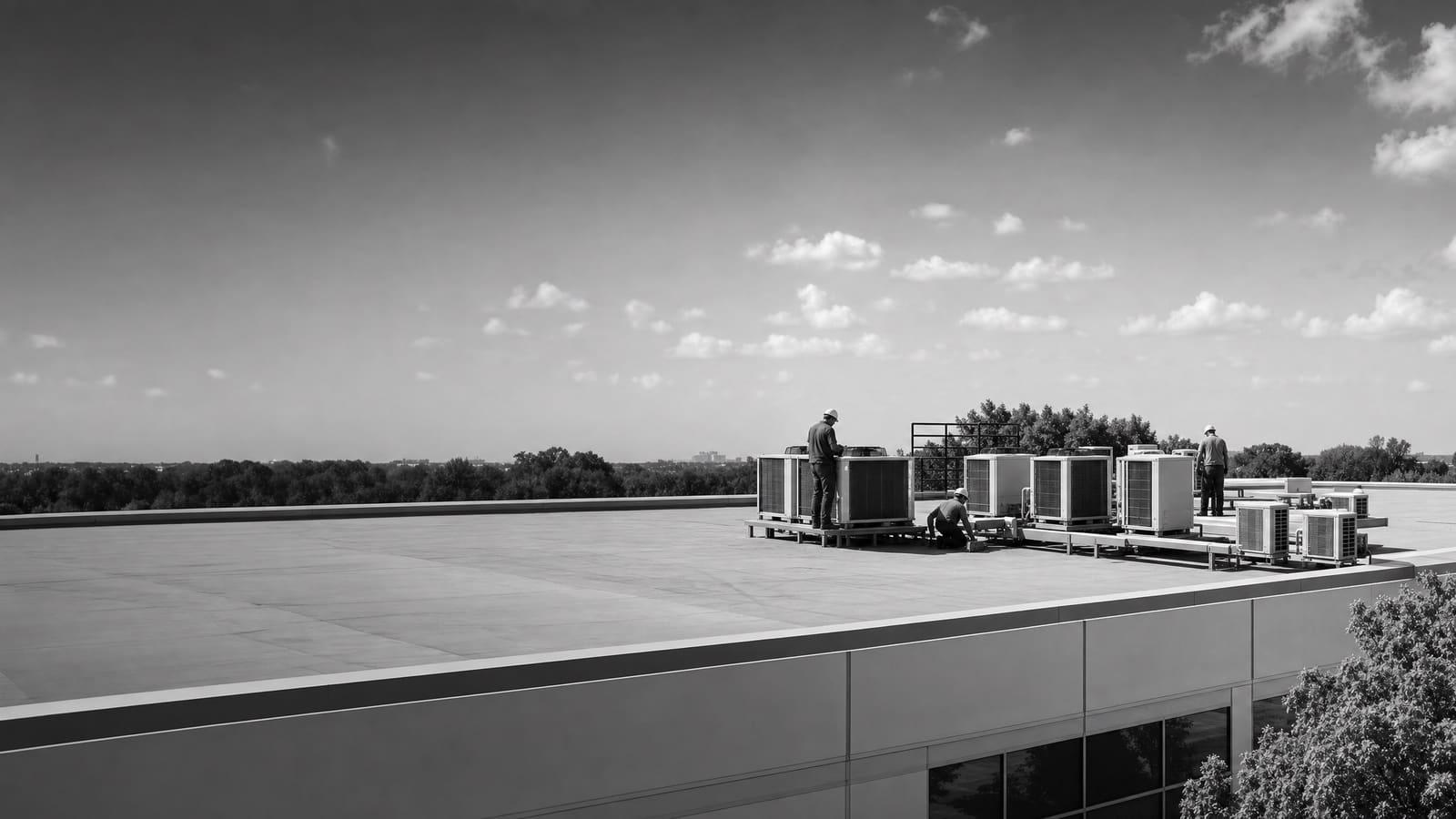
The visible part of the job is one morning. The crane arrives, stalls get coned off, the old unit comes off the curb, and the new one lands on an adapter that was measured weeks earlier. Everything that makes that morning boring happened before it.
The preparation is the part worth shopping. Ask how the load was confirmed, whether the curb adapter is fabricated or field-modified, who pulls the mechanical and electrical permits, and what the crane has to clear. A quote that skips those lines has not priced the job. It has priced the equipment and left the rest for later, which is where change orders come from.
Waiting for failure is its own decision, and an expensive one. Units past fifteen years old burn substantially more energy than current models, and replacing on failure removes every option you would otherwise have: unit selection, efficiency tier, timing, and the chance to actually bid the work. Proactive replacement at the end of useful service life beats a rushed emergency swap, and it leaves room to consider a better unit instead of whatever happens to be on a truck that week.
COMPLEXITY CHECK
What makes a replacement simple or hard
Two buildings can order the same tonnage and get very different projects. Complexity comes from what surrounds the unit — the roof, the service, the access, and the schedule — not from the equipment on the purchase order.
LOWER COMPLEXITY
Same size, same fuel, open lot
Matching tonnage on an existing curb, adequate electrical and gas already at the roof, clear crane access from the street, and a building that can lose conditioning for part of one day.
HIGHER COMPLEXITY
Fuel switch, tight site, no downtime
Moving to electric heating, a panel that needs upsizing, a larger footprint that needs structural review, restricted street or lot access, or a space that has to stay conditioned straight through the swap.
BEFORE THE QUOTE
What a site review has to establish
A useful quote starts on the roof, not in an inbox. The visit should capture the nameplate, the curb dimensions, the condition of the deck around it, the disconnect and feeder serving the unit, and the gas line if there is one. Those items decide whether this is a swap or a small construction project.
Electrical capacity changes the plan more often than anything else. If the building is considering electric heating, the service and panel have to carry the new load, and discovering otherwise after the order is placed is the expensive version of that discovery. Physical constraints matter too: roof access, structural capacity, and whether the new unit fits the opening that already exists.
Equipment availability belongs in the same conversation. A unit that ships in three weeks and a unit that ships in three months are not the same purchase, even at the same price. Ask for lead time next to the number, not after you have chosen.
Finally, ask who is doing the work. Heat pump rooftop units in particular reward a contractor who has commissioned them before, because controls and defrost behavior are where the savings hold up or quietly disappear.
The five-minute roof check
Photograph the nameplate, measure the curb, look at the disconnect and feeder, find the gas line, and walk the crane's path from the street. Send those five things with your request and the first number you get back will land close to the final one.
OWNERSHIP MATH
Two things that outlive the install
The install takes a week. The consequences run fifteen to twenty-five years. Two of them deserve a deliberate decision rather than a default.
The first is operating cost. High-efficiency commercial rooftop units were developed specifically to cut energy use sharply against the older minimum standard, and more than 43,000 units upgraded through a federal campaign saved participating organizations a combined $37 million a year. That gap shows up on every bill for the life of the equipment.
The second is service. Refrigerant handling in commercial equipment is federally regulated, and recovery off the old unit has to be done by certified technicians. New equipment arrives on newer refrigerants, so a building running units of different ages ends up supporting two generations of parts and training at once. That is manageable — but it should be planned, not discovered on a service call.
FIRST COST VS RUNNING COST
The cheapest quote rarely wins
High-efficiency rooftop units were built to cut energy use by up to half against the older minimum standard. That difference compounds every month for fifteen years, long after the quote is forgotten.
FLEET AND SERVICE PLANNING
Refrigerant and parts follow the unit
Recovery from the old unit is regulated work for certified technicians. New units ship on newer refrigerants, so a mixed-age roof needs a parts and training plan rather than a surprise.
PLANNING AHEAD
Phasing a roof full of units
Commercial buildings rarely have one rooftop unit. They have six, or twenty, installed within a few years of each other — which means they tend to fail within a few years of each other too. The only real question is whether that happens on your calendar or theirs.
A phased plan starts with an inventory: age, tonnage, refrigerant, service history, and the last two years of repair spend on each unit. Anything past fifteen years with repeat repairs goes in the first wave. Anything young and healthy waits. The middle group is the interesting one, and the usual tiebreaker is which unit serves the space generating the most comfort complaints.
Phasing also buys purchasing leverage. Three units ordered together share a crane day, a permit cycle, and one mobilization, and they give a supplier a reason to sharpen the number. Spread that same work across three emergency calls in three different summers and you pay full freight three times.
Set a replacement line in the annual budget instead of treating each failure as a surprise. The equipment gets replaced either way. Planning only decides whether you pick the unit or accept the one that happens to be available.
APPLES TO APPLES
Five lines every quote should show
Two quotes are only comparable when they describe the same work. Ask every bidder to break out these five items, then compare the items instead of the bottom lines.
01
Unit make, model, tonnage, efficiency tier
Model numbers, not categories. The efficiency tier sets the operating cost you live with for the next fifteen years.
02
Curb, adapter, and structural scope
Whether the adapter is shop-fabricated or field-modified, and who is responsible if the deck needs work.
03
Crane, rigging, and lot coordination
Reach, closure window, and whether the crane day is inside the price or billed separately later.
04
Permits, inspections, and triggered code work
Mechanical and electrical permits, plus anything the replacement triggers, named on the quote rather than assumed.
05
Startup, commissioning, and documentation
Charge, airflow, and control settings verified against spec, with the report that keeps the warranty intact.
Keep planning locally
Related mechanical pages in Akron
Get a defensible number
Price the equipment and the building together.
Send the address, operating target, and target opening date. Flux will identify what must be verified before the project can be priced.
Get a free estimateQuestions
Straight answers.
How fast can a failed rooftop unit be replaced?
The on-site work for a single packaged unit is short — a crane set, connections, and startup. The honest variable is equipment availability, which moves with model, tonnage, and season. Ask for lead time next to the price, because that number sets your schedule far more than the install day does.
Should a replacement be like-for-like or right-sized?
Confirm the load either way. If occupancy, lighting, and equipment in the space have not changed, like-for-like is often correct and cheaper to engineer. If the space was reconfigured or the comfort complaints never went away, a load calculation usually pays for itself twice: once in equipment cost, again in running cost.
Is a heat pump rooftop unit worth considering?
It depends on four things: the heating season, local electricity and gas prices, the building's electrical capacity, and any emissions goals. Heat pump heating efficiency falls as outdoor temperatures fall, so a colder heating season points toward dual-fuel or cold-climate models rather than a straight all-electric unit. Check the panel before you check the price.
How do you know when to stop repairing?
Watch age and repeat repairs together. Rooftop units past fifteen years old waste meaningful energy compared with current models, so a repeat repair on a unit in that age band is buying months on an asset that already costs you money every day it runs.
What does commercial HVAC installation cost?
There is no universal installed price, and any number offered before someone sees the roof is a guess. The real drivers are tonnage and efficiency tier, curb and structural work, crane access, electrical or gas changes, and controls integration. Get those five broken out and the quotes become comparable.
Who handles the crane and the permits?
The installing contractor should own the rigging plan, lot coordination, permits, and inspections inside the installed price. If the quote does not say so in writing, ask before signing — those are exactly the items that come back as change orders.
Sources used for this guide
- [1]betterbuildingssolutioncenter.energy.gov — DOE Advanced Rooftop Unit Replacement Guidance
- [2]betterbuildingssolutioncenter.energy.gov — DOE Commercial Heat Pump Rooftop Unit Replacement Guidance
- [3]betterbuildingssolutioncenter.energy.gov — DOE High-Efficiency Commercial Rooftop Unit Toolkit
- [4]energy.gov — DOE Efficient Commercial Rooftop Air Conditioner Program
- [5]epa.gov — EPA Stationary HVAC Refrigerant Management