THE DIRECT ANSWER
What a commercial HVAC replacement actually includes
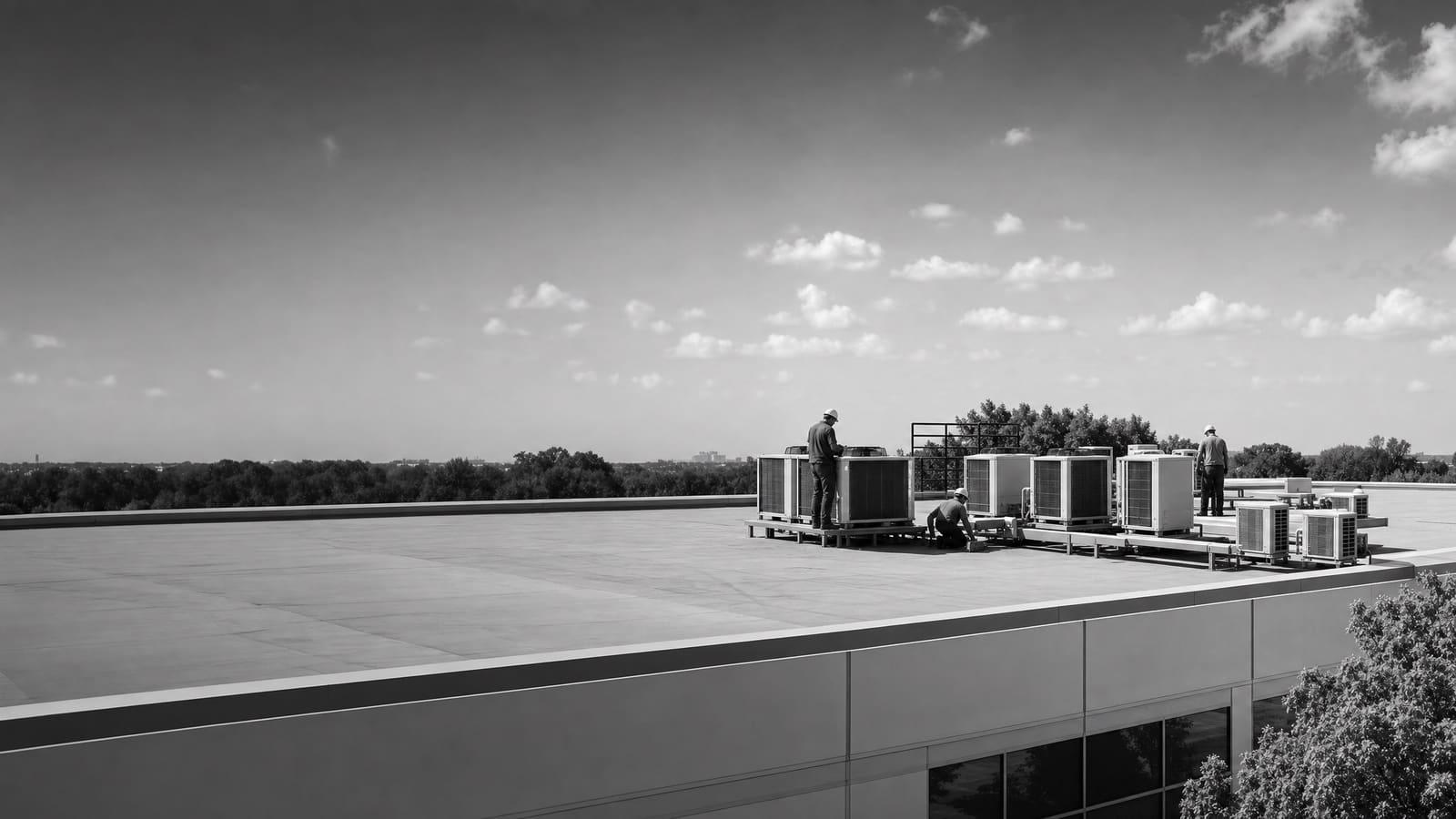
A commercial HVAC replacement covers load verification, equipment selection, rigging and setting the unit, electrical, gas, and refrigerant connections, controls integration, permits, inspection, and documented commissioning. Replacement beats another repair once a rooftop unit is past roughly fifteen years and the repairs are repeating. DOE's guidance is direct about it: units that old waste substantial energy and money, and waiting for outright failure usually costs more than replacing on a plan.
A site review still has to confirm curb size and condition, roof framing, crane access and reach, available electrical capacity, and whether the replacement pulls in requirements the old unit never had.
THREE WAYS TO GO
Your three real replacement paths
Most buyers think the choice is which brand. The real choice is which of three paths the building should take, and that gets decided before anyone quotes a model number.
Like-for-like keeps the fuel type and the curb and gets the space conditioned again quickly. A high-efficiency unit costs more on the invoice and earns it back through the meter, which matters most on units that run long hours. A heat pump rooftop unit replaces gas heat with reverse-cycle heating, and it depends on things a spec sheet cannot tell you: available electrical capacity at the panel, physical room on the roof, existing gas lines, and how much winter heating the building actually needs.
DOE frames the heat pump decision the same way, as a checklist of site conditions rather than a blanket recommendation. Ask for all three priced against each other. The gap between them is usually smaller than owners expect, and the operating cost difference runs for the next two decades.
WHAT MOVES THE NUMBER
The line items that actually move your price
No two roofs price the same. These are the items that separate a clean swap from a project, and each one should show up as its own line on the quote rather than hiding inside a lump sum.
IN PRACTICE
How to buy this without overpaying
The most expensive version of this project is the one nobody planned. When a rooftop unit fails in July, the building takes whatever is available, at whatever price, with whatever sizing the old nameplate suggested. DOE's rooftop replacement guidance makes the same point plainly: owners tend to wait until a unit fails completely, and replacing on failure usually costs more than replacing on a schedule.
Planning does not mean replacing early for its own sake. It means knowing which units are past fifteen years, what they cost to run now, and what the replacement would look like with six weeks of runway instead of six hours. That one piece of homework changes the negotiation. You can compare two or three real options, hold a delivery date, and put the crane on a Saturday instead of paying emergency rates on a Tuesday.
It also changes the sizing conversation. The old nameplate reflects the building as it was designed, not as it is used. Two decades of tenant changes, added plug load, lighting retrofits, and envelope work usually mean the honest load is different from the one on the roof. Confirming it costs a few hours of engineering and prevents both outcomes you do not want: paying for tonnage you never use, or living with a unit that short-cycles for the next fifteen years.
SCOPE CHECK
Simple swap or real project?
Before you read a single price, work out which category your unit falls into. The gap between these two conditions is worth more to your budget than any discount a contractor can offer you.
LOWER COMPLEXITY
A straightforward swap
Same fuel and roughly the same capacity, an existing curb that takes a standard adapter, open lot for the crane, adequate electrical already at the unit, and controls that carry over. This is a single-visit job on a routine approval path.
HIGHER COMPLEXITY
A project, not a swap
A fuel switch to a heat pump, more tonnage than the roof was framed for, tight or shared parking that limits where the crane can set up, or panel capacity that has to be added first. Each one adds scope, schedule, and review time.
BEFORE THE QUOTE
What a real site review has to answer
A quote written from a phone call is a guess. A quote written from a roof visit is a number you can hold someone to. The visit should answer a short list of questions, and you should be able to see every one of those answers reflected in what you are handed.
Start with the unit itself: nameplate, age, refrigerant type, and current condition. Then the curb, because curb size and roof framing decide whether the new unit lands on an adapter or triggers structural work. Then the electrical. DOE's heat pump guidance flags panel capacity as one of the first things to check, and it matters just as much for a high-efficiency unit with a larger fan motor. Then the physical constraints, which is a polite phrase for whether the crane can actually reach the spot with your lot in normal use.
Two items get skipped most often. The first is controls, because integrating a new unit into an existing automation system is real labor that rarely survives a quick estimate. The second is the old refrigerant. EPA Section 608 rules cover recovery and handling from stationary air conditioning equipment, so removal is regulated work with documentation behind it.
The one question to ask every bidder
Ask what they measured. If the answer is the old nameplate and a photo from the ground, the number is a placeholder. If it includes curb dimensions, panel capacity, crane access, and controls type, you are finally comparing real bids.
OWNERSHIP MATH
Two things that outlast the invoice
The invoice is a one-time number. The unit on the roof is a decision you live with for fifteen to twenty years, and two factors decide whether that stretch goes well.
The first is what the unit costs to run. DOE built an entire rooftop program around this because old units are expensive in a way nobody sees on an invoice: the waste arrives spread across monthly bills instead of showing up as a repair charge. The second is what happens when the unit needs service, which is now partly a refrigerant question. New commercial equipment ships on newer refrigerants, so a building replacing units one at a time ends up running a mixed fleet with different parts and different service requirements.
Neither factor should stop a replacement. Both should shape the order you do them in, and how the service contract gets written afterward.
OPERATING COST
The meter never stops
DOE puts the waste from an old, inefficient rooftop unit at $900 to $3,700 a year. On a building carrying several of them, that annual figure is often larger than the price gap between a standard replacement and a high-efficiency one.
SERVICE PLANNING
Mixed fleets need a plan
Replacing one unit at a time leaves the roof with different refrigerants and different parts. Decide early whether your service provider stocks for both, and record the refrigerant type on every unit before you need it.
SEQUENCING
How to phase a multi-unit roof
Buildings rarely replace every rooftop unit at once, and most of them should not. Phasing spreads the capital, lets you learn from the first install, and keeps the roof from becoming one enormous single-year expense. The trick is choosing the order deliberately instead of letting failures choose it for you.
Rank the units by three things: age, run hours, and what happens when one goes down. A twenty-year-old unit over a server room or a customer-facing space belongs ahead of a newer unit over storage, even if the newer one is the noisier complaint. Then check whether any of them share the same tonnage and configuration, because ordering two identical units in one procurement usually buys better pricing and a shorter combined lead time than two separate emergencies eight months apart.
Procurement is where the planning turns into money. Equipment availability is a real constraint, and DOE lists it right alongside cost and infrastructure in its replacement guidance. A quote that names a model without naming a lead time is incomplete. Ask for availability in writing, ask what the alternate is if that model slips, and make the crane date contingent on delivery rather than the other way around. That one habit prevents most of the schedule pain on this kind of work.
APPLES TO APPLES
Five things a comparable quote must show
Bids that look far apart on price usually differ in scope instead. Make every bidder break out these five items separately so you can see what each number actually covers.
01
Model, tonnage, and efficiency tier
The exact unit, not a category. Efficiency tier explains most of the price gap between two bids that otherwise look identical.
02
Curb, adapter, and structural scope
Whether the new unit lands on the existing curb, what adapter is included, and who pays if the roof needs framing work.
03
Rigging, access, and lot closure
Crane size, staging location, how many hours the lot is closed, and which day of the week the lift happens.
04
Electrical, gas, and refrigerant work
Any panel, feeder, or gas changes, plus recovery and documented disposal of the old refrigerant charge.
05
Commissioning and documentation
Startup, charge, airflow, and controls verified against spec, with the report you need to keep the warranty intact.
Keep planning locally
Related mechanical pages in Winston Salem
Get a defensible number
Price the equipment and the building together.
Send the address, operating target, and target opening date. Flux will identify what must be verified before the project can be priced.
Get a free estimateQuestions
Straight answers.
When does replacement beat another repair?
DOE points to units past fifteen years as the age where waste becomes substantial, and estimates an old, inefficient rooftop unit burns $900 to $3,700 a year. Past that mark, with repairs repeating, the repair is buying time on an expense that is already running every month.
Should a Winston-Salem building switch to a heat pump rooftop unit?
Sometimes, and DOE treats it as a site checklist rather than a default. The items that decide it are available electrical capacity, physical room on the roof, existing gas lines, the building's winter heating load, and equipment availability. Heat pump rooftop units run most efficiently where winter heating demand is mild to moderate. Price one alongside a like-for-like unit and compare both numbers.
How long does a commercial rooftop replacement take?
The visible work is short. The crane sets the unit and the connections follow. What actually drives the schedule is equipment lead time and approvals, not the lift itself, which is why availability belongs on the quote right next to the price.
Does replacing a unit trigger requirements the old one did not have?
It can. What applied when your original unit went in is not necessarily what applies to the new one, and adding tonnage or footprint can pull structural review into the job. Do not guess at this. Ask each bidder to list the code-driven items included in their scope so you can tell whether two bids cover the same work.
What happens to the refrigerant in the old unit?
It gets recovered by qualified technicians. EPA Section 608 rules under the Clean Air Act govern the handling and recycling of refrigerant in stationary air conditioning and heat pump equipment, so recovery and its paperwork are part of the job rather than an add-on you can decline.
Sources used for this guide
- [1]betterbuildingssolutioncenter.energy.gov — DOE Advanced Rooftop Unit Replacement Guidance
- [2]betterbuildingssolutioncenter.energy.gov — DOE Commercial Heat Pump Rooftop Unit Replacement Guidance
- [3]betterbuildingssolutioncenter.energy.gov — DOE High-Efficiency Commercial Rooftop Unit Toolkit
- [4]energy.gov — DOE Efficient Commercial Rooftop Air Conditioner Program
- [5]epa.gov — EPA Stationary HVAC Refrigerant Management