THE SHORT ANSWER
What a commercial HVAC replacement actually includes
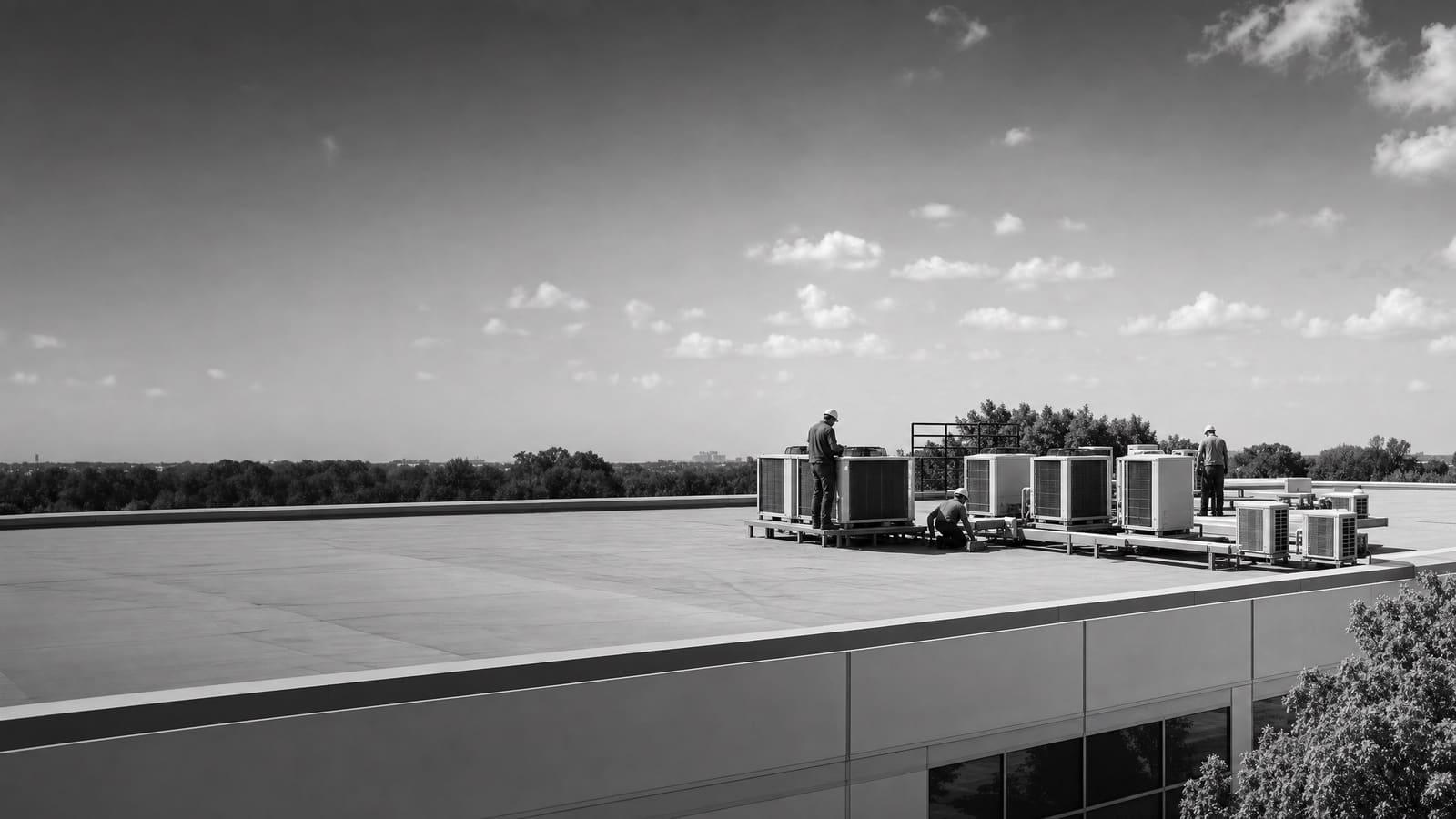
A commercial HVAC replacement covers the load calculation, equipment selection, rigging and set, refrigerant recovery from the old unit, gas and electrical connections, controls, and commissioning. Replacement beats another repair once the unit's efficiency is the real problem. Rooftop units condition close to half of all U.S. commercial floor area, and old, inefficient ones waste roughly $900 to $3,700 per unit each year — money no repair ticket gets back.
A site review still sets the number. It has to confirm the real load, the curb and structural condition, available electrical capacity, and crane access before any installed price means anything.
THREE WAYS TO GO
Three equipment paths for the same roof
Most replacement decisions come down to three paths. The right one depends on how long you plan to hold the building and what your electrical service can carry.
Federal work on rooftop units already moved the market. A DOE performance specification asked manufacturers to cut unit energy use by up to half against the prior standard, and more than twenty models now exceed it. A high-efficiency tier is a catalog option today, not a special order.
The heat pump question is separate from the efficiency question. DOE guidance frames it around climate and heating load, electricity and gas prices, building type, equipment availability, electrical capacity, physical constraints, existing gas lines, and available incentives. Dual-fuel units keep a backup heat source; all-electric units drop the gas connection entirely. Heat pump rooftop units perform best where winter heating demand is mild to moderate, so the design heating condition at your address decides whether that backup source is a formality or a working part of the system.
WHAT MOVES THE NUMBER
Where a commercial HVAC budget actually goes
No two roofs price the same, so read a quote by line item rather than by total. These are the lines that move most between one bidder and the next, and the ones worth asking about before you compare bottom numbers.
HOW TO BUY IT
Replacing on a plan instead of on failure
DOE is blunt about the common pattern: facility teams put off buying a new rooftop unit until the old one stops holding the space, needs constant attention, or fails outright. Replacing proactively with a more efficient unit is often the better business move — better than replacement on failure, and often better than a like-for-like swap at the end of a unit's service life.
The reason is timing. When a unit fails in July, the decision collapses to whatever sits on a regional shelf. You lose the efficiency comparison, the heat pump evaluation, and any incentive application that needed lead time. When the same replacement is planned, you can price two or three equipment paths against each other, schedule the crane on a low-occupancy day, and hold the building at full comfort the whole time.
Fifteen years is a trigger to start looking, not a date to replace. DOE flags units past that age because their efficiency has fallen behind current equipment. Pair the age check with what the unit costs you now: run hours, repair history, and comfort complaints from the spaces it serves. A unit with a clean service record can keep earning its place. One that has needed a compressor, a board, and two refrigerant charges has already told you what it plans to do next summer.
SCOPE CHECK
What makes this project simple or complicated
Two replacements at the same tonnage can price very differently. The gap is almost always access, infrastructure, and whether anything about the building changed since the old unit was set.
LOWER COMPLEXITY
Same fuel, same footprint
The new unit matches the existing curb, the electrical service already carries it, the gas line stays, and the lot gives a crane open reach. Space use has not changed, so the original sizing still holds. These jobs price tightly and move fast once equipment lands.
HIGHER COMPLEXITY
New fuel, new load, tight access
Going all-electric, growing tonnage, or serving a space that was reconfigured. Now the questions are service capacity, curb adaptation, structural review, and whether a crane can reach the set point at all. Expect engineering time before a firm price exists.
BEFORE YOU PRICE IT
What the site review has to settle
A quote is only as good as the walkthrough behind it. DOE's heat pump rooftop guidance gives a usable checklist for any replacement, not only an electrification project: climate and heating load, utility bill impact, building type and how it is used, equipment availability, and infrastructure — electrical capacity, physical constraints on the roof and in the lot, and existing gas lines. Add contractor familiarity with the equipment and any incentive program that has an application window.
Infrastructure is where projects go sideways. Electrical capacity comes first on any unit that adds electric heat, because a panel that comfortably ran a gas-heat unit may not carry an all-electric replacement. Physical constraints come second: curb dimensions, roof structure, clearances around adjacent equipment, and the crane's line of reach from the lot.
Refrigerant is third, and it is regulatory rather than optional. EPA rules under Section 608 govern how refrigerant is handled and recycled in stationary air conditioning and heat pump equipment, so recovery from the outgoing unit belongs in the written scope. New equipment also ships on lower-GWP refrigerants, which matters less on day one than it does for how you stock parts and write service contracts across a mixed fleet.
Three answers to get before a bid
Electrical service capacity at the panel, curb and structural condition under the existing unit, and crane reach from the lot. Settle those three during the walkthrough and the remaining variables are equipment tier and schedule — both of which you control.
OWNING THE DECISION
Two things the spreadsheet usually misses
An installed price is one number inside a decision that runs fifteen years or more. Two factors change the ranking after the equipment is set, and both are far easier to plan for now than to fix later.
The first is what the unit costs to run. The DOE Advanced RTU Campaign is a useful check on scale: more than two hundred organizations upgraded over 43,000 rooftop units and cut a combined $37 million a year from their energy bills. That is real money per unit, per year, for the life of the equipment.
The second is who maintains it. Contractor availability and familiarity with the specific technology is a named consideration in DOE's guidance for a reason. Equipment that nobody within reach wants to service becomes slow and expensive to keep running, no matter how it looked on the bid sheet.
OPERATING COST
The bill outlasts the bid
An inefficient unit can burn $900 to $3,700 a year more than it needs to. Multiply that by the years you plan to hold the building, then set it against the price gap between the standard and high-efficiency tier. The ranking often flips.
SERVICEABILITY
Who keeps it running
Ask who services the equipment you are being sold, how parts arrive, and what the response window looks like in peak season. A unit that is easy to buy and hard to service costs more than the invoice shows.
MULTI-UNIT PLANNING
Phasing a roof with several units on it
Buildings rarely have just one rooftop unit, and they rarely fail all at once. That staggering is an advantage if you use it. Rank the units by age, run hours, and repair spend, then set a replacement order you can fund across two or three budget cycles instead of reacting to whichever one quits first. If you manage several Virginia Beach properties, the same ranking works across the portfolio.
Phasing also lets you test before you commit. Replace the worst unit with the equipment path you are weighing — a high-efficiency AC unit or a heat pump rooftop unit — and run it through a full cooling season and a full heating season before ordering the rest. You get real bills from your own building instead of a modeled estimate, and your service team learns the equipment on one unit rather than six.
Procurement follows the same logic. Lead time is part of the specification, so ask for availability next to price on every option. If an incentive program applies, its application window usually has to open before equipment is ordered, not after it is installed. And keep the units on one controls platform where you can. Mixed control systems on a single roof turn every future service call into a translation exercise.
QUOTE CHECKLIST
Five things a comparable quote has to show
Two bids only compare when they cover the same scope. Ask every bidder to put these five items in writing, and most of the price difference between them stops being a mystery.
01
Equipment, tier, and tonnage
Model number, efficiency tier, capacity, and the load calculation behind it — not just a match to the old nameplate.
02
Availability next to the price
Current lead time for the exact unit quoted, and what changes if that date slips.
03
Rigging, access, and lot plan
Crane size, closure hours, staging area, and who coordinates with tenants.
04
Refrigerant recovery and disposal
Certified recovery from the outgoing unit and removal of the old equipment, stated as included.
05
Commissioning and documentation
Startup readings, charge, airflow, control settings, and warranty registration handed over in writing.
Keep planning locally
Related mechanical pages in Virginia Beach
Get a defensible number
Price the equipment and the building together.
Send the address, operating target, and target opening date. Flux will identify what must be verified before the project can be priced.
Get a free estimateQuestions
Straight answers.
When is replacement better than another repair?
Age, run hours, and repair history together. DOE flags rooftop units past fifteen years as candidates because their efficiency has fallen behind current equipment. If a unit has already needed major component work and still struggles to hold the space, the next repair buys time rather than performance.
Should a gas rooftop unit be replaced with a heat pump?
Sometimes. DOE guidance points at climate and heating load, electricity and gas prices, electrical capacity, existing gas lines, equipment availability, and incentives. Heat pump rooftop units are strongest where winter heating demand is mild to moderate. A dual-fuel unit keeps a backup heat source when the design heating condition is harder.
What does high efficiency actually mean on a rooftop unit?
DOE's performance specification challenged manufacturers to cut unit energy use by up to half against the prior standard, and more than twenty models now exceed it. It is a catalog choice today, so ask for a standard-tier price and a high-efficiency price side by side on the same job.
Who handles refrigerant on the old unit?
The installing contractor. EPA rules under Section 608 govern how refrigerant is handled and recycled in stationary refrigeration, air conditioning, and heat pump equipment. Recovery from the outgoing unit should appear in the written scope, not as a surprise line later.
How much can an aging rooftop unit be costing?
Old, inefficient rooftop units waste roughly $900 to $3,700 per unit each year. That range is the reason a planned replacement usually beats waiting for a failure, because the waste keeps running every month the decision is deferred.
Sources used for this guide
- [1]betterbuildingssolutioncenter.energy.gov — DOE Advanced Rooftop Unit Replacement Guidance
- [2]betterbuildingssolutioncenter.energy.gov — DOE Commercial Heat Pump Rooftop Unit Replacement Guidance
- [3]betterbuildingssolutioncenter.energy.gov — DOE High-Efficiency Commercial Rooftop Unit Toolkit
- [4]energy.gov — DOE Efficient Commercial Rooftop Air Conditioner Program
- [5]epa.gov — EPA Stationary HVAC Refrigerant Management