THE SHORT VERSION
What a commercial HVAC replacement actually includes
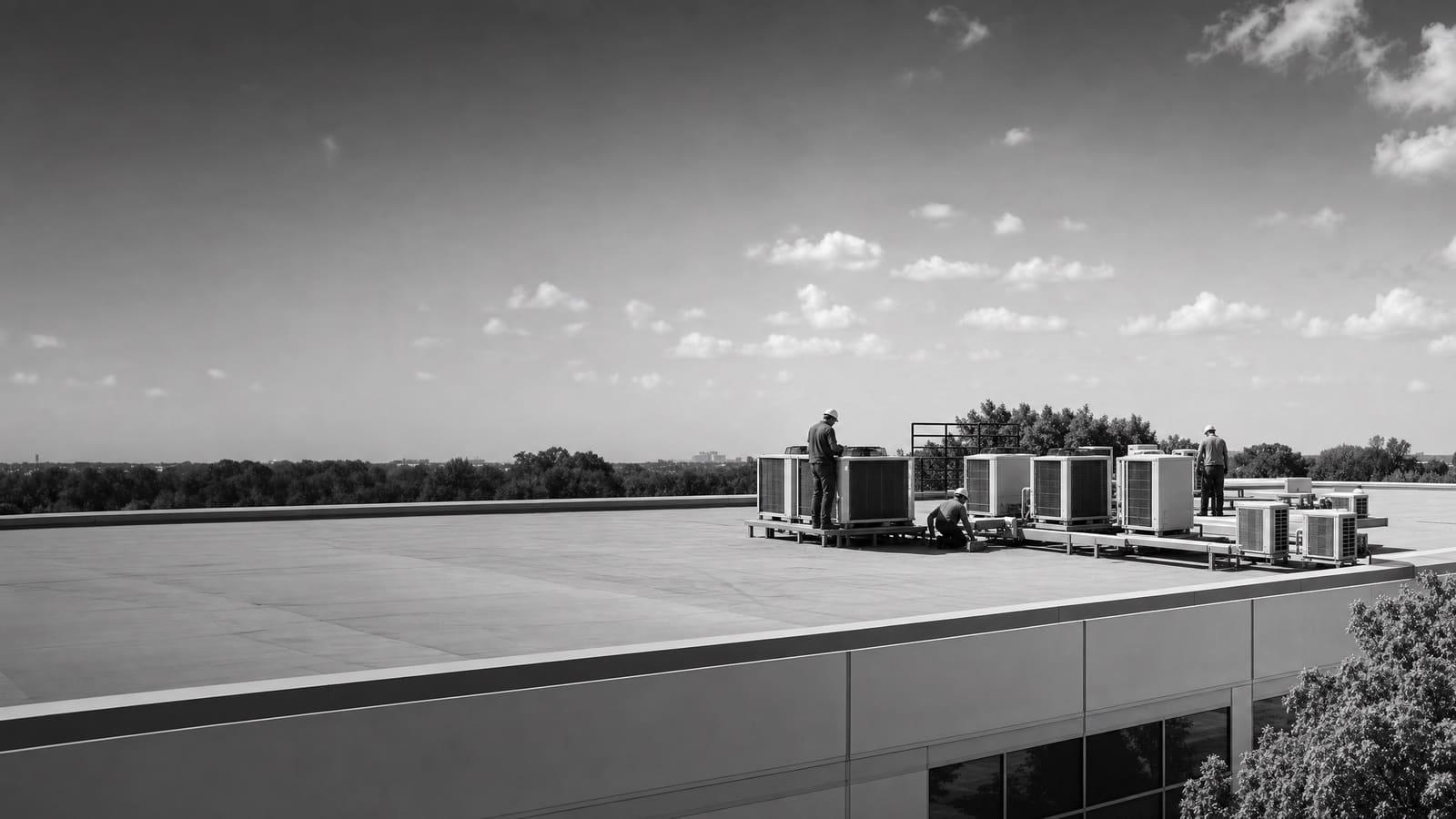
A commercial HVAC replacement covers a confirmed load calculation, equipment selection against real availability, rigging and curb work, gas or electrical changes, controls integration, and documented commissioning. Replacement usually beats another repair once a unit passes 15 years, since DOE puts annual energy waste from an old, inefficient rooftop unit at roughly $900 to $3,700 per unit. Add a failing compressor and the repair is rent on a decision you have already made.
A site review has to verify the load against how the space is used now, the curb and roof structure, crane reach across the lot, and whether the existing electrical service and gas line match the unit you want.
THREE WAYS TO GO
Three replacement paths worth pricing
Rooftop units cool close to half of all commercial floor area in the country, so most replacement decisions are packaged-unit decisions. Once a unit is past 15 years, the useful question is not whether to replace it but what to replace it with.
There are three honest answers. A like-for-like swap gets the building back to normal fastest and keeps engineering cost down. A high-efficiency unit of the same type costs more up front and earns it back through run hours — the DOE spec that created this class targeted up to 50% less energy than the standard in place at the time, and a federal minimum finalized in 2015 has since raised the floor for every new unit. A heat pump rooftop unit adds reverse-cycle heating and comes in dual fuel, all-electric, and cold climate versions.
Price at least two of the three. The gap is usually smaller than owners expect, and it is far easier to compare before the old unit fails.
WHAT MOVES THE NUMBER
The lines that actually move a replacement quote
No two roofs price the same, and the equipment is rarely where a quote goes wrong. These are the lines that swing hardest between two bids on the same building. If a number looks low, one of these is usually missing rather than cheaper.
IN PRACTICE
How to buy this without overpaying or under-scoping
The most expensive way to buy a commercial rooftop unit is to wait until it dies in August. Replacement on failure removes every choice worth having: you take what is available, at the price it is available, with no time to check whether the size still fits the building. Federal guidance is blunt about this — facility managers routinely delay until the unit fails, and proactive replacement usually beats both replacement-on-failure and a reflexive like-for-like swap at end of life.
Start with the load, not the nameplate. Twenty years changes occupancy, plug loads, lighting heat, and often the envelope. A unit sized for the building as it was two decades ago can be oversized today, which shows up as short cycling, poor humidity control, and comfort complaints no service call ever fixes. The load calculation is a few hours of work that decides the largest line on the quote.
Then decide the fuel question once, deliberately. Heat pump rooftop units are strongest where winter heating runs mild to moderate, and the practical constraints are electrical capacity, physical room on the roof, and the existing gas line. Those are answers a site visit produces in an afternoon. If the answer is no, a high-efficiency unit of the same type is a good outcome, not a consolation prize.
SCOPE CHECK
What makes one replacement simple and another complicated
Two buildings on the same block can price very differently. The split is rarely about the equipment. It is about what has to change around the equipment, and how much of that can be confirmed before the crane is booked.
LOWER COMPLEXITY
Same unit, same hole in the roof
Matching tonnage on the existing curb, adequate panel capacity, a gas line already in place, and open lot space for the crane. The load calculation confirms the old size still fits. The swap lands as a single planned day.
HIGHER COMPLEXITY
New size, new fuel, or a tight site
Different footprint, added weight, or a heat pump conversion that needs new service capacity. Add a roof with no crane sightline, tenants who cannot lose conditioning, or a plant larger than packaged equipment covers, and the project becomes engineered rather than swapped.
BEFORE YOU BUY
What a real site review has to answer
A quote written from a phone call is a guess with a number attached. The site review exists to turn the unknowns into fixed lines, and there are only a handful of them.
The first is the load: what the space demands now, on today's schedule, with today's equipment in it. The second is the roof: curb dimensions, structural capacity for the new unit's weight, and whether an adapter or a new curb is the honest answer. The third is infrastructure — electrical capacity at the panel, feeder routing, and the state of the gas line if you are keeping gas heat. Federal heat pump guidance names those same three as the infrastructure questions that decide whether a heat pump is realistic at a given site, alongside equipment availability and contractor familiarity with the technology.
The fourth is access. Crane reach, staging space, which stalls close and for how long, and whether the lift happens before the building opens. The fifth is controls: what the new unit needs to talk to, and who owns the point mapping.
Answer those five and the quote stops being an estimate. Skip any of them and you will meet it again as a change order.
Ask for the load calculation, not just the tonnage
Any contractor can read the old nameplate. The one worth hiring will show you the calculation behind the size they proposed, and explain what changed in the building since the last unit went on.
OWNERSHIP MATH
Two things that outlive the install
The install is one morning. The consequences run for the next decade and a half, and they land in two places: what the unit costs to run, and what it costs to keep running.
On the run side, the numbers are not small. Federal analysis has put the annual energy waste of an old, inefficient rooftop unit at roughly $900 to $3,700 apiece. Across a roof with four or five units, that is a line item, not a rounding error, and it is why the efficiency tier deserves more attention than a rushed replacement usually gives it.
On the service side, the decision you make now sets the shape of your fleet. Roofs replaced one unit at a time, on failure, end up with a mix of ages, control platforms, and refrigerants that no service contract covers cleanly. Owners who plan the sequence end up with fewer variables to manage.
OPERATING COST
Efficiency compounds over run hours
The tier you pick is paid once and collected every month. A DOE campaign run with industry partners reported more than 43,000 units upgraded and about $37 million in combined annual energy savings across participating organizations.
FLEET CONSISTENCY
Mixed roofs get expensive to service
Different ages, controls, and refrigerants on one roof mean more spare parts, more technician familiarity required, and more surprises. Refrigerant handling on removal is regulated work, so a mixed fleet carries a compliance dimension too.
PLANNING AHEAD
Phasing a roof instead of reacting to it
If you own more than one unit, the highest-leverage move is to stop treating replacement as an emergency. Walk the roof once, write down the age and condition of every unit, and rank them. The ones past 15 years are candidates whether or not they are currently complaining.
From there, phasing is a budget exercise rather than a crisis. Replace the oldest and hardest-working units first, in a shoulder season when losing a zone for a day costs nothing. Book the crane once for two or three units instead of three times for one. Standardize on a control platform so the next unit integrates in hours instead of days. Every one of those moves is cheaper when it is scheduled.
Procurement follows the same logic. Equipment availability is one of the factors federal guidance names in deciding what is actually deployable at a site, and availability is something you can plan around when you have months and cannot when you have days. If you are considering a heat pump anywhere on the roof, do the electrical capacity study once for the whole building rather than per unit. It is the same panel either way, and the answer changes which units are candidates.
Lifetime cost is mostly decided in the first week of a project.
QUOTE CHECKLIST
Five things a comparable quote has to show
Two bids are only comparable when they scope the same work. Ask for these five in writing and the differences between contractors become obvious in about a minute.
01
The size and where it came from
Tonnage, efficiency tier, and the load calculation behind them — not a copy of the old nameplate.
02
Curb, structure, and rigging
Adapter or new curb, any structural work, crane size, staging plan, and how long lot access is closed.
03
Utilities and connections
Electrical capacity, feeder work, gas line changes, refrigerant recovery, and who pulls each permit.
04
Controls and integration
What the unit ties into, who maps the points, and whether the existing front end is included in the price.
05
Startup and commissioning
Charge, airflow, and control settings verified against spec, documented at handoff so the warranty holds.
Keep planning locally
Related mechanical pages in Vancouver
Get a defensible number
Price the equipment and the building together.
Send the address, operating target, and target opening date. Flux will identify what must be verified before the project can be priced.
Get a free estimateQuestions
Straight answers.
When does replacing a rooftop unit beat one more repair?
Once a unit is past 15 years, the math usually flips. Federal analysis puts the annual energy waste of an old, inefficient rooftop unit at roughly $900 to $3,700, which is often more than the repair you are weighing. A failing compressor on a unit that age is a decision, not a service call.
Should you replace like-for-like or resize?
Confirm the load either way. If occupancy, equipment, and hours have not changed, like-for-like is often right and it is the fastest path back to service. If the building changed, right-sizing fixes comfort problems the old unit could never solve.
Is a heat pump rooftop unit a good replacement?
It depends on three things: how much winter heating the building needs, whether the electrical panel has capacity, and whether there is physical room for the unit you want. Heat pump efficiency drops as outdoor temperatures fall, so they fit best where winter heating is mild to moderate. Dual fuel is the middle path when the heating load is heavier.
Who handles the crane, permits, and inspections?
The installing contractor should own the rigging plan, lot coordination, permits, and inspections as part of the installed price. Get it in writing before you sign. That is one of the most common places two quotes stop being comparable.
What happens to the refrigerant in the old unit?
It is recovered before the unit comes off the roof. Handling and recycling of refrigerant from stationary air-conditioning equipment is governed by EPA Section 608 rules, so it is regulated work with documentation attached, not a line to leave off a quote.
Sources used for this guide
- [1]betterbuildingssolutioncenter.energy.gov — DOE Advanced Rooftop Unit Replacement Guidance
- [2]betterbuildingssolutioncenter.energy.gov — DOE Commercial Heat Pump Rooftop Unit Replacement Guidance
- [3]betterbuildingssolutioncenter.energy.gov — DOE High-Efficiency Commercial Rooftop Unit Toolkit
- [4]energy.gov — DOE Efficient Commercial Rooftop Air Conditioner Program
- [5]epa.gov — EPA Stationary HVAC Refrigerant Management