THE SHORT ANSWER
What a commercial HVAC replacement actually covers
A commercial HVAC replacement covers more than the unit: load verification, the equipment, curb and structural work, the crane lift, gas, power and refrigerant connections, controls, permits, and commissioning. Replacement beats another repair once a unit is past roughly 15 years and losing capacity, because old, inefficient rooftop units waste an estimated $900 to $3,700 each per year before you count the repair bills.
A site review still has to confirm the real load, the roof and curb condition, electrical capacity at the unit, and crane access before any of those numbers mean anything.
THREE WAYS TO GO
Three replacement paths worth pricing
Most buyers open the conversation with brands. The more useful question is which of three paths the building supports, because each one carries a different invoice, lead time, and monthly bill.
A like-for-like swap is the shortest path: same curb, same fuel, minimal engineering. It also carries forward whatever sizing mistake the old unit had, so it only makes sense when the space and how it's used haven't changed.
A high-efficiency unit costs more up front and pays back on the meter. This is now a catalog choice rather than a special order — more than twenty rooftop models exceed the federal high-efficiency specification, which targets up to half the energy use of the older standard.
A heat pump rooftop unit changes the fuel story. Heating efficiency falls as outdoor temperature drops and trends toward parity with electric resistance heat, which is why dual-fuel and cold-climate versions exist. Electrical capacity, gas line status, and incentives all belong in that decision before anyone orders equipment.
WHAT MOVES THE NUMBER
Where a commercial HVAC quote actually varies
Two quotes for the same tonnage can be thousands apart and both be honest. The difference is almost never the box. It's what sits under the unit, what it takes to get it up there, and what gets verified before the crew leaves.
IN PRACTICE
Buying the install, not just the box
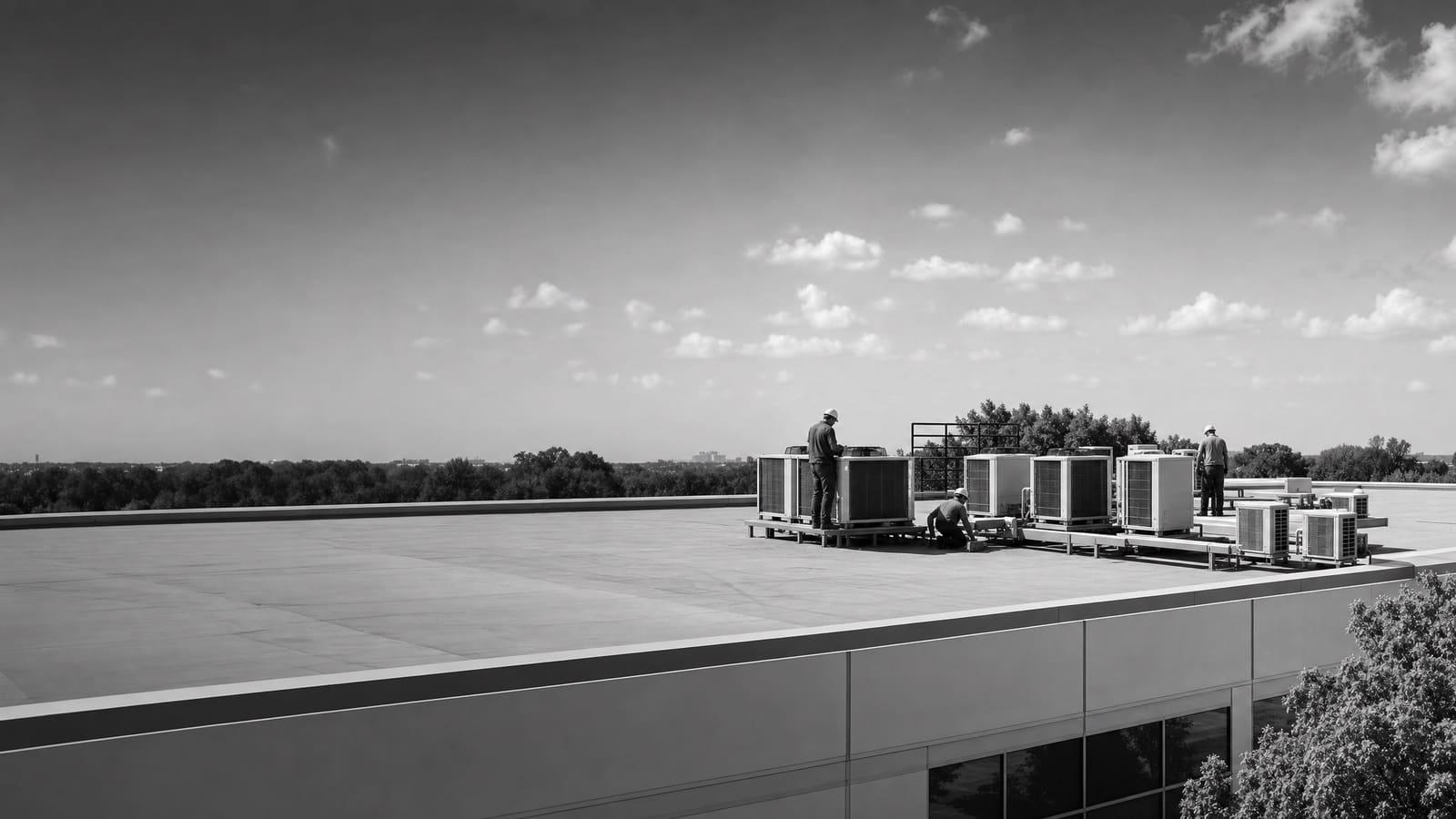
The visible part of a rooftop replacement is one morning. A crane shows up, stalls get coned, the old unit comes off, and the new one lands on an adapter that was measured weeks earlier. Everything that makes that morning uneventful happened before it: the rigging plan, the structural check on the curb, confirmed power and gas, and a weather call the day before.
Which is why the timing of the decision matters more than most owners expect. The common pattern is to wait until a unit can no longer hold the space, needs constant service calls, or fails outright. Replacing ahead of failure is usually the better business decision, because a July failure removes every option except whatever is on a truck this week. Planning it lets you compare efficiency tiers, confirm equipment availability, and schedule the lift around your operating hours instead of around a heat wave.
The last thing you are buying is the installer's familiarity with the equipment. Contractor availability and knowledge are a standard consideration for heat pump rooftop units in particular, and it shows up in the small stuff: refrigerant charge, airflow, staging, and controls setup. A unit that gets installed but never commissioned turns into a comfort complaint in month two.
COMPLEXITY CHECK
Simple swap or a real project?
Before you set a budget, decide which job you actually have. The equipment line looks similar either way. The work around it does not, and that is where the schedule and the price separate.
LOWER COMPLEXITY
Same size, same curb, same fuel
The replacement matches the old unit's footprint and connections, the deck under the curb is sound, and the crane has clear reach from the lot. Permitting is routine, the scope is predictable, and the set is a single scheduled morning.
HIGHER COMPLEXITY
New size, new fuel, or tight access
Tonnage or footprint changes, electric heat needs more capacity than the panel has, the curb needs structural work, or the crane has no straight shot. Expect engineering, a longer approval path, and phasing around occupied hours.
BEFORE YOU BUY
What a site review has to settle
A quote you can trust starts with a site review, and a good one is mostly a list of things that could go wrong later. It begins at the nameplate: make, model, tonnage, fuel, and age. Anything past roughly fifteen years is a replacement candidate on efficiency alone, not just on condition.
Next is the load. Twenty years changes occupancy, plug loads, lighting, and sometimes the envelope, so today's requirement rarely matches the old nameplate. Sizing from the tag is the most common way a brand-new unit inherits an old comfort complaint.
Then the infrastructure, which is where the surprises live. Electrical capacity at the roof decides whether electric heat or a larger unit is even feasible without a panel or service change. Physical constraints matter too: clearance to adjacent units, screen walls, roof access, and the crane's line of sight from the lot. The gas line has to be kept, resized, or properly abandoned. The curb has to be measured, and the deck under it inspected while the old unit is off.
Last, the controls. Whether the unit ties into building automation changes both the price and the commissioning scope.
The five-minute version
Photograph the nameplate, the curb, the electrical disconnect, and the lot from the street. Those four photos let a contractor tell you whether you have a swap or a project before anyone climbs a ladder.
OWNERSHIP MATH
Two things that outlive the invoice
The invoice is a one-time number. What follows you is what the unit burns and what it takes to service. Rooftop equipment conditions nearly half of all U.S. commercial floor area, and old, inefficient units waste an estimated $900 to $3,700 each every year. On a roof with four aging units, that operating gap can be larger than the entire annual maintenance budget, which is part of why utility and federal upgrade programs concentrate on this equipment. Two questions are worth settling before the next service call rather than after it.
REFRIGERANT
Your fleet is about to be mixed
New equipment arrives on current refrigerants while your older units keep what they were built with. Federal Clean Air Act rules govern handling, recovery, and recycling on all of it. Plan service contracts and spare parts for a roof that runs more than one refrigerant at a time.
PORTFOLIO
Replace on a schedule, not on failure
With several units, stagger replacements by age and condition so you are never replacing three at once in the same season. Staging also gives you volume to negotiate, time to chase incentives, and the option to standardize on one platform across the roof.
PHASING AND PROCUREMENT
Sequencing a roof with several units
On a multi-unit roof, the sequencing decision is worth nearly as much as the equipment decision. Rank the units by age, condition, and how much the space they serve costs you when it is uncomfortable. The oldest unit is not automatically first; the one over the area that cannot run warm usually is.
Then buy the schedule, not just the box. Equipment availability varies by model and configuration, and the high-efficiency or heat pump version of a unit is not always in the same warehouse as the base model. Ask for availability in writing next to the price, and treat a quote without it as incomplete.
Incentives follow the same discipline. Utility and federal programs generally want the application before the equipment is purchased, so that paperwork belongs in the procurement timeline rather than the closeout. Confirm what your specific program requires before you sign anything.
Finally, price the whole life of the unit instead of the invoice. The efficiency tier you pick shows up on every bill for as long as the unit sits on that curb. Organizations that upgraded rooftop units through the federal campaign have cut a combined $37 million a year from their energy bills across more than 43,000 units.
COMPARE APPLES TO APPLES
Five things every quote should show
If two bids don't show all five of these, you are comparing assumptions rather than prices. Ask for them in writing before you choose, and ask what happens to each one if the roof deck turns out to be bad.
01
Equipment and efficiency tier
Make, model, tonnage, heating type, and efficiency rating, plus current availability for that exact configuration.
02
Curb, roof, and structural scope
Whether an adapter is included, what happens if the deck underneath is bad, and who pays when it is.
03
Rigging and site plan
Crane size, the lot closure window, and the date the lift is actually scheduled.
04
Permits and inspections
Which permits are pulled, by whom, and whether inspection time is built into the schedule.
05
Commissioning and documentation
Charge and airflow verification, controls setup, startup readings, and the paperwork that keeps the warranty valid.
Keep planning locally
Related mechanical pages in Toledo
Get a defensible number
Price the equipment and the building together.
Send the address, operating target, and target opening date. Flux will identify what must be verified before the project can be priced.
Get a free estimateQuestions
Straight answers.
When is replacement better than one more repair?
Once a unit is past roughly fifteen years, can no longer hold the space, or needs repeat service calls, another repair buys time rather than performance. Old, inefficient rooftop units waste an estimated $900 to $3,700 each per year, and that runs whether or not the unit breaks again. Replacing before failure also keeps the efficiency and scheduling choices in your hands.
Should we switch a gas rooftop unit to a heat pump?
It depends on winter heating load, electrical capacity at the unit, gas line status, equipment availability, and incentives. Heat pump heating efficiency drops as outdoor temperature falls and trends toward parity with electric resistance heat, so buildings with meaningful winter load usually evaluate dual-fuel or cold-climate models rather than a standard all-electric unit.
How fast can a failed rooftop unit be replaced?
The lift itself is a single scheduled morning once the adapter, permits, and rigging plan are staged. The honest variable is equipment availability for your tonnage and configuration, which is why lead time belongs on the quote right next to the price.
Do we have to buy a more efficient unit than the one we're replacing?
New commercial rooftop equipment is built to current federal minimum standards, so a replacement will already outperform a twenty-year-old unit. The real choice is whether to go further: more than twenty models now exceed the federal high-efficiency specification, which targets up to half the energy use of the older standard.
Who handles the crane, permits, and inspections?
The installing contractor should own the rigging plan, lot coordination, permit applications, and inspection scheduling as part of the installed price. Confirm that in writing before you sign, because a quote that leaves those out will look cheaper than one that includes them.
What happens to the refrigerant in the old unit?
It has to be recovered and handled by certified technicians under federal Clean Air Act rules covering refrigerant in stationary air-conditioning and heat pump equipment. Recovery and disposal should appear in the scope up front rather than as a line item discovered after the lift.
Sources used for this guide
- [1]betterbuildingssolutioncenter.energy.gov — DOE Advanced Rooftop Unit Replacement Guidance
- [2]betterbuildingssolutioncenter.energy.gov — DOE Commercial Heat Pump Rooftop Unit Replacement Guidance
- [3]betterbuildingssolutioncenter.energy.gov — DOE High-Efficiency Commercial Rooftop Unit Toolkit
- [4]energy.gov — DOE Efficient Commercial Rooftop Air Conditioner Program
- [5]epa.gov — EPA Stationary HVAC Refrigerant Management