THE SHORT VERSION
What a commercial HVAC replacement actually includes
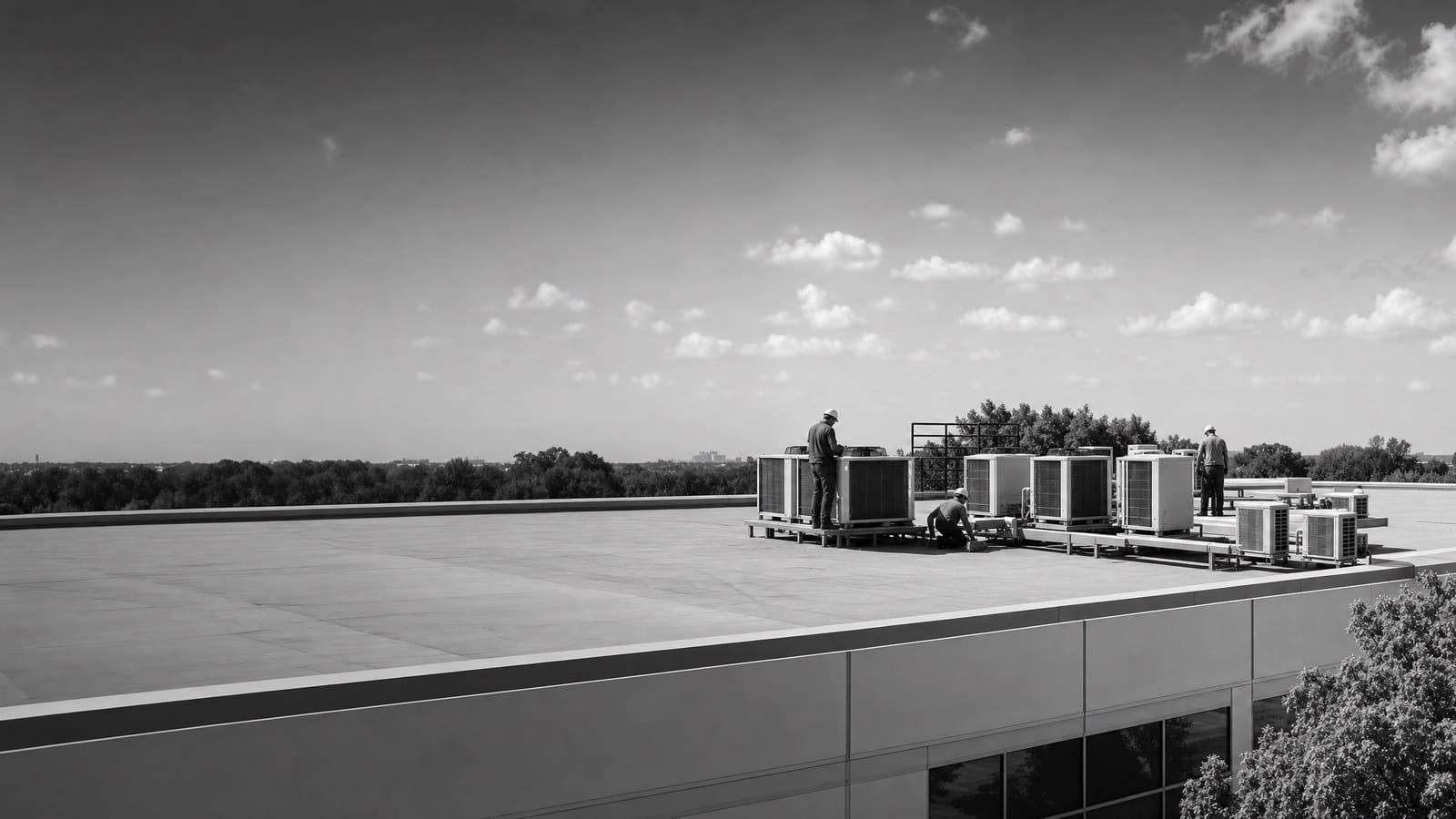
A commercial HVAC replacement covers a confirmed load calculation, equipment selection, removal and disposal of the old unit, curb or duct adaptation, gas, electrical and refrigerant connections, controls integration, permits, and commissioning. Replacement beats another repair once a unit is past fifteen years and repairs have turned routine. Old, inefficient rooftop units can waste $900 to $3,700 each per year, so the utility bill is already funding a replacement you have not made yet.
A site review still has to confirm tonnage against how the space is used now, the condition of the curb and roof structure, available electrical capacity, and whether a crane can reach the unit.
THE THREE PATHS
Three ways to handle an aging rooftop unit
Most buildings choose from three paths. The right one depends on how much runway the unit has left and how much heating the building actually needs.
Replacing on failure is the most expensive version of the same job. It removes the chance to shop equipment, puts whatever is available regionally onto your roof, and sets the crane day on the equipment's schedule instead of yours. Planning the swap while the old unit still runs is what makes the other two options possible.
A like-for-like replacement is the fastest path when the space and its use have not changed. A high-efficiency replacement costs more up front and pays back through the utility bill. Those units are no longer exotic: more than twenty models now exceed the high-performance specification developed with manufacturers, and federal minimum efficiency standards moved the whole market.
The third path is a heat pump rooftop unit, either all-electric or dual fuel. It is technically similar to an air-conditioning unit and adds reverse-cycle heating. Across most of the South and West, heat pump rooftop units can handle most or all of winter heating demand. Where a unit still has real service life left, retrofitting advanced controls instead of replacing is sometimes the better financial call.
WHAT MOVES THE NUMBER
The lines that decide your installed price
Equipment is the anchor, but access and infrastructure decide how far the installed price drifts from the equipment price. These are the lines worth pricing separately so you can compare bids honestly.
IN PRACTICE
Choosing equipment you will live with
The crane day is one morning. The equipment choice is the next fifteen years of utility bills, so it deserves more of your attention than the lift does. Rooftop units condition close to half of all commercial floor space in the country, and the ones still running past fifteen years are usually why a building's energy spend looks the way it does. Inefficient units waste somewhere between $900 and $3,700 each per year. Multiply that across a roof with several units and the payback math answers itself.
Start by deciding whether you are buying cooling or buying a system. A like-for-like unit carries forward every sizing assumption made by whoever specified the original, including the ones that were wrong. A load calculation based on current occupancy, plug loads, lighting, and hours is the cheapest part of the project and the part that determines whether the space is comfortable.
Then decide the heating side. A heat pump rooftop unit does the same cooling work and adds reverse-cycle heating, which matters if you want fewer gas connections on the roof or have emissions targets to meet. The deciding factors are electricity and gas prices, electrical capacity, physical constraints on the roof, equipment availability, and whether your contractor works on heat pumps regularly.
COMPLEXITY
Why two buildings quote differently
Two roofs with the same tonnage can produce very different numbers. The difference is almost never the unit itself. It is what has to change around the unit to make it fit, feed it power, and get it up there.
LOWER COMPLEXITY
Straight swap conditions
Same tonnage, same fuel, and a curb adapter handles the footprint change. The roof already carries the weight, electrical service has headroom, the lot gives a crane clean reach, and the building has a natural off-hours window. Permits stay mechanical and electrical.
HIGHER COMPLEXITY
Conditions that add scope
Tonnage or weight grows enough to trigger structural review. An all-electric conversion needs capacity the service does not have. The unit sits over occupied tenant space, the crane needs a street closure, or the roof carries a mixed fleet on two refrigerants that have to be serviced separately.
BEFORE YOU BUY
What a real site review has to confirm
A quote written from a nameplate photo is a starting point, not a price. Before the number is real, somebody has to be on the roof.
The review should confirm the load from how the space is used today: occupancy, plug loads, lighting, hours, and any tenant changes since the last install. It should confirm the curb, including dimensions, condition, and whether the structure carries the new unit's weight without reinforcement. It should confirm the electrical side, because a heat pump or all-electric unit can ask for capacity the building does not currently have, and learning that after the equipment ships is the expensive version of that conversation.
It should confirm access. Where the crane sets up, how far it reaches, which stalls close, and what sits overhead all decide how disruptive the day is. And it should confirm what is already on the roof, because a mixed fleet running different refrigerants needs a service plan, and the old unit's charge has to be recovered by a certified technician under federal rules before anything comes off the curb.
Everything above either shows up in the site review or shows up later as a change order.
Ask for the scope in writing
The review should produce a written scope, not just a price: tonnage and efficiency tier, curb and structural work, electrical scope, refrigerant recovery, controls integration, permits, and commissioning. If any of those are missing from the document, they are not missing from the project. They are just not priced yet.
OWNERSHIP
Two questions that change the answer
Two things about how you hold the building move the replacement math more than the equipment brand does.
The first is who pays which bill. If you own and occupy, first cost and operating cost land in the same budget, and a higher-efficiency unit is a straightforward trade. If the space is leased, the party buying the unit may not be the party paying to run it, which is how buildings end up carrying the cheapest available equipment for decades.
The second is whether this is one unit or the first of several. A roof with multiple aging units is a portfolio decision, not a repair. Standardizing on one equipment class and one control platform makes every later swap faster, keeps spare parts manageable, and gives you real leverage on price when you buy more than one at a time.
WHO PAYS TO RUN IT
Owned versus leased space
Split incentives are real. When the landlord buys the unit and the tenant pays the power bill, an efficiency upgrade needs a lease or recovery structure that returns some of the savings to whoever funded the equipment.
ONE OR MANY
Single unit versus roof fleet
If three or four units share an age, plan them as a program. Grouped purchasing, one control platform, and staged crane days almost always beat four separate emergencies spread across four summers.
PLANNING AHEAD
Phasing, procurement, and lifetime cost
Planned replacement and emergency replacement are the same scope of work at different prices. The planned version lets you compare equipment, hold a competitive bid, use a shoulder-season crane day, and pick a window when the building is empty. The emergency version gives you whatever a distributor has on the shelf that week.
That is the argument for phasing. Walk the roof, note the age and condition of every unit, and move the ones past fifteen years from the repair budget onto a replacement calendar. Replacing two units on your terms this year and two next year is nearly always cheaper than replacing four the week they fail.
Procurement follows the calendar. Equipment availability is the variable that ruins schedules, so an honest quote pairs the price with real lead time for the specific tonnage and efficiency tier being sold, in writing.
The last piece is lifetime cost. First cost is what you compare on a spreadsheet. Energy is what you actually pay. Because older units waste hundreds to thousands of dollars each per year, efficiency upgrades pay back through the utility bill rather than on the invoice. Across a national upgrade campaign, more than two hundred organizations replaced or retrofitted over forty thousand rooftop units and cut a combined $37 million a year from their energy bills.
THE QUOTE
Five things a comparable quote should show
A quote you can compare against another quote shows the same things in the same units. When two bids differ by a wide margin, it is usually because one of these lines is missing from the cheaper one.
01
The equipment, named
Manufacturer, model, tonnage, efficiency tier, refrigerant, and heating type. Not "new rooftop unit."
02
The load basis
Whether the tonnage came from a current load calculation or was copied from the old unit's nameplate.
03
Curb, structure, and access
Curb adapter, any roof reinforcement, crane setup location, and how many parking stalls close and for how long.
04
Infrastructure changes
Electrical, gas, refrigerant line, and duct work needed to land the new unit, priced as separate line items.
05
Permits, commissioning, warranty
Who pulls permits, who meets the inspector, what startup verification gets documented, and what the warranty actually covers.
Keep planning locally
Related mechanical pages in Tempe
Get a defensible number
Price the equipment and the building together.
Send the address, operating target, and target opening date. Flux will identify what must be verified before the project can be priced.
Get a free estimateQuestions
Straight answers.
When does replacement beat another repair?
Once the unit is past fifteen years, repairs have become routine rather than rare, and comfort complaints return after every service call. Older rooftop units can waste $900 to $3,700 each per year, so at that point the utility bill is quietly funding a replacement you have not made yet.
Should the new unit match the old one's tonnage?
Only if the space and its use have not changed. Occupancy, plug loads, lighting, and hours all shift over the life of a unit. A current load calculation is the cheapest line on the project and the one that decides whether the building is comfortable afterward.
Is a heat pump rooftop unit worth considering?
Often, yes. It cools like a standard rooftop unit and adds reverse-cycle heating, and across most of the South and West these units can carry most or all of winter heating demand. The deciding factors are electrical capacity, energy prices, roof constraints, and equipment availability.
Can controls fix an old unit instead of replacing it?
Sometimes. If a unit has real service life left, retrofitting advanced controls can capture savings without a crane day. The choice is between replacing an aging unit with a more efficient one and retrofitting controls, based on which makes better financial sense for that specific unit.
What happens to the refrigerant in the old unit?
It has to be recovered by a certified technician under federal rules before the unit leaves the roof. That work is not optional and it belongs on the quote. If your roof runs a mix of older and newer equipment, plan service and spare parts for both refrigerants.
What drives the biggest cost difference between bids?
Usually access and infrastructure, not the equipment. Crane reach and lot closure, curb adaptation, structural review, and electrical capacity are where quotes separate. A noticeably cheaper bid has often moved those items out of the price and into a future change order.
Sources used for this guide
- [1]betterbuildingssolutioncenter.energy.gov — DOE Advanced Rooftop Unit Replacement Guidance
- [2]betterbuildingssolutioncenter.energy.gov — DOE Commercial Heat Pump Rooftop Unit Replacement Guidance
- [3]betterbuildingssolutioncenter.energy.gov — DOE High-Efficiency Commercial Rooftop Unit Toolkit
- [4]energy.gov — DOE Efficient Commercial Rooftop Air Conditioner Program
- [5]epa.gov — EPA Stationary HVAC Refrigerant Management