THE SHORT VERSION
What a commercial HVAC replacement actually includes
A commercial HVAC replacement covers confirming the load, selecting equipment that is actually available, recovering the old refrigerant charge under EPA rules, removing and setting the unit, tying in power and controls, and commissioning the result. Replacement beats another repair once a rooftop unit is past about fifteen years. DOE puts the annual energy waste on an old, inefficient unit between $900 and $3,700 — money that leaves the building whether or not anything is broken that week.
A site visit still has to confirm curb fit, roof structure, crane reach, and spare electrical capacity at the panel. Those four items decide whether a swap stays simple or turns into a small construction project.
THE THREE CHOICES
Three ways to handle an aging rooftop unit
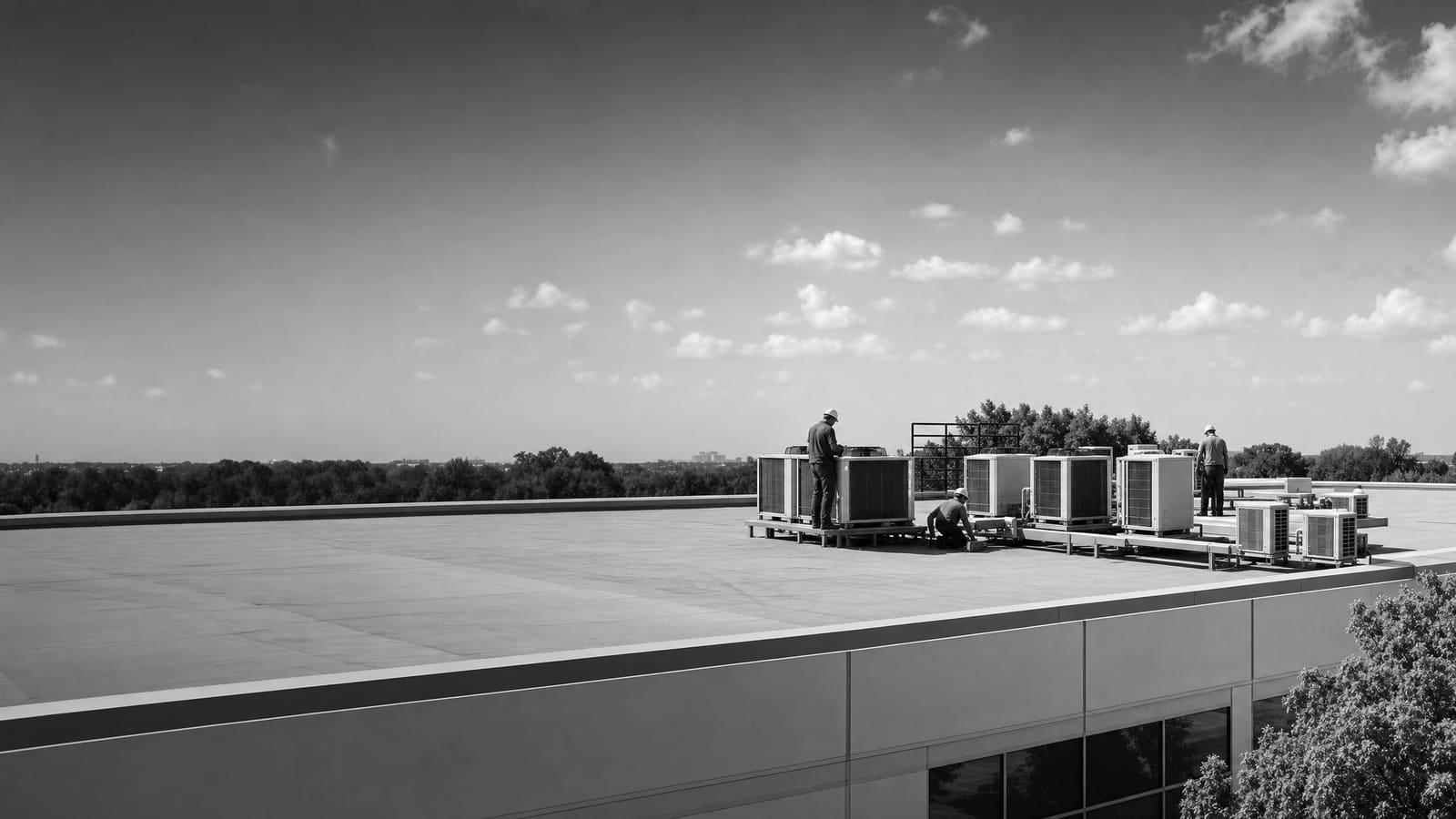
Most commercial buildings here run packaged rooftop units, which DOE says cool close to half of all commercial floor area in the country. When one nears the end, there are really three moves, and they are not equally fast or equally expensive.
The cheapest line on the quote is not always the cheapest choice. DOE's own program work found that owners either replace an old unit with a more efficient one or retrofit the existing unit with advanced controls, and which one wins depends on how the building actually runs. A controls retrofit can buy time on a unit that still has life left. It does nothing for a compressor that has none.
The third move is a heat pump rooftop unit in place of a gas-heat unit. DOE's guidance is direct about geography: across most of the U.S. South, today's heat pump rooftop units are capable of covering most or all of the winter heating demand. Tampa sits inside that group, which makes the all-electric option a genuine candidate rather than a stretch.
WHAT MOVES THE NUMBER
Where the money actually goes
Nobody can price a commercial rooftop replacement from a tonnage number alone. These are the lines that separate two bids on the same building, and the tag shows how much each one can swing once someone is standing on the roof.
IN PRACTICE
Choosing between one more repair and a new unit
The honest test is not whether the unit can be fixed. Almost anything can be fixed. The test is what the next three years look like if it is. DOE's guidance notes that rooftop units over fifteen years old can waste substantial energy compared with newer models, and puts the annual waste on an old, inefficient unit between $900 and $3,700. That number never appears on a repair invoice, which is why it is easy to ignore while paying for another contactor and another leak search.
The pattern DOE describes is common enough to have a name. Facility managers delay the purchase until the unit stops conditioning the space, needs constant attention, or fails outright. Replacing on failure is the most expensive version of the same project. It removes your ability to shop equipment, forces whatever is on the shelf, and puts the crane day in the worst week of the year instead of a quiet Sunday.
Planning it changes three things at once. You choose the efficiency tier instead of accepting one. You choose the outage. And you get to compare a like-for-like unit against a better one on installed price and operating cost together, which is the only comparison that means much over a fifteen-year hold.
SCOPE CHECK
What makes one swap simple and another complicated
Two buildings on the same street can get very different numbers for the same tonnage. The difference is almost always access, structure, and whatever the new unit needs that the old one did not.
LOWER COMPLEXITY
Straight swap conditions
Same fuel, same tonnage, same footprint on an existing curb. An open lot with room for the crane, a roof that already carried the load, and no change in how the space is used. The permit package stays mechanical and electrical, with no structural review attached.
HIGHER COMPLEXITY
Conditions that add scope
A fuel switch to an all-electric heat pump, a larger or heavier unit, tight access, or a building whose occupancy changed since the last install. DOE flags electrical capacity, physical constraints, and gas lines as the three infrastructure items that most often reshape a rooftop project.
BEFORE THE QUOTE
What a real site review covers
A quote written from a nameplate photo is a starting number, not a price. It is genuinely useful for triage when a unit is down and you need options the same day. It is not the number you should sign.
The site review closes the gaps a photo cannot. Someone gets on the roof, measures the existing curb, checks how the unit is supported, and looks at whether the framing carries what you are about to put on it. They confirm the electrical service and the spare capacity at the panel, since DOE treats electrical capacity as one of the deciding factors in whether a heat pump unit is even a candidate for a site. They walk the crane path and count the stalls that close. They look at the ductwork and the economizer, because a replacement can trigger code items the old unit never had to meet.
They also confirm the load. Two decades change occupancy, plug loads, lighting heat, and sometimes the envelope itself. The nameplate tells you what someone sized years ago for a building that no longer operates that way. Rebuilding the load calculation is the difference between fixing the comfort complaints and inheriting them for another fifteen years.
Ask for these before you sign
Curb dimensions and adapter plan, roof framing check, confirmed electrical capacity, crane staging and closure hours, the load calculation the tonnage came from, and any code items the replacement triggers. A bid missing four of the six is not cheaper than one that has them.
TAMPA SPECIFICS
What the Tampa permit package expects
Tampa's commercial alteration permit guide is specific about mechanical work, and it affects your schedule more than your price. Mechanical plans are required whenever the scope includes installing or relocating equipment such as HVAC. Those plans must be signed and sealed by a Florida licensed architect or engineer. Energy calculations are required if the scope includes heating, ventilation, or air conditioning. The submittal also has to show the location of the equipment, and floor or roof framing plans come into play when the work touches roof framing.
Read that as a sequencing instruction. A sealed drawing and an energy calculation are not same-week items. If a unit fails in August and you want it back fast, the design and permit work sits on the critical path right next to equipment delivery. Owners who plan the replacement instead of reacting to one get that paperwork finished while the old unit is still running.
Put the sealed plans on the schedule first
Ask every bidder who is producing the sealed mechanical plans and energy calculations, and when those get submitted. If the answer is vague, the permit will set your install date rather than the equipment lead time.
OWNERSHIP VIEW
Two things that outlast the install
The install is a morning. What you own afterward is a fifteen-year operating decision and a service relationship, and two considerations there matter more than anything else on the quote.
The first is standardization. If you run several units on one roof, or several buildings under one budget, matching equipment lines makes parts, controls, and technician familiarity cheaper every year. The second is refrigerant. New commercial equipment ships on newer refrigerants, and EPA Section 608 governs how refrigerant is handled, recovered, and recycled in stationary air conditioning and heat pump equipment. On a roof replaced one unit at a time, that means your service provider is stocking and tracking more than one thing.
PORTFOLIO
Standardize where you can
Matching manufacturers and control platforms across a roof reduces spare-parts spread and shortens diagnosis time. DOE's guidance treats contractor availability and familiarity with the equipment as a real selection factor, not a preference.
SERVICE PLANNING
Plan for a mixed refrigerant fleet
Replacing units one at a time means running two refrigerants on one roof for years. EPA Section 608 handling and recovery rules apply to all of it. Tell your service provider before the first swap, not after the third.
PHASING AND PROCUREMENT
Replacing several units without doing it all at once
Most owners do not replace a whole roof of units in one year, and they should not have to. The workable approach is to rank the units by age and condition, replace the worst one first, and treat it as the template. You learn the curb situation, the crane path, the permit timeline, and the real installed cost on unit one. Units two and three then get quoted against something you have already lived through.
DOE's Advanced RTU Campaign shows what this looks like at scale. More than two hundred organizations upgraded over forty-three thousand rooftop units, and the group reported a combined thirty-seven million dollars in annual energy savings. The lesson for a single building is the same one: the savings are per unit and they repeat every year, so the order you replace in is a financial decision, not just a maintenance one.
Procurement follows from that. Get equipment availability in writing next to the price, because a cheaper unit that lands weeks later carries a different total cost than the quote suggests during a Tampa summer. And if a heat pump conversion is on the table for any unit, run the electrical capacity check once for the entire roof instead of one unit at a time.
QUOTE CHECKLIST
Five things a comparable quote shows
Two bids are only comparable when both answer the same questions. A single line with a tonnage and a price is not cheaper than the detailed one. It is just less finished. Ask for these five before you compare anything.
01
Make, model, and efficiency tier
Not just tonnage. The efficiency level is the line that decides what the unit costs to run for the next fifteen years.
02
Committed availability date
The delivery window in writing, and what happens if it slips. DOE treats equipment availability as a planning input for exactly this reason.
03
Curb, structural, and rigging scope
Who supplies the curb adapter, what framing work is included, whose crane it is, and how long the lot is closed.
04
Permit and engineering responsibility
Who produces the sealed mechanical plans and energy calculations Tampa requires, who files them, and who carries the inspections.
05
Startup and commissioning records
Charge, airflow, and control settings verified against spec and handed over in writing, so the warranty holds up later.
Keep planning locally
Related mechanical pages in Tampa
Get a defensible number
Price the equipment and the building together.
Send the address, operating target, and target opening date. Flux will identify what must be verified before the project can be priced.
Get a free estimateQuestions
Straight answers.
When does replacement beat one more repair?
Once the unit is past about fifteen years, the math usually flips. DOE finds older rooftop units waste substantial energy against newer models, somewhere between $900 and $3,700 per unit each year. That cost repeats whether or not anything is currently broken.
Does a Tampa commercial HVAC replacement need sealed plans?
Yes. Tampa's commercial alteration guide requires mechanical plans when the scope includes installing or relocating HVAC equipment, signed and sealed by a Florida licensed architect or engineer, plus energy calculations and the equipment location.
Is a heat pump rooftop unit realistic here?
DOE's guidance says today's heat pump rooftop units can address most or all winter heating demand across most of the U.S. South. The gating question is electrical capacity at the panel, which the site review confirms before the option goes on a quote.
How much does commercial HVAC installation cost?
There is no universal installed price, and any number quoted before someone sees the roof is a guess. Equipment tier and availability, curb and structural work, crane access, electrical capacity, and the permit documents are what separate two bids.
What happens to the refrigerant in the old unit?
It gets recovered by a certified technician. EPA Section 608 rules govern the handling, recovery, and recycling of refrigerant in stationary air conditioning and heat pump equipment, and that work belongs in the installed price.
Can controls fix an old unit instead of replacing it?
Sometimes. DOE's program work found owners either replace old units with more efficient ones or retrofit them with advanced controls, depending on which makes better financial sense. A retrofit buys time on a unit with life left, not one that is failing.
Sources used for this guide
- [1]betterbuildingssolutioncenter.energy.gov — DOE Advanced Rooftop Unit Replacement Guidance
- [2]betterbuildingssolutioncenter.energy.gov — DOE Commercial Heat Pump Rooftop Unit Replacement Guidance
- [3]betterbuildingssolutioncenter.energy.gov — DOE High-Efficiency Commercial Rooftop Unit Toolkit
- [4]energy.gov — DOE Efficient Commercial Rooftop Air Conditioner Program
- [5]epa.gov — EPA Stationary HVAC Refrigerant Management
- [6]tampa.gov — Permit Application Guide Commercial Alteration