THE SHORT VERSION
What a commercial HVAC replacement includes
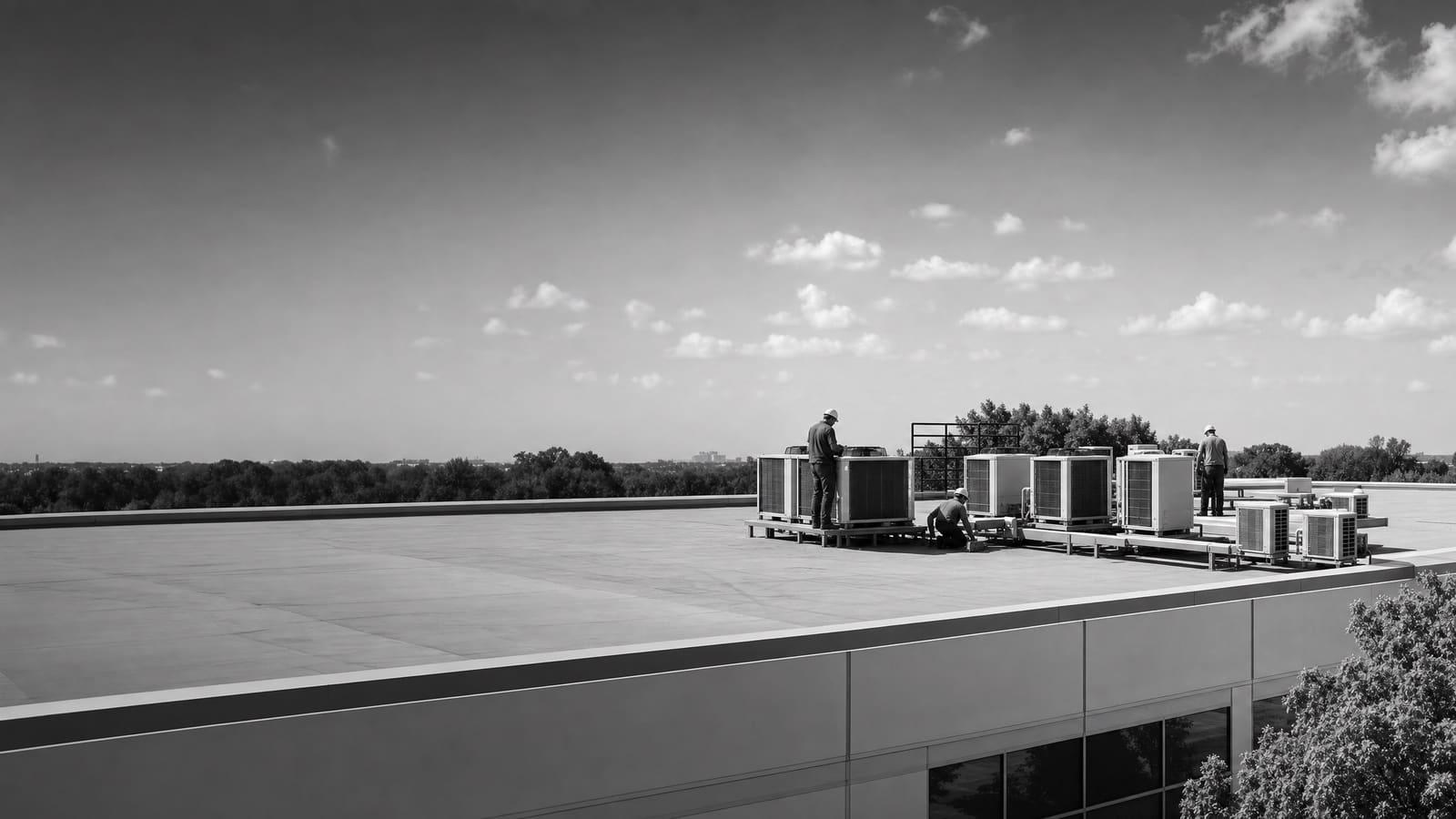
A commercial HVAC replacement includes a load check against how the building runs today, equipment selected with confirmed availability, curb and roof work, electrical or gas changes, controls, permits, and a documented startup. Replacement beats one more repair once a unit is past fifteen years, needs frequent service, or can no longer hold the space. An old, inefficient rooftop unit wastes roughly $900 to $3,700 in energy a year — money a repair invoice never shows.
A site review still has to confirm tonnage against current occupancy, the curb and roof structure, electrical capacity at the panel, crane access, and any code items the old unit never carried.
THREE PATHS
How buildings usually end up replacing a unit
Most commercial buildings land on one of three paths, and the one you pick sets both the price and the disruption. Waiting for failure is the most expensive version of every other option: emergency freight, whatever unit is in stock, and a complaint log. Planned like-for-like keeps the same curb and connections, so it is quick and cheap to engineer, but it carries forward any sizing mistake the old unit already had. A planned efficiency upgrade adds a load calculation and an equipment comparison up front, and that is where the operating savings live — high-performance rooftop specifications were written to cut unit energy use by up to half against the older standard.
WHAT MOVES THE NUMBER
The lines that decide the price
No two roofs price the same, but the swing almost always comes from the same short list. Ask which of these your quote actually carries and which are written as allowances, because allowances are where a clean number turns into a change order.
CHOOSING EQUIPMENT
How to pick the unit that goes back up
Start with the load, not the nameplate. A unit sized twenty years ago was matched to the occupancy, lighting, and equipment of that era, and it may be oversized, undersized, or simply pointed at the wrong zones now. A short load calculation is cheap compared with living inside the answer for the life of the next unit.
The second decision is how the unit heats. A heat pump rooftop is the same machine as a standard rooftop with reverse-cycle heating added, and its heating efficiency drops as outdoor temperatures fall. That matters far less here than in a cold climate: across most of the South and West, winter heating demand sits in the range where a rooftop heat pump can carry most or all of it. Electricity price and available electrical capacity decide whether the switch actually pays at your address.
The third decision is whether the unit has to come off the roof at all. When the cabinet, coil, and compressor are still sound, adding advanced controls can capture part of the savings for a fraction of the cost. Replacement wins once the unit is old, unreliable, or meaningfully wrong in size, which is where most units sit past fifteen years.
SIDE BY SIDE
Simple swaps and complicated ones
The same tonnage can be a half-day job on one roof and a three-week project on another. What separates them is almost never the equipment.
LOWER COMPLEXITY
Straight replacement
Same tonnage, same curb, same fuel, clear crane access from the lot, and a space you can close for half a day. Permit scope stays narrow and the schedule is driven mostly by equipment lead time.
HIGHER COMPLEXITY
Changed scope
Larger tonnage, a new curb footprint, a switch from gas to electric heating, a panel with no room left, or a roof reachable only over occupied space. These add structural review, longer plan review, and phased or after-hours work.
BEFORE THE QUOTE
What the site review has to confirm
A quote written from a photo is a guess. The site review is where the price stops moving.
On the roof, the crew should confirm tonnage against how the space is used now, check the existing curb against the new unit's footprint, and note the condition of the roof around it. Weight and footprint changes are what pull structural review into an otherwise simple job.
Below the roof, the two items that most often break a schedule are electrical capacity and gas. If the new unit is larger, or if it heats electrically, the panel and feeder have to actually support it. If gas is being abandoned, someone has to cap and document it. Both are cheap to verify in advance and expensive to discover on install day.
Then there is access. Where the crane sets up, how far it has to reach, how many stalls close, and for how long. On a tight lot or a shared center, that conversation involves the property manager and sometimes the neighboring tenants, and it goes better weeks early than on the morning of.
Ask for three verifications in writing
Before you sign, have the contractor confirm that the load was calculated, the electrical service was checked at the panel, and the curb and crane plan were verified on site. Those three cover most change orders.
SCOTTSDALE SPECIFICS
Permits and inspections here
Scottsdale reviews plans, issues permits, and schedules inspections through its planning and development department, with an online permit portal and a one-stop counter for intake. A like-for-like mechanical replacement is usually a narrow permit. Scope that grows — added tonnage, a new curb footprint, new electrical service — is what pulls in plan review and stretches the calendar.
The city also publishes its own building and fire codes and runs its own inspections, so a rooftop change that affects access or fire protection is not something to sort out after the crane leaves. Make permit ownership explicit before work starts. A unit that is set but not inspected is not a finished job.
Put the permit in the scope
Ask which permits the quote includes, who submits them, and who calls for inspection. If the answer is that you pull the permit as the owner, the schedule and the liability just moved onto your desk.
BY BUILDING TYPE
What changes by the kind of building you run
The building type changes the plan more than the equipment does. Operating hours, roof access, and who is sitting under the unit decide when the crane comes and how the work is staged.
OWNERSHIP
Two questions that change the answer
Equipment life runs longer than most commercial leases, so the party paying for the unit is often not the party who benefits from the efficiency it buys. That is worth reading in the lease before you compare quotes. And a single replacement on a roof carrying six aging units is really the first move in a multi-year plan, whether or not anyone has written that plan down. Knowing which of those two situations you are in changes the equipment you should buy today.
WHO PAYS
Owned or leased
In a leased building, check who funds capital equipment and how the cost passes through. A landlord funding the swap and a tenant paying the power bill will not weigh the efficiency tier the same way.
HOW MANY
One unit or a fleet
If several units are the same age, replace on a schedule instead of one failure at a time. That buys volume pricing, one refrigerant standard across the roof, and a parts strategy a mixed fleet never gets.
PLANNING AHEAD
Phasing, procurement, and lifetime cost
The industry-wide pattern is that owners wait. Units get replaced when they stop holding the space, need constant service, or fail outright, which is exactly when you have the least leverage over price, equipment choice, and schedule. Replacing proactively, on a date you choose, is usually the better business decision than replacing on failure or defaulting to a like-for-like unit at the end of its service life.
Phasing is what makes that affordable. Walk the roof, write down the age and condition of every unit, and rank them. Replace the worst one or two this year, budget the next group, and hold the rest on maintenance. Buying two or three units at once also gives your contractor something to negotiate with.
On procurement, availability belongs on the quote next to the price. An efficient unit that arrives in three weeks and a cheaper unit that arrives in ten are not the same offer, especially mid-season. Ask for a second equipment option in writing so you can trade a small price difference for a much shorter wait when the schedule is the part that actually hurts.
COMPARE APPLES TO APPLES
Five things a comparable quote shows
A comparable quote lets you set two bids side by side and see the same information in both. If a line is missing, that is not a cheaper bid. It is a smaller scope, and the difference shows up later as a change order.
01
The equipment, spelled out
Make, model, tonnage, efficiency tier, heating type, and refrigerant, plus the quoted lead time for that exact unit.
02
Curb, structure, and roofing
Whether a curb adapter is included, who patches the roof, and whether structural review is expected.
03
Rigging and access plan
Crane size, staging location, how many stalls or lanes close, and for how long.
04
Utilities and controls
Electrical work at the panel and the unit, any gas changes, and integration with your existing building controls.
05
Permits, startup, and warranty
Which permits are included, who schedules inspections, what commissioning is documented, and the labor and equipment warranty terms.
Keep planning locally
Related mechanical pages in Scottsdale
Get a defensible number
Price the equipment and the building together.
Send the address, operating target, and target opening date. Flux will identify what must be verified before the project can be priced.
Get a free estimateQuestions
Straight answers.
When is replacement a better call than another repair?
Once a unit is past about fifteen years, needs frequent service, or can no longer hold the space, repairs are buying time on an asset that is also wasting roughly $900 to $3,700 a year in energy. That is usually the point where replacement wins on the numbers, not just on frustration.
Should a rooftop unit be replaced like-for-like?
Only if the space and how it is used have not changed. Like-for-like is fast and cheap to engineer, but it carries forward whatever sizing error the old unit had. A short load calculation tells you which case you are in before you order equipment.
Does a heat pump rooftop unit make sense in this climate?
Often, yes. Rooftop heat pumps lose heating efficiency as outdoor temperatures drop, and across most of the South and West winter heating demand stays inside what they handle well. The deciding factors are electricity price and whether the building's electrical capacity supports the change.
What does a commercial HVAC installation cost?
There is no honest universal number. Price is set by tonnage and efficiency tier, curb and structural work, crane access, electrical or gas changes, controls, and any code items the replacement triggers. A quote that names all of those is one you can actually compare.
Do I need a permit to replace a rooftop unit in Scottsdale?
Plan on it. The city handles permits, plan review, and inspections through its planning and development department. Have the installing contractor submit the permit and schedule inspections as part of the installed price, and get that written into the scope.
Sources used for this guide
- [1]betterbuildingssolutioncenter.energy.gov — DOE Advanced Rooftop Unit Replacement Guidance
- [2]betterbuildingssolutioncenter.energy.gov — DOE Commercial Heat Pump Rooftop Unit Replacement Guidance
- [3]betterbuildingssolutioncenter.energy.gov — DOE High-Efficiency Commercial Rooftop Unit Toolkit
- [4]energy.gov — DOE Efficient Commercial Rooftop Air Conditioner Program
- [5]scottsdaleaz.gov — Permit Services | City of Scottsdale
- [6]choosescottsdale.com — Primary Industries