THE SHORT ANSWER
What does commercial HVAC replacement and installation include?
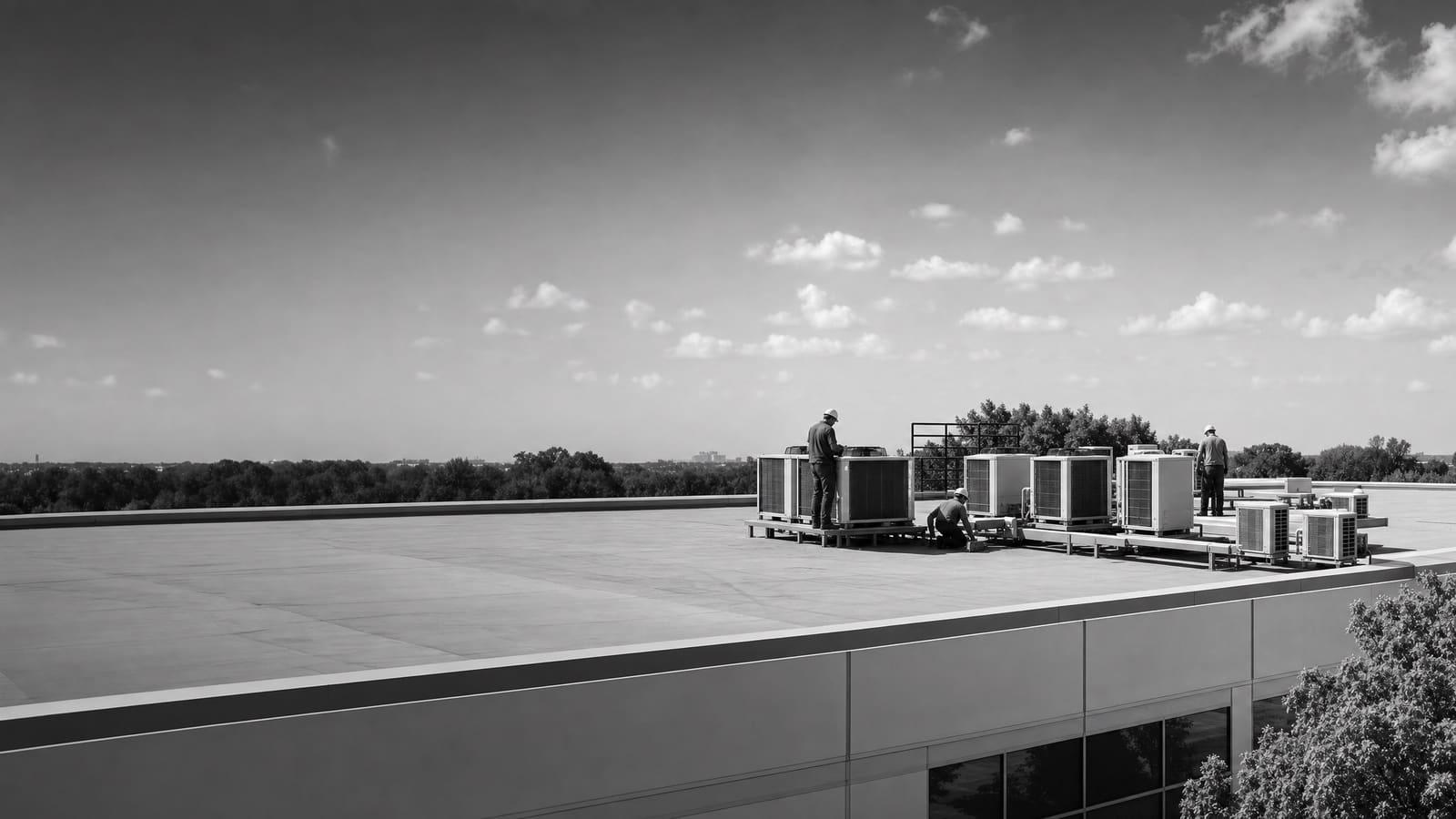
Commercial HVAC replacement and installation in Richmond covers the whole swap, not just the box. A contractor confirms the load, picks equipment against real lead times, sets the unit, ties in power and fuel, then commissions it to spec. Replacement usually beats another repair once a rooftop unit passes about 15 years. Old units waste energy every hour they run, and Department of Energy estimates put that waste at $900 to $3,700 per unit each year.
A site review still has to confirm the real load, the roof structure under the curb, the electrical capacity at the unit, and the crane path. Those four answers move the price more than the equipment tier does.
THREE WAYS OWNERS DO THIS
Should you replace a rooftop unit on failure or plan it?
Most commercial HVAC work falls into three patterns, and the pattern you pick sets the price before anyone quotes equipment.
Waiting for failure feels cheapest because nothing is spent until something breaks. It rarely is. A dead unit in July means whatever is on the truck, overtime rigging, and a tenant with no cooling.
Planned replacement changes the math. You choose the equipment, you choose the week, and you get competing prices instead of one emergency number. Federal guidance makes the same point for rooftop units. Replacing an aging unit on purpose usually beats replacing it after it dies, and it often beats a plain like-for-like swap at the end of its service life.
The third pattern is the upgrade. You replace on your own schedule and step up to a higher-efficiency unit or a heat pump, so the new unit lowers the bill instead of just restoring cooling.
WHAT MOVES THE NUMBER
What drives the cost of a commercial HVAC installation?
No two roofs price the same, so treat these as the lines that swing your number. Equipment is the part most buyers watch. The rest of this list is where quotes actually separate, and where a low bid usually hid something.
THE EQUIPMENT DECISION
How do you choose between a gas rooftop unit and a heat pump?
The biggest equipment question on a replacement today is fuel. The old unit probably burned gas for heat and used electricity for cooling. A heat pump rooftop unit does both jobs with electricity, running the refrigeration cycle backwards to make heat.
Heat pump rooftop units work best where winters are mild to moderate. As it gets colder outside, a heat pump loses efficiency and drifts toward the same efficiency as plain electric resistance heat. That is why most all-electric and cold-climate models carry electric resistance backup. It is also why the honest answer depends on your real heating hours and your own gas and electric rates, not on a brochure.
There is a middle option. A dual-fuel unit runs the heat pump for most of the season and switches to gas heat once it gets cold enough that gas wins. Owners who want lower emissions without betting the building on one fuel often land here.
Federal guidance frames the choice around a short list: climate, utility bill impact, emissions goals, building type, equipment availability, the electrical capacity and gas lines already at the site, contractor familiarity, and incentives. Work through that list before picking a unit. Any single item on it can flip the answer.
TWO KINDS OF JOB
What makes one rooftop replacement simple and another complicated?
Two buildings can run the same tonnage and get very different quotes. The gap is almost never the equipment. It is what has to change around the equipment before the new unit can run.
LOWER COMPLEXITY
Same size, same spot, same fuel
The space is used the way it always was. The new unit matches the old footprint and connections, the curb is sound, and the lot gives the crane a clear reach. Permitting is usually straightforward and the swap is short.
HIGHER COMPLEXITY
New size, new fuel, or hard access
Occupancy or equipment changed, so the load has to be recalculated. Going all-electric can mean added electrical capacity. A larger unit can mean a curb adapter and a structural review. Tight access can turn one crane morning into a staged plan.
BEFORE ANYONE QUOTES
What should a site review check before a commercial HVAC quote?
A quote written from a nameplate photo is a guess. It is a useful guess for a rough range, and it is fine for a first call. It is not a number to sign.
Sizing comes first. The nameplate tells you what someone installed years ago, not what the building needs now. Occupancy changes, plug loads change, lighting changes, and envelope work changes the load. Replacing a wrong size with the same wrong size locks in a comfort problem for the whole life of the new unit.
Then the review looks at what the new unit needs that the old one did not. Electrical capacity at the unit and back at the panel. Whether the gas line stays, changes, or goes away. Whether the curb matches or needs an adapter, and whether the roof under it carries the new weight. Whether the crane can reach the spot without closing half the lot during business hours.
Equipment availability belongs in the same conversation. Lead times set your schedule more often than labor does, and a unit you cannot get is not an option no matter how good the spec sheet reads.
Ask for the load calculation, not the nameplate
Anyone can copy the tonnage off the old unit. Ask for the load calculation behind the size being proposed, and ask what changed in the building since the last unit went in. If nobody can answer that, the quote is pricing a guess.
OWNERSHIP AND OPERATIONS
Who pays for a rooftop unit replacement in a leased building?
Two questions decide more than the equipment spec does: who pays, and who has to keep working while the unit is replaced.
In a leased building, the lease usually says who owns HVAC replacement. Some leases push it to the tenant, some keep it with the landlord, and many split routine repair from capital replacement at a dollar threshold. Read that language before you bid the job. It changes who signs and what a reasonable scope even looks like.
Operations set the schedule. A unit over a warehouse aisle is a different job from a unit over a working kitchen or a server room. Crane time, roof access, and the hours the power can be down all have to fit around the business underneath.
OWNER OR TENANT
Read the lease before the bid
Leases often split routine repair from capital replacement at a set dollar amount. That one line decides who pays and who approves. Sort it out before quotes come in, not after.
PORTFOLIO
Standardize when you own several units
If you run several rooftop units, one equipment platform and one control approach make parts, service, and training simpler. It also gives you a repeatable spec to bid instead of starting over each time.
PLANNING THE SPEND
Is it cheaper to replace rooftop units one at a time or together?
If you have more than one aging unit, sequencing is a real question. Doing them together means one mobilization, one crane day, one permit cycle, and one round of pricing. Doing them one at a time spreads the cash out but repeats the setup cost every year.
The tiebreaker is usually condition, not budget. Replace the units that are actually costing you first. A unit past fifteen years that runs hard is spending money every day it stays on the roof. A newer unit beside it can wait, and waiting is fine as long as it is a decision and not a surprise.
Lifetime cost keeps this honest. Purchase price is one year. Energy, service, and downtime are every year after. High-efficiency rooftop units were designed to cut energy use by up to half against the older baseline. Through a national upgrade campaign, more than 200 organizations replaced or retrofitted over 43,000 rooftop units and cut a combined $37 million a year from their energy bills. Incentives can move payback further, so check what is open before you buy.
Ask for two numbers on any option you are serious about. What it costs to install, and what it is expected to cost to run.
QUOTE CHECKLIST
What should a commercial HVAC installation quote show?
Two quotes are only comparable when they show the same things. Ask every bidder to break out these five items. A quote that leaves them out is not cheaper. It is just less finished.
01
Equipment, size, and efficiency tier
Model number, tonnage, heating type, and the efficiency rating. Without these you are comparing prices on two different machines.
02
The load calculation behind the size
What the building needs today, not what the old nameplate says. Ask to see the calculation.
03
Curb, structure, and rigging
Curb adapter, any roof work, crane size, staging area, and how long the lot is closed.
04
Electrical, gas, and refrigerant work
New feeders or panel work, gas line changes, and recovery of the old refrigerant under federal rules.
05
Startup, commissioning, and lead time
Charge, airflow, and control settings verified and documented, plus the real delivery date for the unit.
Keep planning locally
Related mechanical pages in Richmond
Get a defensible number
Price the equipment and the building together.
Send the address, operating target, and target opening date. Flux will identify what must be verified before the project can be priced.
Get a free estimateQuestions
Straight answers.
When should you replace a commercial rooftop unit instead of repairing it?
Once a rooftop unit passes about fifteen years, replacement usually wins. Older units waste a lot of energy, and Department of Energy figures put that waste at $900 to $3,700 per unit each year. Add repeat service calls and the repair math stops working. The other trigger is performance. If the unit can no longer hold the space, or it fails in the season you need it most, you are already paying for a replacement in comfort and downtime.
Can a heat pump rooftop unit replace a gas rooftop unit?
Often yes, and the deciding factors are your winter heating hours and your utility rates. Heat pump rooftop units heat and cool with electricity. They are most efficient in mild to moderate winters, and their heating efficiency falls as it gets colder, moving toward the same efficiency as electric resistance heat. All-electric and cold-climate models typically include electric resistance backup for the coldest hours. A dual-fuel unit keeps gas heat for those hours instead. Run the numbers on your own bills before choosing.
How long does a commercial HVAC replacement take?
The part you see is short. Setting a packaged rooftop unit is normally one planned lift, and what tenants notice is the closed section of the lot. The calendar is set by everything around that morning: equipment lead time, permits, and any electrical, curb, or structural work the new unit needs. Ask for the equipment delivery date in writing next to the price. Lead time, not labor, is what usually moves a replacement date.
What happens to the refrigerant in the old unit?
It has to be recovered, not vented. Federal rules under the Clean Air Act govern how refrigerant is handled and recycled in stationary refrigeration, air-conditioning, and heat pump equipment. Recovery and disposal belong on the quote as a line item, with the contractor responsible for doing it correctly. This matters more on mixed fleets, because new equipment ships on newer refrigerants than the units already on your roof. Plan parts, service contracts, and technician training around that difference.
Should you replace like-for-like or resize the unit?
Confirm the load either way. If the space is used the same way it was when the last unit went in, like-for-like is usually right, and it is the fastest and simplest path. If occupancy, equipment, lighting, or the envelope changed, resizing fixes comfort problems the old unit could never solve. Replacing a wrong size with the same wrong size locks that problem in for the life of the new unit.
Are there incentives for high-efficiency rooftop units?
Check before you buy, not after. Federal guidance treats incentives as one of the standard factors in a rooftop unit decision, alongside climate, utility rates, and site infrastructure. Programs change, eligibility usually depends on the efficiency level of the equipment, and many require approval before work starts. Get the model number and efficiency rating from your contractor early, then confirm what is currently open for that equipment. Never assume a program you used on a past project is still running.
Sources used for this guide
- [1]betterbuildingssolutioncenter.energy.gov — DOE Advanced Rooftop Unit Replacement Guidance
- [2]betterbuildingssolutioncenter.energy.gov — DOE Commercial Heat Pump Rooftop Unit Replacement Guidance
- [3]betterbuildingssolutioncenter.energy.gov — DOE High-Efficiency Commercial Rooftop Unit Toolkit
- [4]energy.gov — DOE Efficient Commercial Rooftop Air Conditioner Program
- [5]epa.gov — EPA Stationary HVAC Refrigerant Management