THE DIRECT ANSWER
What a commercial HVAC replacement includes
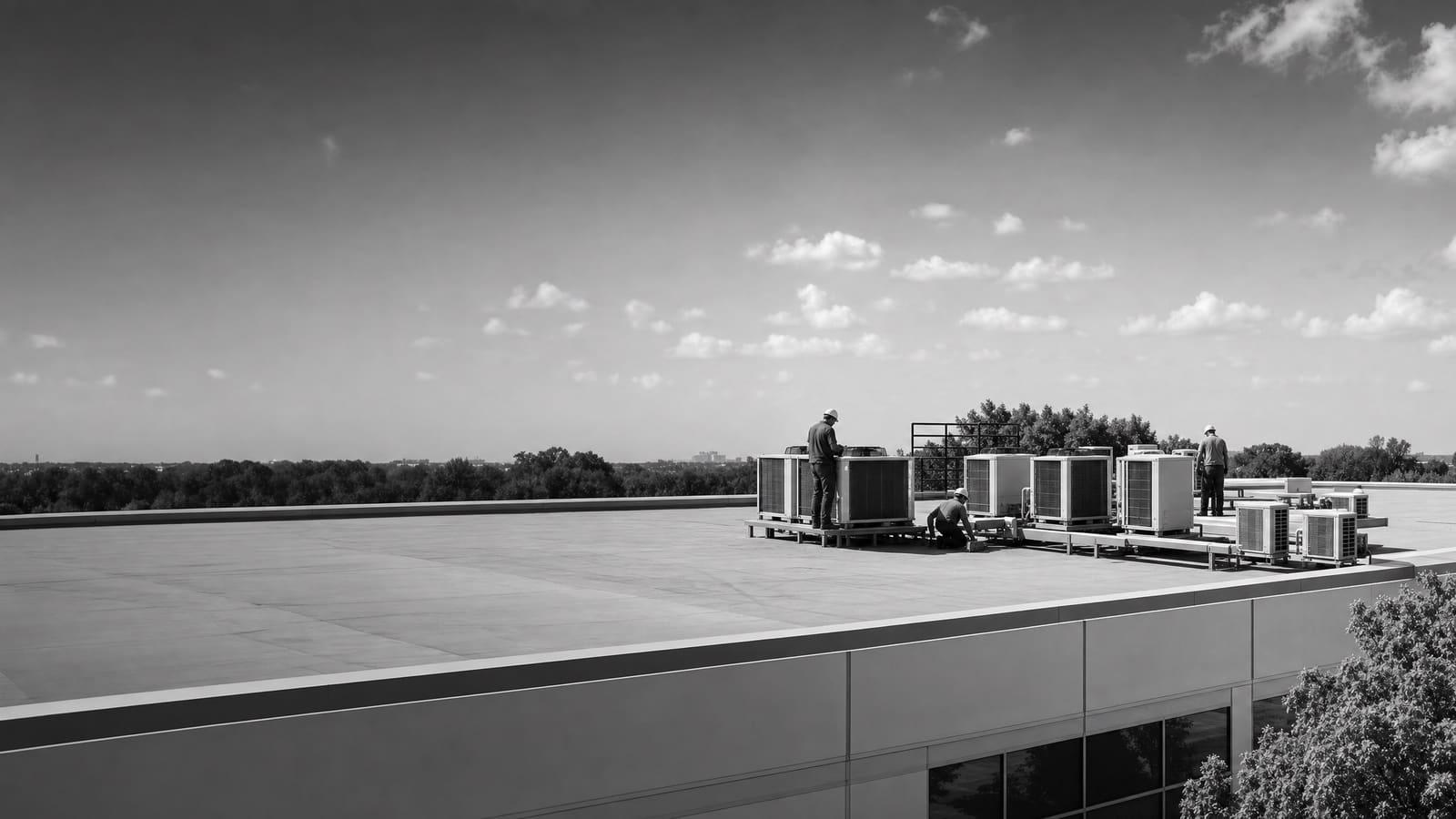
A commercial HVAC replacement covers load verification, equipment selection, refrigerant recovery, the crane set, gas and electrical connections, controls integration, and commissioning. Replacement usually beats one more repair once a unit passes fifteen years and stops holding the space, because an old, inefficient rooftop unit can waste $900 to $3,700 a year on its own. High-efficiency models were built to cut that use by as much as half.
A site review still has to verify the actual load, the curb and roof structure, available electrical capacity, and crane access before any of that turns into a real price.
THREE PATHS
Three ways to handle an aging rooftop unit
Most owners face this decision the week a unit fails, which is the worst week to make it. The stronger move is to decide before the failure. Once a rooftop unit passes fifteen years it is a budget line, not a surprise, and you get to compare real options instead of taking whatever is on a truck that week.
Three paths are usually on the table. Which one wins depends on how much life the cabinet has left, what your building's heating hours look like, and whether your electrical service has headroom.
Rooftop units condition close to half of all commercial floor space in the country, so this is a well-worn decision with well-understood answers, as long as somebody checks the building instead of the nameplate.
WHAT MOVES THE NUMBER
The lines that decide your price
No two roofs price the same, and the spread comes from a short list of items. Ask which of these your quote assumed and which ones it actually verified. Assumptions are where change orders come from.
HOW TO BUY IT
Load first, tier second, availability third
Start with the load, not the nameplate. The unit on your roof was sized for a building that may no longer exist, with different tenants, different equipment, and different hours. Carrying a twenty-year-old sizing mistake forward is the most common and most expensive thing a like-for-like swap does. A fresh load calculation either confirms the tonnage or finally explains the comfort complaints nobody could fix.
Then pick the efficiency tier with your operating hours in front of you. An old, inefficient unit can waste $900 to $3,700 a year by itself, and high-efficiency equipment was developed specifically to cut that use by as much as half. A building running long hours pays that difference back faster than one running short hours, so the right tier is a math question rather than a philosophy.
Last, treat availability as part of the specification. Equipment options should arrive with real lead times attached, because a unit that ships in nine weeks is not comparable to one that ships in two, whatever the bottom line says. If the building cannot survive nine weeks without cooling, that constraint should shape the selection at the start instead of derailing it in week three.
SIDE BY SIDE
Simple swap or a bigger project
Two replacements with identical tonnage can be very different projects. The difference is what the new unit asks the building to do that the old one never did.
LOWER COMPLEXITY
Same fuel, same footprint
Sound roof structure, a curb the new unit matches, electrical service with headroom, and no fuel change. Permits stay simple, the crane day is short, and most of the schedule risk sits with equipment lead time.
HIGHER COMPLEXITY
New fuel or new footprint
Going all-electric, growing tonnage, or relocating the unit. Now you are looking at service capacity, feeder sizing, framing, structural review, and a gas line to resize or abandon, each with its own schedule.
BEFORE THE QUOTE
What a real site review covers
A useful site review answers questions the nameplate cannot. It measures the curb and checks what sits under it, because a new unit rarely matches an old footprint exactly and the adapter is where a clean install turns messy. It reads the electrical service, not the label on the disconnect but the actual capacity and what else already draws from it. It confirms where gas enters and what happens to that line under each option. It looks at the lot the crane has to work from and the hours the building can realistically give up.
It should also look at the units you are not replacing this year. A single failure usually sits inside a group of similar-age equipment, and knowing what is fifteen, seventeen, and nineteen years old turns three future emergencies into one planned sequence.
The output should be written down. A review that produces a verbal impression and a number leaves you comparing quotes that priced different projects.
What has to be verified, not assumed
Actual load, curb and structure, electrical capacity and feeders, gas line disposition, refrigerant recovery, crane reach and lot closure, and the controls the new unit has to talk to. Anything left as an assumption is a change order waiting.
OWNERSHIP
Two questions to settle before the first quote
Who pays and who benefits changes the right answer more than most technical details do. A replacement lands on one budget while its savings land across the next twenty years of utility bills, and those are not always the same pocket.
Fleet age matters just as much. Buildings rarely have one old unit; they have a cohort. Deciding once and applying that decision across the cohort gets you better pricing, one set of spare parts, and one training curve for whoever services them. Both questions are worth settling early, because they change what you should be asking for.
LEASE STRUCTURE
Who carries the bill
In a triple-net or gross lease, capital cost and energy savings can sit on opposite sides of the agreement. Settle that first, because it decides whether the payback argument is even yours to make.
PORTFOLIO
One decision, many roofs
If you run several buildings, evaluate the standard rather than the unit. Some sites will suit an electric option and others will not, but a written decision rule beats relitigating it roof by roof.
OVER THE LIFETIME
Planned replacement costs less than reactive replacement
Replacement on failure is the most expensive way to buy a rooftop unit. You pay emergency labor, you accept whatever tonnage and efficiency tier is available that week, and you make a twenty-year decision in an afternoon. Planned replacement inverts all three: you compete the equipment, you choose the tier, and you set the date around your operating calendar instead of the weather.
Phasing is how most owners afford it. Rank units by age and by what each one costs to run, not by which one squeaked most recently, then take the worst offenders in the first year. Savings from those units help fund the next round, and the fleet quietly converges on a single standard with a single parts list.
The opportunity is not theoretical. More than two hundred organizations working through a federal upgrade campaign have replaced or retrofitted over forty-three thousand rooftop units, with combined energy savings of roughly thirty-seven million dollars a year. That number does not reflect a special product. It reflects what happens when old equipment gets replaced deliberately instead of reactively.
THE CHECKLIST
Five things a comparable quote shows
Quotes are only comparable when they describe the same project. These five items make that possible. If one is missing, you are guessing at the difference between bidders.
01
Equipment and efficiency tier
Make, model, tonnage, efficiency rating, heating type, and the refrigerant the unit ships with.
02
Real lead time
An availability or ship date printed next to the price, not just a promise to order.
03
Curb, structure, and rigging
Adapter or new curb, any framing, crane size, lot closure, and hours on site.
04
Utility and controls scope
Electrical work, gas line disposition, refrigerant recovery, and how the unit ties into existing controls.
05
Commissioning and closeout
Startup readings, charge and airflow verification, permits, inspections, warranty registration, and documents handed over.
Keep planning locally
Related mechanical pages in Raleigh
Get a defensible number
Price the equipment and the building together.
Send the address, operating target, and target opening date. Flux will identify what must be verified before the project can be priced.
Get a free estimateQuestions
Straight answers.
When is replacement better than one more repair?
Once a unit is past about fifteen years, needs frequent service, or can no longer hold the space, another repair usually buys less time than it costs. An old, inefficient unit can waste $900 to $3,700 a year in energy on its own, which often exceeds what the repair saved you.
Should the new unit match the old one exactly?
Only if the building still uses the space the same way. A like-for-like swap is fast and keeps permits simple, but it also carries forward whatever sizing error the old unit had. Run the load calculation either way, then decide with an answer in hand rather than an assumption.
Is a heat pump rooftop unit a good fit here?
Heat pump units install much like standard rooftop units and add reverse-cycle heating. Their efficiency falls as outdoor temperature drops, so they suit buildings with mild to moderate winter heating demand. The deciding factors are your heating hours, electrical capacity, gas line disposition, and local electricity pricing.
What happens to the refrigerant in the old unit?
Federal rules govern how refrigerant is recovered, handled, and recycled from stationary cooling and heat pump equipment. Recovery is performed by certified technicians and documented as part of the removal. It should appear as a line in your scope, not as an unpriced assumption discovered on crane day.
Can better controls delay a full replacement?
Sometimes. If the cabinet, coils, and compressors are sound but the controls are basic, an advanced controls retrofit can cut energy use without a crane. It is a legitimate alternative when the finances favor it, and it buys planning time so the eventual replacement happens on your schedule.
Sources used for this guide
- [1]betterbuildingssolutioncenter.energy.gov — DOE Advanced Rooftop Unit Replacement Guidance
- [2]betterbuildingssolutioncenter.energy.gov — DOE Commercial Heat Pump Rooftop Unit Replacement Guidance
- [3]betterbuildingssolutioncenter.energy.gov — DOE High-Efficiency Commercial Rooftop Unit Toolkit
- [4]energy.gov — DOE Efficient Commercial Rooftop Air Conditioner Program
- [5]epa.gov — EPA Stationary HVAC Refrigerant Management