THE DIRECT ANSWER
What a commercial HVAC replacement actually covers
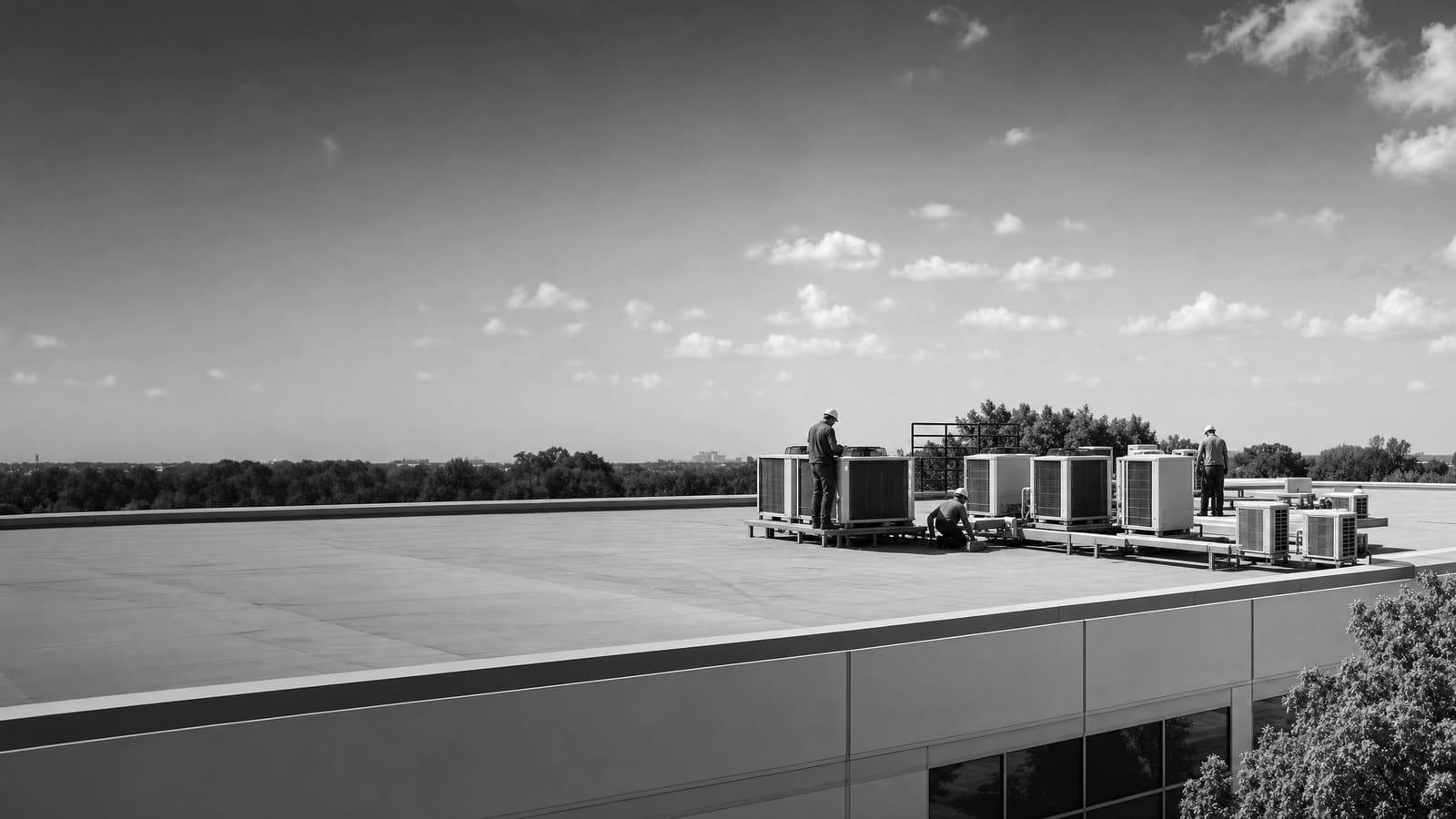
A commercial HVAC replacement confirms the load, selects equipment against real lead times, sets the unit on a curb that fits, reconnects power, gas, and controls, then commissions and documents the result. Replacement beats one more repair once a unit passes roughly 15 years, since Department of Energy guidance finds units that old waste substantial energy and money against newer models. Old, inefficient rooftop units waste an estimated $900 to $3,700 per unit each year.
A site review still has to verify curb fit, roof and crane access, available electrical capacity, and whether the gas line stays or gets abandoned. Those four answers move both the price and the schedule.
THREE WAYS TO GO
Three replacement paths for a Providence roof
Most commercial buildings are replacing a packaged rooftop unit, and the real decision is what kind of unit lands on the curb. DOE heat pump guidance treats climate and geography as the first screen, because winter heating load is what separates a straight air-conditioning unit from a heat pump. As outdoor temperatures fall, heat pump heating efficiency drops toward parity with electric resistance, so a New England winter is exactly the condition that decides between a dual-fuel machine, a cold-climate heat pump, and a like-for-like swap.
None of the three is automatically right. A like-for-like unit is the fastest path back to conditioned space and the cheapest engineering. A dual-fuel unit keeps gas heat for the coldest hours and runs the heat pump the rest of the season. An all-electric or cold-climate unit removes the gas line but leans harder on capacity at the panel. Confirm the load and the available power before you pick, not after the order is placed.
WHAT MOVES THE NUMBER
Where the money actually goes
There is no universal installed price for a commercial change-out, and a quote that offers one before seeing the roof is guessing. These are the lines that separate a routine swap from an expensive one. Ask which of them your building triggers before you put two bids side by side.
IN PRACTICE
Planned replacement versus replacing on failure
Most rooftop units get replaced the week they die. Department of Energy guidance is blunt about the cost of that habit: managers delay until the unit no longer conditions the space, needs frequent maintenance, or fails completely, and proactively replacing inefficient, underperforming units is often the smarter business move than replacement-on-failure or even a like-for-like swap at the end of service life.
The reason is that a failure sets the terms. You take whatever unit is available, at whatever lead time, with no room to price a better efficiency tier or study whether a heat pump fits the building. Planned replacement gives back the three things a failure removes: choice of equipment, choice of date, and time to confirm the load against how the space is used now rather than what the old nameplate says.
That is also the moment to ask whether the tonnage is still right. Twenty years changes occupancy, plug loads, lighting heat, and the envelope. A unit sized for the building's former use will be wrong in a way no amount of service can fix, and copying the nameplate carries that mistake forward into the next two decades.
COMPLEXITY CHECK
What makes a change-out simple or hard
Two buildings can order the same tonnage and get very different quotes. The gap is almost never the equipment. It is what the roof, the panel, and the parking lot require before the unit can land.
LOWER COMPLEXITY
Straight swap conditions
Same tonnage and heating source, a curb that matches or takes a standard adapter, an open lot with room to set the crane, existing power and gas adequate as-is, and no change in how the space is used. Permit scope stays mechanical and electrical.
HIGHER COMPLEXITY
Conditions that add scope
Fuel switching to a heat pump, a larger or heavier unit, structural review on the curb, a service upgrade at the panel, tight downtown access with limited crane staging, or occupied tenant space that narrows when the lot can close.
SCOPING THE JOB
The site review that keeps the price honest
Department of Energy guidance for heat pump rooftop units gives a usable checklist for any replacement, not just an electric one. It asks about climate and heating load, cost and utility bill impact, building type, equipment availability, infrastructure, contractor familiarity with the technology, and available incentives. Infrastructure breaks into three answers a walk on the roof can settle: electrical capacity, physical constraints, and gas lines.
Those three are where late change orders come from. Electrical capacity decides whether an all-electric unit is even on the table. Physical constraints cover curb dimensions, roof structure, clearances, and whether the crane can reach the setting point from anywhere a truck can legally park. Gas lines decide whether you keep a connection, cap it, or verify it for dual fuel.
Equipment availability and crew familiarity belong in the same conversation. A unit that is right on paper and eleven weeks out is a different decision than one sitting on a regional shelf, and newer heat pump equipment only performs as well as the people commissioning it.
Ask for these answers before you take bids
Panel and service capacity, curb dimensions and roof structure, crane reach and staging, gas line disposition, and the real lead time on the model quoted. Get all five in writing and two bids become comparable instead of merely similar.
PROVIDENCE SPECIFICS
Permits and inspections on a Providence commercial roof
Providence handles commercial mechanical work through the Department of Inspection and Standards, which runs building permitting, code enforcement, and zoning questions from its office at 444 Westminster Street. The city's permit guidance exempts genuinely minor work, such as replacing a minor part that does not alter the equipment's approval or make it unsafe. A full unit change-out is not that. It is permitted work, and the final inspection happens only after all work required by the permit is complete.
The step buyers miss is fire review. The city's process routes four-or-more-family dwellings and all commercial properties through the Providence Fire Department. That is a lane on your calendar, not a formality to handle the week the crane shows up.
Book the permit before the crane
Set the crane date after the permit and fire review are moving, not before. Because the final inspection only follows completed work, plan startup, commissioning, and inspection as one sequence instead of three separate surprises.
OWNERSHIP ITEMS
Two things that outlive the install
A replacement is a decision you live with for two decades, and under pressure it gets made in an afternoon. Two items follow the unit long after the crane leaves. The first is refrigerant, which is federally regulated from the moment the old machine comes off the curb through every service call on the new one. The second is who carries the cost and sets the standard: the landlord, the tenant, or a portfolio group that would rather every site run the same platform. Settle both while the quote is still open.
REFRIGERANT
The old charge is regulated
EPA rules under Section 608 of the Clean Air Act address how refrigerant is handled and recycled in stationary refrigeration, air-conditioning, and heat pump equipment. Recovery from the removed unit is part of the job, and the documentation belongs in your file, not only the contractor's.
COST OWNERSHIP
Who pays and who standardizes
In leased space, the lease decides whether a capital replacement sits with the landlord or gets passed through. Across several buildings, standardizing on one equipment platform simplifies parts, training, and the next four replacements.
PLANNING AHEAD
Phasing, procurement, and what the unit costs to run
If you own more than one aging unit, the useful exercise is a replacement order, not a replacement. Rank the fleet by age, service history, and how much conditioned space each unit carries, then work down that list across two or three budget years. With federal figures putting the annual waste of an old, inefficient rooftop unit between $900 and $3,700, the ranking is really a ranking of what each unit costs you to keep.
Procurement follows from that. Lead times, not labor, set the calendar on commercial equipment, and a planned order buys a better efficiency tier than an emergency one ever will. It also leaves room to use whatever utility or federal incentive applies at the time of purchase, which DOE guidance lists among the deciding factors in heat pump adoption. Confirm any program is still active before you count it; do not budget from an old program sheet.
The lifetime number is the one worth comparing. Two quotes with the same install price can differ by thousands of dollars a year in energy. A federal rooftop upgrade campaign reported more than 43,000 units upgraded by over 200 organizations, saving a combined $37 million a year on energy bills — savings that arrive after the invoice, not on it.
QUOTE CHECKLIST
Five things a comparable quote shows
Two commercial quotes are only comparable when both name the same scope. If one of these is missing, you are not comparing price, you are comparing how much got left out. Ask for all five in writing before the crane is booked.
01
The unit, named
Tonnage, efficiency tier, heating type, and refrigerant, plus the model's actual lead time in weeks rather than a phrase like currently available.
02
The load basis
Whether sizing came from a current load calculation or from copying the old nameplate. The answer should be written down, not implied.
03
Curb, roof, and structure
Adapter or new curb, any structural review, and who pays if the roof opening needs work once the old unit is off.
04
Crane day and access
Rigging plan, how many stalls close and for how long, and who coordinates with tenants and makes the weather call.
05
Permits through commissioning
Mechanical and electrical permits, fire review, final inspection, refrigerant recovery records, and a commissioning report covering charge, airflow, and controls.
Keep planning locally
Related mechanical pages in Providence
Get a defensible number
Price the equipment and the building together.
Send the address, operating target, and target opening date. Flux will identify what must be verified before the project can be priced.
Get a free estimateQuestions
Straight answers.
When is replacing a commercial rooftop unit better than repairing it again?
Department of Energy guidance points at the 15-year mark: units that old can waste substantial energy and money compared with newer models, and owners tend to delay until the unit no longer conditions the space, needs frequent maintenance, or fails completely. If your unit is past 15 years and on its second or third significant repair, planned replacement usually beats keeping it alive one more season.
Should a Providence building switch to a heat pump rooftop unit?
Sometimes. Heat pump heating efficiency falls as outdoor temperatures drop, trending toward parity with electric resistance heat, so a cold winter is the condition the decision has to survive. That is what dual-fuel and cold-climate heat pump units exist for. Check the heating load, local electricity and gas prices, and available electrical capacity before committing to all-electric.
Do you need a permit to replace a rooftop unit in Providence?
Yes. The city's permit guidance exempts minor part replacement that does not alter the equipment's approval or make it unsafe, and a full change-out is not that. Commercial properties also route through the Providence Fire Department, and the final inspection is made only after all work required by the permit is complete.
How much does a commercial HVAC replacement cost?
Installed price depends on tonnage, curb and structural work, crane access, and electrical scope, so an honest number follows a look at the roof. What is documented nationally is the operating side: an old, inefficient rooftop unit wastes roughly $900 to $3,700 a year, which is often what justifies replacing it before it fails.
What happens to the refrigerant in the old unit?
It has to be recovered, not vented. EPA rules under Section 608 of the Clean Air Act address the handling and recycling of refrigerants in stationary refrigeration, air-conditioning, and heat pump equipment. Ask for the recovery documentation at closeout and keep it with your permit records.
Sources used for this guide
- [1]betterbuildingssolutioncenter.energy.gov — DOE Advanced Rooftop Unit Replacement Guidance
- [2]betterbuildingssolutioncenter.energy.gov — DOE Commercial Heat Pump Rooftop Unit Replacement Guidance
- [3]betterbuildingssolutioncenter.energy.gov — DOE High-Efficiency Commercial Rooftop Unit Toolkit
- [4]energy.gov — DOE Efficient Commercial Rooftop Air Conditioner Program
- [5]epa.gov — EPA Stationary HVAC Refrigerant Management
- [6]providenceri.gov — permit-faq-20200302.pdf