THE SHORT ANSWER
What a commercial HVAC replacement actually includes
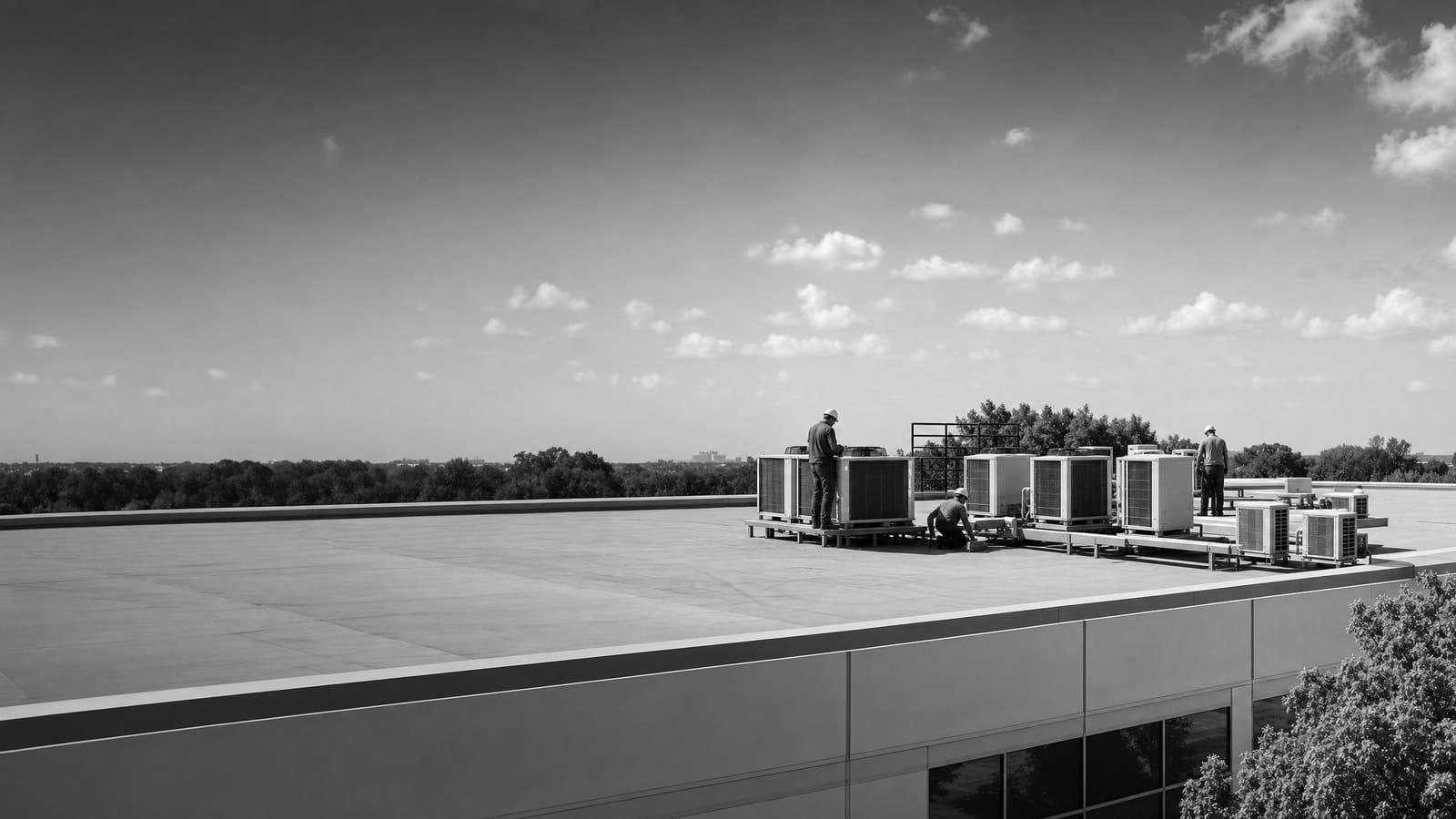
A commercial HVAC replacement covers the load calculation, equipment selection, rigging and set, the electrical, gas, and refrigerant connections, controls integration, permits, and commissioning. Replacement starts beating another repair once a unit is past about fifteen years, because units that old waste substantial energy against current models — federal figures put that waste at $900 to $3,700 per unit every year. Replacing on your schedule almost always costs less than replacing after a failure in season.
A site review has to confirm the real load, the curb and structural fit, available electrical capacity at the unit, and crane access before any price is more than an estimate.
THREE PATHS
The three replacement choices worth pricing
Most commercial replacements come down to three paths, and the right one depends on whether the building still uses the space the way it did when the last unit was chosen. Federal guidance is direct about the trade-off: waiting until a unit fails completely is usually the most expensive version of this project, and a like-for-like swap at end of life is not automatically the cheapest choice over the years you will own the new equipment. The comparison only works when all three options are priced against the same load calculation and the same install scope. Otherwise you are comparing a fast answer to a good one. Ask for all three on paper, even if you already know which one you want, because the spread between them tells you what the efficiency tier is actually buying and what electrical work a conversion would cost if you ever make one.
WHAT MOVES THE NUMBER
The lines that decide the price
No two roofs price the same, but the same handful of lines move the number on nearly every commercial replacement. Ask for each one broken out. A quote that bundles them into a single installed figure hides exactly the items most likely to change once the crew gets on the roof.
HOW TO BUY IT
Choosing equipment without guessing
Two questions usually get answered at once in a replacement conversation, and they should not be. The first is what this building actually needs. The second is what can be on the roof when you need it. Sizing should come from how the space is used today, not from the nameplate on a unit chosen a decade or two ago. Occupancy shifts, plug loads climb, and lighting retrofits change the cooling picture more than most owners expect. A load calculation is a few hours of work that sets your utility bills for the entire service life of the new unit.
Once the load is settled, efficiency tier is the real fork. Rooftop units condition close to half of all commercial floor area in the country, which is why the federal effort on this equipment has been so specific: a performance spec written to cut energy use by up to half against the old standard, third-party verification that the savings showed up in real buildings, and a minimum efficiency standard for the category. More than twenty models exceed that original spec, so a high-efficiency option is a catalog choice rather than a special order.
Availability is what ruins schedules. Ask for lead time next to price on every option, and treat any quote that leaves it blank as incomplete.
SCOPE RISK
Simple swaps and the ones that grow
Not every replacement carries the same risk. The difference is usually whether the new unit can reuse what is already on the roof, and whether the building can be off for an afternoon.
LOWER COMPLEXITY
Straight swap conditions
Same tonnage and heating type, a curb the new unit meets with a standard adapter, clean crane reach from the lot, adequate power already at the disconnect, and a tenant schedule with an off-hours window. These jobs price tightly and move quickly once equipment lands.
HIGHER COMPLEXITY
Where scope grows
Tonnage or footprint changes, a roof that needs structural review, a lift that has to reach over the building or close a main entrance, a move off gas heat that requires new electrical capacity, and around-the-clock operations that need temporary cooling during the changeover.
SCOPING
What the site review has to confirm
A quote written from a phone call is a guess with a decimal point. The site review is what turns it into a number someone can be held to.
Start on the roof. The visit should capture nameplate data on the existing unit, the curb dimensions and condition, the state of the membrane around the unit, and whether the structure was built for anything heavier. Then check the services at the unit: available amperage at the disconnect, gas line size and routing if there is one, and where condensate goes. The federal screening checklist puts electrical capacity, physical constraints, and gas lines near the top for exactly this reason — those three decide whether an electric option is even on the table.
Then look down. Crane access is a parking-lot problem, not a roof problem. Where does the truck set up, what does it reach over, how many stalls close, and for how long. Finally, ask the building: which hours can this space run warm, and who needs to be told.
A review that covers those four areas produces options with real prices. One that skips them produces a number that changes after the crew arrives.
Before anyone quotes a number
Nameplate photo, a roof shot showing access, curb dimensions, panel capacity at the unit, and your blackout dates. That package is usually enough to get a real option set instead of a placeholder price.
OWNING IT
Two things that outlast the install
The install ends in a morning. The decisions inside it follow you for years, and two of them are easy to miss while you are focused on getting cooling back. The first is what a new unit does to a roof full of older ones. The second is whether this replacement is a one-off or the first move in a plan. Both are cheaper to think about now than to retrofit into a service contract later, and both change how you should weigh the quotes in front of you.
REFRIGERANT
Your fleet will be mixed for a while
New commercial equipment ships on newer refrigerants while the rest of your roof runs on what it was built with. EPA Section 608 governs how refrigerant is handled, recovered, and recycled in stationary equipment, so certified technicians, recordkeeping, and parts planning matter across both generations.
PORTFOLIO
One roof or the whole book
If you own several buildings, standardizing on one unit family narrows the spare-parts spread and shortens service calls. Federal guidance also flags contractor familiarity and incentive availability as screening items, and both are easier to line up when replacements are batched instead of handled one emergency at a time.
PLANNING AHEAD
Phasing, procurement, and cost after year one
The cheapest time to replace a rooftop unit is before it decides for you. Federal guidance makes the same point plainly: facility managers often wait until a unit can no longer hold the space, needs constant service, or quits outright, and replacing proactively usually beats replacing on failure. An emergency swap in July means whatever equipment happens to be available, overtime rigging, and a tenant conversation nobody wanted.
If you have more than one aging unit, phase them. Build a short list ranked by age, service history, and how much of the building each one serves, then replace one or two a year in the shoulder seasons when crane schedules are open and the space can run warm for an afternoon. The Advanced RTU Campaign followed exactly this pattern across more than 200 organizations and 43,000 units, and those upgrades save a combined $37 million a year in energy costs.
Lifetime cost is where the argument settles. The invoice is one number, paid once. The energy the unit burns, the service calls it generates, and the comfort complaints it produces are paid every month for as long as you own it. Run the comparison across the full expected service life instead of the first invoice, and the correctly sized, higher-efficiency option usually wins.
COMPARING QUOTES
Five things a comparable quote shows
Two quotes are only comparable when they describe the same project. Ask each bidder to put these five in writing, in the same order, before you line up the totals.
01
Equipment and efficiency tier
Make, model, tonnage, efficiency rating, and heating type — plus the current lead time for that exact unit.
02
The basis for the size
Whether the tonnage came from a load calculation or from the old nameplate, and what occupancy and hours it assumed.
03
Curb, structure, and services
Curb adapter or new curb, any structural review, and the electrical, gas, and refrigerant work included in the price.
04
Rigging and site plan
Crane size, staging area, stalls closed, hours of the lift, and who pulls the permits and schedules inspections.
05
Commissioning and closeout
Startup, charge and airflow verification, controls setup, warranty registration, and the documents you receive at handoff.
Keep planning locally
Related mechanical pages in Plano
Get a defensible number
Price the equipment and the building together.
Send the address, operating target, and target opening date. Flux will identify what must be verified before the project can be priced.
Get a free estimateQuestions
Straight answers.
When does replacement beat one more repair?
Once a unit is past about fifteen years, it is usually wasting enough energy to change the math on its own — federal figures put that waste at $900 to $3,700 per unit annually. Add repeat service calls or a space the unit can no longer hold, and replacement on your schedule wins over another repair that buys you a season.
Should you consider a heat pump rooftop unit?
It belongs on the list. Federal guidance says today's heat pump rooftop units can handle most or all winter heating demand across the South, though southern regions still see occasional sharp cold snaps, which is why dual-fuel exists. The deciding factors are electrical capacity at the unit, local energy prices, and equipment availability.
How much does commercial HVAC installation cost in Plano?
There is no universal installed price, and any number quoted before someone sees the roof is a placeholder. The price is built from equipment tier and tonnage, curb and structural work, crane access, electrical and gas changes, and controls integration. Ask for those broken out so you can see what is actually driving your total.
How long does a replacement take?
The visible part is short: the crane arrives, the old unit comes off, the new one lands on a prepared curb, connections are made, and the system is commissioned. Equipment lead time is the long pole on nearly every project, which is why availability belongs on the quote right next to the price.
What happens to the refrigerant in the old unit?
It has to be recovered, not vented. EPA Section 608 rules govern how refrigerant is handled, recovered, and recycled in stationary air conditioning and heat pump equipment, and the work requires a certified technician. Confirm that recovery is written into the scope rather than assumed.
Sources used for this guide
- [1]betterbuildingssolutioncenter.energy.gov — DOE Advanced Rooftop Unit Replacement Guidance
- [2]betterbuildingssolutioncenter.energy.gov — DOE Commercial Heat Pump Rooftop Unit Replacement Guidance
- [3]betterbuildingssolutioncenter.energy.gov — DOE High-Efficiency Commercial Rooftop Unit Toolkit
- [4]energy.gov — DOE Efficient Commercial Rooftop Air Conditioner Program
- [5]epa.gov — EPA Stationary HVAC Refrigerant Management