THE SHORT VERSION
What a commercial HVAC replacement actually includes
A commercial HVAC replacement is a load check, an equipment decision, curb and roof work, power and gas connections, controls integration, and a documented startup. Replacement beats another repair once a unit is past roughly 15 years and the failures keep repeating, because old, inefficient rooftop units can waste $900 to $3,700 each per year in energy alone. Past that point, repair money buys time rather than performance.
A site review has to confirm the real load, the curb and roof structure, the electrical capacity already at the roof, the crane path, and whether the existing gas service stays or goes. Those five answers set the scope.
THREE WAYS TO GO
Three replacement paths for a rooftop unit
Almost every rooftop replacement lands in one of three places, and the choice is usually narrowed for you by what the roof can carry and what the building already has for power and gas. A like-for-like swap is the shortest path back to conditioned air and the least engineering. A high-efficiency unit costs more the day it lands and pays back through the meter — that class was built to a federal performance target of up to 50% less energy than the older standard, and more than 20 models have been built to exceed it. A heat pump unit adds reverse-cycle heating and takes the gas burner out of the equation entirely; across most of the South and West, current heat pump rooftop units are capable of handling most or all of the winter heating demand. Decide before you order, because each path changes the curb, the connections, and the permit set.
WHAT MOVES THE NUMBER
Where the money actually goes
No two roofs price the same, so treat these as the lines that move your number rather than a price list. Ask to see each one separately. A quote that bundles them into a single figure hides the parts you can still change.
IN PRACTICE
Choosing the equipment before the crane is booked
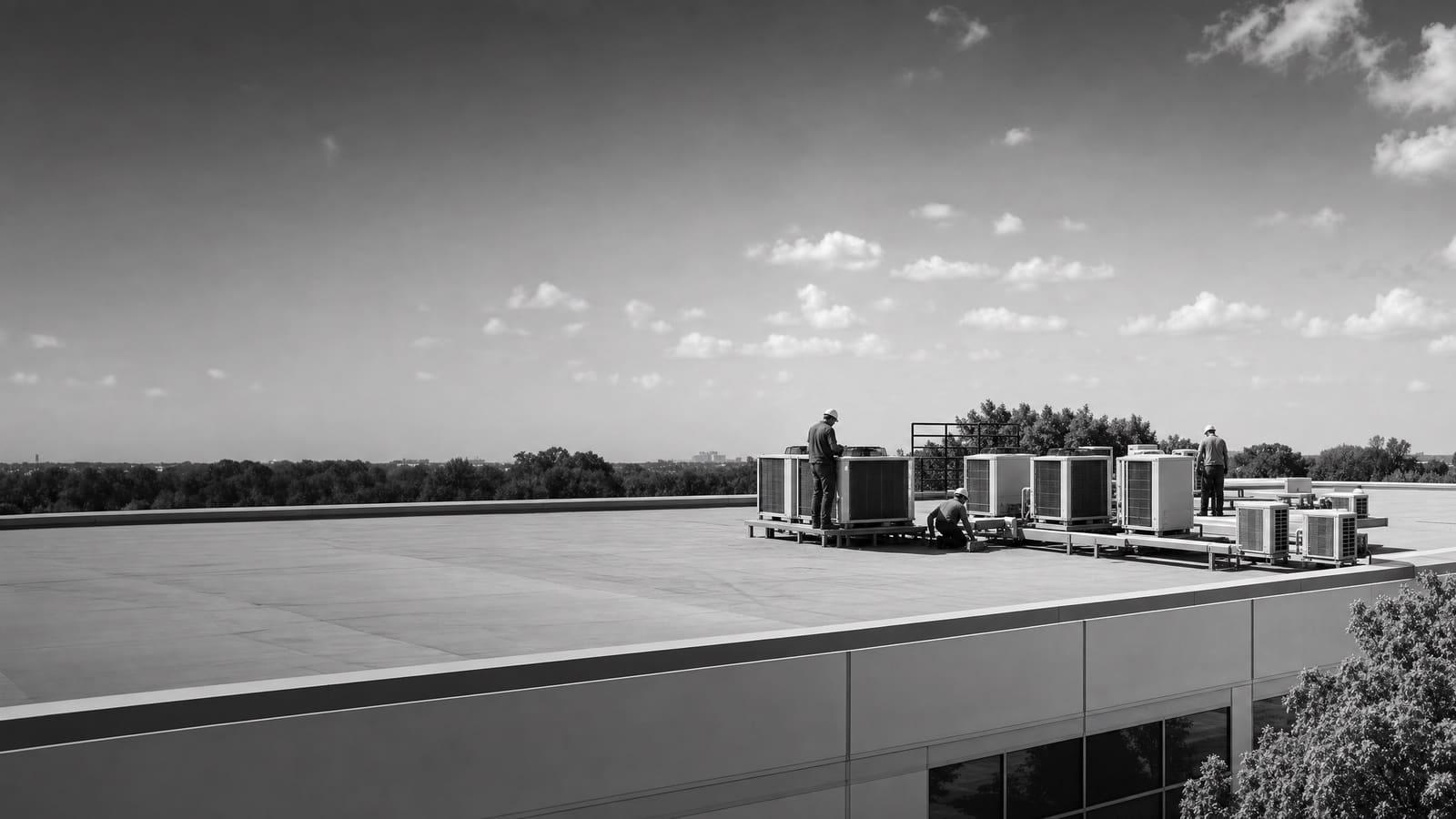
Rooftop units condition close to half of all commercial floor space in the country. That is why the packaged unit is where most of these decisions actually get made, and why the default answer — pull the old one, set the same thing back — is both so common and so often the wrong one.
The useful question is what the building needs now. A unit chosen two decades ago was sized for the occupancy, lighting, and plug load of that era. If the space was subdivided, if the lighting was swapped, or if the operating hours changed, the old nameplate is a record of a building that no longer exists. Confirming the load is a modest amount of work that either validates the same size or keeps you from buying the wrong one a second time.
The second question is fuel. A heat pump unit heats by running the refrigeration cycle backwards, which removes the gas burner from the equipment and from the service contract. Whether that works on your roof depends on electrical capacity, physical space around the curb, and whether the existing gas line serves anything else. Those are answers a site visit produces, not answers a catalog can give you.
SCOPE CHECK
What makes a replacement simple or complicated
Two replacements of the same size can land a week apart on schedule and far apart on price. The difference is rarely the unit itself. It is what surrounds the unit: the curb, the power, the access, and how much of the building has to keep operating while the work happens.
LOWER COMPLEXITY
Straight swap conditions
Same fuel and similar capacity, an existing curb the new unit fits, adequate electrical service already at the roof, and a lot with room to set the crane. Work happens off-hours, and tenants notice cones rather than an outage.
HIGHER COMPLEXITY
Where the scope grows
Changing fuel, adding capacity, or relocating the unit. Each can add structural review, electrical service work, a new curb, and a longer permit set. Sites where the lift needs a street lane add a coordination step of their own.
BEFORE YOU BUY
What a site review has to settle
Most bad rooftop projects were decided before anyone climbed a ladder. A real site review settles a short list of facts, and every one of them can move the price or the schedule.
Start with electrical capacity at the roof. If the replacement uses electric heating or adds tonnage, the existing service has to carry it, and finding that out during the install is the expensive way to learn. Next is physical fit: curb dimensions, clearance for service access, and whether the new footprint sits on the existing opening or needs an adapter. Then gas — whether the line stays, gets capped, or feeds other equipment that would be affected.
Availability is fourth. The equipment choice and the delivery date are the same decision, and a specification nobody can ship inside your window is not really a specification. Fifth is the old unit. Refrigerant has to be recovered under federal rules before it leaves the roof, and that work belongs to the installing contractor with paperwork to match.
Get those five in writing and the rest of the quote becomes comparable.
Ask what was measured, not what was assumed
Anyone can quote a tonnage off a nameplate photo. Ask instead what was actually checked: the load basis, the electrical service at the roof, the curb condition, the crane path, and the lead time attached to the exact model in the proposal.
OWNERSHIP MATH
Two decisions that outlive the install
Replacement timing is an ownership decision more than a mechanical one. Waiting for failure feels like saving money, because the unit runs right up until it does not. What it really does is hand you the decision on the worst possible day, with whatever equipment is in stock and whatever crew is free. Planned replacement puts the choice back on your calendar: you pick the efficiency tier, you pick the week, and you have room to negotiate.
The second decision is what happens after handoff. A rooftop unit is a long commitment to a service relationship, a parts supply, and in mixed fleets, to more than one refrigerant. Decide how the new unit fits your maintenance program before it lands, not after the first summer complaint.
TIMING
Planned versus replace-on-failure
Facility teams often delay until a unit fails outright. Replacing an inefficient unit proactively usually beats both replacement-on-failure and a like-for-like swap at the end of its service life.
FLEET
One roof or a portfolio
If you own several buildings, standardizing the unit, controls, and efficiency tier turns each replacement into a repeat order. It shortens sourcing, simplifies training, and keeps spare parts from multiplying across sites.
PHASING AND PROCUREMENT
How to sequence a multi-unit replacement
If you have more than one aging unit, stop replacing them one emergency at a time. Rank them instead. Age, repair history, and what the space costs you when it goes down will sort the list faster than any formal study. The unit over the server room and the unit over the storage mezzanine are not the same priority, even when they are the same age and the same model.
Then buy in a way that matches the ranking. Ordering two or three units together gives you one negotiation, one crane mobilization, and one permit effort instead of three staggered ones. It also lets you standardize the controls, which is worth more in year five than it is in year one.
Lifetime cost is where the argument gets settled. A high-efficiency unit costs more the day it lands and less every month after. Organizations working through the federal rooftop campaign reported upgrading more than 43,000 units and cutting a combined $37 million a year from their energy bills. Those savings are real, they just need a full cooling season to show up on a statement. Ask for the operating cost comparison next to the installed price and judge the two together.
QUOTE CHECKLIST
Five things a comparable quote shows
Two quotes for the same roof can differ by a third and both be honest, because they are not scoping the same work. These five lines make them comparable. If one is missing, ask about it before you compare price.
01
The exact model and efficiency tier
Manufacturer, model number, capacity, efficiency rating, and heating type. "Equivalent unit" is not a specification.
02
Lead time tied to that model
A delivery window for the unit actually quoted, not a general estimate for the category.
03
Roof and curb scope
Curb adapter, any structural work, and who owns the roof penetration and its warranty afterward.
04
Rigging, access, and closures
Crane size, lot or lane closure, hours of work, and what happens if weather moves the lift.
05
Startup, controls, and refrigerant handling
Documented commissioning, controls integration, and recovery and disposal of the old unit's refrigerant.
Keep planning locally
Related mechanical pages in Peoria
Get a defensible number
Price the equipment and the building together.
Send the address, operating target, and target opening date. Flux will identify what must be verified before the project can be priced.
Get a free estimateQuestions
Straight answers.
When does replacing a rooftop unit beat repairing it again?
Once a unit is past roughly 15 years and needs frequent service, repairs buy time rather than performance. Old, inefficient rooftop units can waste $900 to $3,700 each per year in energy. Replacing proactively generally beats waiting for a complete failure.
Is a heat pump rooftop unit a real option for a commercial building?
Often yes. Across most of the South and West, today's heat pump rooftop units are capable of handling most or all of the winter heating demand. The gate is infrastructure: electrical capacity, physical space at the curb, and what the existing gas line serves.
What does a high-efficiency unit actually save?
That class of equipment was built to a federal performance target of up to 50% less energy than the older standard, and more than 20 models have been built to exceed it. The savings land on the meter over a season, so compare operating cost next to installed price.
Who handles the old unit's refrigerant?
The installing contractor. Federal rules govern how refrigerant is recovered and recycled from stationary air conditioning equipment, so recovery, disposal, and the documentation should be named in the quote rather than assumed.
How do I compare two HVAC installation quotes fairly?
Line them up on model and efficiency tier, lead time for that specific model, curb and structural scope, the crane and access plan, and commissioning. Price gaps almost always trace to one of those five rather than to margin.
Sources used for this guide
- [1]betterbuildingssolutioncenter.energy.gov — DOE Advanced Rooftop Unit Replacement Guidance
- [2]betterbuildingssolutioncenter.energy.gov — DOE Commercial Heat Pump Rooftop Unit Replacement Guidance
- [3]betterbuildingssolutioncenter.energy.gov — DOE High-Efficiency Commercial Rooftop Unit Toolkit
- [4]energy.gov — DOE Efficient Commercial Rooftop Air Conditioner Program
- [5]epa.gov — EPA Stationary HVAC Refrigerant Management