THE DIRECT ANSWER
What a commercial HVAC replacement actually includes
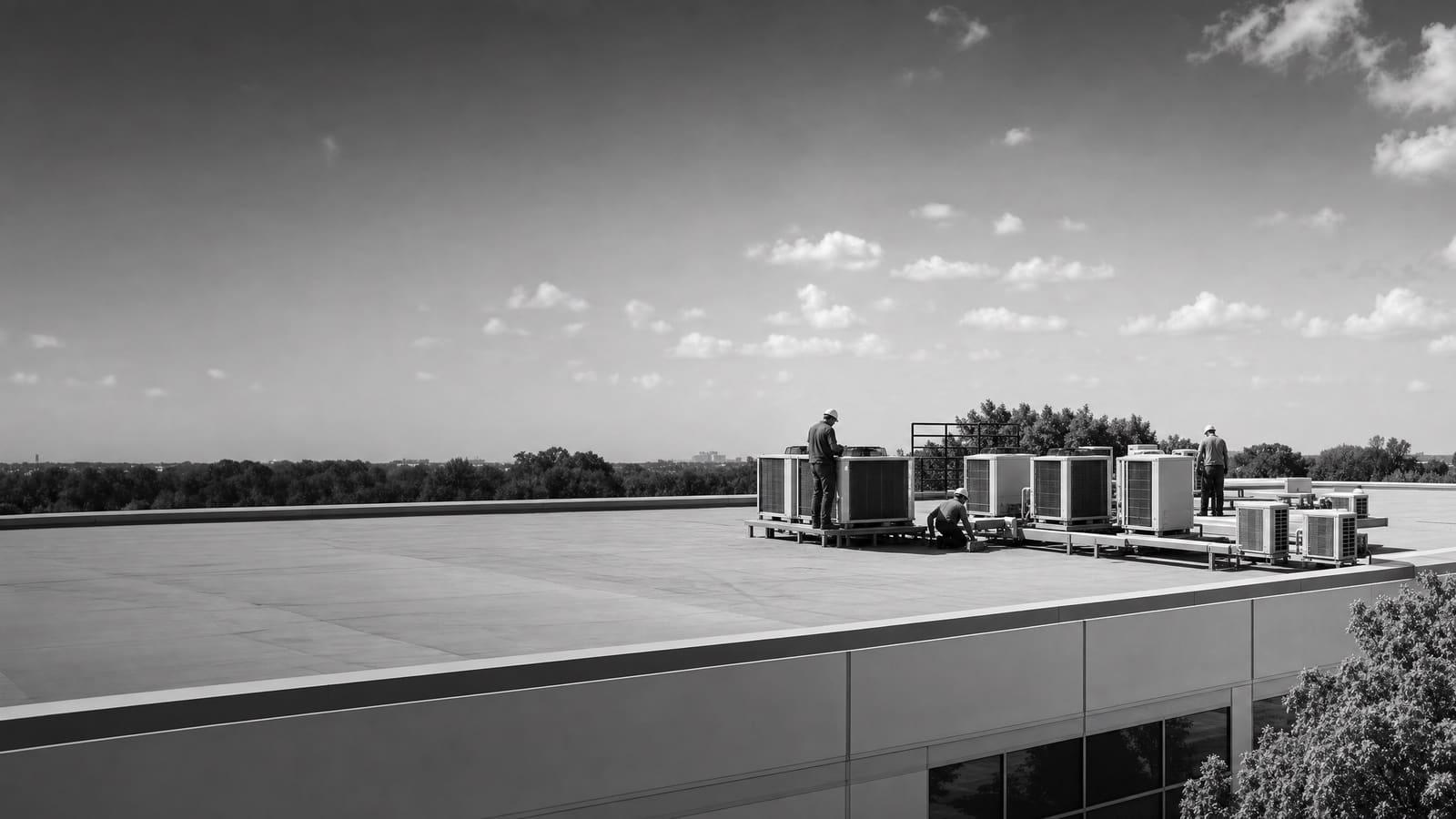
A commercial HVAC replacement covers load verification, equipment selection against real lead times, rigging and set, mechanical and electrical connections, permitted inspections, and commissioning. Replacement beats another repair once a rooftop unit is past about fifteen years and no longer holds the space. Department of Energy figures put the annual waste from an old, inefficient rooftop unit at $900 to $3,700 per unit per year, and no repair recovers that.
A site review still has to confirm actual load against current occupancy, curb and structural condition, available electrical capacity, crane reach, and whether replacement triggers code items the old unit never had.
THREE WAYS TO GO
Repair, replace in kind, or change the equipment type
Three choices sit in front of most facility owners when a rooftop unit starts failing. The cheapest today is another repair. The fastest is a like-for-like swap on the existing curb. The one that changes operating cost is a different class of equipment, usually a heat pump rooftop unit in place of a gas-heat or electric-resistance model.
The Department of Energy is direct about the trap here: facility managers often delay purchasing a new unit until the old one fails completely, and replacement on failure is usually the worst financial outcome. It removes the chance to compare equipment, forces whatever is on the shelf, and puts the crane day in the hottest week of the year instead of a planned Saturday.
Central Florida makes the third option easier than it is in most of the country. Heat pump rooftop units are best suited to mild-to-moderate winter heating, and across the U.S. South today's units are capable of covering most or all of the winter heating demand.
WHAT MOVES THE NUMBER
The lines that decide what a replacement costs
No one can quote a commercial rooftop replacement from a tonnage number alone. These are the lines that separate two bids on the same building, and the ones worth asking about before you compare totals.
IN PRACTICE
How to choose the equipment, not just the price
Start with the load, not the nameplate. A unit installed twenty years ago was sized for the occupancy, lighting, and envelope of that building at that time. Since then a kitchen got added, lighting went to LED, a floor got subdivided into offices. Sizing off the old data plate carries every one of those changes forward, uncorrected, for another twenty years.
Then look at the efficiency tier honestly. Rooftop systems cool close to half of all U.S. commercial floor area, which is why the Department of Energy pushed manufacturers toward a high-efficiency specification designed to cut energy use by up to 50 percent against the older standard. More than twenty models now exceed that specification. The premium over a builder-grade unit is real, and on a building that runs cooling most of the year it is usually the easiest line on the quote to justify.
The third question is fuel. If the old unit had gas heat, a heat pump rooftop unit removes the gas connection and the combustion service that comes with it. That decision turns on electrical capacity, equipment availability, and whether your contractor has actually installed and commissioned these units before. Ask about all three before you sign.
SCOPE CHECK
What keeps a replacement simple, and what complicates it
Two buildings with identical tonnage can be a one-morning job and a three-week job. The difference is almost never the unit itself. It is access, electrical capacity, and whether anything about the building changed since the last install.
LOWER COMPLEXITY
Same use, same curb, open lot
The space is used the way it was, the existing curb takes an adapter, the panel has room, and the crane sets up in the parking lot without closing a drive aisle. Permit scope stays mechanical and electrical.
HIGHER COMPLEXITY
New load, tight access, added capacity
Tonnage grows, the roof needs structural review, the crane has to reach over the building or work a street closure, or an all-electric swap needs a service upgrade. Each one adds engineering, lead time, and another inspection.
BEFORE THE QUOTE
What a real site review has to confirm
A quote written from a photo of the nameplate is a guess with a price on it. The site review is where the guess turns into a number you can hold someone to.
On the roof, the review confirms curb dimensions and condition, structural capacity for the new unit's weight and footprint, the condition of the existing duct drops, and how far the crane has to reach. Inside, it confirms electrical service capacity, the disconnect and feeder, the thermostat or building automation the new unit has to talk to, and whether the space is being used the way the old sizing assumed.
The review also flags what replacement triggers. Energy code items like economizers and controls often attach to the new unit even when the old one never had them, and Florida commercial permit packages expect equipment location, sealed mechanical plans, and energy calculations up front. Finding those at the plan review desk costs weeks. Finding them during the walk costs an hour.
Refrigerant is the last item. The existing charge has to be recovered and handled under federal rules by certified technicians, and that step belongs in the written scope rather than in a surprise line later.
Ask for the walk before the number
Any contractor quoting a rooftop replacement should walk the roof, open the panel, and confirm crane staging before sending a price. If a bid arrives without that visit, treat the number as a placeholder and expect change orders.
ORLANDO SPECIFICS
What Florida permitting and climate change about this job
Two local realities shape a commercial replacement here. The first is permitting. Florida commercial alteration packages require mechanical plans whenever the scope includes installing or relocating HVAC equipment, and those plans must be signed and sealed by a Florida licensed architect or engineer. Energy calculations are required when the scope includes heating, ventilation, or air conditioning, and the drawings have to show equipment location. Submittal checklists differ by jurisdiction, so confirm the current one with the building department that covers your address before drawings are ordered.
The second is climate. Cooling season here runs most of the year and the winter heating load is mild, which is exactly the condition heat pump rooftop units are best suited to. It also means efficiency tier is worth more here than in a mixed climate, because the unit is running hardest when the savings are largest.
Order the sealed drawings early
Sealed mechanical plans and HVAC energy calculations are part of the permit package, not an afterthought. Put the engineer on the schedule when you order equipment so plan review runs alongside the lead time instead of after it.
OWNERSHIP QUESTIONS
Two things to settle before the purchase order
A rooftop unit is a fifteen-to-twenty-year decision usually made in about two weeks. Two questions get skipped most often, and both cost money later rather than now. The first is who pays for what, which lease language decides before anyone talks about equipment. The second is what this unit does to the rest of the site, because every new model adds filters, belts, controls, and refrigerant your service vendor has to carry. Neither question changes the install. Both change what the next ten years cost to operate.
LEASE STRUCTURE
Repair versus capital replacement
Many commercial leases put repair on the tenant and capital replacement on the owner. That makes the line between a compressor rebuild and a full changeout a financial boundary, not just a technical one. Read the clause before approving scope.
FLEET STRATEGY
What the next unit does to service
New commercial equipment ships on lower-GWP refrigerants, and federal rules govern how the old charge is recovered and handled. On a multi-unit roof, plan that transition into the service contract and spare-parts list instead of meeting it mid-season.
PHASING AND PROCUREMENT
Planned replacement beats replacement on failure
The strongest argument for replacing early is not efficiency. It is control. When a unit fails in August you take whatever is available, at whatever price, on whatever day a crane can get there. When you replace on your own schedule, you compare equipment, negotiate the installed price, and set the unit on a morning when the lot is empty.
On a roof with several units, phase them. Rank by age, service history, and the space each one serves, then replace the worst one or two a year against a budget line instead of an emergency. Phasing also lets you standardize: the first replacement sets the model family, the controls, and the filter sizes the rest of the roof will match.
Lifetime cost is where the math lands. A high-efficiency unit costs more on the purchase order and less every month it runs, and the annual waste from an aging unit runs into the thousands per unit per year. Over a full service life on a building that cools nearly year-round, that operating gap is usually wider than the price gap between two bids. Ask for the efficiency tier and the expected operating profile on the quote so you can compare that, not just the total at the bottom.
QUOTE CHECKLIST
Five things a comparable quote has to show
Two bids are only comparable when they show the same things. If any of these are missing, ask for them before you compare totals, because the lower number usually means the smaller scope.
01
Make, model, tonnage, and efficiency tier
Not just "new rooftop unit." The model number is what makes two bids comparable at all.
02
Quoted lead time beside the price
Availability belongs next to the number. A cheaper unit ten weeks out is not the same offer.
03
Curb, structural, and rigging scope
Who supplies the adapter, who checks the roof, and who carries the crane and lot closure.
04
Permits, sealed drawings, and inspections
Stated in writing that the installer owns the permit package and sees the inspections through.
05
Commissioning and refrigerant handling
Startup readings, control settings, and certified recovery of the old charge, documented at handoff.
Keep planning locally
Related mechanical pages in Orlando
Get a defensible number
Price the equipment and the building together.
Send the address, operating target, and target opening date. Flux will identify what must be verified before the project can be priced.
Get a free estimateQuestions
Straight answers.
When does replacement beat another repair?
Once a rooftop unit is past roughly fifteen years and needs repeated repairs, the repair restores capacity but not efficiency. Federal estimates put the annual waste from an old, inefficient unit at $900 to $3,700 per unit. Replacing on your own schedule also beats replacing on the day it fails.
Does a heat pump rooftop unit make sense in Orlando?
Usually yes. Heat pump rooftop units are best suited to mild-to-moderate winter heating, and across the U.S. South today's units can cover most or all of the winter heating load. The deciding factors are electrical capacity at the panel, equipment availability, and whether your installer has commissioned them before.
What does the Florida permit package require?
Commercial alteration packages require mechanical plans when the scope includes installing or relocating HVAC equipment, signed and sealed by a Florida licensed architect or engineer. Energy calculations are required when the scope includes HVAC, and drawings must show equipment location. Confirm the current checklist with your local building department.
Should you replace like-for-like or resize?
Confirm the load either way. If occupancy, lighting, and layout are unchanged, like-for-like is often right and keeps the permit simple. If the space was subdivided or the use changed, sizing off the old nameplate carries a twenty-year-old assumption straight into a brand-new unit.
What happens to the old refrigerant?
Federal Clean Air Act rules govern how refrigerant is recovered and handled when equipment is serviced or removed, and the work must be done by certified technicians. Recovery and its documentation belong in the written scope of the replacement, not in a line item discovered afterward.
Sources used for this guide
- [1]betterbuildingssolutioncenter.energy.gov — DOE Advanced Rooftop Unit Replacement Guidance
- [2]betterbuildingssolutioncenter.energy.gov — DOE Commercial Heat Pump Rooftop Unit Replacement Guidance
- [3]betterbuildingssolutioncenter.energy.gov — DOE High-Efficiency Commercial Rooftop Unit Toolkit
- [4]energy.gov — DOE Efficient Commercial Rooftop Air Conditioner Program
- [5]epa.gov — EPA Stationary HVAC Refrigerant Management
- [6]tampa.gov — Permit Application Guide Commercial Alteration