THE SHORT ANSWER
What a commercial HVAC replacement actually includes
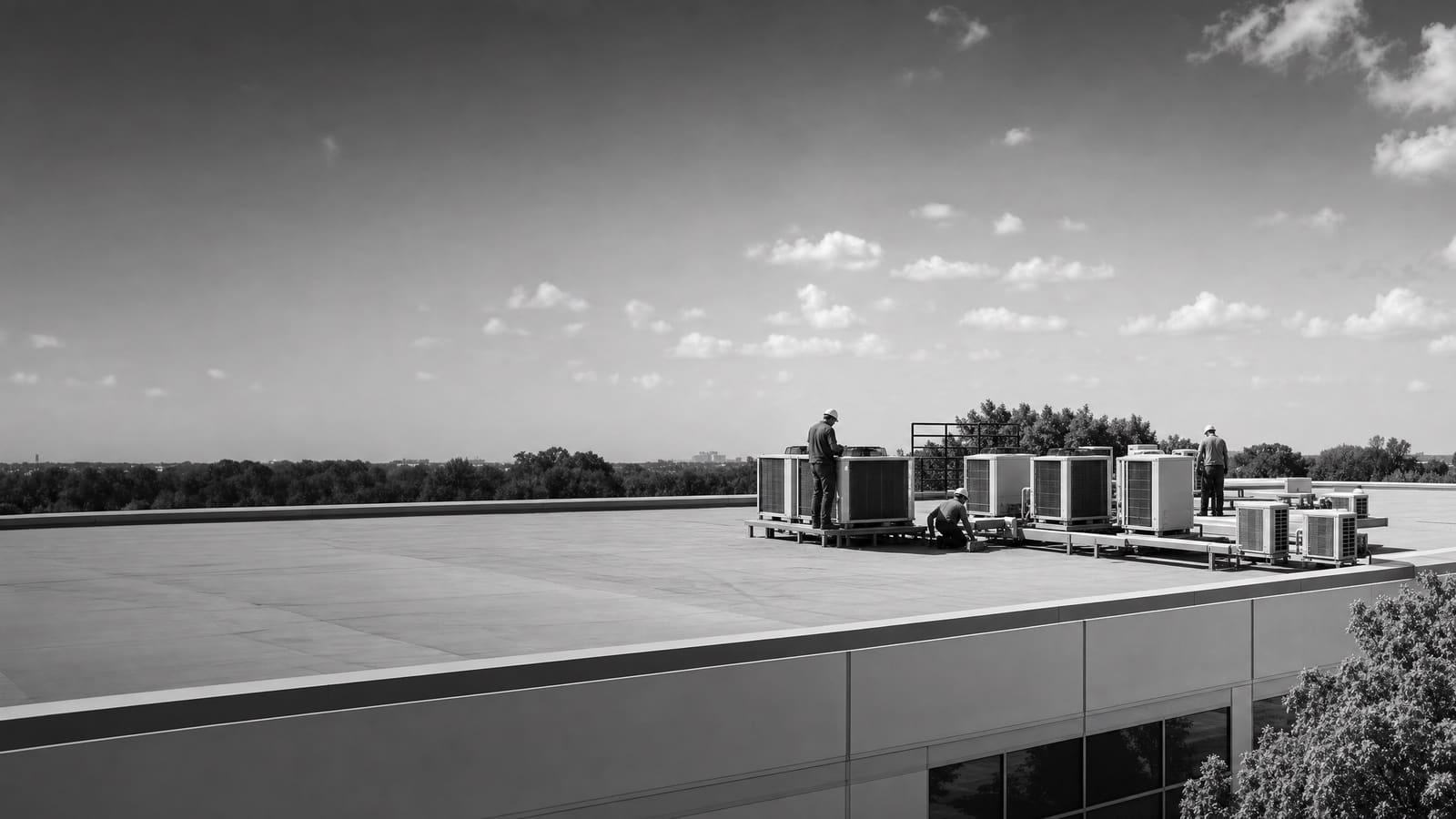
A commercial HVAC replacement covers load confirmation, equipment selection, removing the old unit, curb and connection work, rigging, controls, and commissioning. Replacement beats one more repair once the unit is old enough to waste money every month it runs. Rooftop units past fifteen years can burn substantially more energy than current models, and old, inefficient ones commonly waste $900 to $3,700 per unit each year. At that point a repair buys time, not value.
A site review still has to verify the real load, the curb and roof condition, electrical capacity at the unit, and how a crane reaches the roof. Those four items set the scope more than the nameplate does.
THE THREE CHOICES
Like-for-like, right-sized, or heat pump
Most commercial replacement decisions come down to three paths, and they are not equally good in every building.
The first is a like-for-like swap: same tonnage, same fuel, same curb. It is the fastest way back to conditioned space and the cheapest to engineer, but it carries forward whatever sizing mistake the old unit had.
The second is a right-sized, high-efficiency replacement. The load gets recalculated against how the space is used now, and the unit is selected against a current efficiency tier. Equipment built to the high-performance specification cuts energy use by up to half compared with the older standard, and more than twenty models on the market exceed that specification, so the choice is real rather than theoretical.
The third is a heat pump rooftop unit. It is technologically similar to a standard air conditioning unit but adds reverse-cycle heating. Across most of the U.S. South and West, today's heat pump rooftop units can carry most or all of the winter heating demand. Whether that fits your building depends on electrical capacity, existing gas service, and energy prices.
WHAT MOVES THE NUMBER
Where the money in a commercial installation actually goes
No two roofs price the same, so treat these as the lines that swing a quote rather than as a price list. When two bids for the same building land far apart, the gap is almost always hiding in one of them.
IN PRACTICE
Buy the replacement, not just the unit
The most expensive habit in commercial HVAC is waiting for total failure. Replacement-on-failure means buying whatever is available, on someone else's schedule, at the worst possible moment, with tenants already calling. Planning the same replacement months earlier changes nearly every variable in your favor. You can compare equipment, hold the crane day for a weekend, and choose an efficiency tier instead of accepting one.
The second habit worth breaking is buying from the old nameplate. A unit installed twenty years ago was sized for that building's occupancy, lighting, plug load, and envelope. If any of those changed, and over twenty years they usually did, the nameplate is a record of an old building rather than a specification for the current one. Confirming the load is a short exercise that either validates the same tonnage or saves you from paying to install the wrong size twice.
Third, judge bids on scope instead of on the bottom line. A cheap number usually means something was left out: the curb adapter, the structural check, the electrical upgrade, the controls work, or the commissioning. Those items do not disappear when they are left off a quote. They reappear as a change order, and by then you have no leverage.
COMPLEXITY CHECK
What makes a replacement simple or hard
Two projects with identical tonnage can be weeks and thousands of dollars apart. The difference is rarely the equipment itself. It is what the building asks the crew to work around.
LOWER COMPLEXITY
Straight swap, open roof
Same tonnage and same fuel, an existing curb the new unit fits or adapts to cleanly, a lot with room for the crane to set up, and adequate power already at the unit. The work happens in one session and the building barely notices.
HIGHER COMPLEXITY
Changed load or changed fuel
Larger tonnage, added structural review, a switch from gas heat to all-electric, limited crane access, occupied space directly below, or controls that have to talk to an existing automation system. These jobs get planned in phases, not in a morning.
THE SITE REVIEW
What a proper walk confirms before anyone quotes
A quote written from a nameplate photo is a guess with a dollar sign on it. That is fine for a first conversation and dangerous as a commitment. The walk that produces a real number checks what cannot be seen from the ground.
On the roof, that means the curb and its condition, the actual footprint of the replacement unit, the structural capacity for any change in weight, and how condensate and ductwork connect today. It means checking the electrical service at the unit, because heat pump and higher-capacity equipment can ask for more than the existing feeder delivers, and that upgrade is not a small line. If the building heats with gas and the replacement does not, someone has to decide what happens to that gas line.
From the ground, it means the crane picture: where the truck sets up, what it has to reach over, how many stalls close, and for how long. On a shared lot, that conversation belongs to the property manager before it belongs to the crew.
The walk should also settle which permits and inspections the replacement requires and who is responsible for pulling and meeting them. Finding that out at inspection costs far more than finding it out on the roof.
Ask for this before you sign
A written scope that names the exact unit and efficiency tier, the curb solution, the electrical work, who pulls permits, and which commissioning documents you receive at handoff. If any of those are missing, the price is not final.
OWNERSHIP
Two decisions that outlive the install
The day the crane leaves, two choices you made during procurement start compounding. One is what the unit costs to run. The other is what it costs to service. Owners tend to negotiate hard on the install price and model neither.
The running cost is not theoretical. Old, inefficient rooftop units commonly waste $900 to $3,700 each per year, and rooftop equipment conditions nearly half of all commercial floor space in the country. Across one national upgrade campaign, more than two hundred organizations upgraded over 43,000 rooftop units and cut a combined $37 million a year from their energy bills.
OPERATING COST
Efficiency tier is a long-term decision
The premium for a higher tier gets paid once at purchase and returned every month the unit runs. Run that comparison against your actual rates and operating hours before defaulting to the cheapest qualifying unit.
SERVICEABILITY
Plan for a mixed refrigerant fleet
New equipment ships on newer refrigerants, so a roof replaced one unit at a time ends up mixed. Handling, recovery, and disposal are federally regulated and require certified technicians, so confirm your service partner is set up for both generations.
PHASING
Replacing a roof full of units without wrecking the budget
Buildings rarely have one rooftop unit, and they rarely have the budget to replace all of them in one year. The workable answer is a phased plan built on condition and consequence rather than on age alone. Rank the units by what they serve, what they cost to run, and how badly a failure would hurt. The unit over the server room or the busiest tenant space moves up the list regardless of its birthday.
Phasing also buys procurement leverage. When replacements are scheduled instead of urgent, you can order equipment ahead of the cooling season, hold one crane mobilization for two or three units instead of paying for three separate days, and standardize on a platform your service technicians already stock parts for. Emergency replacement gives up all three at once.
Finally, budget for the whole life rather than the purchase. A unit that is cheaper to install, more expensive to run, and harder to get parts for is only a savings in one fiscal year. Ask every bidder to state the efficiency tier and expected annual energy performance next to the installed price, so you are comparing systems instead of comparing numbers.
THE QUOTE
Five things a comparable quote has to show
Bids only compare when they describe the same job. Ask each bidder to put these five items in writing so the numbers can sit next to each other honestly.
01
The exact unit and efficiency tier
Manufacturer, model, tonnage, heating type, and efficiency rating. Not "equivalent unit" and not "or similar."
02
Curb, structural, and roof scope
Whether the unit lands on the existing curb, what adapter or structural work is included, and who patches and warranties the roof.
03
Electrical, gas, and controls work
Feeder and disconnect changes, what happens to an existing gas line, and how the unit ties into your controls or automation system.
04
Rigging, access, and downtime window
Crane day, stall closures, hours of work, and how long the space goes without conditioning.
05
Permits, commissioning, and closeout
Who pulls permits, who meets the inspector, and which startup and commissioning records you receive at handoff.
Keep planning locally
Related mechanical pages in North Las Vegas
Get a defensible number
Price the equipment and the building together.
Send the address, operating target, and target opening date. Flux will identify what must be verified before the project can be priced.
Get a free estimateQuestions
Straight answers.
When is replacement a better call than one more repair?
When the repair is buying months on a unit that is already expensive to run. Rooftop units past fifteen years old can waste substantial energy compared with current models, and old, inefficient ones commonly waste $900 to $3,700 per unit each year. If a major component fails on a unit in that range, the repair rarely wins the math.
Should you replace like-for-like or resize the unit?
Confirm the load either way. If occupancy, equipment, and envelope are unchanged, like-for-like is usually right and it is the fastest path back to conditioned space. If the space has been reconfigured or the bills have crept up, a right-sized unit fixes comfort problems the old one caused.
Is a heat pump rooftop unit worth considering here?
Often, yes. Heat pump rooftop units are technologically similar to standard air conditioning units but add reverse-cycle heating, and across most of the U.S. South and West they can carry most or all of the winter heating demand. The deciding factors are electrical capacity at the roof, existing gas service, and your energy prices.
How long is the building without cooling?
For a straightforward packaged swap onto an existing curb, the disruptive part is a single work session: old unit off, new unit set, connections made and verified. The unpredictable part is equipment availability, which is why lead time belongs on the quote right next to the price.
What happens to the refrigerant in the old unit?
It has to be recovered, not vented. Federal rules govern the handling, recovery, and disposal of refrigerant in stationary air conditioning and heat pump equipment, and that work must be done by certified technicians. A complete quote names who performs it and includes removal of the old equipment.
Why do two bids on the same roof differ so much?
Almost always scope. One quote includes the curb adapter, the electrical upgrade, controls integration, permits, and commissioning, and the other leaves some of them out. Compare the written scope line by line before you compare totals, because the missing items come back as change orders.
Sources used for this guide
- [1]betterbuildingssolutioncenter.energy.gov — DOE Advanced Rooftop Unit Replacement Guidance
- [2]betterbuildingssolutioncenter.energy.gov — DOE Commercial Heat Pump Rooftop Unit Replacement Guidance
- [3]betterbuildingssolutioncenter.energy.gov — DOE High-Efficiency Commercial Rooftop Unit Toolkit
- [4]energy.gov — DOE Efficient Commercial Rooftop Air Conditioner Program
- [5]epa.gov — EPA Stationary HVAC Refrigerant Management