THE SHORT VERSION
What a commercial HVAC replacement includes
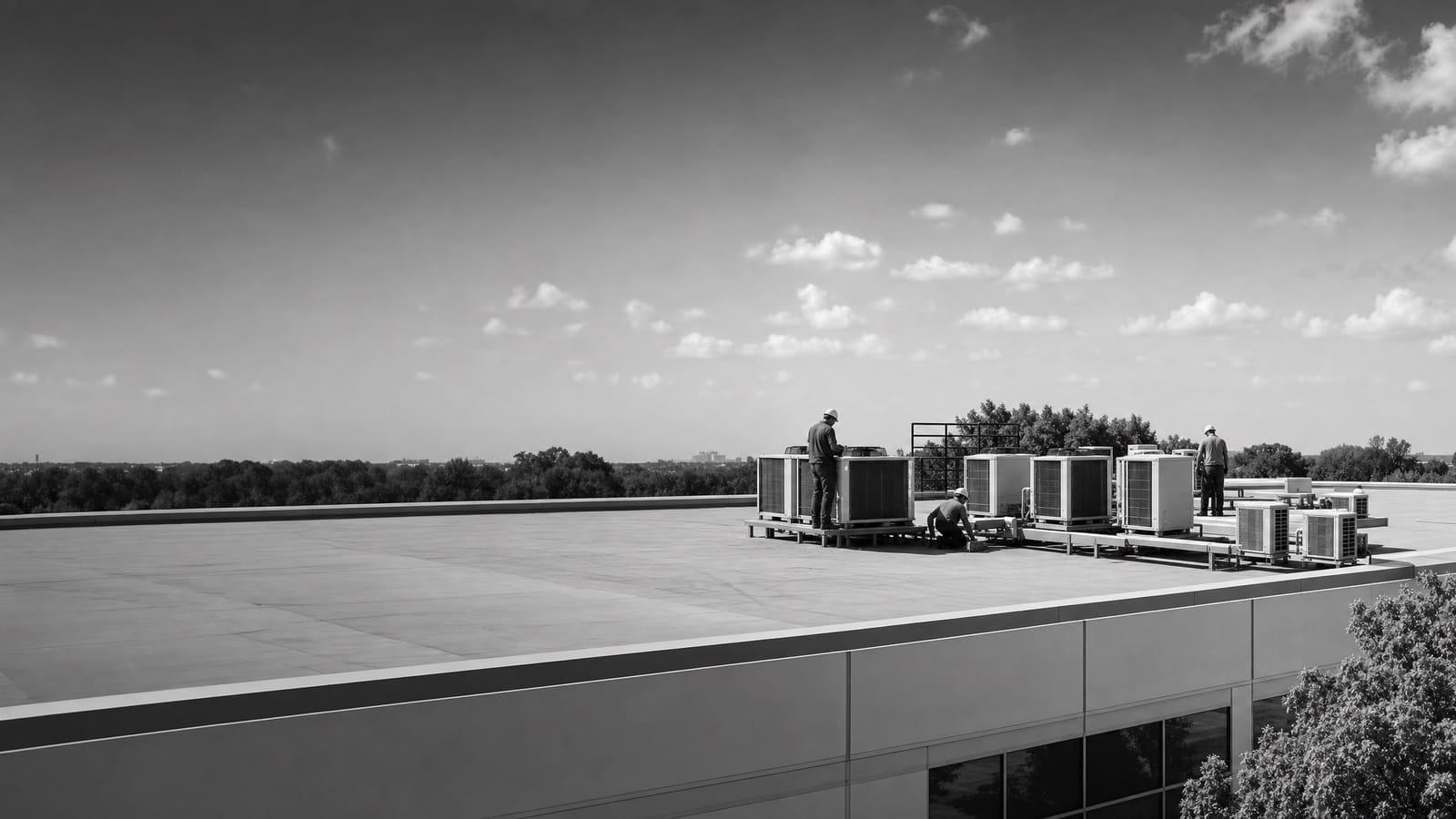
A commercial HVAC replacement means confirming the load, selecting equipment, pulling permits, rigging the old unit off and the new one on, connecting power, gas, and controls, then commissioning the system. Replacement usually beats another repair once a unit passes 15 years. Old, inefficient rooftop units waste between $900 and $3,700 each per year, so a second compressor repair on a tired cabinet rarely pays for itself.
A site review has to confirm tonnage against current occupancy, the curb and roof structure, available electrical capacity, gas line and clearance constraints, and crane access to the setting point.
THE THREE PATHS
Three ways to handle an aging rooftop unit
Most buyers land on one of three paths, and the cheapest one on paper is rarely the cheapest over ten years.
Replace-on-failure is usually the default by accident. The unit runs until it dies, generally in August, and then you buy whatever is available instead of what fits. Planned like-for-like replacement fixes the timing problem but carries the old sizing forward, including any mistake the last installer made.
The third path is a planned upgrade: confirm the load first, then step up the efficiency tier or change the heating source. Federal efficiency work pushed manufacturers to build rooftop units that cut energy use by up to 50 percent against the older standard, and that gap is where the operating savings live.
Which path fits depends on how long you hold the building, what an outage costs you, and whether the space is still used the way it was when the old unit was sized.
WHAT MOVES THE NUMBER
The line items that actually swing the price
No two roofs price the same, and the spread usually comes from five or six places rather than the unit itself. Ask for each of these as its own line so you can compare bids that look different on the cover page.
IN PRACTICE
How to choose the equipment
Start with what the building needs today. A twenty-year-old nameplate tells you what someone calculated for a different tenant, different lighting, and a different plug load. A fresh load calculation is cheap next to buying ten extra tons you will pay to run for the next two decades.
Then pick the heating source, because that decision drives everything downstream. A gas-fired packaged rooftop unit and a heat pump rooftop unit look nearly identical on the curb, but the heat pump reverses its cycle to heat instead of firing a burner. Heat pump rooftop units are best suited to mild-to-moderate winter heating, and across most of the South and West today's units are fully capable of covering most or all of the winter heating demand. Dual-fuel versions keep a gas burner for the cold snaps that even southern climates get.
Last, check what the site can actually support before you fall in love with a model. Electrical capacity, physical clearance on the roof, and existing gas lines decide more of these projects than efficiency ratings do. So does equipment availability. The unit you can get in three weeks may beat the unit you can get in twelve.
SCOPE CHECK
What makes a swap simple, and what does not
Two replacements at the same tonnage can finish a week apart or a season apart. The difference is usually access, electrical headroom, and whether anything about the system changes besides the box.
LOWER COMPLEXITY
Same box, same connections
Matching tonnage on the existing curb, gas and electric already sized for it, clear crane reach from a lot you can close for a morning, and a space used the same way it was at the last install.
HIGHER COMPLEXITY
Anything that changes the utilities
Going all-electric on a panel with no spare capacity, growing the footprint until the roof needs structural review, tight street access with no staging room, or a tenant who cannot lose conditioning for a full day.
BEFORE YOU BUY
The site review that keeps the quote honest
A quote written from a nameplate photo is a starting number, not a price. It gets you a tonnage range and real lead times, which is genuinely useful when a unit is down in August. It does not tell you what the roof, the panel, or the parking lot will add.
The walk should produce four answers. First, the load the space needs now, calculated rather than copied off the old plate. Second, whether the existing curb accepts the new unit or needs an adapter, and whether the structure carries the weight. Third, what the electrical service has to spare, because that single number decides whether an all-electric option is on the table at all. Fourth, how the crane gets in: reach, staging, and the hours you are allowed to close stalls.
Ask about the old refrigerant too. Recovering it from stationary equipment is federally regulated work, and it belongs on the quote as named scope rather than surfacing later as a change order.
Take three documents to the walk
Bring the nameplate, last summer's utility bills, and your panel schedule. Those three answer most of the sizing and electrical questions on the spot, and they turn a rough range into an installed price you can actually compare.
NEW ORLEANS
Who can pull the permit, and what it commits you to
New Orleans handles this through the mechanical A/C permit application, and one line on that form shapes your bidder list: only City of New Orleans Class A licensed mechanical A/C contractors may apply for this permit type. A contractor without that license cannot file for your replacement, whatever the price says.
The form treats replacement as its own project type alongside new construction, alteration, and demolition, and it notes that electrical, plumbing, heating, ventilating, air conditioning, and mechanical equipment each require separate permits. A rooftop swap that also touches the panel is more than one filing.
When the work counts as new construction or substantial improvement, the contractor attests that heating and cooling equipment is sized to ACCA Manual S using loads calculated by ACCA Manual J. Sizing stops being a judgment call and becomes something signed for.
Permits run on a six-month clock
A permit becomes null and void if the authorized work does not start within six months, or if it is suspended or abandoned for six months after it begins. On a long-lead unit, file with the delivery date in view rather than at contract signing.
OWNERSHIP MATH
Two things to settle before you sign
Equipment choice is the visible decision. The two that follow you for the next fifteen years are how the unit gets serviced and who pays for what.
New commercial equipment ships on different refrigerants than the units it replaces, which matters less on day one than it does in year three, when your service contractor is stocking parts for a mixed roof. And in a leased building, the split between landlord capital and tenant operating expense decides whether the higher efficiency tier is worth arguing for. The party paying the power bill is not always the party buying the unit.
SERVICE PLANNING
Mixed fleets get complicated
Handling and recycling refrigerant in stationary equipment is federally regulated. Adding a new refrigerant to a roof full of older units means recovery equipment, certified technicians, and separate spare parts on the service contract.
WHO PAYS
Split incentives on leased space
If the tenant pays the power bill and the owner buys the equipment, nobody is naturally motivated to fund the efficient unit. Settle that in the lease conversation before the equipment conversation, not after.
PLANNING AHEAD
Phasing a roof full of units
Buildings rarely have one rooftop unit, and replacing five at once is a capital event most owners cannot schedule. Phasing works better when it follows condition and load rather than age alone. Rank the units by what they cost to run and how often they fail, replace the worst two this year, then reuse the same engineering and rigging plan for the next pair.
That approach has a track record. Under the federal advanced rooftop unit campaign, more than two hundred public and private organizations upgraded over forty-three thousand units and cut a combined thirty-seven million dollars a year from their energy bills. Those were portfolio owners doing exactly this, replacing on a plan instead of on failure.
Procurement matters as much as selection. Order early enough that lead time is not quietly designing the project, and schedule the crane against a delivery date you trust. If a unit is already limping, decide now whether you accept a temporary rental during the gap or carry the risk. Deciding that in advance costs nothing. Deciding it during a heat wave costs plenty.
QUOTE CHECKLIST
Five things a comparable quote shows
Bids that differ by a wide margin usually differ in scope, not in price. Make every quote answer the same five questions and the comparison gets simple.
01
Tonnage, model, and efficiency tier
Named equipment rather than a category, with the heating source spelled out.
02
Curb, adapter, and structural work
Whether the new unit lands on the existing curb, and who patches the roof.
03
Electrical and gas scope
Feeder, disconnect, panel work, and any gas line capped or rerouted, each priced separately.
04
Crane day and closure window
Rigging, lot coordination, and the hours the building loses conditioning.
05
Permits, recovery, and commissioning
Class A permit filing, recovery of the old charge, and documented startup readings.
Keep planning locally
Related mechanical pages in New Orleans
Get a defensible number
Price the equipment and the building together.
Send the address, operating target, and target opening date. Flux will identify what must be verified before the project can be priced.
Get a free estimateQuestions
Straight answers.
When is replacement better than another repair?
Once a rooftop unit passes fifteen years, a repair mostly buys time on equipment that is already wasting money. Old, inefficient units burn $900 to $3,700 each per year in avoidable energy cost. If the compressor is the failing part and the cabinet is that old, replacement is usually the better spend.
Who can pull a commercial HVAC permit in New Orleans?
Only a City of New Orleans Class A licensed mechanical A/C contractor may apply for the mechanical A/C permit. Confirm the license before you compare prices, and remember that electrical work on the same project requires its own separate permit.
Does a heat pump rooftop unit make sense here?
Heat pump rooftop units suit mild-to-moderate winter heating, and across most of the South today's units can cover most or all of the winter heating demand. Efficiency falls as temperatures drop, so if the building cannot tolerate a cold snap, a dual-fuel unit keeps a gas burner for the coldest hours.
What sizing method should the quote use?
For new construction or substantial improvement, the New Orleans permit supplement has the contractor attest that equipment is sized to ACCA Manual S from loads calculated with ACCA Manual J. Even on a straight replacement, that is the standard worth asking for.
How long does a mechanical permit stay valid?
It becomes null and void if work does not begin within six months, or if the work is suspended or abandoned for six months after it starts. With long equipment lead times, time the filing to the delivery date rather than to contract signing.
Sources used for this guide
- [1]betterbuildingssolutioncenter.energy.gov — DOE Advanced Rooftop Unit Replacement Guidance
- [2]betterbuildingssolutioncenter.energy.gov — DOE Commercial Heat Pump Rooftop Unit Replacement Guidance
- [3]betterbuildingssolutioncenter.energy.gov — DOE High-Efficiency Commercial Rooftop Unit Toolkit
- [4]energy.gov — DOE Efficient Commercial Rooftop Air Conditioner Program
- [5]epa.gov — EPA Stationary HVAC Refrigerant Management
- [6]nola.gov — OSS_SP_MECHANICAL_PERMIT_APPLICATION_SUPPLEMENT_D1-AC.pdf