THE SHORT ANSWER
What a commercial HVAC replacement includes
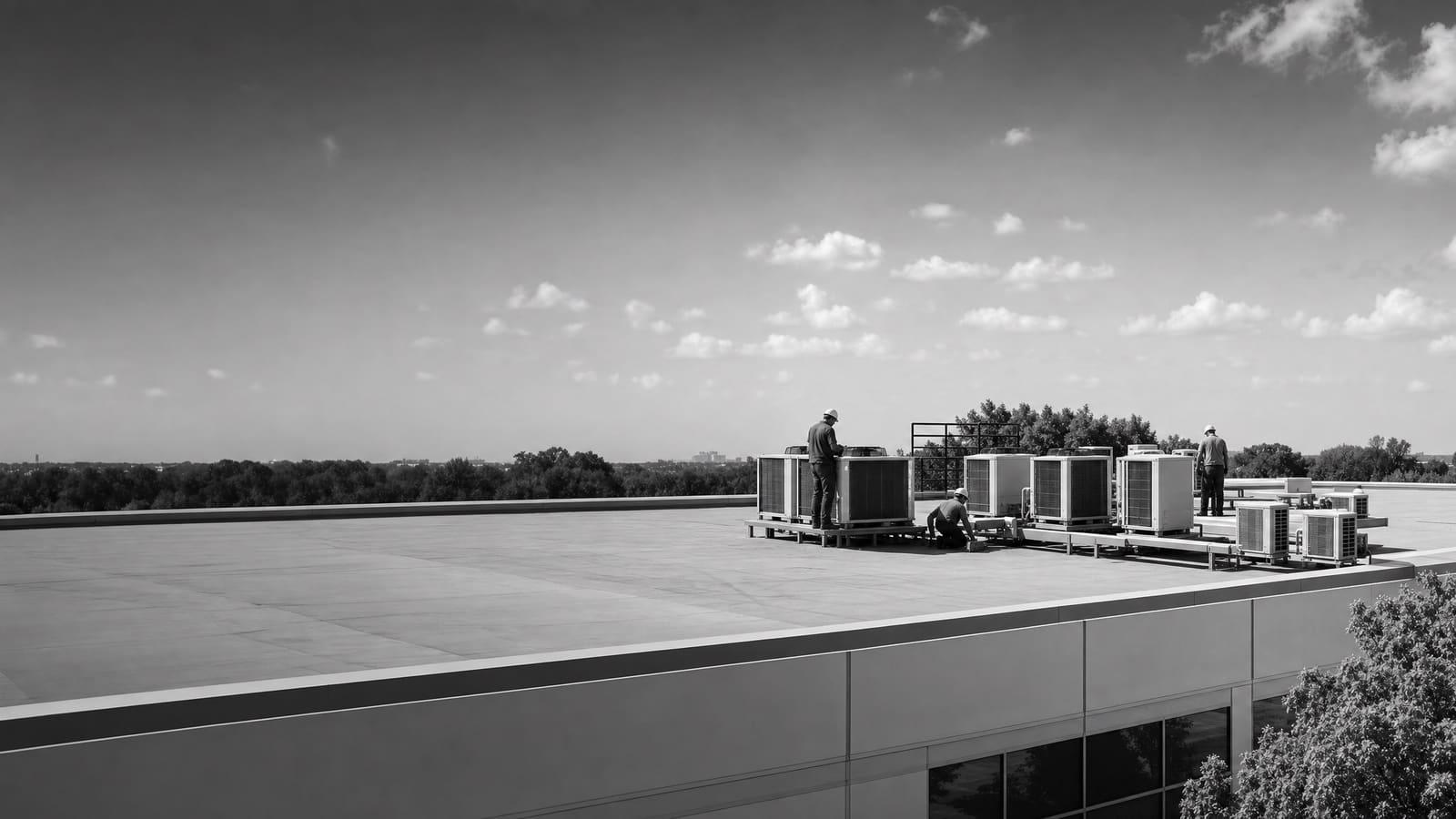
A commercial HVAC replacement covers the load calculation, equipment selection, permits, rigging and crane work, the curb adapter, electrical and gas connections, refrigerant recovery from the old unit, and commissioning. Replacement beats one more repair once a unit is past about fifteen years, or when the failure is in the compressor, the coil, or the cabinet itself. Old, inefficient rooftop units can waste roughly $900 to $3,700 each per year. A newer unit with one failed part is still worth fixing.
A site review has to confirm the actual load, the curb size and roof structure, the electrical service at the unit, and crane access before any of that turns into a price.
THREE WAYS TO GO
Gas heat, all-electric, or dual fuel
Most Modesto replacements come down to what the new unit runs on. A straight air-conditioning rooftop unit with a gas burner is the familiar path. A heat pump rooftop unit is technically similar equipment with reverse-cycle heating added, so it makes heat from electricity instead of gas.
Geography decides whether that trade works. Heat pump heating efficiency falls as outdoor temperatures drop, trending toward parity with electric resistance in real cold, which is why these units are best suited to mild-to-moderate winter heating. Across most of the U.S. West, today's heat pump rooftop units are capable of covering most or all of the winter heating demand, and California sits inside that region.
The catch is infrastructure, not climate. An all-electric unit asks for electrical capacity at the roof that the old gas unit never needed, and most all-electric models carry electric resistance backup that adds to the panel load. Dual fuel keeps the gas line as that backup instead. Sort the three by what your building already has, then by what your utility bills actually look like.
WHAT MOVES THE NUMBER
Where the money actually goes
There is no honest per-ton price for a commercial replacement, because the equipment is often the smaller half of the job. These are the lines that separate a cheap quote from a real one. Ask which of them the number in front of you already includes.
IN PRACTICE
Replace on your calendar, not the unit's
The most expensive commercial HVAC installation is the one nobody planned. The pattern is well documented: facility managers delay buying a new rooftop unit until the old one stops holding the space, needs constant service, or fails outright. Then the choice narrows to whatever is on a truck this week, at whatever that costs this week, with no time to compare efficiency tiers or chase an incentive.
Planned replacement gives all three back. You can run the load calculation before the crisis, pick the tier that pays over the life of the unit, and put the crane day on a Saturday when the lot is empty. Replacing an inefficient unit proactively is frequently the better business move than replacing on failure, and often better than a like-for-like swap even at the natural end of a unit's service life, because like-for-like carries the old sizing decision forward for another two decades.
The practical trigger is age plus behavior. A unit past fifteen years that still holds setpoint is a budget item for next fiscal year. A unit past fifteen years that has taken three service calls in one cooling season is this year's project. Get the quote before it dies, keep it on file, and the emergency turns into a phone call.
COMPLEXITY CHECK
What makes a swap simple or hard
Two replacements at the same tonnage can differ by weeks and by a lot of money. The split is almost never the equipment. It is what the roof, the panel, and the parking lot will allow.
STRAIGHTFORWARD
Same footprint, same fuel
The new unit matches the existing curb, the gas line and disconnect stay where they are, and the crane sets from a corner of the lot. The permit is a mechanical filing, the set happens in a morning, and the building opens normally the next day.
MORE INVOLVED
New size, new fuel, or tight access
Growing the tonnage means a curb adapter and often a structural look. Going all-electric means new feeders and possibly panel capacity. A unit that has to fly over the roofline or lift from the street means a bigger crane, a longer closure, and more coordination.
SCOPING IT
What the site review has to settle
A quote written from a nameplate photo is a starting number, not a price. The photo gives you tonnage, fuel type, and age. It does not tell you whether the roof can carry a heavier unit, whether the panel has capacity for electric heat, or whether the crane can reach the curb without closing the drive aisle.
A real site review walks four things. The load: what the space uses now, calculated from current occupancy, equipment, and operating hours, rather than copied off a nameplate someone selected twenty years ago. The infrastructure: electrical capacity at the unit, the gas line, physical constraints on the roof, and clear space around the curb. The access: crane position, reach, overhead lines, and how many stalls come out of service and for how long. And the schedule: the lead time for the tier you actually want, not for whatever happens to be in stock.
One more belongs on that list and usually gets skipped. Contractor familiarity with the technology you are choosing matters. A heat pump rooftop unit is a different commissioning conversation than a gas unit, and the startup, controls setup, and backup-heat staging all go better with someone who has done it before.
Ask for this before you sign
The installed price should name the tonnage and efficiency tier, the curb or structural scope, who pulls permits, the crane plan and closure window, and the commissioning documentation. If a line is missing, it is not free. It is a change order waiting to happen.
MODESTO SPECIFICS
Permits, and the roof under the unit
California building departments treat mechanical work as permit work. Any mechanical upgrade or repair, along with the electrical and plumbing that comes with it, needs a permit before the work happens, and a like-for-like rooftop swap is not an exception. Re-roofing is its own separate permit, whether it is an overlay or a full tear-off.
That second line is the one that changes a decision. If your roof membrane is near the end of its life and you are about to land a new unit on it, sequencing matters. Doing the roof first means the new unit sits on new material and the curb flashing gets detailed once. Doing the unit first means a roofer works around it later and you pay for that detail twice. Both are permitted separately either way, so the only real question is which order costs less.
Decide the roof before the crane
If the membrane is near end of life, price the re-roof and the replacement together and run the roof first. Confirm current filing and inspection requirements with the Modesto building department before the crane date is booked, not after.
OWNERSHIP QUESTIONS
Two decisions that outlive the install
The first is what the new unit does to the operating bill, and that is not settled by the efficiency rating alone. Whether a heat pump saves money depends on the local price of electricity against gas, so identical equipment can be a clear win in one building and a wash in another a few miles away. Run that comparison on your own bills before the order is placed.
The second is what happens to the rest of the roof. Replacing one unit out of four leaves you with a mixed fleet: different controls, different service intervals, and different refrigerant. New commercial equipment ships on lower-GWP refrigerant, which is a parts and training question for whoever holds your service contract rather than a day-one operating problem.
OPERATING COST
Run the fuel math on your own bills
Heat pump savings track your electric and gas rates, not a national average. Pull twelve months of both, compare them against the tier you are quoting, and check whether a current utility incentive applies before the equipment order goes in.
FLEET CONSISTENCY
One new unit changes the service plan
A single replacement leaves mixed controls and mixed refrigerant across the roof. Tell your service contractor what is landing so parts stocking, technician training, and inspection intervals get updated before the first call, not during it.
PHASING AND PROCUREMENT
One unit now, or the whole roof over three years
Buildings with several rooftop units rarely replace them all at once, and usually should not. But replacing them one emergency at a time is the worst possible phasing, because every unit gets bought at panic speed and the roof ends up carrying four vintages and four control schemes.
The middle path is a written sequence. Rank the units by age, service history, and what they serve, because the unit over the server room or the dining floor goes first regardless of what its nameplate says. Set a target of one or two per year. Then buy them as a program instead of a series of incidents: quote the full sequence with one contractor, lock the efficiency tier and controls standard once, and let each year's order reference that same spec. Lead times stop being a surprise, and the roof converges on one platform instead of drifting apart.
Lifetime cost is where the discipline pays. High-efficiency rooftop units were developed to use up to half the energy of the older standard they replace, and that gap repeats every year the unit is on the roof. Buying the cheapest available box under time pressure spends the capital budget and leaves the operating budget exactly where it was.
QUOTE CHECKLIST
Five things a comparable quote shows
Two quotes only compare when they scope the same job. Ask for these five in writing, and the cheaper number either stays cheaper or explains itself.
01
Equipment and tier
Make, model, tonnage, heating type, and efficiency rating, plus the lead time for that exact unit rather than a similar one.
02
Curb and structural scope
Whether the unit lands on the existing curb, an adapter, or new framing, and who owns the cost if the roof needs reinforcement.
03
Electrical and gas scope
Any panel, feeder, disconnect, or gas line change the new unit requires, priced out instead of marked as by others.
04
Crane, access, and schedule
Rigging plan, crane size, which stalls close and for how long, and the calendar day the set actually happens.
05
Permits and commissioning
Who files, who meets the inspector, and what startup record you receive with charge, airflow, and control settings verified.
Keep planning locally
Related mechanical pages in Modesto
Get a defensible number
Price the equipment and the building together.
Send the address, operating target, and target opening date. Flux will identify what must be verified before the project can be priced.
Get a free estimateQuestions
Straight answers.
When is replacing a commercial rooftop unit better than repairing it?
Once a unit is past about fifteen years, or when the failure is in the compressor, the coil, or the cabinet, replacement is usually the better spend. Old, inefficient rooftop units can waste roughly $900 to $3,700 each per year, and repeated in-season service calls are the signal that the repairs have stopped buying you much. A newer unit with one failed component is still worth fixing.
Does a heat pump rooftop unit make sense in Modesto?
Heat pump rooftop units are best suited to mild-to-moderate winter heating, and across most of the U.S. West today's units can cover most or all of the winter heating demand. The limit is usually infrastructure rather than climate. An all-electric unit needs electrical capacity the old gas unit never asked for, and its backup heat is electric resistance. If the panel is tight, dual fuel keeps the gas line as backup.
Do I need a permit to replace a rooftop unit in Modesto?
Plan on it. California building departments treat any mechanical upgrade or repair as permit work, including the electrical that comes with it, and a like-for-like swap does not escape that. Re-roofing is a separate permit. Confirm current filing and inspection requirements with the Modesto building department before the crane is scheduled.
What happens to the refrigerant in the old unit?
It gets recovered, not vented. Federal Clean Air Act rules govern the handling and recycling of refrigerant in stationary air-conditioning and heat pump equipment, and the work is done by certified technicians. Recovery should appear as a line on the quote rather than being folded into demolition.
Should I replace all the rooftop units at once?
Rarely all at once, but also not one emergency at a time. Rank the units by age, service history, and what they serve, then set a pace of one or two a year and quote the whole sequence against one equipment and controls standard. You get predictable lead times and a roof that runs on one platform instead of four.
Sources used for this guide
- [1]betterbuildingssolutioncenter.energy.gov — DOE Advanced Rooftop Unit Replacement Guidance
- [2]betterbuildingssolutioncenter.energy.gov — DOE Commercial Heat Pump Rooftop Unit Replacement Guidance
- [3]betterbuildingssolutioncenter.energy.gov — DOE High-Efficiency Commercial Rooftop Unit Toolkit
- [4]energy.gov — DOE Efficient Commercial Rooftop Air Conditioner Program
- [5]epa.gov — EPA Stationary HVAC Refrigerant Management
- [6]californiacity-ca.gov — HVAC Permits