THE DIRECT ANSWER
What commercial HVAC replacement and installation includes
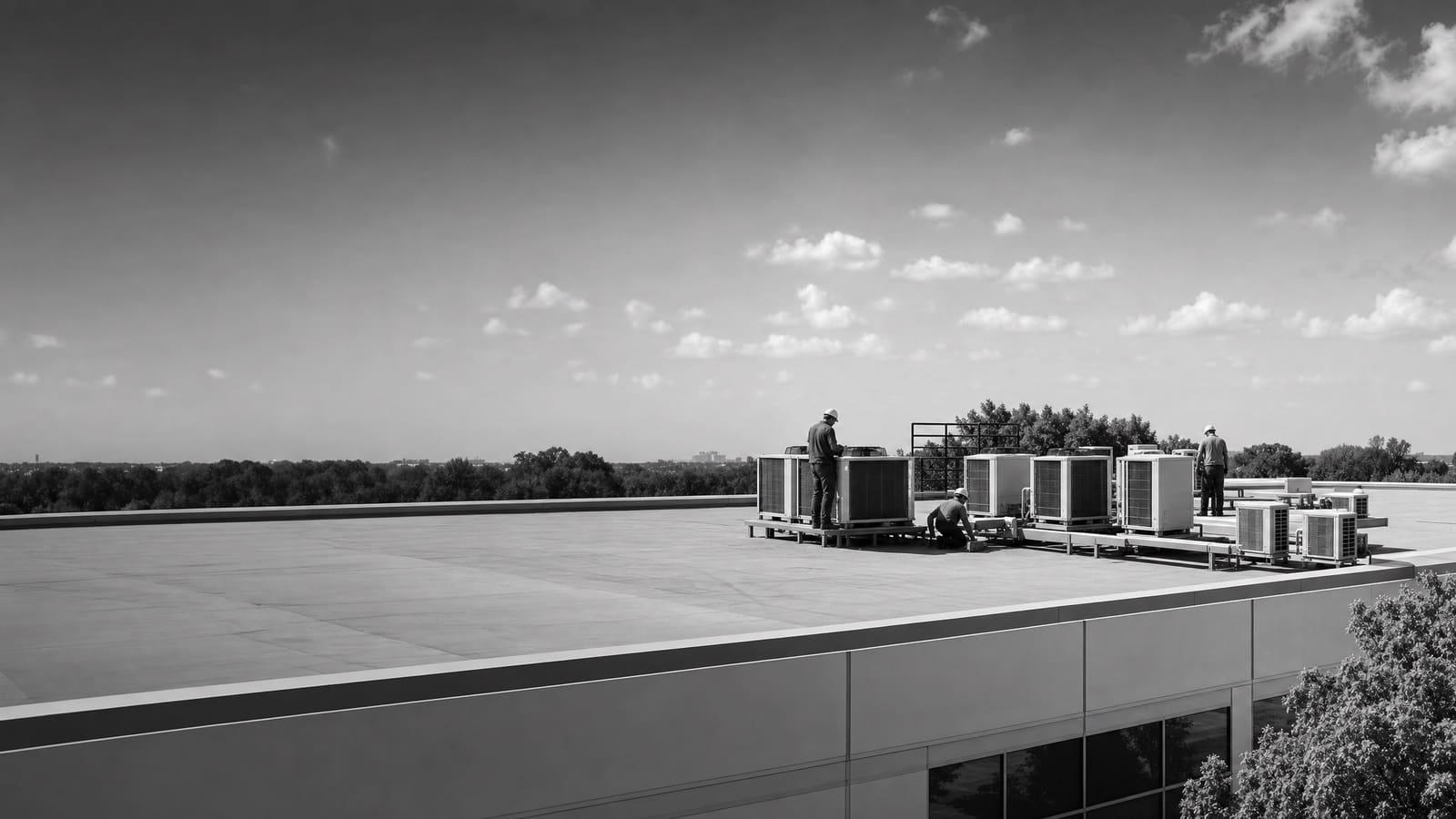
A commercial HVAC replacement covers load verification, equipment selection, permitting, rigging and set, mechanical and electrical connections, controls integration, and commissioning. Replacement usually beats another repair once a unit is past fifteen years and calling for repeat service. Federal analysis finds old, inefficient rooftop units waste roughly $900 to $3,700 per unit each year — a cost you carry whether or not you act. Waiting for failure also removes your choice of equipment, efficiency tier, and timing.
A site review has to confirm actual load against current occupancy, curb and structural condition, available electrical capacity, gas service, crane reach, and any controls the new unit must talk to.
THE THREE PATHS
Three ways to handle an aging rooftop unit
Most owners are choosing between three paths, and the honest comparison is not this year's invoice. It is what each path costs over the next several years.
Repair keeps cash in the account today. It is the right call on a young unit with a discrete failure. It is the wrong call on equipment past fifteen years, where federal analysis finds old, inefficient rooftop units waste roughly $900 to $3,700 per unit each year in energy alone, before the repair bills.
Like-for-like replacement is the fastest route back to conditioned space and the cheapest to engineer, because the curb, the connections, and the permit scope stay familiar. Its weakness is that it inherits whatever sizing decision was made for a building that may no longer exist in its old form.
A planned upgrade — right-sized capacity, a higher efficiency tier, and possibly a heat pump instead of gas heat — costs the most upfront and usually returns the most. It only stays available while the old unit is still running.
WHAT MOVES THE NUMBER
Budget lines that decide the final price
Installed price is a stack of separate decisions, not one number. These are the lines that move it most, and the ones worth pinning down before you compare bids.
IN PRACTICE
How to choose the equipment
Start with the load, not the nameplate. A unit sized twenty years ago was matched to that era's occupancy, lighting, plug load, and envelope. If the space has been re-tenanted, subdivided, or re-purposed since, the old tonnage is a guess wearing a data plate. A short load calculation is cheap next to a decade of running the wrong capacity, and it is the only honest way to know whether to replace like-for-like or resize.
Then choose an efficiency tier with eyes open. Federal work with manufacturers produced high-efficiency rooftop units built to cut energy use by up to half against the older standard, and more than 200 organizations that upgraded over 43,000 units together report about $37 million a year in lower energy bills. That is the case for paying up on the equipment line when a unit will run hard for its entire life.
Fuel is the third choice. Heat pump rooftop units are close technical cousins of standard air-conditioning units, and federal guidance says today's models are an appropriate solution across most of the U.S. South and West, capable of covering most or all winter heating demand. Whether one pencils out at your building depends on electricity and gas prices, electrical capacity at the roof, and available incentives.
SCOPE CHECK
What makes this job simple or complicated
Not every replacement is the same job. A short list of conditions separates a straightforward swap from a project that needs engineering, and knowing which one you have before you bid keeps the surprises out of the change orders.
STRAIGHTFORWARD
Lower complexity
Same tonnage, same fuel, a reusable curb, adequate electrical service already at the unit, a clear crane setup inside your own lot, and a stand-alone thermostat rather than a building automation tie-in.
ENGINEERED
Higher complexity
A capacity change, a gas-to-electric conversion, added ventilation or economizer scope, a shared or obstructed lot, roof framing that needs review, or a controls system other equipment depends on.
BEFORE THE QUOTE
What a real site review checks
A quote that arrives without anyone climbing the ladder is a guess. The site review is where the real scope gets found, and it should cover the same list every time.
Condition and size of the existing curb, because a different footprint means an adapter and sometimes a structural look. Roof deck and framing at the opening, especially if tonnage is going up. Electrical service at the unit — feeder size, breaker, and disconnect — which is the line that most often surprises owners moving from gas heat to an all-electric unit. Gas piping and venting if the heat stays fuel-fired. Ductwork, outside air, and any economizer tied into the unit. Controls, including what the building automation system expects to see and who owns that integration.
Access is the other half. Crane reach from the only usable setup point, what has to be coned off, how long that closure lasts, and when the building can absorb it. On an occupied building, the schedule is scope. A contractor who has walked the lot can tell you whether this is a morning or a weekend. One who hasn't will find out on the day, at your expense.
Ask for the findings, not just the price
The site review should come back as a written list of what was verified — curb, structure, electrical capacity, gas, controls, and access — so you can compare two quotes on the same scope instead of on the same number.
OWNER CONSIDERATIONS
Two questions that outlast the install
The first is refrigerant. New commercial equipment ships on newer refrigerants, and EPA rules under Section 608 of the Clean Air Act govern how refrigerant is handled, recovered, and recycled in stationary air-conditioning and heat pump equipment. On day one this changes nothing about how the building feels. It does change spare-parts strategy and service contracts on a roof carrying mixed vintages.
The second is who carries the cost. In leased buildings, the split between capital replacement and operating expense usually decides how much efficiency an owner is willing to buy. When the tenant pays the utility bill and the owner pays for the unit, the higher tier is a harder sell — which is exactly where a documented energy case and any available incentives matter most.
REFRIGERANT
Plan for a mixed fleet
Certified recovery is required work on the unit coming off. Going forward, decide whether the roof gets standardized over time or serviced as two generations of equipment.
COST SPLIT
Capital versus operating
Where the utility bill lands often decides the efficiency tier. Documented annual savings is what turns an upgrade from a preference into an approved capital line.
PLANNING AHEAD
Phasing a roof with several units
If your roof carries more than one unit, resist treating each one as an emergency when it fails. Replacement on failure is the most expensive way to buy equipment: no bid competition, no lead-time cushion, and whatever the supply house happens to have. Federal guidance is direct about this — proactively replacing inefficient units is often the smarter business move compared with replacing on failure, or even with a like-for-like swap at the end of a unit's useful service life.
A phased plan is simple. Inventory the roof by age, tonnage, refrigerant, and service history. Rank the units that are past fifteen years and pulling the most service calls, since those are the ones quietly spending $900 to $3,700 a year in wasted energy. Then replace on a schedule you set, in batches that share a crane day and a permit cycle.
Batching pays twice. Mobilization, rigging, and inspection costs spread across more than one unit, and you buy equipment with enough runway that lead time is a planning fact rather than a crisis. It also lets you standardize — same manufacturer, same controls, same filters — which makes maintenance cheaper for the rest of the equipment's life.
COMPARING QUOTES
Five things every installed price should show
Two installed prices are only comparable when they describe the same scope. Ask for these five lines in writing before you sign anything.
01
Equipment and capacity
Manufacturer, model, tonnage, efficiency tier, heat type, and refrigerant, with current availability stated next to the price.
02
Curb and structural scope
Whether an adapter is included, and whether roof framing or deck work is priced in or explicitly excluded.
03
Rigging and access plan
Crane size, setup location, how long the lot closure lasts, and who coordinates it with tenants.
04
Electrical, gas, and controls
Feeder and disconnect work, gas piping changes, and building automation integration, each priced rather than assumed.
05
Commissioning and closeout
Startup, charge and airflow verification, permits and inspections, warranty registration, and the documentation handed to you.
Keep planning locally
Related mechanical pages in Miami
Get a defensible number
Price the equipment and the building together.
Send the address, operating target, and target opening date. Flux will identify what must be verified before the project can be priced.
Get a free estimateQuestions
Straight answers.
When is replacement better than another repair?
Once a unit is past fifteen years and pulling repeat service calls, the math usually turns. Old, inefficient rooftop units waste roughly $900 to $3,700 per unit each year in energy alone, and that number runs whether you replace or not. A single discrete failure on a younger unit is still worth repairing.
Should you replace like-for-like or resize?
Confirm the load either way. If the occupancy, layout, and equipment in the space are unchanged, like-for-like is usually right and always faster. If the space was re-tenanted or re-purposed, a load calculation is what tells you whether the old tonnage was ever correct for how the building is used now.
Is a heat pump rooftop unit a real option for a Miami building?
Often, yes. Federal guidance says today's heat pump rooftop units are an appropriate solution across most of the U.S. South and West, and are capable of covering most or all winter heating demand. Whether one pencils out at your building depends on electricity and gas prices, electrical capacity at the roof, and available incentives.
What does the crane day actually look like?
Short, if the planning was done. The lot gets coned, the old unit comes off, the new one lands on a curb or adapter measured well in advance, and connections follow. The parts that go wrong — reach, closure time, weather — are decided weeks earlier, not that morning.
What happens to the refrigerant in the old unit?
It gets recovered by a certified technician. EPA rules under Section 608 of the Clean Air Act govern how refrigerant is handled, recovered, and recycled in stationary refrigeration, air-conditioning, and heat pump equipment. It is required work, and it should already sit inside the installed price rather than appearing later.
Sources used for this guide
- [1]betterbuildingssolutioncenter.energy.gov — DOE Advanced Rooftop Unit Replacement Guidance
- [2]betterbuildingssolutioncenter.energy.gov — DOE Commercial Heat Pump Rooftop Unit Replacement Guidance
- [3]betterbuildingssolutioncenter.energy.gov — DOE High-Efficiency Commercial Rooftop Unit Toolkit
- [4]energy.gov — DOE Efficient Commercial Rooftop Air Conditioner Program
- [5]epa.gov — EPA Stationary HVAC Refrigerant Management