THE DIRECT ANSWER
What a commercial HVAC replacement actually includes
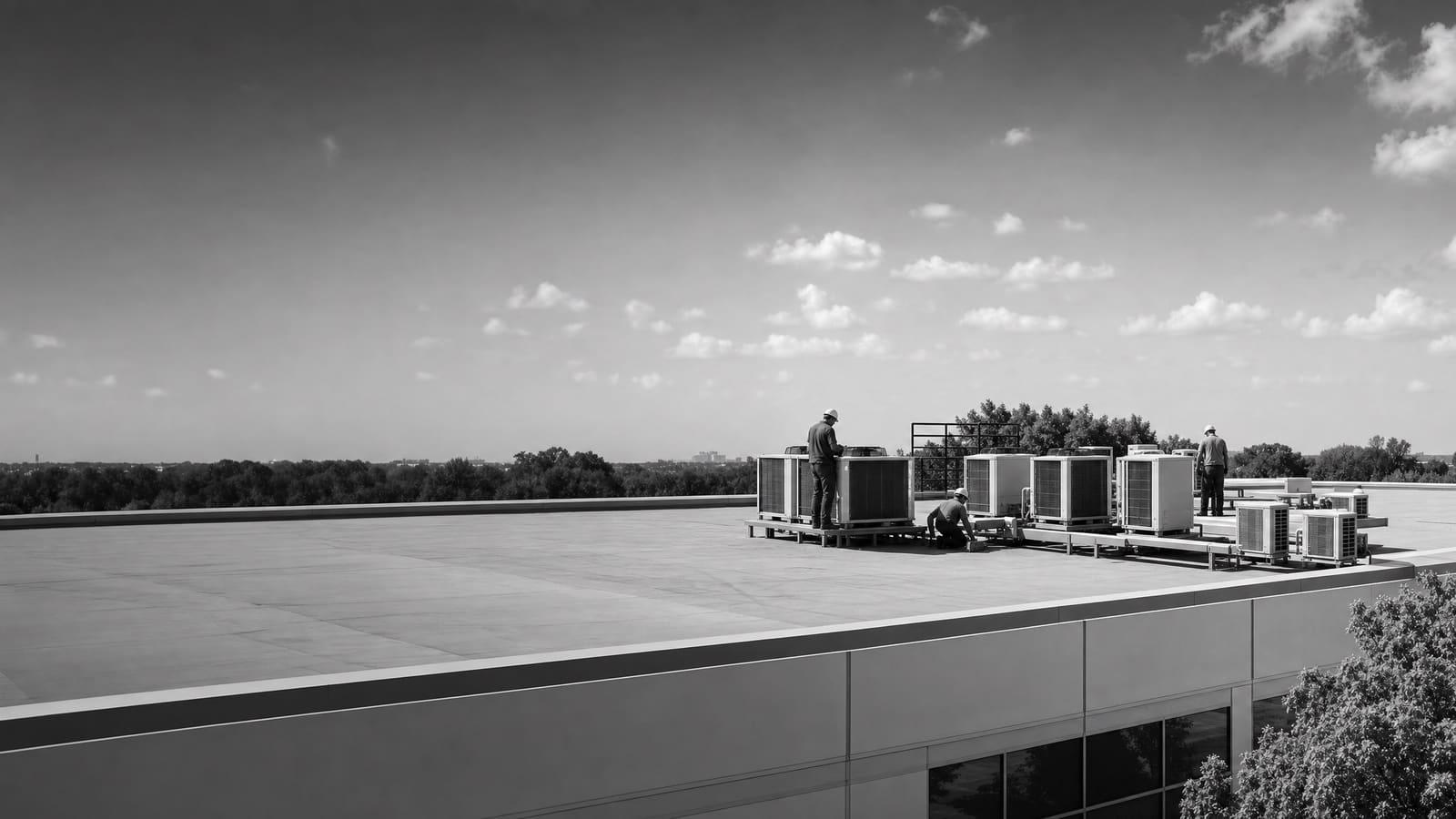
A commercial HVAC replacement covers the load calculation, equipment selection, refrigerant recovery from the old unit, rigging and setting, the curb adapter, gas, electrical and control connections, permits, and commissioning. Replacement beats one more repair once a unit is past roughly 15 years. Federal analysis puts the energy an old rooftop unit wastes at $900 to $3,700 per unit each year, and no repair returns that money.
A site review still has to confirm today's load, the curb and roof structure, electrical capacity at the unit, crane access across the lot, and which items the permit review adds to the scope.
THREE OPERATING CHOICES
How to handle an aging rooftop unit
Most Memphis buildings reach this decision with three paths open, and the cheapest-looking one is not always the cheapest to own. Price all three before the equipment order goes in.
A like-for-like gas-and-electric replacement is the fastest route back to conditioned space and the simplest permit. A heat pump rooftop unit puts heating and cooling on the same refrigerant circuit, and DOE guidance treats today's heat pump units as well matched to most of the South, where winter heating loads run mild to moderate. Dual fuel keeps a gas heat section for the cold snaps that reach this far south. The third path is to keep serviceable equipment and retrofit advanced controls instead, which DOE lists as a legitimate alternative when the unit still has life left.
What decides it is the unit's age, the condition of the cabinet and coils, and whether your electrical service has room for an electric heat section.
WHAT MOVES THE NUMBER
The lines that separate two bids on the same roof
No two roofs price the same, so compare quotes line by line instead of on the bottom number. These are the lines that move most between bids on the same building.
BUYING GUIDANCE
Buy the equipment, not just the installation
The decision starts with the load, not the nameplate on the old unit. Rooftop units cool close to half of all commercial floor space in this country, and plenty of them were sized for a building that has since changed tenants, lighting, and plug load. Replacing tonnage you no longer need locks in short cycling, humidity complaints, and a larger bill for the next two decades. Ask for the load calculation as a deliverable, not a promise.
Then compare equipment on total cost rather than sticker price. DOE's rooftop unit challenge pushed manufacturers well past the old baseline, toward a specification aimed at cutting unit energy use by up to half against the then-current standard. Across a Memphis cooling season, that gap shows up on every bill, which is why the unit that costs more to buy can be the cheaper unit to own.
Finally, put availability next to price. Lead time decides whether a failed unit is handled in weeks or months, and it belongs on the quote in writing. Teams often wait until a unit fails outright, and DOE's guidance is blunt that proactive replacement usually beats replacement-on-failure. Ordering ahead of the season is the cheapest scheduling decision available to you.
SIDE BY SIDE
What makes one swap simple and another one long
Two jobs with identical tonnage can sit a week apart on the schedule. The difference is almost always what has to change around the unit, not the unit itself. Read your building against these two profiles before you assume a timeline.
LOWER COMPLEXITY
Straight swap on an open roof
Same tonnage, same fuel, and an existing curb that fits or takes a standard adapter. Open lot for the crane, service capacity already in place, and no change in how the space is used.
HIGHER COMPLEXITY
New footprint or new fuel
Different tonnage or a move to electric heat. That can mean structural review, a new curb, added electrical capacity, gas line changes, and tight access that limits when and where a crane can set up.
SCOPING THE JOB
What a real site review checks before the quote
A number written from a nameplate photo is a starting point, not a price. Before it becomes a commitment, someone should be on the roof.
DOE's heat pump guidance lists the infrastructure questions plainly: electrical capacity at the unit and at the panel, physical constraints around the curb and the roof deck, and the gas lines already run to the equipment. Those three answers decide whether an all-electric or dual-fuel unit is even on the table, and they cost far less to answer in week one than on a crane day.
The review should also cover the parts buyers rarely think to ask about. How the old refrigerant comes out matters, because EPA rules under the Clean Air Act govern how refrigerant is handled and recycled in stationary air-conditioning equipment. Contractor familiarity matters too. DOE flags installer knowledge as its own consideration for heat pump units, since a crew that has set dozens of them scopes the work differently than a crew setting its first.
Ask for the findings in writing. One site review that produces a one-page scope is worth more than three quotes written from the same guess.
Ask for these before you sign
The load calculation, measured curb dimensions, available electrical capacity at the unit, the rigging and lot-closure plan, a confirmed equipment lead time, and the commissioning checklist you receive at close-out.
WHAT MEMPHIS CHANGES
Southern climate, long cooling season
Memphis sits in the part of the country DOE describes as well suited to heat pump rooftop units. The heating season is mild to moderate, and DOE's guidance says today's heat pump units can cover most or all of the winter heating demand across most of the South. Cooling is the long season here, so cooling efficiency and dehumidification carry most of the operating cost.
The same guidance carries a caution worth reading before you commit to all-electric. Southern climates still see sharp cold snaps, and heat pump heating efficiency falls toward electric resistance as outdoor temperature drops. That is the argument for dual fuel in buildings that cannot tolerate a cold morning, and for sizing the electric heat section carefully if you go all-electric. Whether the switch lowers the bill depends on local electricity and gas prices, so model it against your own rates.
Before you commit to all-electric
Run the numbers on your own gas and electric rates, confirm the panel has capacity for an electric heat section, and decide what the building has to do on the coldest morning of the year.
AFTER THE INSTALL
What owning the new unit looks like
The install ends on a Tuesday. Ownership runs for the next two decades, and two decisions made during the project shape most of it.
The first is the fleet. If you have several rooftop units of different ages, a replacement is really a portfolio decision, which is exactly how DOE writes its guidance. Setting the replacement order and a standard specification once beats making the same call in a panic five separate times.
The second is refrigerant. New equipment ships on newer refrigerants, and EPA rules under the Clean Air Act set how refrigerant is handled, recovered, and recycled in stationary equipment. A mixed fleet means your service contract and spare-parts plan have to cover both the old chemistry and the new one.
PLANNED VS PANIC
Replace before failure
DOE is direct about this: proactively replacing inefficient units usually beats waiting for failure, and often beats a like-for-like swap at the end of service life. Failure pricing is the most expensive pricing there is.
SERVICE PLANNING
Keep the commissioning record
Charge, airflow, and control settings verified at startup are what a warranty claim and the next technician both lean on. Ask for the documentation package at close-out, not months later.
PROCUREMENT
Phasing a multi-unit replacement
Buildings rarely have one tired unit. They have six, installed the same year, aging along the same curve. Replacing all of them at once is the cleanest engineering answer and the hardest budget conversation, so most owners phase the work.
Phase by consequence, not by age. The unit over the space that cannot lose cooling goes first, followed by the units wasting the most energy. An old rooftop unit can burn $900 to $3,700 a year in wasted energy alone, so the worst performers help pay for their own replacement while the rest of the fleet waits its turn.
Standardize before the first order. One manufacturer, one efficiency tier, and one control platform across the phases keeps spare parts, technician familiarity, and building automation simple for years. It also gives you a repeatable quote to compare against instead of six unrelated bids.
Then check the incentive picture before each phase rather than once at the start. Utility and program incentives for high-efficiency rooftop equipment shift from year to year, and DOE maintains guidance on where incentives for rooftop replacement sit. Confirm what actually applies at the moment you buy.
COMPARING QUOTES
Five lines every comparable quote should show
Bids only compare when they show the same things in the same order. Ask every contractor for these five lines, and the differences between prices stop being a mystery you have to guess at.
01
Equipment and efficiency tier
Make, model, tonnage, heat type, and the efficiency rating of the exact unit being quoted.
02
Confirmed lead time
The real availability date for that model, in writing, not a general range.
03
Curb, structural, and rigging scope
Adapter or new curb, any structural work, crane size, and how long the lot is closed.
04
Utility and code work included
Electrical, gas, and control changes, plus permits, inspections, and anything the review adds.
05
Commissioning and close-out
Startup readings, refrigerant recovery documentation, warranty registration, and the record you receive at handoff.
Keep planning locally
Related mechanical pages in Memphis
Get a defensible number
Price the equipment and the building together.
Send the address, operating target, and target opening date. Flux will identify what must be verified before the project can be priced.
Get a free estimateQuestions
Straight answers.
When does replacement beat one more repair?
DOE points at the 15-year mark: units older than that waste substantial energy compared with newer models, on the order of $900 to $3,700 per unit each year. Once repairs are recurring on a unit that old, the repair money is buying time on equipment that is already costing you more every month it runs.
Does a heat pump rooftop unit make sense in Memphis?
Usually it is worth pricing. DOE's guidance says today's heat pump rooftop units can cover most or all of the winter heating demand across most of the South. Confirm two things first: that your panel has capacity for the electric heat section, and how your own gas and electric rates compare, since that is what decides the bill.
How long is the building without conditioned air?
The lift itself is a short, scheduled outage that gets planned around your operating hours, and tenants generally notice the coned-off parking more than the equipment. The long pole is equipment lead time, which is why a confirmed availability date belongs on the quote next to the price.
What happens to the refrigerant in the old unit?
It is recovered, not vented. EPA regulations under Section 608 of the Clean Air Act govern how refrigerant is handled and recycled in stationary refrigeration and air-conditioning equipment. Ask for the recovery documentation as part of your close-out package.
Should we replace every rooftop unit at once?
Most owners phase it. Start with the unit over the space that cannot lose cooling, then work through the worst energy performers. Standardize the manufacturer, efficiency tier, and control platform on the first order so the later phases stay simple to service and easy to price.
Sources used for this guide
- [1]betterbuildingssolutioncenter.energy.gov — DOE Advanced Rooftop Unit Replacement Guidance
- [2]betterbuildingssolutioncenter.energy.gov — DOE Commercial Heat Pump Rooftop Unit Replacement Guidance
- [3]betterbuildingssolutioncenter.energy.gov — DOE High-Efficiency Commercial Rooftop Unit Toolkit
- [4]energy.gov — DOE Efficient Commercial Rooftop Air Conditioner Program
- [5]epa.gov — EPA Stationary HVAC Refrigerant Management