THE SHORT VERSION
What a commercial HVAC replacement actually includes
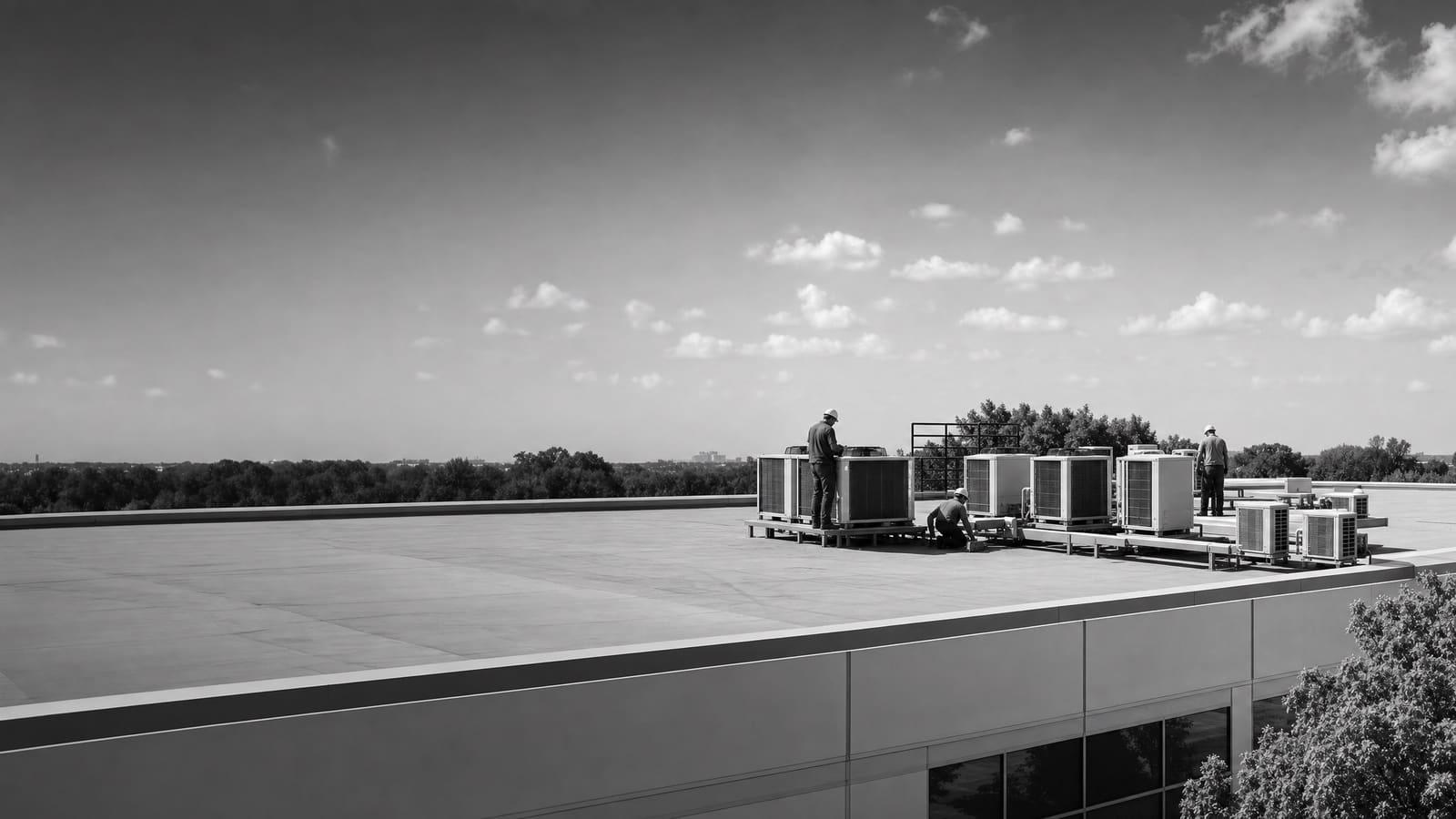
A commercial HVAC replacement is load verification, equipment selection, refrigerant recovery, rigging and setting the new unit, curb and duct transitions, gas, power and control connections, plan review where it applies, and commissioning. Replacement beats another repair once age is the actual problem rather than the failed part. Rooftop units past 15 years old waste substantial energy against current equipment, and old inefficient units burn $900 to $3,700 per unit per year in wasted energy — often more than the repair you were about to approve.
A site review still has to confirm the real load, the curb and roof structure under the new weight, available electrical capacity, gas service, crane access, and how the new unit ties into the controls you already run.
THE MAIN DECISION
Three ways to heat the replacement
Wisconsin winters decide most of this. A heat pump rooftop unit is the same machine as a standard air-conditioning rooftop unit, with the added ability to run the cycle backward and heat with it. Heat pump heating efficiency falls as outdoor temperature drops, and at the bottom of a cold snap it trends toward the efficiency of electric resistance heat. That does not rule heat pumps out here. It means the heating side has to be designed around the coldest hours, not the average day. The three configurations below cover nearly every Madison replacement, and which one fits depends on your gas service, your available electrical capacity, and whether the building carries emissions or electrification targets. Ask for the operating-cost comparison at your actual utility rates before you choose, because the answer changes building by building.
WHAT MOVES THE NUMBER
The lines that decide your price
Nobody can price a roof from an address. These are the items that actually swing a commercial HVAC installation number, roughly in order of how much they can move it. Get each one named on the quote so two bids describe the same job.
BUYING GUIDANCE
How to actually choose the equipment
Most owners inherit this decision from a nameplate. The old unit was 15 tons, so the quote is 15 tons. That is worth challenging once. Twenty years of tenant turnover, lighting retrofits, added plug load, and envelope work move a building's real load in both directions. A load calculation built on how the space is used today is the cheapest part of the project and the one that decides whether the building is comfortable for the next two decades.
The second decision is efficiency tier, and it is not a moral question. Old rooftop units waste roughly $900 to $3,700 each per year against current equipment, and the high-efficiency specification manufacturers built to cuts energy use by up to half compared with the older standard. Run that against your real utility rates and operating hours. A building open sixteen hours a day pays back a better unit far faster than one open forty hours a week.
The third decision is timing. Replacing on failure means taking whatever is available that week, at whatever it costs, with no room to compare heating configurations. Planned replacement lets you specify, bid, and schedule. Same money, spent with leverage instead of without it.
SIDE BY SIDE
Why one replacement is simple and the next one is not
Two replacements on the same street can land far apart on price. The gap is almost never the equipment. It is what has to change around the equipment to make the new unit fit and run.
LOWER COMPLEXITY
Straight swap conditions
The load has not changed, the new unit meets the existing curb with a standard adapter, the roof structure carries it, gas and power are already sized, and the lot gives the crane a clean reach. This is a scheduled morning, not a project.
HIGHER COMPLEXITY
Scope-expanding conditions
Tonnage or footprint changes, the heating source changes, the panel has no spare capacity, the roof needs structural review, the unit sits over occupied tenant space, or the only crane position closes your main entrance. Each one adds a trade and a week.
SCOPING
What a site review has to settle
A quote written from a phone photo of the nameplate is a guess wearing a number. The site review is where the guess becomes a price, and there are only about six things it has to answer.
First, the real load — how the space is used now, not what the last unit was rated for. Second, the physical fit: curb dimensions, adapter type, roof structure under the new weight, and clearances around anything the unit has to breathe past. Third, electrical capacity, which is the line most likely to surprise you on an all-electric or cold-climate heat pump. A unit that draws more than the one it replaces is only a good idea if the panel and service can carry it.
Fourth, gas service — whether it stays, gets resized, or gets capped and removed. Fifth, access: where the crane sets up, what it closes, and which hours the building can surrender. Sixth, controls — what the new unit has to talk to, and whether your existing automation speaks the same language.
Answer those six and two bids finally describe the same job. Skip them and you are comparing a complete scope against an incomplete one.
The one that surprises people
Electrical capacity. Heat pump rooftop units, especially all-electric and cold-climate models with resistance backup, can pull more than the equipment they replace. Confirm available service and panel space before the order is placed, not after the unit is on the roof.
IN WISCONSIN
Who reviews the plans matters here
Wisconsin handles commercial HVAC review at the state level through the Department of Safety and Professional Services. Commercial submittals go in as HVAC only, as building and HVAC together, or bundled with a kitchen hood review when the project includes one. Which path applies to your Madison building is not automatic. Some municipalities are delegated to take plan review locally instead of the state's Division of Industry Services, and the state publishes the current delegated list. It also publishes guidance written specifically for HVAC equipment replacement, which is the document that tells you whether a straight swap needs review at all. Sort this out before the equipment is ordered. A submittal path discovered late turns a scheduled crane day into a rescheduled one.
Two questions to settle first
Ask your contractor, in writing: who reviews this submittal, the state or a delegated municipality? And does this replacement fall under the state's equipment-replacement guidance, or does it require full HVAC plan review? Both answers change your schedule.
OWNERSHIP
Who pays for the box, who pays to run it
Two buildings can need identical equipment and still be different purchases, because the party paying for the unit is not always the party paying to run it. Settle that before the specification is written, since it decides how much efficiency is worth buying. The same question scales up. A single owner-occupied building can decide on its own merits. A portfolio decides once and then lives with that answer across a dozen roofs, which makes standardization worth more than the best individual pick at any one site. Neither answer is wrong, but the two lead to different equipment.
LEASED SPACE
Capital versus operating
In a triple-net or expense-recovery structure, the owner funds the replacement and the tenant pays the utility bill. That split quietly argues for the cheapest unit on the list. Check what your lease actually lets you recover before you accept it.
PORTFOLIO
One roof or twelve
Replacing one unit at a time leaves you running several refrigerants, several control platforms, and a parts shelf that fits none of them cleanly. A standard specification costs slightly more per site and considerably less per year.
PHASING
Procurement, sequencing, and the cost after year one
The cheapest version of this project is the one you schedule. Waiting for failure means buying whatever is on a truck that week, in season, with no room to compare a dual-fuel unit against an all-electric one, and often no room to do anything but a like-for-like swap at end of life. Planned replacement is the same money spent with leverage.
If you have more than one aging unit, sequence them rather than batching them. Take the worst performer first — usually the oldest, the one drawing the most service calls, or the one over the space that generates the most complaints. Watch what the new unit actually does for twelve months before you commit that standard across the rest of the roof. Rooftop units condition close to half of all commercial floor space in the country, so this is a well-traveled path: organizations that upgraded more than 43,000 of them cut a combined $37 million a year from their energy bills.
Then hold the specification. The value of a portfolio standard is not the first install. It is the third year, when your service contractor stocks one set of parts, your technicians know one control platform, and a failure at any building has a known answer instead of a fresh decision.
THE QUOTE
Five things a comparable quote shows
Two quotes are only comparable when they describe the same scope. These five items are what to look for. Anything missing is either a line someone bills you for later or a decision someone makes without you.
01
Equipment, named
Manufacturer, model, tonnage, efficiency rating, and heating configuration — gas, dual-fuel, or heat pump. Not just "new rooftop unit."
02
The heating design point
For any heat pump option, what the unit delivers at design cold and what carries the load when it cannot.
03
Curb, roof, and structure
Adapter type, framing or roofing work, and whether structural review is included or explicitly excluded.
04
Electrical and gas scope
Confirmed available capacity, any panel or service work, and what happens to the existing gas line.
05
Recovery, review, commissioning
Certified refrigerant recovery, the plan review or permit path, startup with airflow and charge verified, and the documentation you receive.
Keep planning locally
Related mechanical pages in Madison
Get a defensible number
Price the equipment and the building together.
Send the address, operating target, and target opening date. Flux will identify what must be verified before the project can be priced.
Get a free estimateQuestions
Straight answers.
When does replacement beat one more repair?
When age is the real problem rather than the failed part. Rooftop units past 15 years old waste substantial energy against current equipment, and old inefficient units run $900 to $3,700 per unit per year in wasted energy. Once a unit is in that age band and the repair is a meaningful share of a replacement, the repair is usually the more expensive choice.
Does a heat pump rooftop unit work through a Madison winter?
It can, but the configuration matters. Heat pump heating efficiency drops as outdoor temperature falls, and near the bottom it approaches electric resistance heat. That is exactly why cold-climate and dual-fuel rooftop units exist. In a Wisconsin climate, design the heating side around the coldest hours and decide deliberately what carries the load there.
Who reviews commercial HVAC plans in Wisconsin?
The state Department of Safety and Professional Services handles commercial building and HVAC plan review, and submittals can be HVAC only or bundled with building and kitchen hood review. Some municipalities are delegated to review locally instead of the state's Division of Industry Services, so check the current delegated list for your address before submitting.
What actually drives the installed price?
Tonnage and efficiency tier first, then everything the new unit forces around it: curb adapters and structural work, electrical capacity, gas line changes, crane access and the hours you can give up, and controls integration. Two quotes that differ sharply almost always differ on those lines, not on the equipment itself.
What happens to the refrigerant in the old unit?
It gets recovered, not vented. EPA rules under Section 608 of the Clean Air Act govern how refrigerant is handled and recycled in stationary refrigeration, air-conditioning, and heat pump equipment, and that work belongs to certified technicians. Confirm recovery appears as a line on the quote instead of an assumption.
Sources used for this guide
- [1]betterbuildingssolutioncenter.energy.gov — DOE Advanced Rooftop Unit Replacement Guidance
- [2]betterbuildingssolutioncenter.energy.gov — DOE Commercial Heat Pump Rooftop Unit Replacement Guidance
- [3]betterbuildingssolutioncenter.energy.gov — DOE High-Efficiency Commercial Rooftop Unit Toolkit
- [4]energy.gov — DOE Efficient Commercial Rooftop Air Conditioner Program
- [5]epa.gov — EPA Stationary HVAC Refrigerant Management
- [6]dsps.wi.gov — DSPS Heating, Ventilation, & Air Conditioning