THE DIRECT ANSWER
What commercial HVAC replacement in Louisville includes
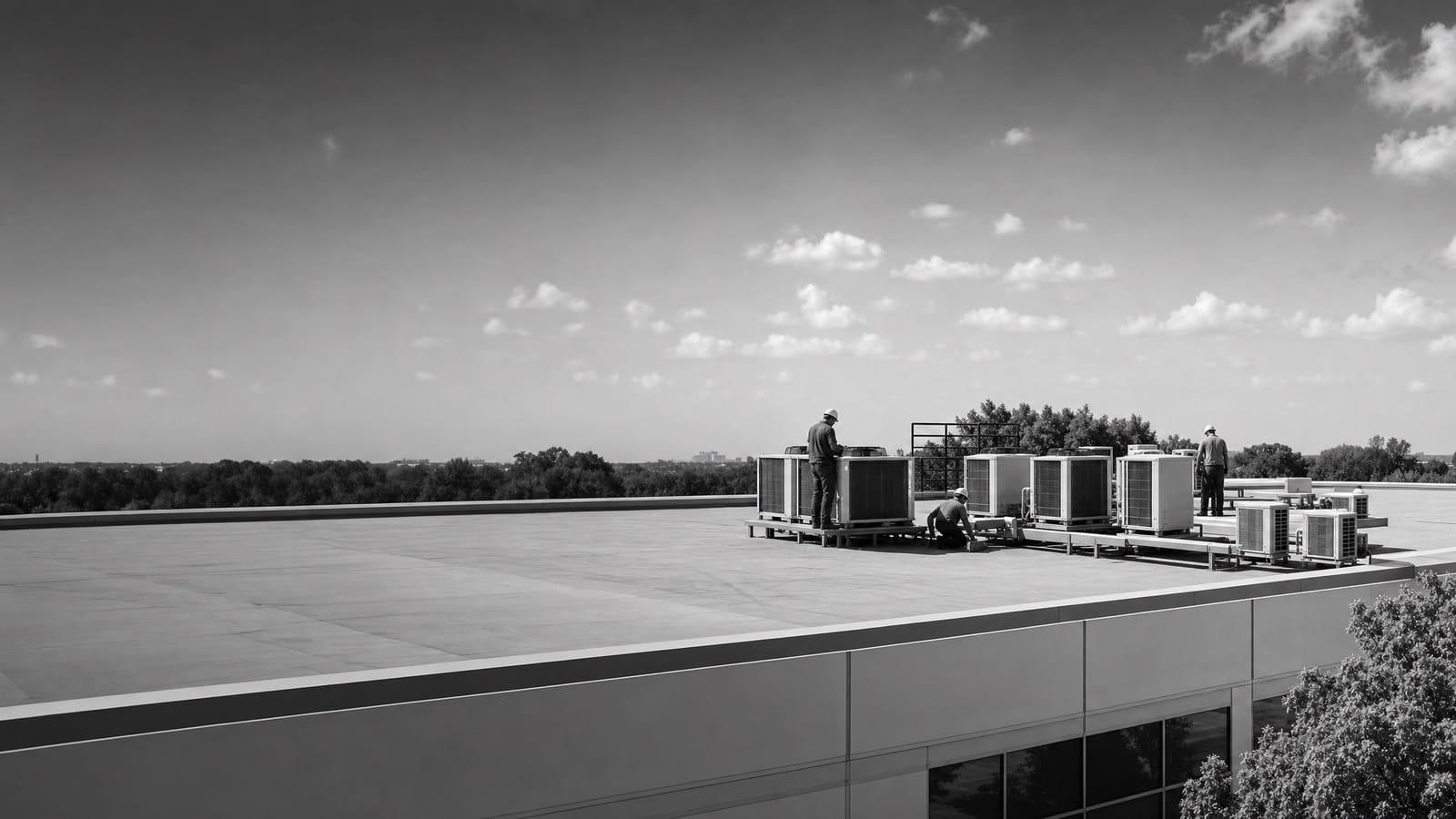
A commercial HVAC replacement covers the load calculation, equipment selection, removal of the old unit, curb or curb adapter work, gas, electric, and refrigerant connections, controls, permits, and commissioning. Replacement beats another repair once a unit is past about fifteen years. DOE reports that rooftop units that old can waste substantial energy, and that old, inefficient units burn $900 to $3,700 per unit a year in avoidable operating cost. Waiting for failure also removes your ability to choose the equipment.
A site review still has to confirm tonnage against how the space is used now, the roof structure under the curb, electrical capacity at the panel, and whether crane access works with your lot and your hours.
THREE PATHS
Three ways to replace a commercial unit
Every commercial replacement is a fuel and efficiency decision, not just a swap. You have three realistic paths.
The first is like-for-like: same fuel, same tonnage, same curb where possible. It is the fastest way back to conditioned space and the cheapest to engineer, and it is the right answer when the building's use has not changed. Its weakness is that it carries forward whatever sizing mistake the old unit had.
The second is a high-efficiency unit of the same type. DOE's High-Performance Rooftop Unit Challenge set a specification targeting up to fifty percent less energy than the standard of the day, and manufacturers now offer many models that exceed it. You pay more at the crane and take it back on the bill.
The third is a heat pump rooftop unit. DOE groups these into dual-fuel, all-electric, and cold-climate types, and its guidance is clear that the right choice depends on climate, local gas and electric prices, electrical capacity, existing gas lines, and whether contractors in your market install and service them regularly. It is a real option, and it deserves a real model rather than a coin flip.
WHAT MOVES THE NUMBER
Budget lines that decide the price
An installed price is a stack of line items, and the stack is where quotes diverge. These are the lines that move most between bidders looking at the same roof. If one quote is notably cheaper, one of these is usually missing or assumed away.
IN PRACTICE
Choosing between another repair and a new unit
DOE's guidance on rooftop units makes a blunt observation: most facility teams wait until the unit fails, needs constant service, or can no longer hold the space before they buy a new one. That is understandable, and it is also the most expensive way to make the decision. Failure picks your equipment for you. Whatever is on a regional shelf that week becomes your next fifteen years.
The better test is simple. Add up what the unit has cost you over the last two seasons in parts, labor, refrigerant, and tenant complaints, then set that against the annual waste DOE attributes to old, inefficient rooftop equipment: $900 to $3,700 per unit. If the repairs are climbing and the unit is past fifteen years, another compressor is rarely the cheaper answer. It is just the answer that fits this month's budget.
Planned replacement also buys options that emergency replacement cannot. You can right-size against how the building is actually used today, spec the efficiency tier you want, order a curb adapter from real measurements instead of a guess, and schedule the crane for a Saturday morning instead of a Tuesday at noon. DOE frames proactive replacement as a business decision rather than a maintenance event, and on a commercial roof that framing holds up.
SCOPE CHECK
What makes a replacement simple or complicated
Two replacements can carry the same tonnage and land thousands of dollars apart. The difference is almost never the equipment itself. It is what the roof, the panel, and the lot demand around it. Here is roughly where a job sits on each side.
LOWER COMPLEXITY
Straightforward swap
Same tonnage and same fuel, a unit that lands on the existing curb or a simple adapter, adequate panel capacity already in place, clear crane access from a lot you control, and a building that can give up a few stalls on a weekend morning.
HIGHER COMPLEXITY
Engineered replacement
Larger tonnage or a new footprint, structural review on the deck, a panel that needs upgrading, a fuel change with gas line work, crane reach over a street or a neighbor's property, controls integration, or a tenant who cannot lose conditioning for a shift.
THE SITE REVIEW
What a walk of the roof has to settle
A quote written from a nameplate photo is a starting number, not a price. What turns it into a price is somebody standing on the roof.
The review has to settle tonnage first, and tonnage should come from how the building is used now, not from what the last contractor installed. Twenty years changes occupancy counts, plug loads, lighting, and often the envelope itself. Then it settles the physical questions: does the new footprint match the existing curb, what does the deck under that curb look like, where does the crane set up, and what does the lot lose for the morning.
The infrastructure questions are the ones that quietly reprice a job. DOE lists electrical capacity, physical constraints, and gas lines as core considerations for anyone weighing a rooftop change, and each of them can turn a same-day swap into a two-trade project. A panel with no spare capacity means an electrical scope. A larger unit can mean structural work. A fuel change means a gas line decision either way.
The review should end with commissioning on the page. Charge, airflow, and control setpoints verified against spec and documented is what keeps month-two comfort complaints from becoming your problem.
Ask for the scope in writing
A good scope names the tonnage, the efficiency tier, the curb approach, who pulls the mechanical and electrical permits, how long the lot is closed, and which commissioning documents you receive at handoff.
LOUISVILLE CONTEXT
What Louisville changes about the decision
Louisville sits in the Ohio Valley, where buildings cool hard through a humid summer and still run real heating hours through winter. That combination is exactly what DOE's heat pump guidance tells you to model before choosing a fuel path. Heat pump heating efficiency falls as outdoor temperatures drop and trends toward electric resistance in the coldest hours, which is why dual-fuel and cold-climate rooftop units exist alongside all-electric ones.
For a Louisville building, that usually means the all-electric question deserves an actual model of your gas and electric rates rather than a rule of thumb, and dual-fuel deserves a serious look where winter occupancy runs long.
The permitting side is local. A replacement typically touches mechanical and electrical review, and structural review enters the picture when tonnage or footprint grows. Confirm the current scope and inspection sequence with the local building authority before you set a crane date, because that timeline drives everything after it.
Model it before you commit
Before choosing all-electric, run your own gas and electricity rates against the building's heating hours, and have the electrician confirm panel capacity. DOE treats both as decision points, not afterthoughts.
AFTER THE INSTALL
Two things you own the day the unit runs
An installation is measured in days. Ownership is measured in the fifteen-plus years the unit sits on the roof. Two things start the morning the new equipment runs, and both are far cheaper to plan for during procurement than to react to in year three.
The first is refrigerant. New commercial equipment ships on newer low-GWP refrigerants, which means a mixed roof holds units on different refrigerants with different service requirements. The second is maintenance, which is the only thing protecting the efficiency you just paid for. Neither is dramatic. Both are the difference between a unit that delivers rated performance for a decade and one that quietly drifts back toward what you replaced.
REFRIGERANT
Plan the service side
EPA rules under Section 608 of the Clean Air Act govern how refrigerant is handled and recycled in stationary air conditioning and heat pump equipment. On a mixed roof, your service contractor needs the right recovery equipment and certification for every unit up there, not just the newest one.
MAINTENANCE
Protect the efficiency
The savings case for a high-efficiency unit assumes it stays clean, charged, and correctly controlled. Dirty coils, drifting economizer dampers, and overridden setpoints erase the difference fast. Put the maintenance scope and the controls documentation in the same conversation as the purchase.
PLANNING AHEAD
Replacing a fleet without replacing it all at once
Most commercial buildings do not have one aging unit. They have four, and three of them went in the same year. Replacing all of them at once is a capital event most owners cannot absorb, so the practical move is to sequence them.
Rank the fleet by age, service history, and how much the space each unit serves actually matters. The unit over the conference rooms and the unit over the warehouse are not the same priority. Replace the worst one first, use it to settle your standard spec — efficiency tier, controls platform, curb approach — then repeat that spec on the rest as budget allows. The second and third replacements move faster and cost less to engineer because the decisions are already made.
This is not a fringe strategy. DOE's Advanced RTU Campaign has tracked more than 200 organizations upgrading over 43,000 rooftop units, with combined reported savings of $37 million a year on energy bills. Those are portfolios working through their roofs a phase at a time.
Two procurement notes. DOE lists incentives among the key considerations for a rooftop change, so check what is available and confirm application timing with the program administrator before you order. And get lead times in writing, since availability, not price, usually decides whether the unit lands before the season turns.
BEFORE YOU SIGN
Five things a comparable quote shows
Three quotes are only comparable if they describe the same job. Ask every bidder to show these five lines and the spread usually explains itself. The cheapest number often turns out to be the one missing a scope item.
01
The unit, spelled out
Manufacturer, model, tonnage, efficiency tier, heating type, and refrigerant. Not just "replace RTU-3 in kind."
02
Curb and structural approach
Whether the new unit lands on the existing curb, needs an adapter, or triggers framing work, and who is responsible for that scope.
03
Crane, rigging, and lot impact
Who supplies the crane, which day it lands, how many stalls close, and for how long.
04
Electrical, gas, and controls scope
Panel work, feeder changes, gas line sizing, and what it takes to tie into your building automation system.
05
Permits, lead time, and commissioning
Which permits are included, the quoted equipment lead time, and the startup documents you receive at handoff.
Keep planning locally
Related mechanical pages in Louisville
Get a defensible number
Price the equipment and the building together.
Send the address, operating target, and target opening date. Flux will identify what must be verified before the project can be priced.
Get a free estimateQuestions
Straight answers.
How long does a commercial rooftop replacement take?
The crane set and connections for a single packaged unit are usually a one- to two-day event on site. Equipment lead time is the real variable, which is why availability belongs on the quote right next to the price.
When is replacement better than another repair?
DOE notes that rooftop units over fifteen years old can waste substantial energy, and that old, inefficient units run $900 to $3,700 per unit a year in avoidable cost. Once repairs start repeating and the unit is past that age, replacement usually wins.
Should we switch to a heat pump rooftop unit?
Sometimes. DOE points to climate, gas and electric prices, electrical capacity, and existing gas lines as the deciding factors, and offers dual-fuel and cold-climate versions for buildings with real winter heating. Model it for your building before deciding.
Do we have to right-size, or can we match the old unit?
Confirm the load either way. If occupancy, equipment, and operating hours have not changed, like-for-like is often correct. If they have, matching the old nameplate just repeats a twenty-year-old assumption.
Who handles the crane, permits, and inspections?
The installing contractor should own the rigging plan, lot coordination, permits, and inspection scheduling inside the installed price. Confirm that in writing before you sign, because it is a common gap between quotes.
Sources used for this guide
- [1]betterbuildingssolutioncenter.energy.gov — DOE Advanced Rooftop Unit Replacement Guidance
- [2]betterbuildingssolutioncenter.energy.gov — DOE Commercial Heat Pump Rooftop Unit Replacement Guidance
- [3]betterbuildingssolutioncenter.energy.gov — DOE High-Efficiency Commercial Rooftop Unit Toolkit
- [4]energy.gov — DOE Efficient Commercial Rooftop Air Conditioner Program
- [5]epa.gov — EPA Stationary HVAC Refrigerant Management