THE SHORT VERSION
What a commercial HVAC replacement actually covers
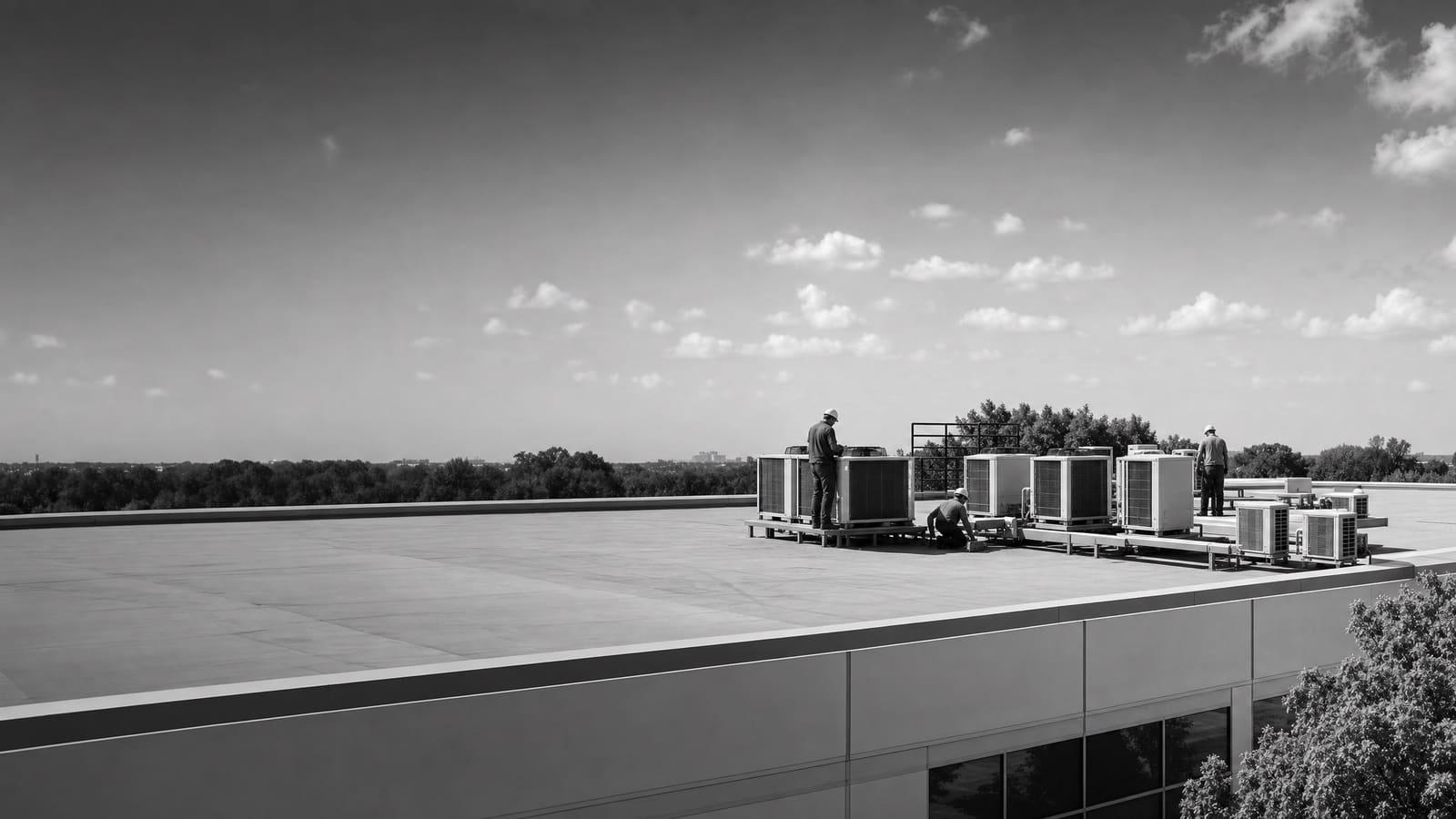
A commercial HVAC replacement covers a fresh load check, equipment selection against real lead times, rigging and the crane set, curb and connection work, permits, and commissioning. Replacement beats one more repair once a rooftop unit passes roughly 15 years, needs frequent service calls, or can no longer hold the space. An old, inefficient rooftop unit can waste $900 to $3,700 a year in energy alone, which is often the repair budget in disguise.
A site review still has to verify curb size and roof structure, electrical capacity at the unit, gas line status, and crane reach across the lot before any number is real.
THE THREE PATHS
Three ways this project usually gets decided
Almost every commercial HVAC replacement lands on one of three paths, and the choice is usually made long before the quote arrives. Waiting for failure is the default, and it is the most expensive default available: you buy whatever unit exists that week, on whatever schedule the crane and the manufacturer allow, while the space stays uncomfortable. Planning a like-for-like swap at end of life keeps engineering light and permits simple, but it carries forward whatever the old unit got wrong. Planning an efficiency or fuel-switch upgrade takes the most homework up front — load, electrical capacity, gas lines, incentives — and it is the only path that changes what the building spends every month afterward. Which one fits depends on how long you plan to hold the building and what a bad week of downtime actually costs you.
WHAT MOVES THE NUMBER
The six lines that decide your installed price
No two roofs price the same, and the spread almost always comes from six places. Ask for each one broken out rather than buried inside a single installed number, because the risky lines are the ones a bidder can quietly leave out.
IN PRACTICE
Choosing equipment before the crane is booked
Start with what the building actually does today. Rooftop units cool close to half of all commercial floor area in the country, and most of them were sized for an occupancy pattern that has since changed. Twenty years of new lighting, different tenants, added glass, or a lighter headcount can move the load enough that a same-tonnage swap locks in a comfort complaint you will hear about every July.
Then decide about fuel. Heat pump rooftop units are technically close to standard cooling units, but they add reverse-cycle heating, and they perform best where winters are mild to moderate. Across most of the South, current heat pump models can carry most or all of the winter heating demand, which moves the real decision onto electrical capacity and utility rates rather than onto whether the equipment can do the job. If the building's power service is already tight, a dual-fuel unit keeps gas heat as backup and shrinks the electrical scope.
Book the crane last. Equipment lead time, not the lift, is what sets the schedule, so availability belongs on the quote right next to the price.
SCOPE CHECK
What makes this project simple or complicated
Two buildings with the same tonnage can be a one-morning job and a three-month job. The difference is almost never the unit itself. It is what the roof, the power, and the operating schedule allow.
LOWER COMPLEXITY
Same curb, same fuel, open lot
The replacement matches the existing footprint and connections, the structure already carries the weight, gas and electric stay as they are, and a crane can set up in the lot without closing the drive. Permits stay straightforward and the outage is a morning.
HIGHER COMPLEXITY
New footprint, new fuel, tight access
Larger tonnage or a different footprint brings curb adapters and structural review. Switching to all-electric heat can outrun the existing service and panels. Add a crane that has to reach over the building and a tenant who cannot lose a business day, and the schedule stretches past the equipment lead time.
BEFORE THE QUOTE
What a real site review has to confirm
A quote written from a nameplate photo is a starting point, not a price. Someone has to get on the roof and confirm four things that routinely change the number after the fact.
First, the physical fit: curb dimensions, the structure under it, clearances to walls and neighboring units, and whether a crane can reach the position without shutting the whole lot. Second, the electrical: what the existing feeder and panel can carry today, and what an all-electric heating option would need instead. Third, the gas: whether the line stays, gets resized, or gets abandoned, and which trade owns that work. Fourth, the controls: how the unit ties into building automation, and whether existing thermostats and sensors carry over.
That fourth item is where most disputes start. If the quote does not say who programs and verifies the controls, it usually becomes a change order after startup, at the exact moment you have no leverage and the building is already running on the new unit.
Ask this before you sign
Who pulls each permit, who owns the rigging plan and the lot closure, and who documents startup — charge, airflow, and control settings — against spec? If those three answers are not in writing, the two bids in front of you are not comparable.
IN LITTLE ROCK
Permits are separate, and skipping one triples the fee
Little Rock issues mechanical and HVACR permits separately from electrical, gas, and plumbing permits, and replacements, repairs, alterations, additions, and new commercial work all fall under the mechanical permit. That matters here more than on most projects, because one rooftop replacement can touch three trades at once: the unit itself, the power feeding it, and the gas line it either keeps or gives up. A bid showing a single permit line for a job that clearly changes the electrical service has not been fully scoped.
The city also prices the shortcut. Mechanical work done without the required permit is subject to a tripled fee, and paying it does not excuse the work from meeting the mechanical code or from other penalties. No further permits are issued until the balance is cleared, which can stall unrelated work on the same building.
Make permits a line item
Ask the bidder to list every permit the scope triggers — mechanical or HVACR, electrical, gas — and to name who pulls each one and who schedules the inspections. Permit responsibility belongs in the contract, not in a phone call after the crane leaves.
AFTER HANDOFF
Two things that outlive the install
The install ends in a morning. The decisions inside it stay with the building for fifteen years or more, and two of them keep showing up on operating budgets long after the crane is gone. One is refrigerant, which is regulated on the way out of the old unit and different on the way into the new one. The other is everything you did or did not fix while the roof was already open and the rigging was already paid for.
REFRIGERANT
Mixed fleets get harder every year
Handling and recycling refrigerant in stationary cooling and heat pump equipment is federally regulated, so recovery from the old unit is licensed work with documentation attached. A roof carrying units from three different eras needs a service contract and a parts plan that accounts for all of them.
TIMING
Do the roof work on crane day
Curb repairs, structural reinforcement, disconnect relocation, and sensor runs cost a fraction when the crew, the rigging, and the lot closure are already on site. Deferring them means paying mobilization a second time for an hour of work.
PLANNING AHEAD
Phasing a roof full of aging units
If you own several aging units, replacing them one funeral at a time is the most expensive schedule available. Emergency replacement means no competitive bidding, no incentive paperwork filed in time, and whatever equipment happens to sit in a regional warehouse that week. Replacing inefficient units proactively routinely beats both replace-on-failure and a straight like-for-like swap at end of service life, because you keep control of timing, specification, and price.
A workable phasing plan sorts units by age and condition, replaces the worst two or three first, and standardizes on one equipment platform so parts, controls, and service stay simple. Group the work where you can — one crane mobilization costs roughly the same whether it sets one unit or three.
Lifetime cost is the honest comparison, not the bid total. A higher-efficiency unit costs more on day one and less every month after. Set that difference against what the old unit wastes annually and against the repair calls you are already making, and the payback question usually answers itself before anyone opens a spreadsheet.
THE QUOTE
Five things a comparable quote shows
Two bids are only comparable when both spell out the same five things. If one leaves a line blank, it is not cheaper — it is less complete, and the gap will surface later as a change order.
01
Equipment, by tonnage and efficiency tier
Model number, heating type, and the quoted lead time in writing.
02
Curb, structure, and rigging
Curb adapter, any structural work, crane size, and how long the lot is closed.
03
Electrical and gas scope
What the new unit needs, what exists today, and who does the work between them.
04
Every permit and inspection
Mechanical or HVACR, electrical, and gas listed separately, with who pulls each one.
05
Commissioning and documentation
Charge, airflow, and control settings verified against spec and handed over in writing.
Keep planning locally
Related mechanical pages in Little Rock
Get a defensible number
Price the equipment and the building together.
Send the address, operating target, and target opening date. Flux will identify what must be verified before the project can be priced.
Get a free estimateQuestions
Straight answers.
When is replacing a rooftop unit better than repairing it again?
Once a unit passes roughly fifteen years, needs frequent service, or can no longer hold the space, repair spending stops buying reliability. An old, inefficient rooftop unit can waste $900 to $3,700 a year in energy on its own, which usually dwarfs the gap between one more repair and a planned replacement.
Does a heat pump rooftop unit make sense in Little Rock?
Heat pump efficiency falls as outdoor temperatures drop, so these units suit mild to moderate winters best. Across most of the South, current heat pump rooftop models can handle most or all of the winter heating demand. The deciding factors are usually electrical capacity and utility rates, not whether the equipment can keep up.
What permits does a commercial HVAC replacement need in Little Rock?
The city requires a mechanical or HVACR permit for replacements, repairs, alterations, additions, and new commercial work, and it issues electrical, gas, and plumbing permits separately. Work done without a required permit is subject to a tripled fee, and no additional permits are granted until that fee is paid.
How long does the actual replacement take?
The set itself is usually a morning of crane work plus connections and startup. Equipment lead time is what really sets the calendar, which is why availability belongs on the quote next to the price and why planned replacements beat emergency ones.
Should we replace like-for-like or resize the unit?
Confirm the load either way. If occupancy, lighting, and use have not changed, like-for-like is often right and keeps permits simple. If the building's use has changed, a same-tonnage swap carries the old unit's sizing error into the next fifteen years.
Sources used for this guide
- [1]betterbuildingssolutioncenter.energy.gov — DOE Advanced Rooftop Unit Replacement Guidance
- [2]betterbuildingssolutioncenter.energy.gov — DOE Commercial Heat Pump Rooftop Unit Replacement Guidance
- [3]betterbuildingssolutioncenter.energy.gov — DOE High-Efficiency Commercial Rooftop Unit Toolkit
- [4]energy.gov — DOE Efficient Commercial Rooftop Air Conditioner Program
- [5]epa.gov — EPA Stationary HVAC Refrigerant Management
- [6]littlerock.gov — CITY OF LITTLE ROCK