THE DIRECT ANSWER
What a commercial HVAC replacement actually includes
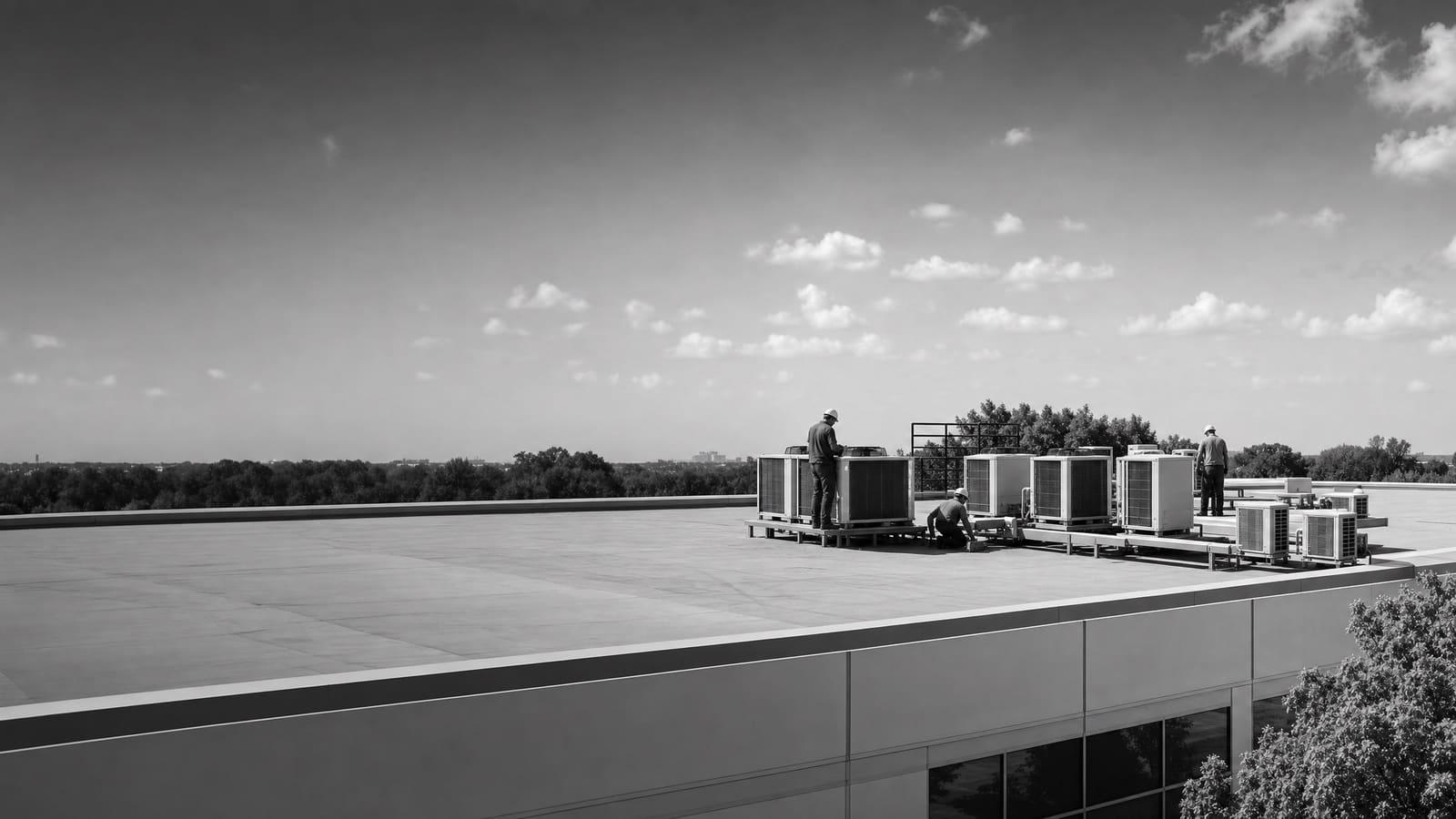
Commercial HVAC replacement covers the whole path, not just the box. It includes a load check against how the building runs today, equipment selected against real lead times, certified refrigerant recovery, removal and disposal, curb adapter and rigging, gas and electrical connections, controls integration, and documented commissioning. Replacement beats one more repair once a unit is past about fifteen years and needing regular visits. Old, inefficient rooftop units waste roughly $900 to $3,700 each in energy every year, on top of whatever the repairs cost.
A site review still has to confirm four things: the curb and roof structure, crane reach and lot access, available electrical capacity, and whether the existing gas and refrigerant runs can be reused. Those answers move the installed price more than tonnage does.
THREE PATHS
Choose the replacement path before you compare prices
Most commercial replacements land on one of three paths, and the right one depends on whether the building still runs the way it did when the old unit went in. A like-for-like swap reuses the curb and the connections, so it is the fastest way back to conditioned space. A right-sized replacement recalculates the load first, which matters when occupancy, plug loads, or envelope work changed the building since the original install. A heat pump or dual-fuel rooftop unit adds reverse-cycle heating and moves part or all of the heating load to electricity.
The third path is a real option, not a novelty, but it turns on your electrical capacity, the physical constraints on the roof, the gas line, and how cold the winter design condition is at your site. Price the paths side by side before you commit to one. The differences show up in the quote, not in the equipment brochure.
WHAT MOVES THE NUMBER
The lines that decide your installed price
No one can quote a rooftop replacement from a tonnage number alone. These are the lines that move the installed price the most, ordered roughly by how much they vary between two buildings that look identical from the street.
IN PRACTICE
Planned replacement costs less than emergency replacement
The buying decision usually comes down to timing. Rooftop units get replaced two ways. On failure, in season, with the building uncomfortable and every decision made under pressure. Or on plan, before the unit quits, with time to compare equipment and schedule the crane around your operating hours. The second way costs less for the same scope, because nothing gets expedited and nothing gets chosen because it happened to be on the truck.
That matters because an aging unit is already spending your money. Old, inefficient rooftop units waste somewhere between $900 and $3,700 a year each in energy. The high-efficiency performance specification that federal and industry partners wrote for commercial rooftop units was aimed at cutting energy use by up to half against the older standard, and more than twenty models now exceed it. On a roof carrying several units, that gap compounds every season you wait.
Waiting also narrows your options. Once a unit is dead in July, the question stops being which equipment fits the building and becomes what can be delivered this week. Plan the replacement while the old unit still runs and efficiency tier, heating type, and lead time stay real choices instead of constraints.
SIDE BY SIDE
Why two same-size jobs price differently
Two replacements with identical tonnage can land far apart on price. Complexity, not capacity, is usually what separates them.
LOWER COMPLEXITY
Straight swap on an open roof
Same tonnage and heating type, an existing curb that can be reused, open parking that gives the crane room to set up, gas and electrical service already sized for the unit, and stand-alone controls that carry over unchanged.
HIGHER COMPLEXITY
Bigger unit on a tight site
Capacity or footprint grows, so the curb and roof support need review. Add a shared or obstructed lot, a panel with no spare capacity, a switch from gas heat to electric heating, and controls that must talk to an existing building automation system.
SCOPING THE JOB
What a real site review has to answer
A useful site review answers questions a phone quote cannot. The first is load. What does the space need now, not what the nameplate said twenty years ago? Occupancy, added equipment, and envelope work all move that number, and a unit sized to the old nameplate can end up oversized, short-cycling, and no better at humidity than the one it replaced.
The second is infrastructure. Heat pump and higher-capacity units run into the same three physical limits again and again: electrical capacity at the panel and the service, physical constraints on the roof like clearance and structural support, and what happens to the gas line if heating moves to electricity. Any one of those can change the equipment decision. All three are far cheaper to find during a walkthrough than in a change order.
The third is access. The crane sets the schedule. Where the truck sets up, what it has to reach over, which stalls close and for how long, and whether the lift happens during business hours or after them. Those answers belong in the quote, not in a conversation on the morning of the lift.
What to hand the estimator
Nameplate photos of every unit on the roof, a rough count of people and operating hours in the space, twelve months of utility bills, and a note on which parking stalls you can actually close. That package turns a range into a number.
AFTER THE LIFT
Two things that decide how the unit performs
The install ends. The ownership does not. Two items decide whether a new unit performs the way the quote implied, and both are settled before the crane leaves the lot.
REFRIGERANT
Plan for a mixed fleet
Federal rules govern how refrigerant is handled, recovered, and recycled in stationary cooling and heat pump equipment. When a roof ends up with older and newer units side by side, that shapes your service contract, the certifications your technicians need, and which spare parts are worth stocking.
COMMISSIONING
Get the startup documented
Charge, airflow, economizer operation where the unit has one, and control settings verified against the submittal, then written down. Undocumented startup is how a high-efficiency unit quietly performs like a standard one, and how warranty conversations go sideways in year three.
PHASING AND PROCUREMENT
Replace a roof full of units as a program
If the roof carries more than one unit, treat replacement as a program instead of a string of emergencies. Rank the units by age, repair history, and the hours they actually run, then replace in that order across two or three budget cycles. Organizations that did this at scale reported real money. Across a national rooftop upgrade campaign, participants replaced or retrofitted more than 43,000 units and cut a combined $37 million a year from their energy bills.
Phasing also gives procurement room to work. Ordering two units together instead of one at a time gets better pricing and one mobilization instead of two. It also lets you standardize on the same manufacturer, the same control platform, and the same filter sizes, which quietly lowers what your service contractor charges to keep the fleet running.
The last piece is lifetime cost. The cheapest unit on the quote sheet is rarely the cheapest unit on the roof. Compare the installed price against the efficiency tier, the expected run hours, and what the old unit was wasting every year it stayed. When a replacement is genuinely overdue, the efficiency difference pays back a meaningful share of the upgrade over the years you will own it. Ask for that arithmetic using your rates and your run hours, not generic ones.
COMPARING QUOTES
Five lines every comparable quote should show
Three quotes are only comparable when they scope the same work. Make each one show these five lines and the differences stop being mysterious.
01
Equipment, spelled out
Manufacturer, model, tonnage, efficiency tier, heating type, and refrigerant. A tonnage number by itself is not a specification.
02
Lead time and availability
The realistic delivery date for the unit quoted, plus what changes on price and schedule if you accept an alternate.
03
Everything the roof needs
Curb adapter, structural support, patching, and any gas, electrical, or refrigerant line work included in the installed price.
04
The crane day
Rigging plan, lot closures, hours of work, and who coordinates access with tenants and neighboring businesses.
05
Permits, startup, and warranty
Which permits and inspections are included, what commissioning gets documented at handoff, and the labor warranty term.
Keep planning locally
Related mechanical pages in Lexington
Get a defensible number
Price the equipment and the building together.
Send the address, operating target, and target opening date. Flux will identify what must be verified before the project can be priced.
Get a free estimateQuestions
Straight answers.
When does replacement beat another repair?
Age plus repair frequency. Units past roughly fifteen years lose efficiency and start pulling regular service visits, and an old, inefficient rooftop unit can waste $900 to $3,700 a year in energy on its own. When the next repair is a large one on a unit in that range, replacement usually wins on total cost.
Should you replace like-for-like or resize?
Confirm the load either way. If occupancy, equipment, and operating hours have not changed, like-for-like is often right and it is faster. If the building runs differently than it did when the old unit went in, right-sizing fixes comfort problems the old unit was never able to fix.
Is a heat pump rooftop unit a good swap for a gas unit?
It turns on three things: electrical capacity, physical constraints on the roof, and how cold the winter design condition is at your site. Heat pumps are most efficient in mild to moderate heating, and their efficiency falls toward electric resistance as temperatures drop. Dual-fuel and cold-climate models exist for exactly that reason.
What happens to the refrigerant in the old unit?
It is recovered under federal rules that govern how refrigerant is handled and recycled in stationary cooling and heat pump equipment. Recovery and disposal should appear on the quote as a line item rather than being assumed into the removal price.
How much does commercial HVAC installation cost?
There is no honest per-ton number that holds sight unseen. Installed price is set by equipment tier and tonnage, curb and structural work, crane access, available electrical capacity, and controls integration. Send nameplate photos and a lot layout and the range narrows quickly.
Sources used for this guide
- [1]betterbuildingssolutioncenter.energy.gov — DOE Advanced Rooftop Unit Replacement Guidance
- [2]betterbuildingssolutioncenter.energy.gov — DOE Commercial Heat Pump Rooftop Unit Replacement Guidance
- [3]betterbuildingssolutioncenter.energy.gov — DOE High-Efficiency Commercial Rooftop Unit Toolkit
- [4]energy.gov — DOE Efficient Commercial Rooftop Air Conditioner Program
- [5]epa.gov — EPA Stationary HVAC Refrigerant Management