THE DIRECT ANSWER
What a commercial HVAC replacement actually includes
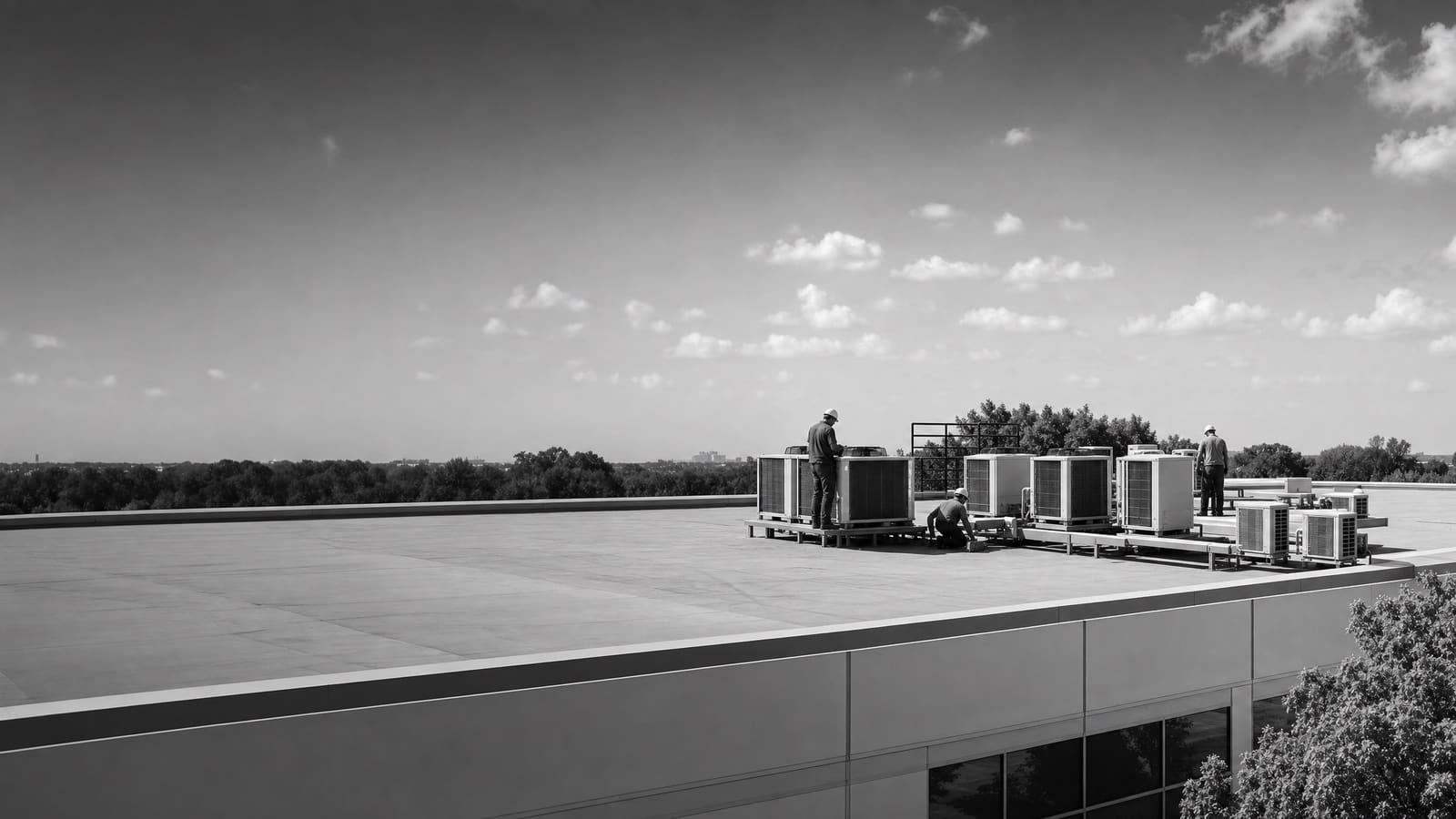
A commercial replacement is a load check, an equipment selection made against real lead times, a curb and rigging plan, the mechanical and electrical connections, and commissioning that proves the unit performs. Replacement beats one more repair when the unit is past fifteen years, when the same failure returns in season, or when the equipment quietly wastes money every month it runs. DOE estimates a single old, inefficient rooftop unit wastes $900 to $3,700 a year on its own.
A site review still has to confirm the real load, the roof structure and curb fit, the electrical capacity available at the panel, and crane access before any number holds.
THREE WAYS THIS GOES
Replace on failure, replace on plan, or retrofit controls
There are three real ways to handle an aging commercial unit, and the choice is usually made by default rather than on purpose.
Waiting for failure is the default. It is also the most expensive, because it hands you emergency labor, whatever equipment is on the shelf that week, and no time to check the load. DOE's guidance notes that facility managers often delay replacement until a unit fails completely, and that proactive replacement usually beats that outcome — and often beats a straight like-for-like swap at end of service life.
Planning the replacement flips every one of those pressures. You choose the efficiency tier, you order against a lead time you already know, and you set the crane day around your operation instead of around a breakdown.
The third option gets skipped too often: retrofitting a structurally sound unit with advanced controls. DOE's rooftop campaign treats that as a legitimate alternative when the numbers favor it.
WHAT MOVES THE NUMBER
The lines that separate two quotes for the same tonnage
None of these are prices. They are the lines that decide how far apart two bids for the same size unit will land, and which ones deserve a hard number before you sign anything.
CHOOSING EQUIPMENT
Like-for-like, right-sized, or a heat pump
Most commercial space is cooled from the roof. DOE puts rooftop units at nearly half of all U.S. commercial floor area, which makes the packaged rooftop the default replacement and pushes the real decision one level down: what goes on that curb next.
A like-for-like swap is the fastest path back to cooling and the cheapest engineering. It is the right call when the space is used the way it was used when the old unit was sized. It also carries forward every sizing mistake the old unit had, which is why even a like-for-like decision deserves a load check instead of a nameplate reading.
The other live option is a heat pump rooftop unit. DOE's guidance is direct about where those fit: across most of the U.S. South and West, today's heat pump units are capable of handling most or all of the winter heating demand, and they pay off best where electricity prices are low. DOE also points at Texas when it notes that southern climates can still see a sharp cold snap, citing the February 2021 freeze. That is the argument for deciding early whether dual-fuel or supplemental heat belongs in the design, rather than discovering the question in January.
SIDE BY SIDE
What makes one replacement simple and another complicated
Two replacements of identical tonnage can price very differently. The gap is almost never the equipment. It is what the building makes the crew do to get that equipment in place.
STRAIGHTFORWARD
Lower-complexity replacement
Same tonnage on the existing curb, a clear lot with room for the crane, gas and electric already sized for the unit, and simple stand-alone controls. Permitting is routine and the swap lands in a morning.
MORE MOVING PARTS
Higher-complexity replacement
A different footprint or added weight, a tight lot with no clean crane setup, electrical capacity that has to grow for an all-electric unit, gas that has to be cut and capped, or a building automation tie-in that needs programming and testing.
SCOPING THE JOB
What a site review has to settle before a number is real
A quote written from a nameplate photo is a starting point, not a price. DOE's heat pump guidance lists what decides whether a given unit can go on a given roof, and every item is a site question: electrical capacity, physical constraints, gas lines, and whether the equipment is actually available in the size you need.
Electrical capacity is the one that surprises people. Moving from a gas-heat unit to an all-electric unit raises the connected load, and the panel, feeder, or service may not have room for it. That work is real money and it belongs in the original quote rather than in a change order six weeks later.
Physical constraints come next. The existing curb may not match the new unit's footprint, which means a curb adapter and sometimes a structural look at the roof deck. The lot has to give the crane somewhere to set up with clear reach to the landing point.
Then there is availability. Equipment lead time is a scheduling input, not a footnote. A unit that is perfect on paper and months out can lose to a good unit you can have in weeks, especially when the building is limping along on a failed compressor in the meantime.
Four answers before you sign
One walkthrough should produce the confirmed load, the curb and structural condition, the electrical capacity available at the panel, and the crane setup with lot closure hours. Anything still open after that walkthrough is a change order waiting to be written.
AFTER THE INSTALL
Two things that change the math for years
The install is one morning. The decisions made before that morning follow the building for fifteen years or more, so they are worth looking at past the invoice.
Two questions matter most. The first is who pays for what, because in leased space the split between landlord capital and tenant utility cost decides whether a higher efficiency tier is worth buying at all. The second is what the new unit does to your service program. DOE's numbers make the case for efficiency plainly: more than 200 organizations upgraded over 43,000 rooftop units through its campaign and cut a combined $37 million a year from their energy bills. Those savings only hold if the equipment is maintained and the control settings stay where commissioning left them.
WHO PAYS
Split incentive in leased space
If the landlord buys the unit and the tenant pays the power bill, nobody owns the efficiency decision. Settle that before the spec is written, because it changes which efficiency tier actually makes sense.
MIXED FLEETS
Refrigerant and service planning
New equipment ships on newer refrigerants, and EPA Section 608 governs how refrigerant is handled and recovered. On a roof with several unit ages, parts, technician certification, and service coverage get planned rather than assumed.
PHASING AND PROCUREMENT
Handling a roof full of units the same age
When a building has several units of the same vintage, they tend to fail within the same few years. Replacing them one emergency at a time is the most expensive version of that story: overtime labor, whatever equipment is on the shelf, a separate crane mobilization for each unit, and no opportunity to standardize anything.
The alternative is to rank them. Age is the cheapest screen — DOE notes that rooftop units over fifteen years old can waste substantial energy compared with newer models. Layer service history on top of that, then comfort complaints, then which units serve the spaces you can least afford to lose. That produces an order, and the order lets you spread the spend across two or three budget years instead of one panicked quarter.
Standardizing pays off more than most owners expect. One manufacturer and a short list of models across the roof means shared spare parts, a single controls approach, and technicians who already know the equipment. It also makes next year's quote easy to compare against this year's.
Phasing also lets you time the crane. Two or three units replaced on one mobilization costs less than the same units replaced across three visits, and it closes the lot once instead of three times. Where the budget allows, group replacements by roof location and by which tenants they affect.
BEFORE YOU SIGN
Five things a comparable quote shows
A quote you can hold up against another quote shows all five of these in writing. Whichever line is missing is usually the line that grows after the contract is signed.
01
Tonnage, model, and efficiency tier
The specific unit selected, not a size class, with the efficiency rating you are paying for.
02
Curb, adapter, and structural scope
Whether the existing curb is reused, adapted, or replaced, and any roof work that decision triggers.
03
Rigging and lot plan
Crane size, setup location, closure hours, and who coordinates the closure with tenants.
04
Electrical, gas, and refrigerant work
Feeder or panel changes, gas cut and cap, line work, and recovery of the old charge.
05
Commissioning and documentation
Startup, charge, airflow, and control settings verified against spec and handed over in writing.
Keep planning locally
Related mechanical pages in Laredo
Get a defensible number
Price the equipment and the building together.
Send the address, operating target, and target opening date. Flux will identify what must be verified before the project can be priced.
Get a free estimateQuestions
Straight answers.
When is replacement better than another repair?
When the unit is past fifteen years, when the same failure keeps coming back in season, or when the repair cost approaches a real share of a new unit. DOE estimates an old, inefficient rooftop unit wastes $900 to $3,700 a year all by itself, and that waste keeps running after every repair.
Should we replace like-for-like or resize?
Confirm the load either way. If occupancy, equipment, and operating hours still match what the old unit was sized for, like-for-like is usually right and always faster. If any of those changed, resizing fixes comfort problems the old unit was never able to solve.
Does a heat pump rooftop unit make sense for a commercial building?
DOE's guidance says heat pump rooftop units can handle most or all winter heating demand across most of the U.S. South and West, and that they pay off best where electricity prices are low. The site questions are electrical capacity and whether you want dual-fuel backup for a hard cold snap, as the February 2021 Texas freeze showed.
How much does commercial HVAC installation cost?
There is no honest universal number, because tonnage, curb work, crane access, electrical scope, and controls each move it independently. What you can insist on is a quote that prices those separately, so you can see which one is actually driving the total.
Who handles the crane, the permits, and the refrigerant?
The installing contractor should own rigging, lot coordination, permits, and inspections inside the installed price. Recovery of refrigerant from the old unit is regulated under EPA Section 608 and handled by certified technicians. Confirm all of it is in the written scope rather than assumed.
Sources used for this guide
- [1]betterbuildingssolutioncenter.energy.gov — DOE Advanced Rooftop Unit Replacement Guidance
- [2]betterbuildingssolutioncenter.energy.gov — DOE Commercial Heat Pump Rooftop Unit Replacement Guidance
- [3]betterbuildingssolutioncenter.energy.gov — DOE High-Efficiency Commercial Rooftop Unit Toolkit
- [4]energy.gov — DOE Efficient Commercial Rooftop Air Conditioner Program
- [5]epa.gov — EPA Stationary HVAC Refrigerant Management