THE DIRECT ANSWER
What a commercial HVAC replacement actually includes
A commercial HVAC replacement covers far more than the unit. It includes a load check against how the building is used now, equipment selection, rigging and set, gas or electrical work, controls, and startup. Replacement beats another repair when the unit is past about fifteen years, when the same failures keep repeating, or when it can no longer hold the space. Federal estimates put the annual energy waste of an old, inefficient rooftop unit at $900 to $3,700 per unit.
A site review still has to confirm tonnage against current use, curb and structural condition, available electrical capacity, and crane access. Those four items decide whether this is a simple swap or a small construction project.
THE THREE MOVES
Repair, swap, or upgrade the equipment
Most commercial replacements start in one of two places: a unit that failed in season, or a planned swap on a capital schedule. The difference matters. A failed unit narrows your options to what is available right now, while a planned swap lets you compare efficiency tiers, heating fuel, and controls before anything is ordered.
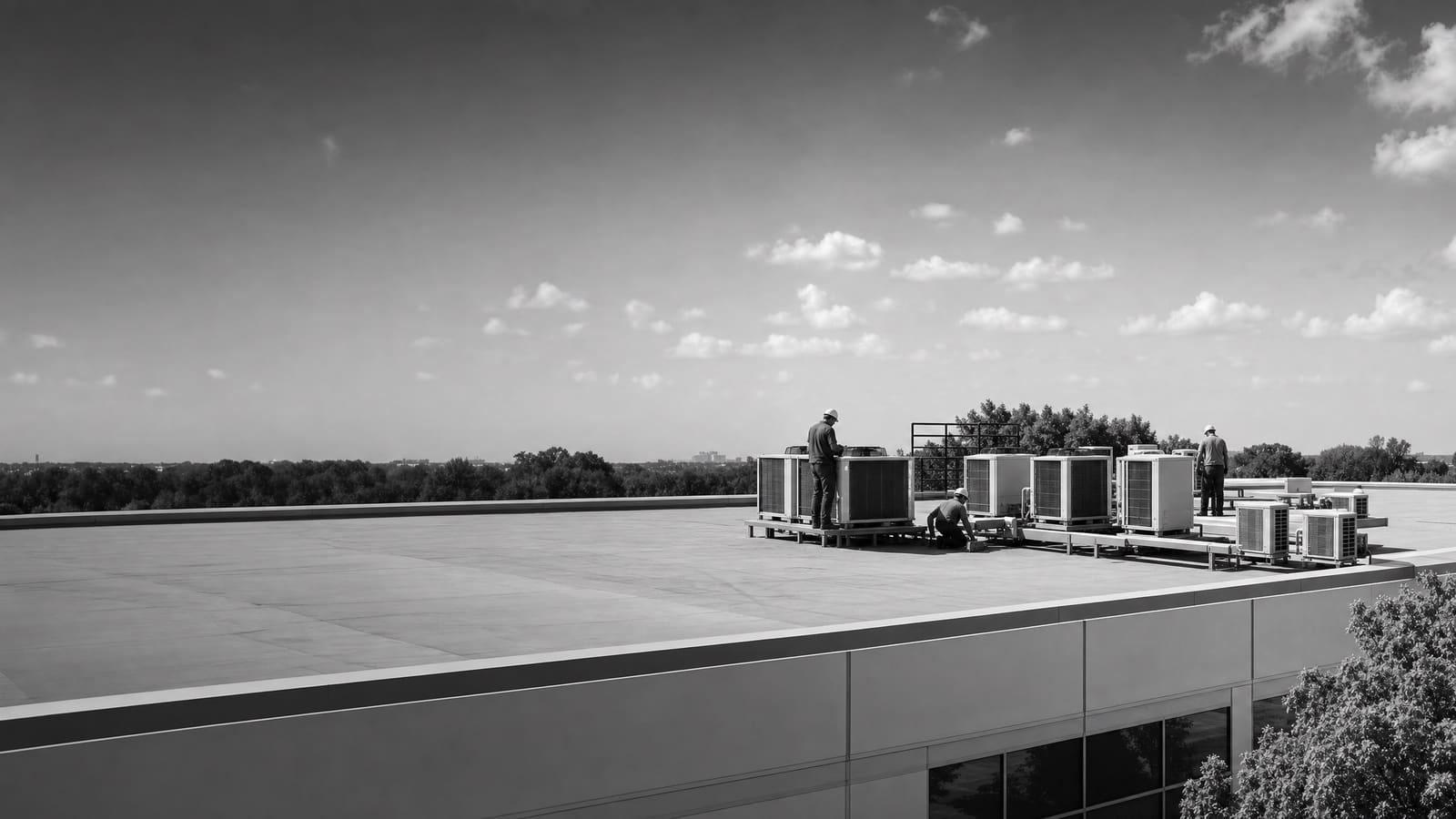
Rooftop units cool close to half of all commercial floor area in the United States, so most buildings are choosing among the same three moves. Federal guidance is direct about the trade-off: waiting for total failure usually costs more than replacing proactively, and even a like-for-like swap at end of life leaves savings on the table compared with a higher-efficiency unit. The right answer still depends on how long you plan to hold the building and how the space is used today.
WHAT MOVES THE NUMBER
The lines that swing a commercial installation quote
No two roofs price the same, and the unit itself is often not the largest swing. These are the lines that move a commercial HVAC installation quote, roughly in order of how much they vary from building to building.
IN PRACTICE
How to choose the equipment before you choose a price
Start with the load, not the nameplate. A unit installed fifteen or twenty years ago was sized for the occupancy, plug loads, and envelope of that time. If the space became an office instead of a warehouse, or the headcount doubled, or the lighting and equipment inside it changed, the old tonnage is a historical artifact rather than an answer. Carrying it forward carries forward the mistake too, and the comfort complaints come back with a brand new unit attached to them.
Then decide the heating question, because that is where the equipment paths split. A heat pump rooftop unit is the same basic machine as an air conditioning rooftop unit, with the added ability to run in reverse for heating. Heat pump efficiency falls as outdoor temperature drops and trends toward electric resistance in deep cold, so these units suit buildings with mild to moderate winter heating best. Federal guidance treats them as an appropriate, fully capable solution across most of the southern and western United States, with dual-fuel and cold-climate versions available where winter loads run harder.
Efficiency is the third lever, and it is worth more than most buyers assume. The high-performance specification that drove modern commercial units targeted energy use up to fifty percent below the prior standard. Against $900 to $3,700 of annual waste per aging unit, that gap compounds across every year you hold the building.
SCOPE CHECK
When a swap is simple and when it is not
The same nominal replacement can be a one-morning job or a multi-trade project. What separates them is almost never the unit. It is what the unit needs from the roof, the panel, and the fuel supply once it lands.
LOWER COMPLEXITY
Straight replacement
Same fuel, similar tonnage, existing curb reusable with an adapter, electrical service already adequate, clear crane reach, and standalone controls. Equipment availability is usually the only real schedule variable.
HIGHER COMPLEXITY
Configuration change
Gas to all-electric, a jump in tonnage, a different footprint, or a tight lot with no crane setup. Electrical capacity, structural review, and building automation integration each add scope, cost, and lead time.
BEFORE THE QUOTE
What a site review has to confirm
A price given over the phone from a tonnage figure is a guess. The review that produces a real number is not long, but it is specific, and it answers questions that decide the entire scope.
Infrastructure comes first. Federal guidance on rooftop replacements calls out electrical capacity, physical constraints, and existing gas lines as the three items that most often make or break an equipment choice. If the building is switching from a gas-heat unit to an all-electric or heat pump unit, the electrical service, panel space, and feeder path have to be confirmed before anyone commits to that equipment. Discovering a capacity shortfall after the order is placed is the most expensive way to learn it.
The roof itself is next. The curb has to be measured and its condition assessed, the structure checked if weight or footprint changes, and the crane path walked so the lot closure is planned instead of improvised. Finally, confirm equipment availability. Availability is part of the decision, not a footnote to it, and it belongs next to the price on every option you compare.
Bring these to the walkthrough
Nameplate photo, a recent utility bill, the panel schedule or last electrical survey, current occupancy and operating hours, and any comfort complaints by zone. That set answers most sizing and infrastructure questions in one visit.
OWNERSHIP CONSIDERATIONS
Two things that outlive the install
The install is a week of attention. The decisions inside it shape the next fifteen years of service calls, parts sourcing, and utility spend. Two of those decisions deserve a conversation before signing rather than after.
The first is what happens to your fleet when it becomes mixed. The second is who actually captures the savings, which matters whenever the party paying for the equipment is not the party paying the energy bill.
MIXED FLEETS
Service and parts planning
Once one unit is replaced, the roof holds two generations of equipment. Refrigerant handling, recovery, and disposal are federally regulated and require certified technicians, so service contracts and spare-parts strategy should reflect the split.
OWNER VERSUS TENANT
Who captures the savings
If the tenant pays the utility bill, the efficiency upgrade the owner funds shows up on someone else's statement. Sort that out in the lease or the capital case before efficiency tier gets value-engineered out of the scope.
PROCUREMENT
Phasing, timing, and what the project really costs
If you have more than one aging unit, phase them deliberately rather than one funeral at a time. Replacement on failure is the most expensive path available: it happens in peak season, at whatever price and availability the moment allows, with no time to compare efficiency tiers or verify the load. A standing plan that replaces the oldest units first, in shoulder seasons, converts emergencies into scheduled work and lets a single mobilization cover more than one machine.
Timing also buys you leverage. Ordering ahead of the season means real equipment choices instead of whatever is in the regional warehouse, and it means the electrical or structural work discovered during the review can be scheduled rather than rushed. When a unit does fail unexpectedly, that earlier planning still pays: the load is already confirmed and the infrastructure questions are already answered, so the only open item is availability.
Judge the total on lifetime cost, not the install invoice. The purchase price is one year. The energy the unit burns is every year, and an aging rooftop unit can waste $900 to $3,700 annually on its own. Utility and program incentives for high-efficiency equipment are worth checking before you order, since eligibility usually depends on the specification you buy, not the one you wish you had bought.
QUOTE CHECKLIST
Five things a comparable quote must show
Two quotes are only comparable when they scope the same work. If any of these five items is missing, you are comparing an installed price against an equipment price, and the difference will surface later as a change order.
01
Equipment, tier, and availability
Make, model, tonnage, efficiency tier, heating type, and a real lead time stated next to the price.
02
Curb, structure, and roof work
Curb adapter, any structural review, and who repairs the roof around the opening after the set.
03
Rigging and site plan
Crane, lot closure, staging, and how long access is affected, priced in rather than noted as an exclusion.
04
Electrical, gas, and controls
Service or feeder changes, gas line work, and integration into the existing building automation system.
05
Permits, startup, and documentation
Permits and inspections, refrigerant recovery on the old unit, commissioning results, and the warranty paperwork at handoff.
Keep planning locally
Related mechanical pages in Huntsville
Get a defensible number
Price the equipment and the building together.
Send the address, operating target, and target opening date. Flux will identify what must be verified before the project can be priced.
Get a free estimateQuestions
Straight answers.
When does replacement beat one more repair?
When the unit is past roughly fifteen years, when the same failures keep repeating, or when it can no longer hold the space. Older units waste substantial energy, and federal guidance is clear that proactive replacement usually costs less overall than waiting for total failure in season.
Should the new unit match the old tonnage?
Only if the space and its use have not changed. Confirm the load against current occupancy, equipment, and operating hours first. A like-for-like swap is fast and simple, but it carries forward any sizing mistake the old unit had.
Is a heat pump rooftop unit the right choice?
It depends on your winter heating load and your electrical capacity. Heat pump units are the same basic machine with reverse-cycle heating added, and they perform best with mild to moderate winter heating. Dual-fuel and cold-climate versions exist where winter loads run harder.
What most often blows up the budget?
Electrical capacity and roof structure. If the replacement changes fuel type, footprint, or weight, service upgrades and structural review can add more than the equipment difference. That is why the site review has to happen before the equipment is ordered.
What happens to the refrigerant in the old unit?
Federal rules govern the handling, recovery, and disposal of refrigerant in commercial equipment, and the work requires certified technicians. It should be part of the installed scope, not a separate surprise, and it matters more once your roof holds two generations of equipment.
Sources used for this guide
- [1]betterbuildingssolutioncenter.energy.gov — DOE Advanced Rooftop Unit Replacement Guidance
- [2]betterbuildingssolutioncenter.energy.gov — DOE Commercial Heat Pump Rooftop Unit Replacement Guidance
- [3]betterbuildingssolutioncenter.energy.gov — DOE High-Efficiency Commercial Rooftop Unit Toolkit
- [4]energy.gov — DOE Efficient Commercial Rooftop Air Conditioner Program
- [5]epa.gov — EPA Stationary HVAC Refrigerant Management