THE DIRECT ANSWER
What a commercial HVAC replacement actually covers
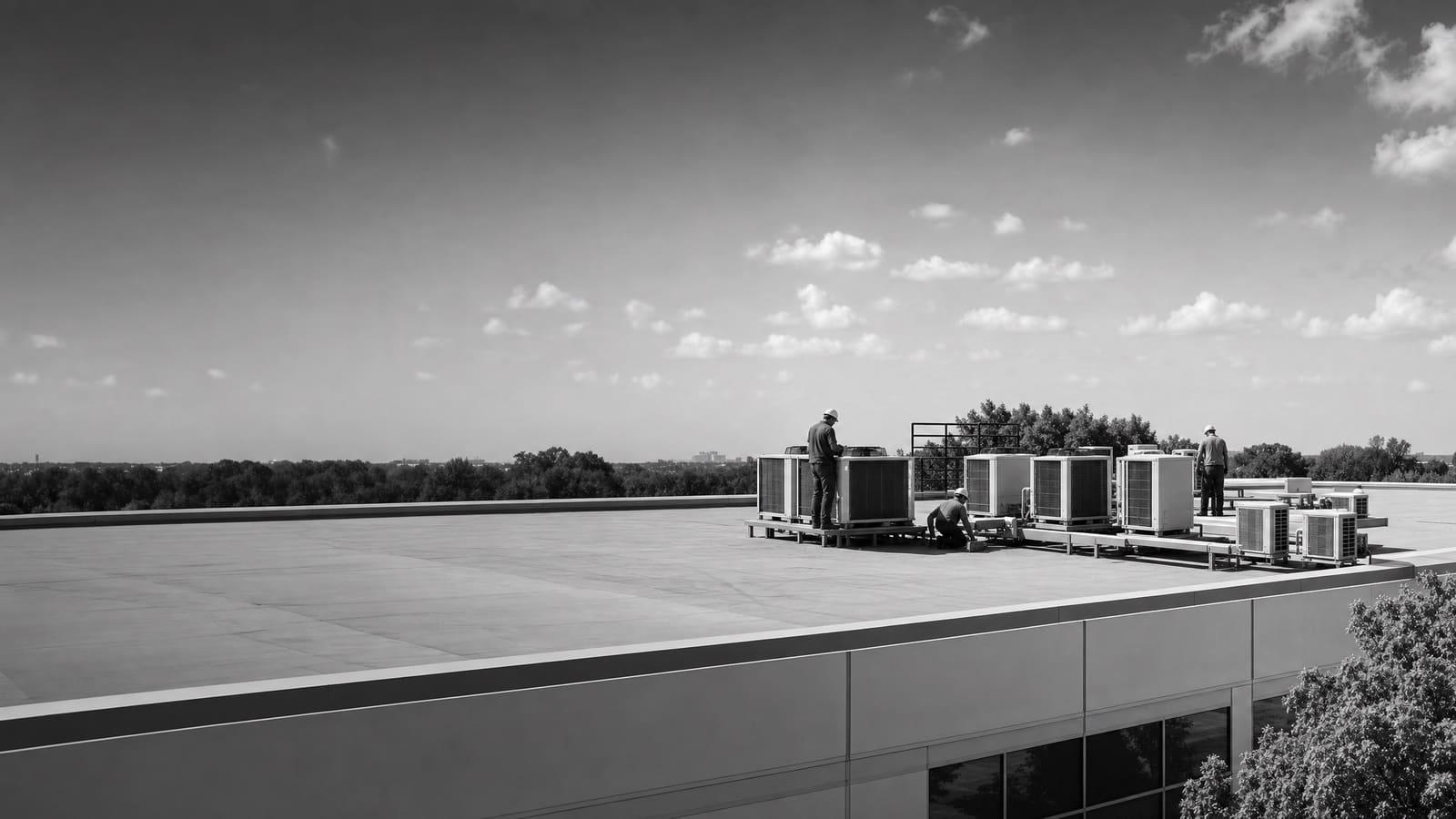
A commercial HVAC replacement is the whole project, not just the box. It means confirming the load the building carries today, selecting equipment against real availability, rigging and setting the unit, connecting power, gas, and controls, then commissioning it against spec. Replacement beats one more repair once age itself is the problem. Old, inefficient rooftop units waste roughly $900 to $3,700 per unit every year, and the units doing that are usually the ones past fifteen years of service.
A site review still has to verify the existing curb and roof framing, available electrical capacity and gas service, crane reach into the lot, and what today's occupancy actually needs — before tonnage gets fixed on paper.
THREE POSTURES
Three ways owners handle an aging rooftop unit
Most buyers are choosing between three postures, and the choice usually gets made before the unit fails — by default if not on purpose. Running to failure feels cheap because nothing is spent until something breaks, but it hands you the worst version of every variable: no time to compare equipment, no time to price the curb work, and whatever tonnage happens to be sitting in a regional warehouse that week. Planned like-for-like replacement removes the schedule pressure and keeps engineering light, because the curb, the connections, and the permit path are already known. A planned efficiency upgrade takes the most scoping, and it is the only path that changes what the building spends after the install. High-performance rooftop equipment built to federal challenge specifications was designed to cut unit energy use by up to half against the older standard, and more than twenty models now exceed that specification. That gap only pays if you decide before the unit dies.
WHAT MOVES THE NUMBER
The lines that decide your installed price
No honest quote produces a single installed number before someone stands on the roof. These are the lines that move it. Ask which ones your bidder has actually verified on site and which are still assumptions carried forward from the old unit's nameplate.
HOW TO CHOOSE
Choosing the equipment, not just the vendor
Packaged rooftop units condition nearly half of all commercial floor area in the country, so for most owners this is the first real decision, not a detail. The useful question is not which brand. It is which efficiency tier and which fuel, because those two answers follow the building for the next fifteen or twenty years while the brand plate stops mattering after startup.
The fuel question has three real answers. A dual-fuel unit runs the heat pump when it is efficient and falls back to gas when it is not. An all-electric unit removes gas from the equation entirely. A cold-climate unit is engineered to hold useful heating capacity further down the temperature curve. That last distinction matters because heat pump heating efficiency drops as outdoor temperature falls, trending toward parity with electric resistance heat at the bottom. Heat pump rooftop units perform best where winter heating demand is mild to moderate; where it is not, dual-fuel and cold-climate equipment exist precisely to cover that gap.
Whatever you pick, the deciding factors are usually infrastructure, not preference: electrical capacity, physical constraints on the roof, whether gas lines stay or go, and whether local crews know the equipment well enough to service it.
COMPLEXITY
What makes this project simple or hard
Two replacements with identical tonnage can differ by weeks of schedule and a large share of cost. The difference is almost never the equipment. It is what the building forces you to change on the way in.
LOWER COMPLEXITY
Same footprint, same fuel
The replacement lands on the existing curb with an adapter, keeps the same gas and electrical connections, and serves a space whose occupancy has not shifted. Crane access is clear, the lot can lose a few stalls for a morning, and the permit path is the familiar one.
HIGHER COMPLEXITY
New fuel, new footprint, live building
Switching to a heat pump or all-electric unit can push past what the panel and service can carry. Add a larger footprint needing structural review, tight crane reach, occupied tenant space below, and a facility that cannot lose conditioning during business hours, and the project becomes a sequencing problem.
THE SITE REVIEW
What a real site review has to confirm
The site review is where a quote becomes trustworthy. Sizing should come from how the space is used now, not from what the old nameplate says. Fifteen or twenty years changes occupancy, plug loads, lighting heat, and sometimes the envelope itself. A unit sized to a building that no longer exists will short-cycle, run hot rooms and cold rooms, and generate comfort complaints nobody can fix later.
The physical checks come next. Does the roof structure carry the new weight. Will the new footprint sit on the existing curb with an adapter, or does framing change. Where does the crane set up, how far does it have to reach, and how long does the lot lose those stalls. Whether the electrical service has headroom is the question that most often reroutes a project, especially on any move toward electric heating.
Finally, the review should name what the replacement triggers. Code items attach to replacements, refrigerant from the old unit has to be recovered under federal handling rules, and controls integration is easier to specify now than to retrofit after the crane leaves.
Ask for this before you sign
A quote worth comparing states the load basis it used, whether the curb and roof structure were verified in person, what electrical capacity is available, and who owns permits, rigging, inspections, and startup inside the installed price.
OWNERSHIP
Two questions that outlive the install
The install ends in a morning. The consequences of how you scoped it stay with the building. Two questions decide whether the project reads as a win three years out, and both are worth answering before you choose an efficiency tier rather than after the invoice clears.
WHO HOLDS THE SAVINGS
Lease structure changes the math
If tenants pay the utility bills and you pay for the equipment, a higher efficiency tier spends your capital to lower their operating cost. That is sometimes still the right call for leasing and retention, but it should be a deliberate choice, not an accident of who signed the purchase order.
WHO SERVICES IT
Your fleet gets more mixed every swap
Replacing one unit at a time leaves a roof with several generations of equipment, different refrigerants, and different control platforms. Refrigerant has to be handled and recovered under federal rules on the old side as well as the new, so service contracts and spare-parts planning should track the whole roof.
PHASING AND PROCUREMENT
Replacing several units without replacing them all at once
Owners with four or ten units on a roof rarely have the capital to do them in one season, and they usually should not. The workable approach is to rank the roof by age and condition, replace the worst performers first, and let the operating savings on those units help fund the next round. That ranking is easy to build: the oldest units are typically the ones carrying most of that $900 to $3,700 a year in avoidable waste, and they are also the ones most likely to fail on the hottest or coldest day of the year.
This is not theory. More than two hundred public and private organizations working through a federal upgrade campaign replaced or retrofitted over forty-three thousand rooftop units, and those upgrades together cut about thirty-seven million dollars a year in energy bills. The savings came from doing this on a plan rather than on a breakdown.
Procurement follows the same logic. Confirm equipment availability before you commit to a shutdown date, and confirm which incentive programs are actually open in the current program year before the purchase order goes out, because eligibility usually attaches to the efficiency tier you order.
THE QUOTE
Five things a comparable quote has to show
If two quotes are hard to compare, it is usually because one of these is missing. Ask for all five in writing and the bids line up on their own.
01
The load basis
What sizing came from — a current load calculation, or the old nameplate.
02
Equipment tier and availability
Model, efficiency tier, heating type, and the lead time the price is valid against.
03
Curb, structure, and access
Adapter or framing work, crane setup, reach, and how long the lot is affected.
04
Utility and code work
Electrical or gas changes, refrigerant recovery, permits, inspections, and any code items the replacement triggers.
05
Commissioning and handoff
Startup, charge, airflow, control settings verified against spec, and the documentation that keeps the warranty intact.
Keep planning locally
Related mechanical pages in Fort Wayne
Get a defensible number
Price the equipment and the building together.
Send the address, operating target, and target opening date. Flux will identify what must be verified before the project can be priced.
Get a free estimateQuestions
Straight answers.
When does replacing beat repairing a commercial rooftop unit?
When age, not a part, is the problem. Units past fifteen years waste substantial energy compared with current equipment — roughly $900 to $3,700 per unit each year for old, inefficient ones. Once repairs are frequent and comfort still suffers, another repair is buying time at a bad rate.
How much does a commercial HVAC installation cost in Fort Wayne?
There is no honest universal number, because tonnage, efficiency tier, curb and structural work, crane access, and electrical capacity all move it independently. What you can price before a site visit is the operating side: an aging unit's annual energy waste is well documented and often larger than owners expect.
Should we switch from gas heat to a heat pump rooftop unit?
It depends on heating demand, local electricity and gas prices, and whether your electrical service has headroom. Heat pump efficiency falls as outdoor temperatures drop, trending toward electric resistance at the bottom. Where winters carry real heating hours, dual-fuel or cold-climate units are the categories built for that.
What happens to the refrigerant in the old unit?
It has to be recovered, not vented. Federal Clean Air Act rules govern the handling and recycling of refrigerants in stationary air-conditioning, refrigeration, and heat pump equipment, and those rules apply to the removal side of your project. Confirm recovery is included in the installed price.
Can we skip commissioning to save money?
You can, and it is the most common regret. Commissioning verifies refrigerant charge, airflow, and control settings against spec before handoff. Skipping it moves those problems into month two as comfort complaints, and it can weaken your position on a warranty claim later.
How far ahead should we start planning a replacement?
Before the unit fails. Planning ahead is what gives you a real comparison between efficiency tiers, time to price curb and electrical work, and room to confirm equipment availability and open incentive programs. Emergency replacements surrender all three of those at once.
Sources used for this guide
- [1]betterbuildingssolutioncenter.energy.gov — DOE Advanced Rooftop Unit Replacement Guidance
- [2]betterbuildingssolutioncenter.energy.gov — DOE Commercial Heat Pump Rooftop Unit Replacement Guidance
- [3]betterbuildingssolutioncenter.energy.gov — DOE High-Efficiency Commercial Rooftop Unit Toolkit
- [4]energy.gov — DOE Efficient Commercial Rooftop Air Conditioner Program
- [5]epa.gov — EPA Stationary HVAC Refrigerant Management