THE DIRECT ANSWER
What a commercial HVAC replacement actually includes
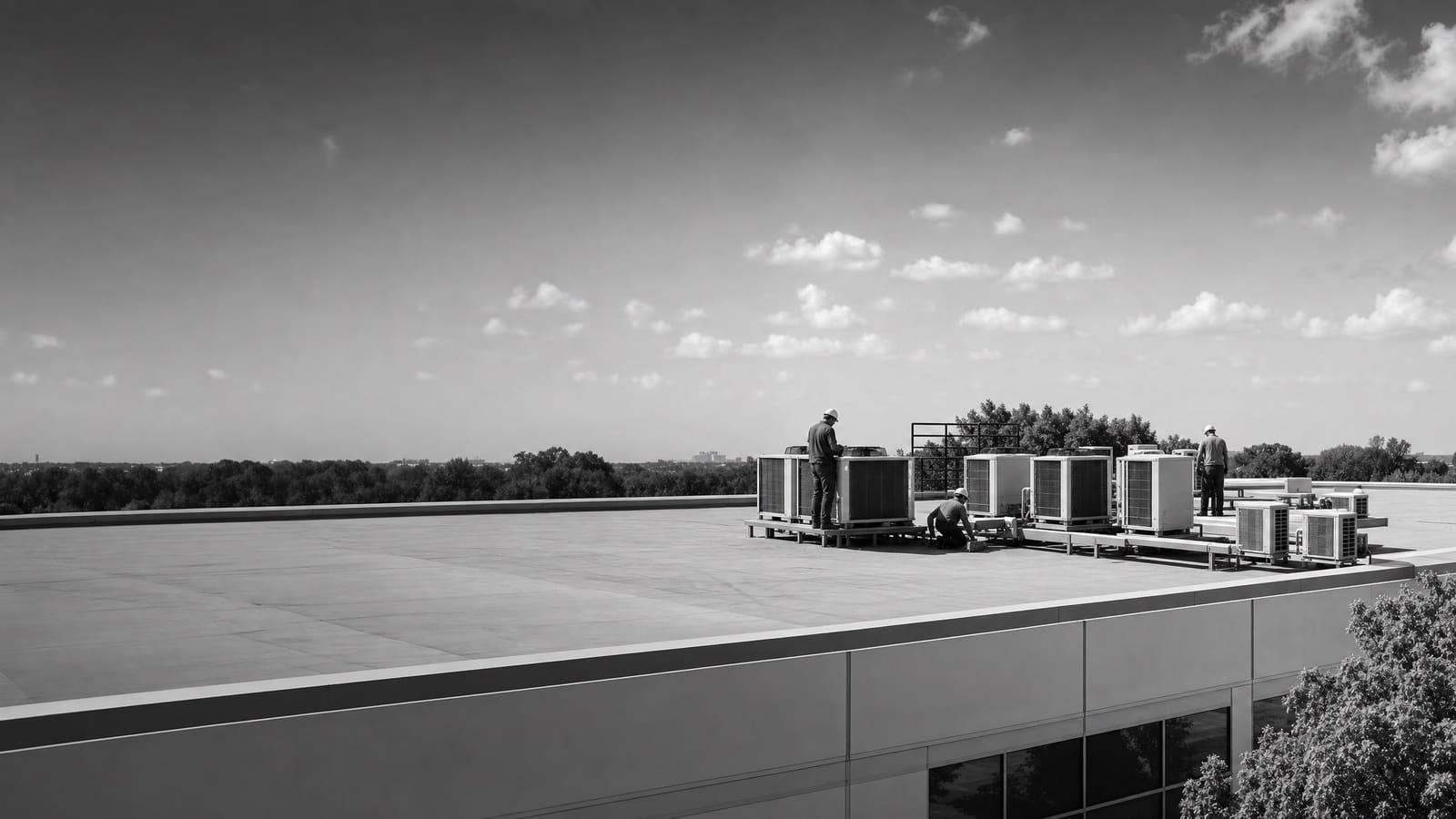
A commercial HVAC replacement covers a load check against how the building runs today, equipment selection against real availability, curb and rigging work, refrigerant and electrical connections, permits and inspections, and commissioning that proves the unit performs. Replacement beats one more repair once the unit is old enough that energy waste and repair spend compound together. An old, inefficient rooftop unit can burn $900 to $3,700 a year in avoidable energy cost on its own, before a single service call.
A site review still has to confirm tonnage against current occupancy, curb and roof condition, available electrical capacity, gas line status, and crane reach before any of those numbers hold.
THREE WAYS TO GO
Three replacement paths for an aging rooftop unit
Most buyers land in one of three positions. The first is waiting until the unit quits. That is common, and it is the expensive one: the failure sets the timing, whatever is in stock sets the specification, and the space runs hot or cold while the order clears. The second is a planned like-for-like swap. If the building is used the way it was when the old unit was selected, matching capacity on the same curb is a clean decision with the least engineering attached. The third is a planned upgrade, where you treat the replacement as the one chance in fifteen or twenty years to change efficiency class, add controls, or move from gas heat to a heat pump. Equipment built to the high-performance rooftop specification was designed to cut unit energy use by up to half against the older baseline, so the third path is usually where the money is, as long as you start it before the equipment forces your hand.
WHAT MOVES THE NUMBER
The lines that actually move a replacement budget
Two quotes for the same building can be far apart and both be honest. The gap is almost never the box itself. It is what each contractor assumed about the roof, the power, and how much of your operating day they are allowed to take.
IN PRACTICE
Buy the unit, not the crane day
The crane day is logistics. The equipment decision is the one you live with for the next two decades, so give it the time.
Start with load instead of the nameplate. Twenty years changes occupancy, plug loads, lighting, and sometimes the envelope, so the old tonnage is a data point rather than an answer. Then choose the equipment class deliberately. Three show up on most commercial roofs: a straight air-conditioning rooftop unit with gas or electric heat, a dual-fuel heat pump unit that runs as a heat pump and hands heating off to gas in the coldest hours, and an all-electric heat pump unit. Heat pump rooftop units are technically close cousins of the air-conditioning units they replace, and they add reverse-cycle heating on the same footprint.
The honest limit is temperature. Heat pump efficiency falls as it gets colder outside and trends toward electric resistance heating at the bottom of the range, which is why these units suit mild to moderate winter heating best and why the dual-fuel and cold-climate versions exist. Decide which one fits your building's heating hours and your tolerance for a cold snap, then check that the roof, the panel, and the gas service can support it.
SCOPE CHECK
Simple swap or an actual project
Before you set a budget or a date, figure out which of these two your building is. The difference is rarely the equipment. It is the infrastructure and the access around it.
LOWER COMPLEXITY
A clean swap
Same capacity, same fuel, existing curb still square and sound. Power and gas already sized for the new unit. Open lot with room for the crane, and a few hours after close where nobody misses the outage.
HIGHER COMPLEXITY
A staged project
Capacity changes, or you move from gas heat to all-electric. That pulls in panel capacity, feeder runs, a curb adapter, possible structural review, tight crane reach, and a schedule that has to work around occupied hours.
BEFORE THE QUOTE
What a real site review has to confirm
A quote written from a phone call is a guess with a number attached. The site review is what turns it into a price you can hold someone to.
Start on the roof. Confirm the existing curb dimensions and condition, the structural situation under it, how the unit is currently fed, and whether the drain, duct connections, and service clearances still work for the equipment you are considering. Photograph the nameplate and the data plate, because model and serial tell the installer more about the original design intent than a tonnage guess ever will.
Then go downstairs. Electrical capacity is the one that quietly reorders a project. If the plan is a heat pump or any unit with electric heat, someone has to verify the panel, the feeder, and the service can carry it, and say so in writing. Gas lines get the same treatment: keep, cap, or re-route, priced either way. Finally, walk the approach a crane would actually take, including the overhead lines, the pinch points, and which stalls you can lose for a morning. Equipment availability belongs in that same conversation, since the unit you want and the unit you can get in three weeks are not always the same unit.
Five things to nail down on site
Curb size and condition, structural support, electrical capacity for the equipment class you picked, gas line disposition, and crane access with a realistic closure window. Anything unverified here becomes a change order later.
AFTER THE INSTALL
Two things that follow the unit for its whole life
The install ends in a morning. Two decisions made during it stay with the building for as long as the equipment runs, and both are easier to handle before the unit is on the roof than after.
One is refrigerant. New commercial equipment ships on newer low-global-warming-potential refrigerants, which does not change day-one operation but does change parts, training, and service planning across a mixed fleet. The other is who keeps it running, and whether they know this specific platform well enough to be useful at 2 a.m. in July.
COMPLIANCE
Refrigerant handling
EPA rules under Section 608 of the Clean Air Act govern how refrigerant in stationary air-conditioning, refrigeration, and heat pump equipment is handled and recycled. That covers recovery from the unit being removed, so it belongs in the scope, not in a surprise line item.
OPERATIONS
Service coverage and parts
Contractor availability and familiarity with the equipment class is a real selection factor, especially for heat pump rooftop units and advanced controls. Ask who services the platform locally and how parts are stocked before you commit to a manufacturer.
PORTFOLIO VIEW
Phasing, procurement, and the lifetime number
If you own more than one unit, the useful question is not which one to replace. It is which order to replace them in.
Rank by age, by service history, and by what each unit costs you to run rather than by which one complained loudest last summer. Rooftop units older than about fifteen years are the usual candidates, since that is where wasted energy and repair frequency start climbing together. Replacing two or three on one mobilization spreads the crane and permit effort across more equipment, and it gives you one specification and one controls approach instead of a fleet nobody can service consistently.
Procurement follows the same logic. Lock the specification early, get availability in writing, and check what incentives exist for the efficiency tier or the heat pump option before you order, not after the invoice is cut. Incentives are a documented part of the decision for high-efficiency and heat pump rooftop equipment, and they are time-sensitive, so confirm what is live in the month you are buying.
Then judge the result on the lifetime number. A unit that costs more up front and less every month for twenty years is a different purchase from the cheapest thing that fits the curb, and only one of them gets better with age.
COMPARE FAIRLY
Five things a comparable quote should show
If two quotes do not show these five items the same way, you are not comparing them. You are guessing which one left more out.
01
Equipment, spelled out
Manufacturer, model, tonnage, heating type, efficiency tier, refrigerant, and a stated lead time.
02
Curb and structural scope
Adapter or new curb, roof work included, and who owns any structural review the change triggers.
03
Electrical and gas work
What the new unit needs, what exists today, and who pays for the gap between them.
04
Rigging and access plan
Crane, lot closure hours, removal and disposal of the old unit, and refrigerant recovery.
05
Permits, startup, and warranty
Permits and inspections included, commissioning documented, and warranty terms stated in writing.
Keep planning locally
Related mechanical pages in Fayetteville
Get a defensible number
Price the equipment and the building together.
Send the address, operating target, and target opening date. Flux will identify what must be verified before the project can be priced.
Get a free estimateQuestions
Straight answers.
When is replacement better than another repair?
When the unit is old enough that energy waste and repair spend are climbing together. Older, inefficient rooftop units can waste roughly $900 to $3,700 each per year on their own, which is often more than the repair being debated. Age past fifteen years, repeat service calls, and spaces that never quite hold setpoint are the usual signals.
Should the new unit be a heat pump?
It depends on your heating hours, your electrical capacity, and how you want to handle cold snaps. Heat pump rooftop units share the footprint and most of the technology of the air-conditioning units they replace, and they suit mild to moderate winter heating best. Dual-fuel and cold-climate versions exist specifically for buildings that cannot risk the bottom of the temperature range.
Can we replace like-for-like and be done?
Often yes, and it is the fastest path when the space is used the way it was when the old unit was selected. Confirm the load first. If occupancy, equipment, or hours changed, matching the old nameplate carries forward whatever sizing mistake you have been living with.
What usually causes the surprise cost?
Electrical capacity and curb work. A unit with a different footprint needs an adapter, and a heavier one can trigger structural review. Fuel switching adds panel, feeder, or service work plus a decision about the existing gas line. All of it is knowable during a site review and expensive to discover on install day.
What happens to the old refrigerant?
It gets recovered by the contractor removing the unit. EPA regulations under Section 608 of the Clean Air Act cover how refrigerant in stationary air-conditioning, refrigeration, and heat pump equipment is handled and recycled, so recovery and disposal should appear in the scope rather than showing up later as an extra.
Sources used for this guide
- [1]betterbuildingssolutioncenter.energy.gov — DOE Advanced Rooftop Unit Replacement Guidance
- [2]betterbuildingssolutioncenter.energy.gov — DOE Commercial Heat Pump Rooftop Unit Replacement Guidance
- [3]betterbuildingssolutioncenter.energy.gov — DOE High-Efficiency Commercial Rooftop Unit Toolkit
- [4]energy.gov — DOE Efficient Commercial Rooftop Air Conditioner Program
- [5]epa.gov — EPA Stationary HVAC Refrigerant Management