THE SHORT VERSION
What a commercial HVAC replacement actually covers
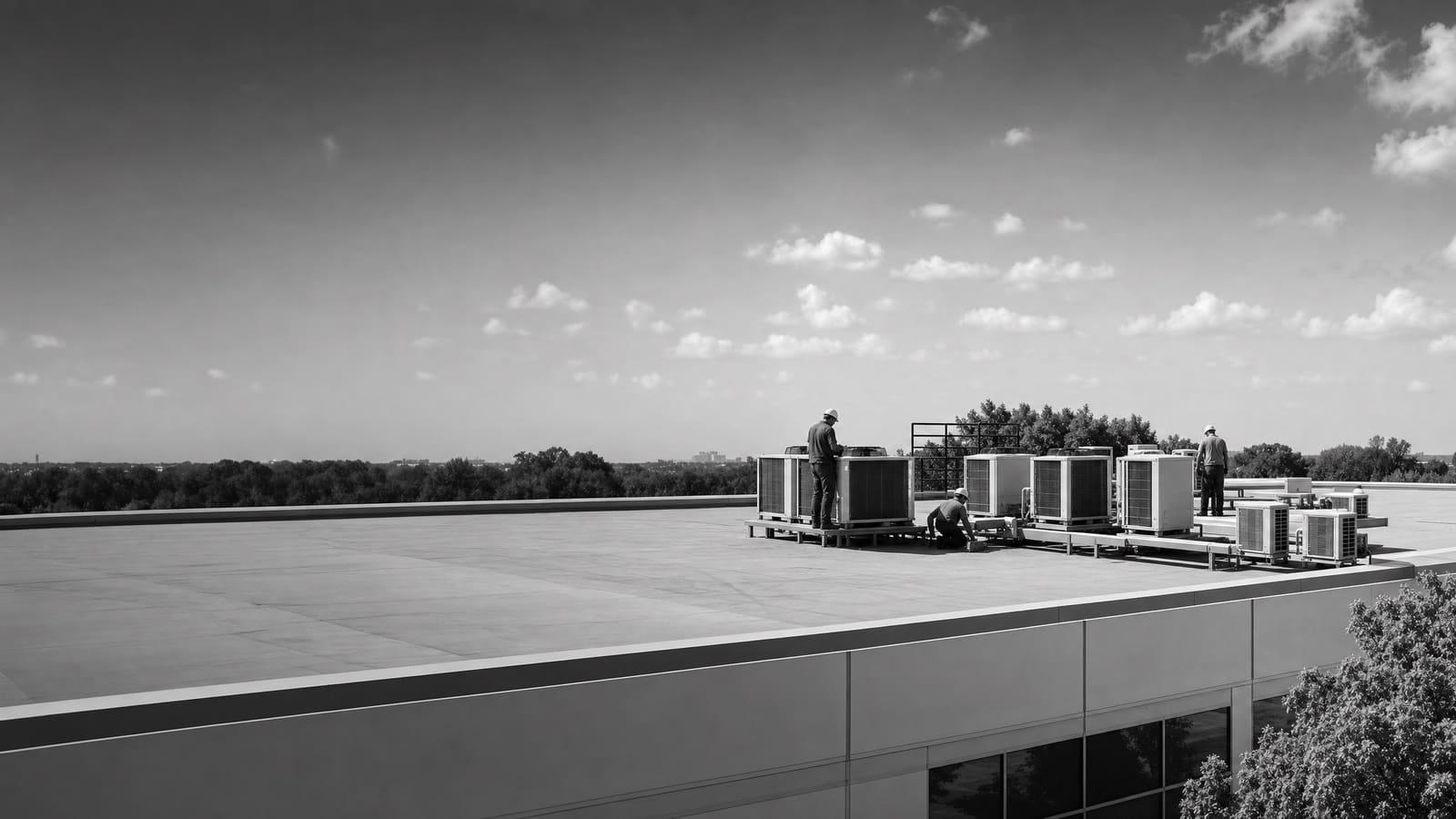
A commercial HVAC replacement covers a confirmed load calculation, equipment selected against real lead times, refrigerant recovered from the old unit, rigging and set, gas and electrical connections, curb work, controls integration, and commissioning. Replacement beats another repair once a unit needs frequent service, can no longer hold the space, or is past fifteen years, where federal data puts annual energy waste on old rooftop units at roughly $900 to $3,700 each.
A site review has to verify tonnage against how the space is used today, curb and structural fit, available electrical capacity, gas service, and roof access for a crane before any number is real.
THE REAL FORK
Three ways this replacement can go
The first decision is not brand. It is whether you are buying back a schedule, buying back operating cost, or changing what the building burns for heat.
Replacing on failure with the closest available match is the fastest path back to conditioned space, and it is the honest answer when a unit dies in season. It also carries forward whatever the old unit got wrong, including its sizing. Planning the replacement before failure is what opens the other two doors.
A high-efficiency unit costs more up front and pays that back through the meter every month it runs. A heat pump rooftop unit is a larger decision, because it changes the fuel behind your heating load and depends on electrical capacity and local energy prices. Federal guidance treats these as three separate paths with separate checklists, not as one upgrade.
WHAT MOVES THE NUMBER
Where the price is actually decided
Two replacements of the same tonnage can land far apart. Equipment is rarely the reason. These are the lines to read first on any bid, because they are where an incomplete quote hides the work it plans to bill you for later.
IN PRACTICE
How to choose between the options
Start with the load, not the nameplate. Twenty years of tenant changes, added equipment, and lighting retrofits move a building's cooling load in both directions, and the old tonnage is only evidence of what someone calculated back then. A confirmed load is what makes the rest of the decision honest. It tells you whether you are buying the same size again, a smaller unit that runs longer and dehumidifies better, or a larger one the roof has to be checked for.
Then decide how long you plan to hold the building. Efficiency tiers are priced as a premium today against savings spread across the unit's service life. Owners holding long term almost always take the higher tier. Owners with a sale or a lease expiration in view often do not, and that is a defensible call as long as it is made deliberately rather than by default.
Fuel is the last fork. Heat pump rooftop units are close technical cousins of the air-conditioning units they replace, and they add reverse-cycle heating. Their heating efficiency falls as outdoor temperature drops, trending toward electric resistance in deep cold, which is exactly why dual-fuel and cold-climate versions exist. If your building carries a real winter heating load, those variants are the ones worth pricing.
SIDE BY SIDE
What makes one replacement simple and another one long
Same tonnage, same roof, weeks apart on schedule. The difference is almost never the equipment itself.
STRAIGHTFORWARD
Lower-complexity replacement
Same fuel, same tonnage, a curb the new unit adapts to cleanly, open lot for the crane, and connections already sized for the load. These get scoped from a nameplate photo and a roof visit, permitted as mechanical and electrical work, and set in a morning.
PLAN AHEAD
Higher-complexity replacement
Fuel switching, a tonnage or footprint change, a roof needing structural review, limited crane reach, or panel capacity that will not carry an all-electric unit. Each adds a review step before ordering. None of them are problems if they surface during scoping instead of on crane day.
SCOPING
What a site review has to confirm
A useful quote comes from a site review that answers a short list of physical questions. Federal guidance for rooftop replacement groups them in a clear order, and it is worth asking them in that order.
Infrastructure comes first. Is there electrical capacity at the panel for the unit being proposed, especially if it is all-electric? Does the physical space allow the new footprint, and does the structure carry the weight? Are there gas lines to keep, cap, or reroute? Those three questions cause more change orders than everything else on a replacement combined.
Equipment availability comes second. The ideal unit that arrives in ten weeks and the acceptable unit that arrives in two are different projects. That tradeoff belongs on the quote next to the price, not in a phone call after you sign.
Contractor capability comes third, and it matters most on heat pump work. Reverse-cycle rooftop equipment commissions differently than a straight air-conditioning unit, and crews who have set them before catch charge and control issues that otherwise surface as winter complaints.
Refrigerant handling runs through all of it. EPA rules govern how refrigerant is recovered from the equipment coming off your roof, so recovery is scoped and priced rather than assumed.
Confirm these before you order
Panel capacity confirmed, curb and structural fit confirmed, the gas service decision made, a dated lead time in writing, and confirmation that any efficiency rebate you are counting on matches the exact model being ordered.
OWNERSHIP
Two decisions that outlive the install
Planned replacement and replacement on failure produce different buildings over ten years, even when the equipment ends up identical.
The unplanned version buys whatever is in the warehouse, at whatever the schedule costs, during the week you had the least attention to give it. The planned version gets a load calculation, an efficiency comparison, and a crane day chosen around your operating hours. Federal guidance is blunt about this: proactively replacing inefficient, underperforming units is often the better business move than waiting for failure, and often better than defaulting to a like-for-like swap at end of service life.
The second decision is what happens to the rest of the roof after this unit lands.
FLEET
One unit or the whole roof
If several units share a vintage, this replacement is really the first of a sequence. Setting the standard now — efficiency tier, controls platform, fuel — means the next four inherit it instead of each becoming its own negotiation.
SERVICE
A mixed refrigerant fleet
If the new unit uses a different refrigerant than the ones beside it, that splits your spare-parts strategy and your technician's truck stock. It belongs in the maintenance contract conversation before the first replacement, not after the third.
PROCUREMENT
Phasing, timing, and what the unit really costs
The cheapest month to replace a rooftop unit is a month you picked. Lead times are the reason. Order ahead of failure and you can compare units, hold a delivery date, and choose a crane day that misses your busiest hours. Order after failure and availability picks the unit for you.
For a roof with several aging units, phasing beats both extremes. Replacing everything at once concentrates capital and crane cost into a single year but standardizes the fleet immediately. Replacing one at a time spreads the spend and lets each install inform the next, at the cost of running mixed equipment for a few years. Most owners land in the middle: replace the worst two now, set the standard those two establish, and put the rest on a calendar instead of on luck.
Whichever path you take, price the unit across its service life rather than at purchase. Rooftop equipment is mostly an energy expense once it is installed, and the gap between an old inefficient unit and a current high-efficiency one has been measured at roughly $900 to $3,700 per unit per year on the worst equipment. That is the number that should decide which tier you buy, not the delta on the bid sheet.
THE QUOTE
Five things a comparable quote shows
When two bids disagree by a lot, one of these lines is usually missing from the cheaper one. Ask for all five in writing so the comparison is actually a comparison.
01
Tonnage, efficiency tier, and model number
The exact model and its efficiency rating, so two bids are compared on the same equipment rather than on the word equivalent.
02
A dated lead time
A delivery window for that specific model, in writing. Availability shapes the project as much as price does.
03
Curb, structural, and roof work
The curb adapter, any structural review the new footprint triggers, and how the roofing membrane gets patched and warranted.
04
Crane plan and lot impact
The rigging plan, which stalls close, for how long, and who coordinates that with your tenants.
05
Permits, recovery, and commissioning
Who pulls mechanical and electrical permits, who recovers refrigerant from the old unit, and what startup verification you receive at handoff.
Keep planning locally
Related mechanical pages in Des Moines
Get a defensible number
Price the equipment and the building together.
Send the address, operating target, and target opening date. Flux will identify what must be verified before the project can be priced.
Get a free estimateQuestions
Straight answers.
How do I know it is time to replace instead of repairing again?
The usual signals are frequent service calls, a unit that no longer holds the space through a hot afternoon, and age. Federal guidance flags rooftop units past fifteen years as significant energy wasters compared with current models, which means a repair on a unit that old often buys a few months at a cost that would have gone toward equipment that lowers your bill every month.
Is a heat pump rooftop unit the right replacement for my building?
It depends on three things: how much winter heating your building actually needs, whether your electrical service can carry the unit, and what electricity and gas cost you. Heat pump efficiency drops as outdoor temperatures fall, so buildings with meaningful heating load usually price dual-fuel or cold-climate models rather than a standard all-electric unit.
How long will my building be without cooling?
The visible work is short. The crane arrives, stalls are coned, the old unit comes off, and the new one lands on a prepared curb. The real variable is equipment lead time, which is why a dated delivery window belongs on the quote next to the price rather than being discovered after you sign.
What drives the installed price the most?
Tonnage and efficiency tier set the base. After that it is curb and structural work, crane access and lot closure, and any electrical or gas changes the new unit requires. A fuel switch adds the most uncertainty, because panel capacity has to be confirmed before the unit is ordered rather than after.
What happens to the refrigerant in the old unit?
EPA rules under Section 608 govern how refrigerant is recovered and handled when stationary air-conditioning and heat pump equipment is serviced or removed. Recovery should appear as a scoped line on your quote. If the replacement uses a different refrigerant than the rest of your roof, plan for that in your service contract and parts strategy.
Sources used for this guide
- [1]betterbuildingssolutioncenter.energy.gov — DOE Advanced Rooftop Unit Replacement Guidance
- [2]betterbuildingssolutioncenter.energy.gov — DOE Commercial Heat Pump Rooftop Unit Replacement Guidance
- [3]betterbuildingssolutioncenter.energy.gov — DOE High-Efficiency Commercial Rooftop Unit Toolkit
- [4]energy.gov — DOE Efficient Commercial Rooftop Air Conditioner Program
- [5]epa.gov — EPA Stationary HVAC Refrigerant Management