THE SHORT ANSWER
What a commercial HVAC replacement actually includes
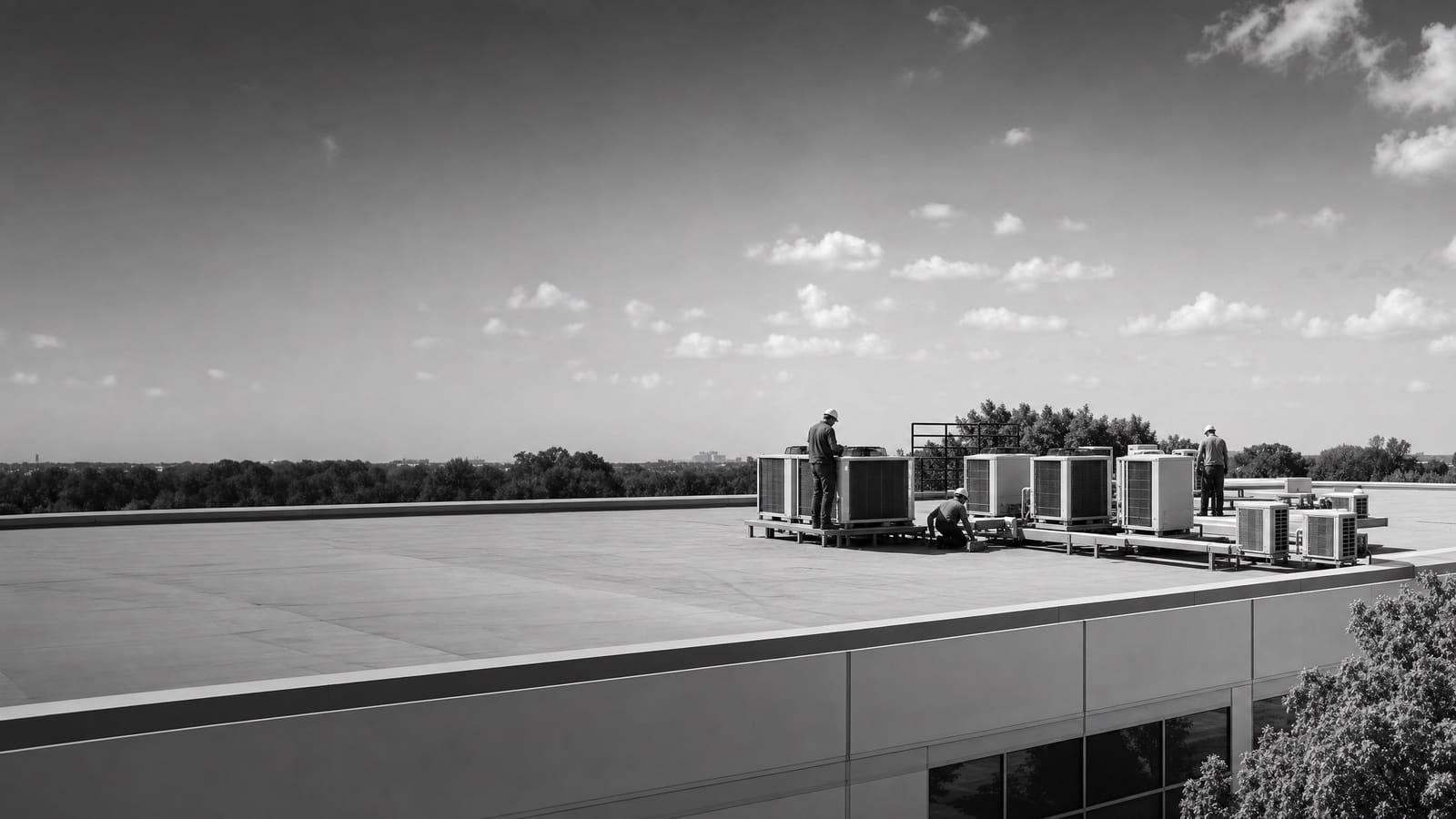
A commercial HVAC replacement is a load check, an equipment decision, a rigging and set plan, the gas, electric, and control connections, and a documented startup. Replacement usually beats one more repair once a rooftop unit passes 15 years, needs service repeatedly in season, or can no longer hold the space. Old, inefficient rooftop units waste an estimated $900 to $3,700 each per year in energy alone, which is often more than the repair being debated.
A site review still has to confirm tonnage against current use, curb and deck condition, available electrical capacity, and crane access before any of that becomes a price.
THREE WAYS TO GO
Three replacement paths worth pricing
Packaged rooftop units cool close to half of all commercial floor area in the country, so this decision usually comes down to which kind of rooftop unit goes back on the curb.
The three paths below cost different amounts on day one and different amounts every month after. A like-for-like unit is the shortest path back to service. A high-efficiency unit costs more up front and earns it back through runtime. A heat pump rooftop unit is built much like an air-conditioning unit but adds reverse-cycle heating, which matters if you are moving off gas or working against an emissions target.
One caution on the third path: heat pump heating efficiency falls as outdoor temperature drops, trending toward parity with electric resistance heat in the coldest hours. That is why dual-fuel units exist, and why your building's winter heating load belongs in the conversation before the equipment is picked.
WHAT MOVES THE NUMBER
The budget lines that actually move
A quote gets easier to compare when it is broken into the lines that move. Two honest bids on the same roof can differ by thousands, and the gap is usually hiding in three of the six items below.
BUYING GUIDANCE
Choosing the unit, not just the bid
The cheapest way to buy a rooftop unit is to replace the one that failed with the same thing and move on. Sometimes that is correct. It is wrong when the building changed underneath the equipment. Twenty years of tenant fit-outs, added plug load, new lighting, and a resealed roof move the load in both directions. A unit sized off an old nameplate can be too large as easily as too small, and an oversized unit short-cycles, dehumidifies poorly, and produces the comfort complaints nobody can trace.
The second decision is efficiency tier, and it is a runtime question. A building running long hours behind an aging unit has the strongest case for stepping up, because proactive replacement of an inefficient unit generally beats both waiting for failure and a like-for-like swap at end of life. A building running a few hours a day recovers that premium far more slowly.
The third decision is fuel, and it is an infrastructure question before it is an equipment question. The checklist for heat pump conversions is blunt about what to verify: climate and heating load, utility bill impact, building type, equipment availability, electrical capacity, physical constraints, gas lines, contractor familiarity, and incentives. Any one of them can turn a good idea into a change order.
SCOPE CHECK
What makes a swap simple or complicated
Before you budget, work out which project you actually have. The same tonnage can be a routine morning on one roof and a three-trade coordination job on the next. The difference is almost never the unit itself.
SIMPLER
Lower-complexity replacement
Same fuel, same size, same footprint on the existing curb. Open lot with clear crane reach. Electrical service already sized for the unit. Stand-alone controls. The scope is equipment, rigging, connections, and startup.
HARDER
Higher-complexity replacement
A fuel switch, a size change, or a new footprint that needs an adapter and possibly structural review. Restricted crane access or occupied hours that push the lift to nights. Panel capacity that has to be verified or upgraded. Building automation integration on top of it.
BEFORE THE QUOTE
What a real site review confirms
A number given over the phone from a tonnage and a ZIP code is a guess. The visit that turns it into a price is short, and it answers a fixed list of questions.
The first is load. What does the space do now, how many people are in it, what equipment runs in it, and what has changed since the last unit went in. The second is the roof: curb dimensions, deck condition, the structure carrying the unit, and whether the old footprint matches anything currently built.
The third is service. Electrical capacity at the panel and the feeder, gas line size and location if gas stays, and where condensate goes. The fourth is access — where the crane sets up, what it has to reach over, how many stalls come out of service and for how long. On a tight site, that answer sometimes changes the equipment selection.
The last is controls. How the unit talks to the building, who owns the integration, and what commissioning means at handoff: charge, airflow, economizer function, and setpoints verified and written down instead of assumed.
Ask for the assumptions, not just the total
Have every contractor write down what they assumed about the curb, the electrical service, and commissioning. Once those three assumptions are on paper, the gap between two bids usually explains itself in a few minutes.
CLARKSVILLE, TENNESSEE
Licensing and inspection on a Clarksville project
Tennessee splits HVAC work at a dollar figure, and for commercial equipment it is a low one. Projects over $25,000 require a state contractor's license carrying the CMC-C classification; a full CMC mechanical license covers the work as well. Most commercial rooftop replacements land above that line, so the classification on the bid is worth confirming before you compare prices.
Below $25,000, the work is mostly regulated at the local level. The city or county where the work happens issues its own mechanical licensing and sets permit and inspection requirements, and those are not uniform across the state. In jurisdictions where the Fire Marshal's electrical inspectors perform inspections, the HVAC permit calls for a state Limited Licensed Electrician license or a contractor's license carrying CMC-C.
For a Clarksville building, that means one call before anything gets scheduled: confirm with the local building office which permits apply and who inspects.
Match the license class to the project size
Ask which classification the contractor holds and which authority will inspect. On a commercial rooftop replacement above $25,000, CMC-C or full CMC is the state requirement — and a hold at inspection costs more than the phone call that would have prevented it.
AFTER THE CRANE LEAVES
Two things that outlive install day
The installation takes a week or two of your attention. The unit takes a decade or more of it. Two items decide how that stretch goes, and both are cheaper to settle before the equipment is ordered than after.
The first is refrigerant. Federal Clean Air Act rules govern how refrigerant is handled and recycled in stationary air-conditioning, refrigeration, and heat pump equipment, which covers both the recovery from the unit coming off and the service on the one going up. New equipment running a newer refrigerant changes nothing on day one, but it does change what your service contract stocks and what your technicians work on across a mixed fleet.
The second is timing. Waiting for failure is the default, and it is expensive. It removes your leverage on equipment selection, on scheduling, and on price, and it puts the outage in whatever season the unit chose.
REFRIGERANT
Handling is regulated work
Recovery from the old unit and service on the new one both fall under federal refrigerant rules. Keep recovery on the quote as its own line, and make sure the service agreement matches what the new equipment actually runs.
TIMING
Replace before it picks the date
A planned replacement lets you choose the unit, the shutdown window, and the crane day. A failure in August chooses all three for you, out of whatever happens to be available.
OVER THE LIFE
Phasing, procurement, and total cost
If you own more than one unit, treat this as a portfolio problem instead of a run of emergencies. Rank the units by age, service history, and runtime hours, then replace from the top of that list on a schedule you control. Doing this at scale moves real money: a national rooftop upgrade campaign covering more than 43,000 units reported a combined $37 million in annual energy savings across its participants.
Procurement follows the same logic. Equipment availability is a live constraint on commercial replacement, and it belongs next to price on the comparison sheet. A slightly more expensive unit you can actually get is worth more than a cheaper one that is not on a shelf. Ask what is available in the tier you want, and what the alternate is if the first choice slips.
Then price the decade, not the day. The installed number is one input. Energy at your real operating hours, the maintenance the unit needs, the parts your service provider stocks, and any incentive tied to the efficiency tier all belong in the same comparison. An aging, inefficient unit can quietly burn $900 to $3,700 a year by itself — that is the number the efficiency premium is competing against.
THE QUOTE
Five things a comparable quote shows
You cannot compare two bids that describe different projects. Ask every contractor to put these five items in writing, and the bids become comparable in about ten minutes.
01
The load basis
Tonnage and efficiency tier, with a note on whether the size came from a current load calculation or from the old nameplate.
02
Curb, structure, and roof work
Adapter or new curb, any structural review triggered by the unit, and who patches and flashes the roof afterward.
03
Rigging and access plan
Crane size, setup location, lot closure, the hours of the lift, and who notifies tenants.
04
Permits, license class, and inspections
The classification the contractor holds, which permits get pulled, who schedules inspections, and whether that cost is inside the price.
05
Commissioning and closeout
Startup readings, charge and airflow verification, controls setup, warranty registration, and the documents you receive at handoff.
Keep planning locally
Related mechanical pages in Clarksville
Get a defensible number
Price the equipment and the building together.
Send the address, operating target, and target opening date. Flux will identify what must be verified before the project can be priced.
Get a free estimateQuestions
Straight answers.
When is replacement better than one more repair?
Look at three things: age, repeat service, and performance. Rooftop units past 15 years waste substantial energy compared with current equipment, and an inefficient one can burn $900 to $3,700 a year on its own. When a unit needs service repeatedly in season or can no longer hold the space, that annual waste plus the next repair usually clears the cost of replacing it.
Should the new unit match the old one?
Confirm the load either way. If the space, its occupancy, and its hours have not changed, like-for-like is often the right call and the fastest path back to service. If use changed, right-sizing fixes the comfort problems the old unit created — and an oversized replacement causes as much trouble as an undersized one.
Does a heat pump rooftop unit make sense for a commercial building here?
It can, but check the infrastructure before the equipment. Heat pump units are built much like air-conditioning units and add reverse-cycle heating, and they are most efficient in mild-to-moderate winter heating. Efficiency drops as outdoor temperature falls, trending toward electric resistance heat in the coldest hours, which is why dual-fuel exists. Verify electrical capacity, heating load, gas lines, and equipment availability first.
What license does a commercial HVAC contractor need in Tennessee?
For projects over $25,000, a state contractor's license with the CMC-C classification is required; a full CMC mechanical license also covers the work. Under $25,000, requirements are mostly local — the city or county issues its own mechanical licensing and sets permits and inspections. Where the Fire Marshal's electrical inspectors inspect, the HVAC permit needs a Limited Licensed Electrician license or a CMC-C.
How much does commercial HVAC installation cost?
There is no honest universal price, because tonnage, efficiency tier, curb and structural work, electrical or gas changes, crane access, and controls integration each move the number independently. Ask for the quote broken into those lines instead of a single total. The $25,000 figure that comes up in Tennessee is a licensing threshold, not a price guide.
Sources used for this guide
- [1]betterbuildingssolutioncenter.energy.gov — DOE Advanced Rooftop Unit Replacement Guidance
- [2]betterbuildingssolutioncenter.energy.gov — DOE Commercial Heat Pump Rooftop Unit Replacement Guidance
- [3]betterbuildingssolutioncenter.energy.gov — DOE High-Efficiency Commercial Rooftop Unit Toolkit
- [4]energy.gov — DOE Efficient Commercial Rooftop Air Conditioner Program
- [5]epa.gov — EPA Stationary HVAC Refrigerant Management
- [6]support.commerce.tn.gov — HVAC Projects Less Than $25,000