THE SHORT VERSION
What a commercial HVAC replacement includes
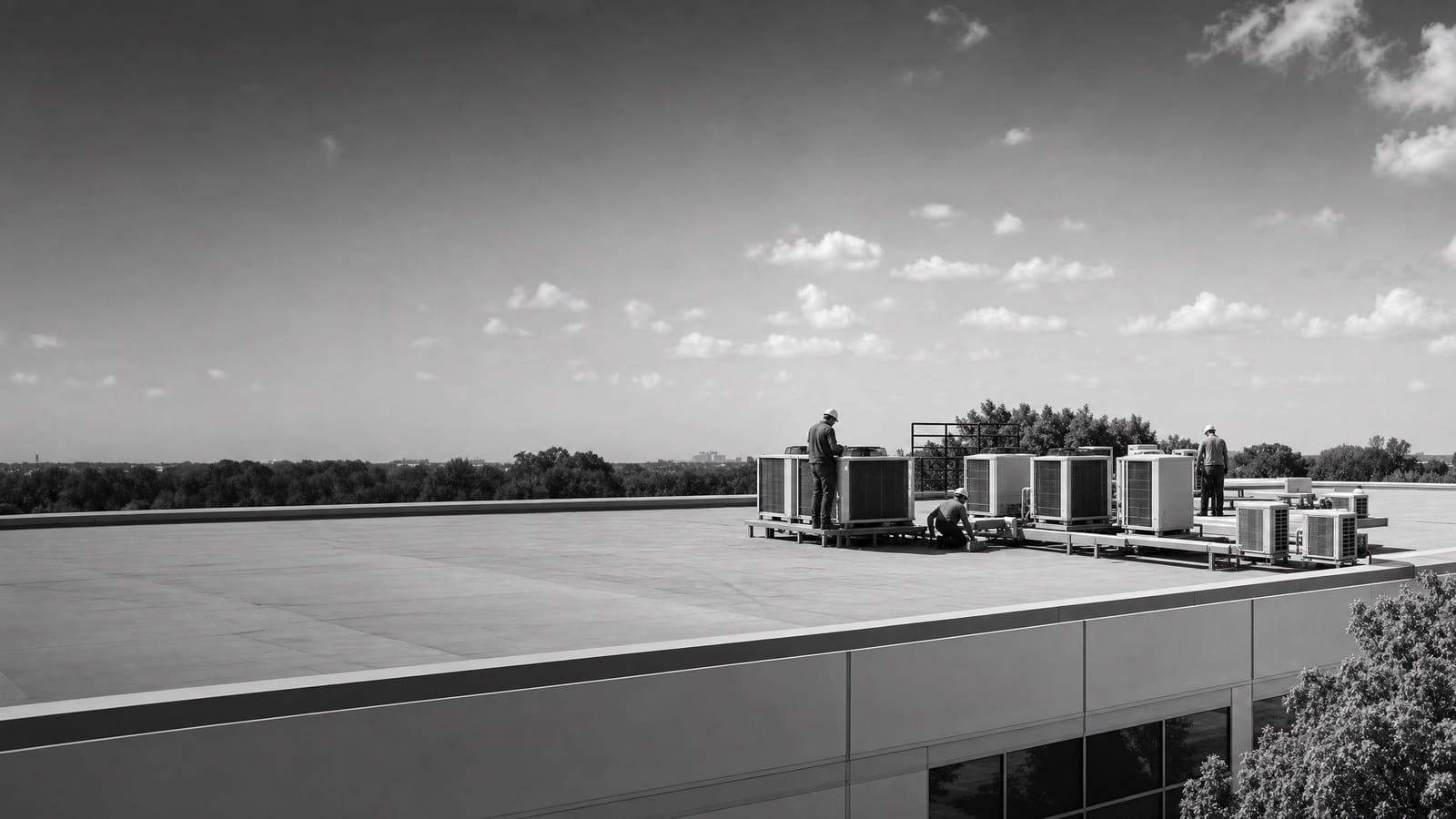
A commercial HVAC replacement covers load confirmation, equipment selection, rigging and set, gas or electrical connections, controls, permits, and commissioning. Replacement starts beating another repair once a rooftop unit is around 15 years or older, because aging units waste substantial energy compared with newer models. Federal figures put that waste at roughly $900 to $3,700 per unit each year on old, inefficient equipment — money repair spending never gets back.
A site review still has to verify tonnage against current occupancy, curb and structural condition, available electrical capacity, and crane reach before any price is real.
THE THREE PATHS
What can go back on the curb
Three paths cover most rooftop decisions. The first is a like-for-like swap with a current equivalent of what is up there now. The second is a high-efficiency replacement, specified above the federal minimum; the DOE performance spec that reshaped this market targeted up to 50% less energy use than the standard it replaced, and more than 20 models now exceed it. The third is a heat pump rooftop unit that heats by reverse cycle instead of burning gas.
There is a fourth option worth pricing before you commit to any of them. DOE's guidance is that owners can either replace old units with efficient ones or retrofit them with advanced controls, depending on which makes better financial sense. On a unit that is mechanically sound but poorly controlled, controls can buy real years. On a unit past 15 years with failing compressors, they cannot.
WHAT BUILDS THE NUMBER
The lines a replacement price is made of
Nobody can quote a rooftop replacement from a phone call, because the price is assembled from these lines rather than from tonnage alone. Ask for each one separately so you can see which part of the number is fixed and which part is a judgment call.
IN PRACTICE
Choosing between gas heat and a heat pump on a coastal site
Rooftop units cool close to half of all commercial floor area in the country, so most Chula Vista buildings are facing the same question: what goes back on the curb. The honest answer starts with heating. Heat pump rooftop units are technologically similar to air-conditioning units, but they heat by reverse cycle. As outdoor temperatures fall, heat pump efficiency drops toward electric resistance, which is why DOE frames them as best suited to mild-to-moderate winter heating. Across the U.S. South and West, DOE says today's units are fully capable of addressing most or all of the winter heating demand.
That makes the decision here less exotic than it sounds. The question stops being whether a heat pump can carry the heat and becomes whether the building can carry the heat pump. DOE's own checklist puts electrical capacity, physical constraints, and existing gas lines alongside equipment availability and contractor familiarity. A building with panel headroom and a short conduit run is an easy yes. A fully loaded service on a leased pad is a different project with a different budget.
So price both. A gas unit and a heat pump unit, each carrying the electrical work its own installation actually needs, is the only comparison that tells you anything.
TWO KINDS OF JOB
What makes one replacement simple and another complicated
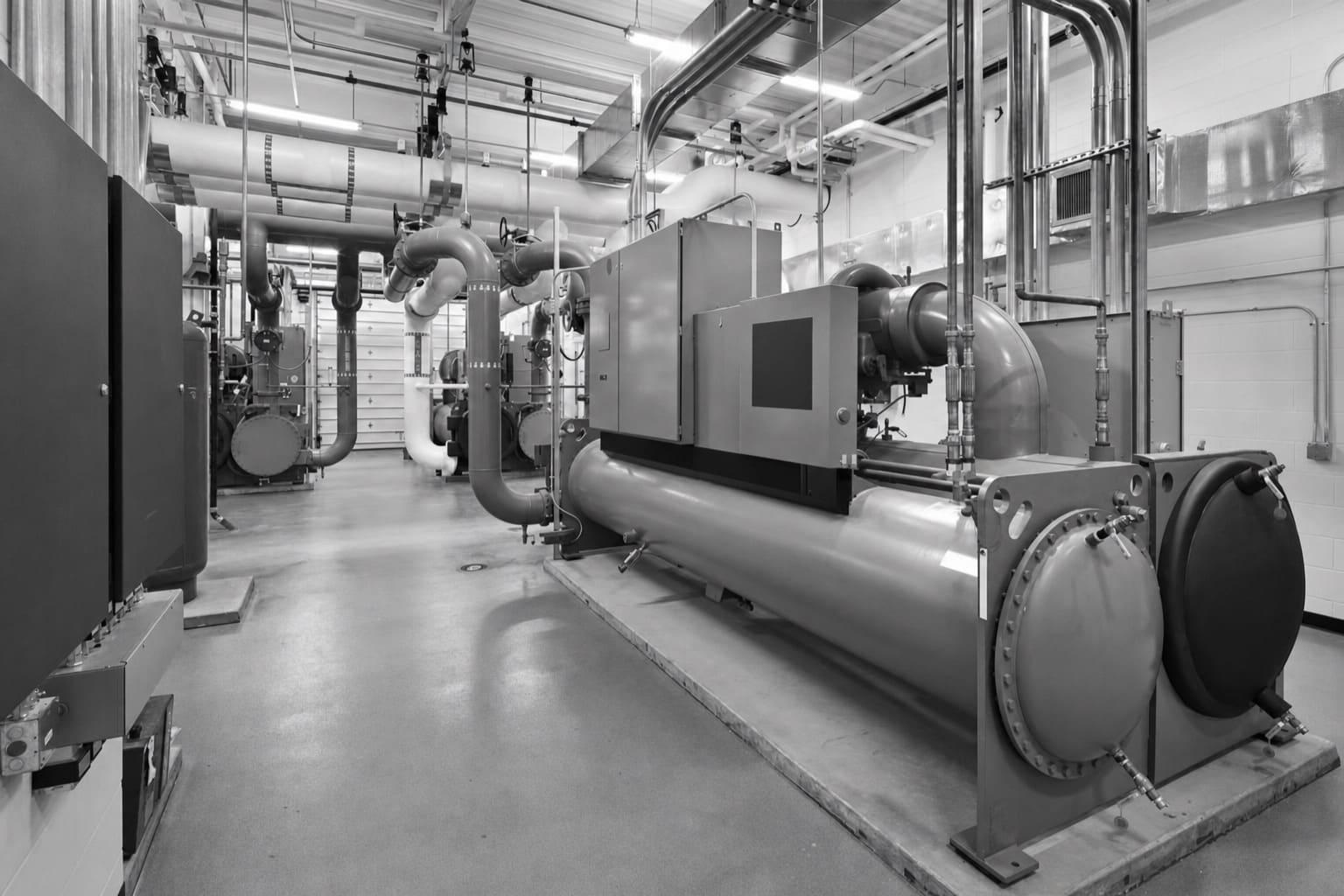
Two buildings with the same tonnage can be two very different projects. The gap is almost never the equipment. It is access, infrastructure, and how much of the existing installation still meets current code.
LOWER COMPLEXITY
Same load, open access
The use of the space has not changed, the curb carries the new unit with a standard adapter, the lot gives the crane clean reach, and the existing service already has capacity. Permits are routine and the set is a morning.
HIGHER COMPLEXITY
Changed load or tight service
Occupancy or equipment has changed, so the load has to be recalculated. Add structural work on the curb, an electrical service at its limit, a courtyard set, or a gas line that has to be abandoned, and the schedule stretches well past the crane day.
BEFORE THE QUOTE
What a site review has to establish
A price written from a nameplate photo is a starting point, not a quote. The nameplate tells you what somebody sized years ago for a building that may no longer run the same way. Occupancy changes, lighting changes, plug loads change, and roofs get re-insulated. The load calculation should come from how the space operates now.
From there the review is physical. Someone should stand on the roof and look at the curb, the existing penetrations, and how much load the structure will actually carry. They should open the panel and read available capacity rather than assume it. They should walk the ground the crane will occupy and note which stalls close and for how long, because on a leased building that is a tenant conversation, not a logistics footnote.
The last piece is the refrigerant in the unit coming down. EPA rules under Section 608 of the Clean Air Act govern how refrigerant is handled and recycled in stationary refrigeration, air-conditioning, and heat pump equipment. Recovery is not optional, and it is not something you want discovered on removal day.
Ask for this in writing
A completed load calculation, photos of the existing curb and electrical panel, the crane position and closure window, and the refrigerant recovery plan for the old unit. If a bidder cannot produce those, the price is an estimate wearing a quote's clothes.
IN CHULA VISTA
Mild winters make the electric option a real question here
Chula Vista sits on the coastal Southern California edge, where winter heating loads are mild and short. That matters more than it sounds. Heat pump efficiency falls as outdoor temperatures drop and trends toward electric resistance heating in cold weather, which is why DOE describes heat pump rooftop units as best suited to mild-to-moderate winter heating — and why it says that across the U.S. South and West, today's units are fully capable of addressing most or all of the winter heating demand.
The practical effect for a buyer here is that all-electric is a live option rather than a stretch, and the deciding factor moves off the weather and onto the building. Electrical capacity, conduit routing, and whether an existing gas line can be abandoned will settle it. Get those three answered before you compare a heat pump price to a gas price, or you are comparing two different scopes.
Confirm the permit path before booking the crane
Mechanical equipment replacement is permitted work, and an electrical permit follows whenever the service changes. Confirm the current requirements and submittal package with the City of Chula Vista building division early, so inspection timing does not strand a unit on the roof.
OWNERSHIP
Two things that decide when, not what
Two conditions move the timing of a replacement more than any technical detail. The first is who pays. On a leased building, the equipment is usually the landlord's and the utility bill is usually the tenant's — exactly the split that keeps 15-year-old units running. The party that would fund the upgrade is not the party that sees the savings. Putting that on the table early is worth more than another round of bids.
The second is failure timing. Facility teams often wait until a unit no longer holds the space, needs constant service calls, or quits outright. DOE's point is blunt: proactively replacing inefficient units often beats both replacement-on-failure and a like-for-like swap at the end of service life. An emergency removes every option you would have wanted.
SPLIT INCENTIVE
Landlord owns it, tenant pays to run it
Decide up front how an efficiency upgrade gets recovered — rent, a capital pass-through, or a shared-savings term. Without that conversation, the default outcome is the cheapest possible replacement, every time.
TIMING
Planned beats emergency
A planned replacement lets you compare equipment, schedule the crane around operating hours, and order ahead of need. A failure in August gets you whatever is already sitting on a regional shelf.
OVER TIME
Phasing a roof with more than one unit
Most commercial roofs carry several units, and they rarely fail on a convenient schedule. The useful move is to stop treating each replacement as its own emergency and start treating the roof as a fleet. Rank the units by age and service history. Anything past 15 years is a candidate on efficiency grounds alone, since older units waste substantial energy compared with newer models — the federal estimate runs from roughly $900 to $3,700 per unit per year on old, inefficient equipment. Multiply that across six units and the phasing question answers itself.
Phasing also buys procurement leverage. Replacing three units on a planned sequence lets you standardize on one manufacturer and one control platform, which shortens future service calls and simplifies spare parts. It also means ordering ahead of need instead of paying for whatever is available the week a compressor fails.
The last piece is refrigerant. A roof replaced over several years runs a mixed fleet for a while, with newer units on newer refrigerants and older units on what they were charged with. That is manageable, but it belongs in the service contract and the parts plan rather than being discovered by a technician on a Saturday.
QUOTE CHECKLIST
Five things every bid should show
Bids that look wildly different are usually not pricing different work — they are showing different amounts of it. Ask every bidder for these five lines in the same format, and most of the spread explains itself.
01
The load calculation behind the tonnage
Not the old nameplate. Sizing based on how the space is used today, with the assumptions written down.
02
Equipment make, model, and efficiency tier
Including where it sits relative to the federal minimum, so you can compare units instead of comparing totals.
03
Curb, structural, and roofing scope
Adapter, any reinforcement, and who owns the flashing and the roof warranty at the penetration.
04
Rigging plan and lot impact
Crane position, which stalls close, for how long, and who notifies tenants.
05
Commissioning and closeout documents
Startup report, charge and airflow verification, control settings, permit sign-off, and the refrigerant recovery record.
Keep planning locally
Related mechanical pages in Chula Vista
Get a defensible number
Price the equipment and the building together.
Send the address, operating target, and target opening date. Flux will identify what must be verified before the project can be priced.
Get a free estimateQuestions
Straight answers.
When is replacement better than another repair?
Once a rooftop unit is around 15 years or older, it can waste substantial energy compared with newer models — federal figures put that at roughly $900 to $3,700 per unit a year on old, inefficient equipment. Past that point, repair spending is buying time on a unit that costs money every month it runs.
Does a heat pump rooftop unit make sense in Chula Vista?
It is a real option here. Heat pump efficiency falls in cold weather, but DOE describes today's units as fully capable of addressing most or all winter heating demand across the U.S. South and West. The deciding factor is usually electrical capacity and gas line routing, not the climate.
Do I have to replace the unit, or can controls fix it?
DOE's guidance is that owners can either replace old units with more efficient ones or retrofit them with advanced controls, whichever makes better financial sense. A mechanically sound but poorly controlled unit is a good controls candidate. A unit with failing compressors is not.
What happens to the refrigerant in the old unit?
It has to be recovered. EPA rules under Section 608 of the Clean Air Act govern the handling and recycling of refrigerant in stationary refrigeration, air-conditioning, and heat pump equipment. Ask for the recovery record as part of project closeout.
Why will nobody give me a price over the phone?
Because the equipment is only part of the number. Curb condition, structural work, electrical capacity, and crane access can move a replacement more than tonnage does. A site review is what turns an estimate into a quote you can hold someone to.
Sources used for this guide
- [1]betterbuildingssolutioncenter.energy.gov — DOE Advanced Rooftop Unit Replacement Guidance
- [2]betterbuildingssolutioncenter.energy.gov — DOE Commercial Heat Pump Rooftop Unit Replacement Guidance
- [3]betterbuildingssolutioncenter.energy.gov — DOE High-Efficiency Commercial Rooftop Unit Toolkit
- [4]energy.gov — DOE Efficient Commercial Rooftop Air Conditioner Program
- [5]epa.gov — EPA Stationary HVAC Refrigerant Management
- [6]californiacity-ca.gov — HVAC Permits