THE DIRECT ANSWER
What a commercial HVAC replacement actually includes
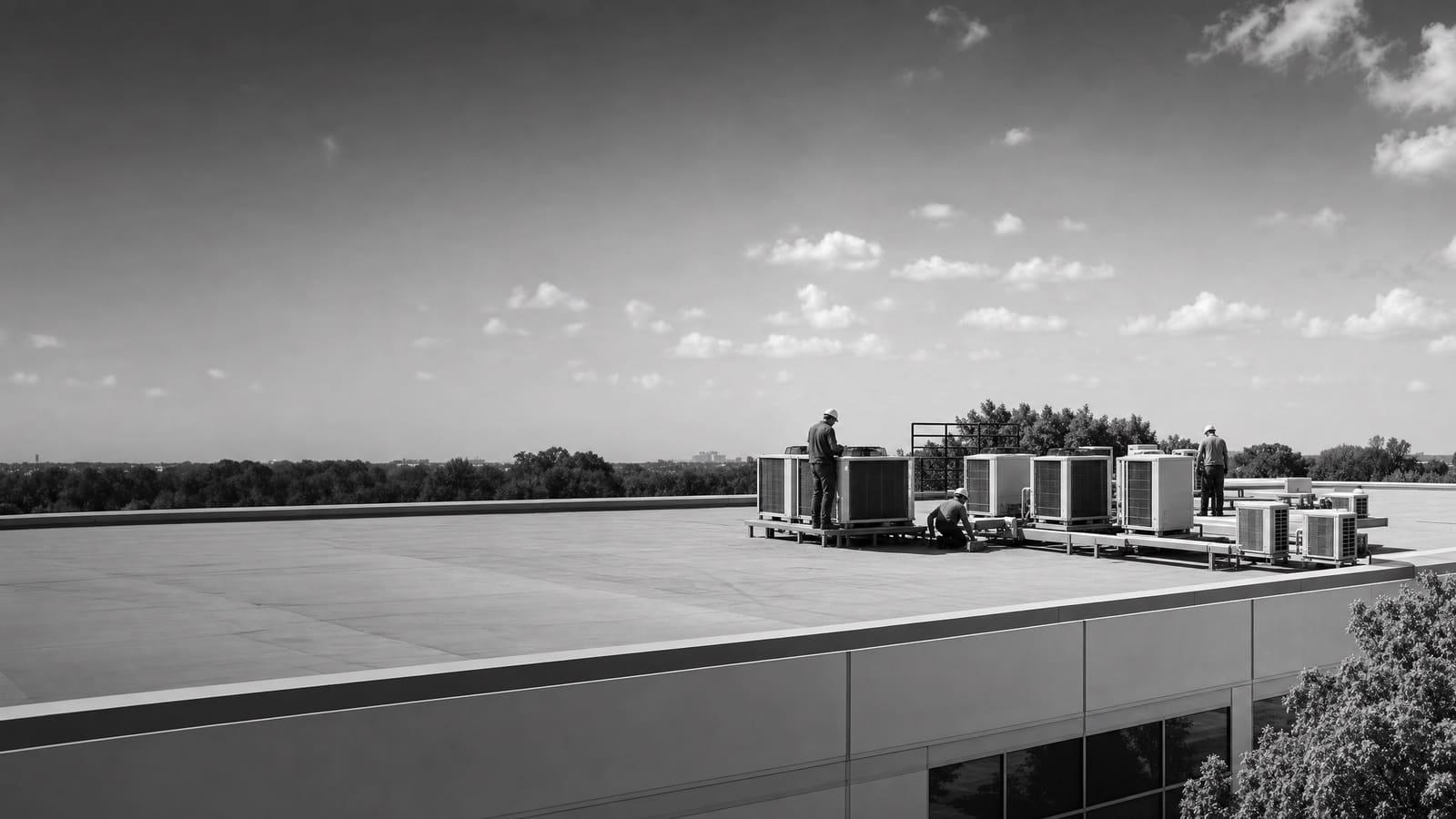
A commercial HVAC replacement covers verifying the load, selecting equipment against real lead times, recovering refrigerant from the old unit, rigging and setting the new one, reconnecting gas and power, integrating controls, and commissioning. Replacement usually beats another repair once a unit passes about fifteen years and service calls stack up. Department of Energy estimates put the energy waste from an old, inefficient rooftop unit at roughly $900 to $3,700 per unit every year, so a failing unit is already costing money before it quits.
A site review still has to confirm actual load against how the space is used now, roof and curb condition, available electrical capacity, and crane access before any of that applies to your building.
THE CHOICE
Three ways to replace a commercial rooftop unit
Three paths sit in front of most buildings when a rooftop unit reaches the end of its life. The first is the same class of unit the roof already has. The second keeps the same fuel but steps up to a high-efficiency model. The third puts reverse-cycle heat pump heating in place of gas.
The right answer depends less on preference than on what the building can support. Federal guidance for heat pump rooftop units points at the same short list every time: climate, utility rates, electrical capacity, physical constraints on the roof, existing gas lines, equipment availability, and whether local contractors know the technology. Chattanooga sits in a Southern climate, where today's heat pump rooftop units can carry most or all of the winter heating load — which makes the conversion worth pricing rather than dismissing.
Dual-fuel units are the middle path: heat pump heating for mild hours, gas for the coldest ones. All-electric and cold-climate models lean on electric resistance backup when temperatures drop, and that is where the panel capacity question gets real.
WHAT MOVES THE NUMBER
Where two quotes for the same roof diverge
Two bids on the same unit can land far apart, and it is usually one of these lines doing the work. Ask for them broken out rather than rolled into a single installed number.
IN PRACTICE
When replacement beats one more repair
The honest test is not whether the unit can be fixed. Almost anything can be fixed. The test is what the next three years look like if you fix it.
Most facility teams wait. A unit gets replaced when it stops holding temperature, needs constant attention, or dies outright. That is understandable, and it is also the most expensive way to buy equipment. Replacement on failure means no time to compare options, no leverage on lead time, and whatever unit the supply chain happens to have that week. Federal guidance is blunt about this: proactively replacing an inefficient unit often beats both replacement on failure and a like-for-like swap at the end of service life.
Age is the first screen. Rooftop units past fifteen years old waste substantial energy compared with current models, and that waste is continuous — it does not wait for a breakdown. Repair pattern is the second. One repair is maintenance. Three in two seasons on the same system is a replacement schedule the equipment is writing for you.
The third screen is fit. If occupancy, operating hours, or plug load changed since the unit went in, the old nameplate is no longer a specification. It is a record of what someone sized for a different building.
SCOPE
What separates a simple swap from a complicated one
Scope is set by the roof and the building, not by the unit on the quote. These are the conditions that turn a one-morning set into a multi-visit project.
LOWER COMPLEXITY
Same fuel, same footprint
The new unit matches the old one in class and capacity, the curb adapts cleanly, the roof deck is sound, and the crane has open lot space within reach. Permits stay mechanical and electrical, and the set happens in a single morning.
HIGHER COMPLEXITY
New fuel, new footprint, tight access
Capacity changes, the unit grows, or heating moves to electric. Now you are looking at structural review, possible electrical service work, gas line abandonment, controls reprogramming, and a rigging plan built around limited lot or street access.
BEFORE YOU BUY
What a real site review has to confirm
A quote written from a nameplate photo is a starting number, not a price. It tells the contractor tonnage and fuel type. It does not tell them whether the roof can carry the new unit, whether the panel has room, or whether a crane can reach the spot.
A proper review walks four things. Load comes first, calculated from how the space is used now — occupancy, hours, equipment, and any envelope work done since the last install. Then infrastructure: electrical capacity at the panel and feeder, existing gas service, and the physical room around the curb for a unit that may not share the old footprint. Then access, which is the least technical item and the one most likely to surprise you. Reach distance, lot closure time, tenant parking, and the weather window all belong on paper before a crane is booked.
Last is what the replacement triggers. Energy codes commonly require outside-air economizers above a capacity threshold, so a unit that never had one may not be replaceable without adding it. Refrigerant in the old unit has to be recovered by certified technicians under federal Clean Air Act rules before that unit leaves the roof.
Ask for the review, not just the number
Any contractor willing to price a commercial replacement without seeing the roof is pricing the equipment and guessing at the rest. The guess tends to surface later as a change order, usually during the week the building is already without cooling.
CHATTANOOGA SPECIFICS
Licensing and permits in Tennessee
Tennessee splits mechanical work at a dollar line, and it changes who you are allowed to hire. Projects over $25,000 require a state contractor license carrying the CMC-C classification for HVAC, or the broader CMC full mechanical classification. Below $25,000, most projects are regulated locally, which means license, permit, and inspection rules come from the city or county where the work is performed rather than from the state.
There is a second wrinkle. In municipalities where the State Fire Marshal's electrical inspectors perform inspections, HVAC permits require a state Limited Licensed Electrician license, or a contractor's license with CMC-C.
For a Chattanooga building, that leaves two questions before you sign: where the total project value falls against the $25,000 line, and which license classification your contractor holds for that value. Confirm permit and inspection requirements with the jurisdiction that will actually inspect the work.
Put the license classification on the quote
Ask for the license number and classification in writing next to the project total. If change orders push a job that started under $25,000 above the line, the licensing requirement moves with it — and that is a bad thing to discover at inspection.
OWNERSHIP
Two things to settle before the crane is booked
Equipment decisions outlive the people making them. Two of those decisions matter more than the rest, and both are far easier to settle before the purchase order than after the unit is on the roof.
The first is who carries the cost and who collects the benefit. In a leased building, the capital sits with one party and the utility savings with the other, and that split quietly decides whether anyone ever funds a high-efficiency unit. The second is what happens after handoff — who holds the commissioning records, who registers the warranty, and how one new unit fits into a roof where everything else is a generation behind it.
LEASE STRUCTURE
Capital versus operating cost
If the tenant pays the utility bill and the owner buys the equipment, the efficiency upgrade has no natural champion. Resolving that split — through a rent adjustment, a cost share, or lease language — is what makes the better unit purchasable at all.
AFTER HANDOFF
Service continuity
Commissioning records, warranty registration, and refrigerant documentation should transfer to you, not stay in the contractor's file. Federal rules govern how refrigerant is handled and recovered on this equipment, and that obligation runs through the unit's whole service life.
PLANNING AHEAD
Phasing a roof full of aging units
One replacement is a project. Four aging units on the same roof is a program, and it should be budgeted like one.
Staging beats waiting. When units are replaced one or two per year on a plan, you buy at negotiated lead times instead of emergency ones, you spread capital across budget years, and each replacement is informed by how the last one actually performed. The federal Advanced RTU Campaign shows the scale this reaches: more than 200 organizations upgraded over 43,000 rooftop units, and those upgrades together saved roughly $37 million a year in energy costs.
Lifetime cost is the frame that makes staging obvious. The purchase price is one number, paid once. The energy the unit uses is paid every month for the whole service life, and on an old, inefficient unit that stream runs into the thousands each year. A high-efficiency unit costs more on the quote and less over the period you actually own it.
Procurement deserves the same attention. Ask for lead time in writing rather than as a verbal estimate, and ask what happens to the schedule if the unit slips. Availability of the specific model and efficiency tier you want is a real constraint on this equipment, not a formality.
THE QUOTE
Five things a comparable quote shows
Two bids are only comparable if they describe the same scope. These five lines are where the differences hide. If one quote carries them and the other does not, you are not looking at a price difference — you are looking at a scope difference.
01
Equipment identity
Make, model, tonnage, efficiency tier, and heating type — not a line that says "replace rooftop unit."
02
Sizing basis
Whether capacity came from a load calculation on current use, or was carried straight over from the old nameplate.
03
Roof and curb scope
Curb adapter, structural work, and roof patching, itemized separately from the equipment cost.
04
Rigging and permits
Crane reach, lot closure window, who pulls the mechanical and electrical permits, and who meets the inspector.
05
Startup and commissioning
Charge, airflow, and control settings verified against spec, documented at handoff, with warranty registration included.
Keep planning locally
Related mechanical pages in Chattanooga
Get a defensible number
Price the equipment and the building together.
Send the address, operating target, and target opening date. Flux will identify what must be verified before the project can be priced.
Get a free estimateQuestions
Straight answers.
When is replacing a commercial unit better than repairing it?
Once a rooftop unit is past about fifteen years, it is wasting substantial energy every hour it runs, whether or not it is broken. Add a repair pattern of several calls across two seasons, and the repair budget is already funding a replacement — just slowly, and without the efficiency gain.
Does a heat pump rooftop unit make sense in Chattanooga?
It is worth pricing. Across most of the U.S. South, current heat pump rooftop units can handle most or all of the winter heating demand. The deciding factors are electrical capacity at your panel, utility rates, physical room on the roof, and equipment availability — not climate alone.
What license does a commercial HVAC contractor need in Tennessee?
For projects over $25,000, a state contractor license with the CMC-C classification, or the broader CMC full mechanical classification. Under $25,000, most work is regulated locally, so the license, permit, and inspection requirements come from the city or county performing the inspection.
Should you replace like-for-like or resize the unit?
Confirm the load either way. If the space and its use have not changed, like-for-like is often correct and simplest. If occupancy, hours, or equipment load changed, resizing fixes comfort complaints the old unit was never capable of solving.
What happens to the refrigerant in the old unit?
It has to be recovered by certified technicians before the unit comes off the roof. Federal Clean Air Act rules govern how refrigerant is handled, recovered, and recycled on stationary air-conditioning and heat pump equipment, and that documentation should come to you at handoff.
Sources used for this guide
- [1]betterbuildingssolutioncenter.energy.gov — DOE Advanced Rooftop Unit Replacement Guidance
- [2]betterbuildingssolutioncenter.energy.gov — DOE Commercial Heat Pump Rooftop Unit Replacement Guidance
- [3]betterbuildingssolutioncenter.energy.gov — DOE High-Efficiency Commercial Rooftop Unit Toolkit
- [4]energy.gov — DOE Efficient Commercial Rooftop Air Conditioner Program
- [5]epa.gov — EPA Stationary HVAC Refrigerant Management
- [6]support.commerce.tn.gov — HVAC Projects Less Than $25,000