THE DIRECT ANSWER
What a commercial HVAC replacement actually includes
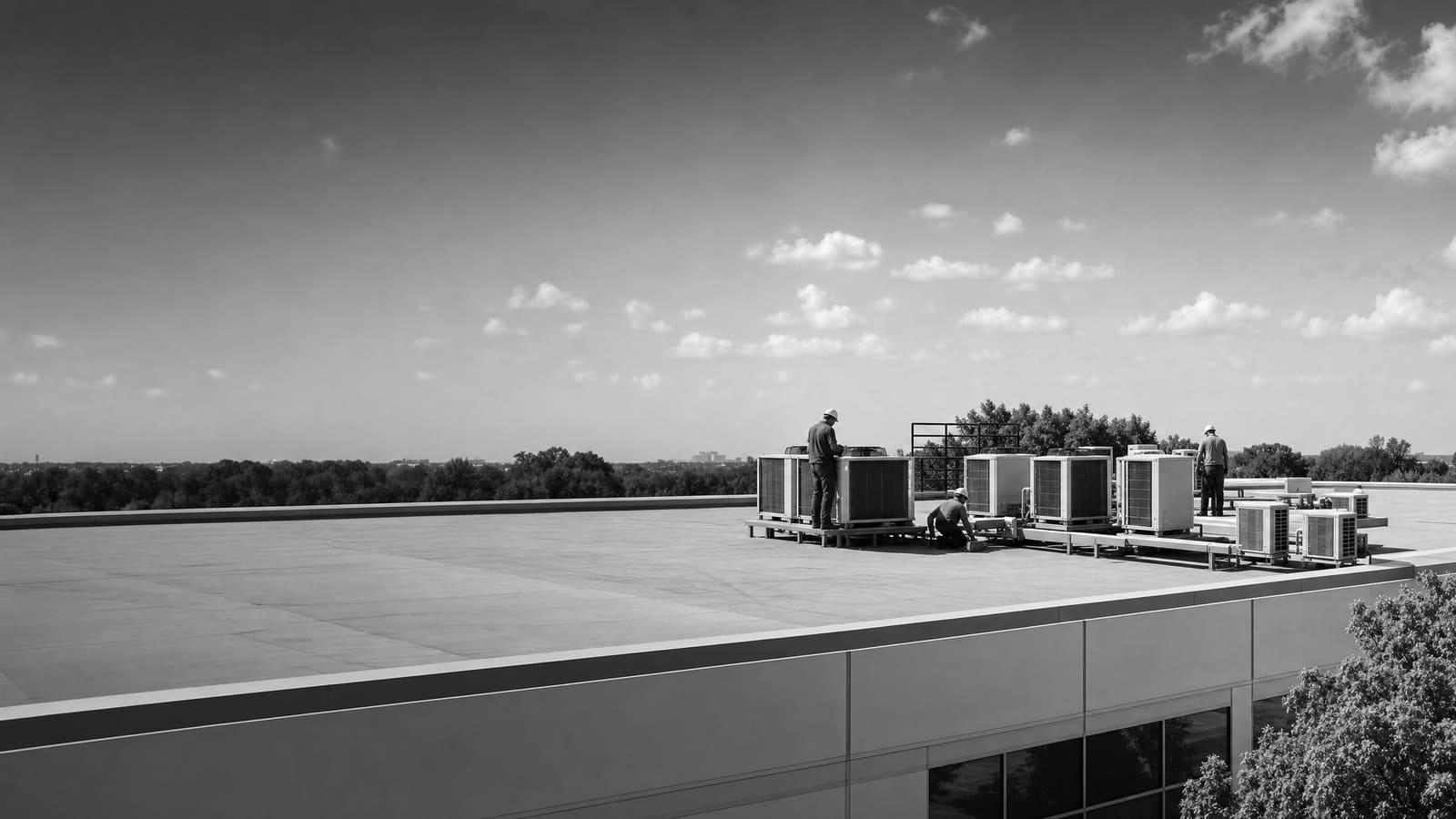
A commercial HVAC replacement is a confirmed load calculation, equipment selected against real availability, refrigerant recovery, removal and disposal of the old unit, curb and structural work, the crane set, utility and control connections, permits, and commissioning. Replacement beats another repair once a unit is past fifteen years and failing often. The Department of Energy puts the yearly energy waste of old, inefficient rooftop units at $900 to $3,700 per unit, which usually dwarfs the repair bill you keep paying.
A site review still sets the price. It has to verify roof structure and curb dimensions, electrical service capacity, gas line size, crane reach and lot access, and whether the existing ductwork suits the new unit.
THREE PATHS
Three ways to replace the system
Most Boston buildings choose between three paths, and the right one depends on how the space is used now and how long you plan to hold the building.
A like-for-like swap puts the same type and size of unit back on the same curb. It is the quickest way back to conditioned air, and it carries forward whatever sizing error the old unit had.
A right-sized, high-efficiency replacement starts with a fresh load calculation. Occupancy, plug loads, lighting, and envelope work all change what a space needs over twenty years. A federal challenge to manufacturers produced units specified to cut energy use up to 50% against the standard of the day, along with a field of models that exceed it, so the efficient option is a catalog choice rather than a special order.
A heat pump unit adds reverse-cycle heating in the same footprint. That is the path that matters if you have emissions targets or want off gas, but in a cold-winter city it needs the right model class, not just any heat pump.
WHAT MOVES THE NUMBER
Where two bids on the same roof diverge
No two roofs price the same, so compare quotes line by line rather than on the bottom number. These are the lines that move most between bidders looking at the same building.
BUYING THE JOB
Buy the installation, not just the box
The quote you want prices the whole job. When two bids land far apart, the gap is almost always in what one of them left out: the curb adapter, the structural check, the crane hours, the controls work, or the permit and inspection time. Ask each bidder to show those lines separately and the comparison gets honest fast.
Equipment availability belongs on the page next to price. A unit that ships in a week and a unit that ships in three months are different products when the building is already warm. A serious contractor quotes what they can actually get, names the model, and tells you the alternate they would use if the first choice slips.
The efficiency decision is easier than it used to be. Federal work with manufacturers turned high-efficiency rooftop units from a special request into a normal catalog choice, and more than 200 organizations have since upgraded over 43,000 units, saving a combined $37 million a year on energy. You do not need a national portfolio to get that math. On one building, the annual waste from a single tired unit often funds the step up in efficiency tier over the life of the equipment.
SIDE BY SIDE
Simple swap or a real project
Two jobs with the same tonnage on paper can be a one-morning set or a multi-week project. It is worth knowing which one you have before you read a price.
LOWER COMPLEXITY
Straight roof swap
Same tonnage on an existing curb, a clear lot for the crane, adequate electrical service already at the unit, and controls that carry over. Permits are routine, the set happens in a morning, and tenants notice the cones more than the outage.
HIGHER COMPLEXITY
Changed load or changed fuel
A larger footprint, added weight, a tight roof with limited crane reach, a service upgrade, or a switch from gas heat to a heat pump. Each one adds engineering, longer review, and utility coordination before anything gets hoisted.
SCOPING
What a real site review checks
A price given over the phone from a nameplate photo is a starting range, not a quote. The number firms up when someone stands on the roof.
The review starts with the load. Twenty years of tenant changes, lighting retrofits, added plug loads, and window or roof work all move what the space actually needs. The old nameplate is a record of a decision made under different conditions, and sizing to it repeats the guess.
Then the physical constraints. Curb dimensions and roof structure decide whether an adapter works or framing is required. Panel capacity and feeder size decide whether the unit you want can be fed at all, which matters most when the new unit adds electric heat. Gas line size matters when heating stays on gas. Crane placement, reach, and how long you can close part of the lot decide the schedule.
The last piece is controls. A unit that runs but never talks to the building automation system produces comfort complaints in month two, and those get blamed on the equipment rather than on the integration nobody scoped.
Ask for the details, not the promise
A bidder who walked the roof can tell you the curb dimensions, the panel capacity at the unit, where the crane will sit, and how long the lot closure runs. If a quote cannot answer those four questions, it is a guess with a decimal point.
BOSTON CONTEXT
What a cold winter changes about the choice
Boston winters are what change this decision. Heat pump rooftop units are most efficient in mild-to-moderate winter heating, and as outdoor temperature falls, heating efficiency drops toward parity with electric resistance heat. That does not rule out a heat pump here. It rules out assuming any heat pump will do.
Federal guidance sorts the equipment into three classes for exactly this reason: standard all-electric units, cold-climate models built to hold capacity at low outdoor temperatures, and dual-fuel units that run the heat pump through the shoulder seasons and hand off to gas on the coldest days. In a heating climate, the fair comparison is a cold-climate or dual-fuel unit against a like-for-like gas unit.
Electrical capacity is the second check. Adding electric heating to a building whose service was sized for cooling and gas heat can turn a unit swap into a service upgrade, so that question belongs at the start of scoping rather than at permit time.
Before you price an electric option
Confirm three things: panel and feeder capacity at the unit, whether the model holds heating capacity at Boston design temperature, and whether keeping the gas line for backup heat is cheaper than the electrical work required to go without it.
OWNERSHIP
Two decisions that outlive the install
The install takes a week. What you decide during it runs for the life of the equipment, which is most of the next two decades. Two of those decisions are easy to leave to chance and expensive to leave to chance: when you replace, and what your service team is holding afterward. Both are cheaper to settle while you still have leverage with the bidder and a choice of models, and both get made for you if you wait for the unit to fail in August.
TIMING
Planned beats replacement-on-failure
Federal guidance is direct about this: proactively replacing an inefficient unit usually beats waiting for failure, and often beats a like-for-like swap at end of service life. Failure in season means buying what is available that week, at that week's price, with no time to compare.
SERVICE
A roof running two refrigerants
New equipment ships on newer refrigerants than the units it replaces, and federal rules govern how refrigerant is recovered and handled. Day-one operation does not change, but a mixed roof means your service contract and spare-parts plan now cover two families instead of one.
PHASING
Phasing a roof with several units
If the building carries several units, replacing them one at a time as each dies is the most expensive schedule available. Every emergency swap is a separate mobilization, a separate crane day, a separate permit, and whatever equipment happens to be in the region that week.
The alternative is to rank the units. Age first, since units past fifteen years are where the waste concentrates. Then runtime, because the unit over the conference rooms works harder than the one over storage. Then condition: compressor history, cabinet and coil corrosion, and how often the service log shows the same repair. That ranking gives you a two- or three-year plan with one crane mobilization per phase instead of one per failure.
Lifetime cost is where the efficiency tier settles the argument. The premium for a higher tier is paid once. The waste from a tired unit, which federal estimates put as high as several thousand dollars a year on a single unit, is paid every year until that unit comes off the roof. Run the comparison across the years you intend to hold the building rather than against the day-one price, and the ranking of the bids often flips.
COMPARE FAIRLY
Five things every quote should show
Bids are only comparable when they show the same things. Ask each bidder for these five in writing before you compare bottom numbers.
01
Model number and efficiency rating
The exact unit proposed, its tonnage, its efficiency tier, and the alternate model if the first choice slips.
02
Lead time and a price hold
When the unit ships, and how long the quoted price and the equipment allocation stay good.
03
Rigging and lot plan
Crane placement, reach, closure hours, and who coordinates with tenants and the property manager.
04
Curb, structural, and roofing scope
Adapter or new curb, any framing required, and who patches the roof around the opening.
05
Commissioning and closeout package
Startup readings, refrigerant charge, airflow, controls verification, permits closed, and warranty registration.
Keep planning locally
Related mechanical pages in Boston
Get a defensible number
Price the equipment and the building together.
Send the address, operating target, and target opening date. Flux will identify what must be verified before the project can be priced.
Get a free estimateQuestions
Straight answers.
When does replacement beat one more repair?
Once a unit is past fifteen years and the service log shows the same repair returning, the math usually tips. Old, inefficient rooftop units waste $900 to $3,700 each per year in energy alone, and that number is paid every year whether or not you also pay the repair.
How long does a commercial HVAC installation take?
The crane set is the short part, typically a day on site for a packaged rooftop unit. Equipment lead time is the variable that decides your date, which is why availability belongs on the quote next to the price rather than in a phone call after you sign.
Does a heat pump make sense on a Boston roof?
It can, but the model class matters. Heat pump efficiency falls as outdoor temperature drops, so a cold-climate or dual-fuel unit is the honest comparison here, not a standard all-electric unit. Check panel capacity and a backup heat plan before pricing the option.
What happens to the refrigerant in the old unit?
Federal rules govern how refrigerant is recovered and handled when equipment is serviced or taken out of service. Recovery and documented disposal belong in the installing contractor's scope, and the closeout package should show them rather than leaving them assumed.
Should every unit on the roof be replaced at once?
Rarely. Rank them by age, runtime, and condition, then phase the work so one crane mobilization covers several units. The units past fifteen years with the heaviest runtime carry most of the waste and should lead the schedule.
Sources used for this guide
- [1]betterbuildingssolutioncenter.energy.gov — DOE Advanced Rooftop Unit Replacement Guidance
- [2]betterbuildingssolutioncenter.energy.gov — DOE Commercial Heat Pump Rooftop Unit Replacement Guidance
- [3]betterbuildingssolutioncenter.energy.gov — DOE High-Efficiency Commercial Rooftop Unit Toolkit
- [4]energy.gov — DOE Efficient Commercial Rooftop Air Conditioner Program
- [5]epa.gov — EPA Stationary HVAC Refrigerant Management