START HERE
Commercial EV charger installation in Atlanta.
A commercial EV charging project includes a site and electrical assessment, charger selection, utility coordination, engineered plans, permitting, construction, inspection, commissioning, and staff turnover. Level 2 charging often connects through building distribution equipment. DC fast charging places a much larger load on the site, so service upgrades, utility equipment, and heavier electrical work may become central parts of the plan.
The site review must verify usable electrical capacity, parking dwell time, cable routes, accessibility, communications, drainage, security, and room for later expansion.
OPERATING PLAN
Make three choices before selecting a charger
Start with the vehicles and the time they remain parked. A workplace car may sit for most of a shift. A service vehicle may return overnight. A public driver may expect a much shorter stop. Those patterns determine whether Level 2 charging can meet the need or whether DC fast charging deserves study.
Next, decide who may charge and what the site must track. Private fleet charging may need driver or vehicle access controls. Workplace charging may need employee rules. Public charging can add payment processing, customer support, pricing decisions, and station listings.
Finally, decide how much growth to prepare for now. Installing every charger on day one is not always necessary. A project can provide electrical capacity, conduit, panels, foundations, or communications for later ports. That choice should appear in the design before paving and landscaping are disturbed.
SCOPE CONTROL
What belongs in the installation budget?
A useful budget separates equipment from the work needed to power, protect, connect, and operate it. Ask bidders to state assumptions and exclusions for each line.
EQUIPMENT CHOICE
Level 2 and DC fast charging create different projects
Level 2 charging is often the practical choice when vehicles remain parked for hours. It can serve workplaces, overnight fleets, assigned vehicles, and other long-dwell uses. Several ports may share available capacity through load management. That can reduce simultaneous demand, but it also limits the power available to each vehicle when many plug in at once. The charging model must show that every vehicle can still receive the energy it needs before departure.
DC fast charging moves energy faster and shifts the installation plan. Its higher electrical demand can require new distribution equipment, service work, utility involvement, cooling clearances, and a larger equipment area. It may fit vehicles with short turnaround times or public charging where a long stay is not workable. Faster equipment is not automatically better if the vehicles already sit for hours.
Compare connector support, output, cable reach, environmental rating, network functions, warranty, replacement parts, and service response. Also confirm that vehicles can accept the planned power. A charger’s maximum rating does not guarantee that every connected vehicle will charge at that rate.
PROJECT COMPLEXITY
What makes one installation easier than another?
Charger count alone does not define complexity. The condition of the electrical system and the path between power and parking often matter more.
LOWER COMPLEXITY
Capacity and parking are close
The building has verified electrical capacity, the charger area is near suitable distribution equipment, communications are reliable, and construction can occur without major paving, structural, or utility work.
HIGHER COMPLEXITY
New power must cross an active site
Service upgrades, long underground routes, parking-deck work, structural attachments, buried conflicts, phased access, or DC fast charging can add design, coordination, equipment, and schedule risk.
SITE REVIEW
Turn a charging idea into a buildable scope
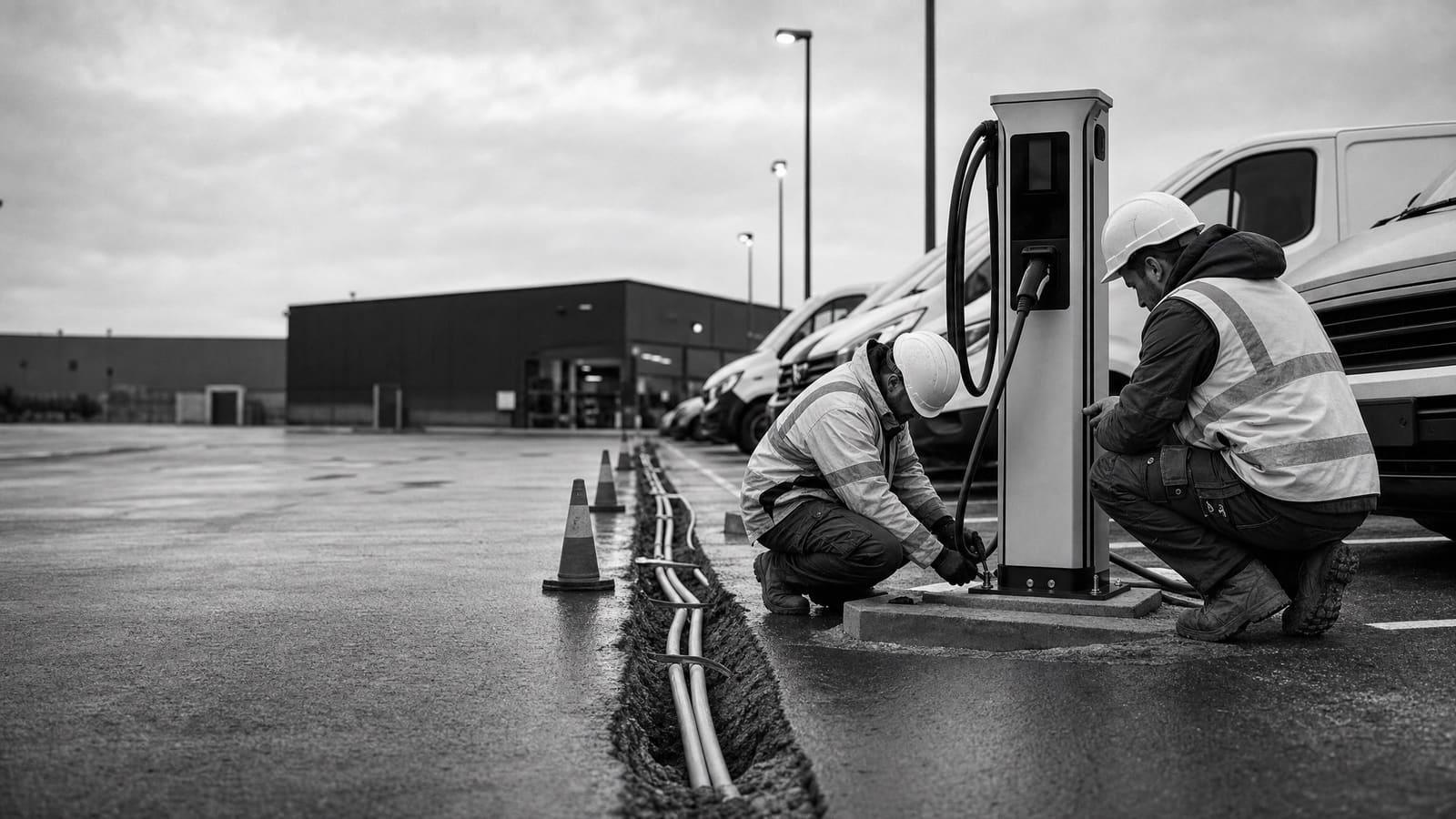
A site review should begin at the electrical service and end at each proposed parking space. The team records service and distribution equipment, available ratings, existing loads, panel space, metering, and the likely path for new conductors. Drawings and field conditions should agree before a contractor prices the route.
The parking review is just as important. Confirm who uses each space, how long vehicles remain, whether charging cables can reach safely, and how drivers move between the charger and the building. Review accessible routes, curbs, slopes, signs, lighting, drainage, vehicle impact protection, and snow-free or weather-protected operating needs where relevant. Outdoor equipment and connections must suit the installed environment.
Then test the operating plan. Estimate how many vehicles arrive together, how much energy each needs, and when each must leave. Include building loads that may overlap charging. If capacity is tight, compare managed charging with an electrical upgrade instead of assuming either answer. A good site design also shows future ports, conduit routes, equipment clearances, and the limits of the first phase.
Ask for a field-verified basis of design
The basis should name vehicle demand, charger output, simultaneous load, electrical source, cable route, communications method, parking layout, expansion allowance, and every unresolved utility or permit item.
ATLANTA REVIEW
Atlanta’s 2026 permit changes belong in the schedule
The City of Atlanta Office of Buildings issues permits and conducts inspections for construction in the city. New permit applications submitted beginning February 1, 2026 must comply with Georgia’s newly adopted building codes. The city also announced that, beginning January 12, 2026, its Office of Buildings would temporarily suspend review of structural drawings until further notice. Structural documents still must be submitted, with responsibility placed on the Engineer of Record.
That matters when charger work includes structural attachments, equipment pads, canopies, parking-deck penetrations, or other structural scope. Before pricing, confirm which drawings are required, who will seal them, and whether the temporary policy remains in effect at the planned submission date.
Keep the permit active
Atlanta states that an expired building permit becomes invalid, requires a new application, and forfeits previously paid building permit fees. Tie procurement and construction milestones to the permit schedule.
OWNERSHIP AND OPERATIONS
Decide who owns the charger experience
Commercial charging continues after the final inspection. Someone must monitor station status, help drivers, manage access, review energy use, update software, handle payments if offered, and arrange repairs. Put those duties in writing before selecting a network or ownership model.
A site may own its equipment and contract separately for software and service. Another arrangement may bundle equipment, networking, operation, or maintenance. Compare control of pricing and data, contract length, recurring fees, uptime support, parts availability, warranty labor, and what happens if the network relationship ends. Review maintenance planning before procurement so service access and spare-parts needs influence the equipment choice.
SITE-CONTROLLED
More control, more responsibility
The owner can set access and operating rules but must coordinate software, driver support, warranties, preventive maintenance, and repairs.
SERVICE-BUNDLED
Simpler administration, added dependency
A provider may combine operating services, but the buyer should test fees, data access, response terms, renewal conditions, and exit options.
PROCUREMENT
Buy a working charging system, not separate parts
Issue the same design basis to every bidder. State the vehicle use, parking plan, charger quantity and output, electrical assumptions, network functions, payment needs, construction hours, restoration standard, and target opening date. If the design is not complete, require each bidder to list allowances and unresolved items instead of hiding them inside one total.
Plan around equipment delivery, utility decisions, permits, inspections, and site access. These activities can overlap, but they depend on one another. Ordering chargers before confirming power and communications can leave equipment waiting on site. Starting civil work before the route is coordinated can cause rework. Define who owns each submission, approval, inspection, and scheduling task.
For a phased project, compare the full build with a make-ready plan. The first phase might install distribution equipment, conduit, communications, foundations, or reserved breaker space for later chargers. Price that future-ready work separately. It is valuable only when the design records what was installed, where it ends, and how much capacity remains. At turnover, keep approved drawings, test results, equipment settings, warranties, software credentials, training records, and emergency contacts.
QUOTE CHECK
Five things every comparable quote should show
Do not compare totals until scope, assumptions, exclusions, and responsibility are aligned. Each proposal should make these five items easy to find.
01
A defined charging outcome
Show vehicles served, parking time, energy need, port count, charger output, and planned future growth.
02
Verified electrical scope
Name the power source, load assumptions, managed-charging limits, panels, switchgear, metering, and utility-dependent work.
03
Complete site construction
Include routes, trenching, conductors, pads, mounting, protection, signs, striping, accessibility work, restoration, and traffic control.
04
Permits and project responsibilities
Assign engineering, sealed documents, submissions, fees, utility coordination, inspections, schedule control, and correction work.
05
Commissioning and long-term support
Include activation, load testing, network setup, training, records, warranties, recurring fees, maintenance, and service response.
Keep planning locally
Related EV charging pages in Atlanta
Get a defensible number
Price the equipment and the building together.
Send the address, operating target, and target opening date. Flux will identify what must be verified before the project can be priced.
Price my chargersQuestions
Straight answers.
What is the first step in commercial EV charger installation in Atlanta?
Begin with a site and electrical assessment. Verify the service, building loads, distribution equipment, parking use, conductor route, communications, accessibility needs, and future expansion. Then match charger power to how long vehicles park and how much energy they need.
Should an Atlanta commercial property use Level 2 or DC fast chargers?
Choose Level 2 when vehicles can remain parked for hours and the operating plan allows slower charging. Study DC fast charging when vehicles need short turnarounds or public drivers cannot wait. DC fast charging can bring greater electrical, utility, equipment, and site-work requirements.
Can load management avoid an electrical service upgrade?
It may help when several chargers can share limited capacity, but it is not an automatic substitute for an upgrade. The design must test building demand, simultaneous vehicle arrivals, required energy, and departure times. The utility and electrical assessment determine whether the existing service is usable.
Who handles utility coordination and Atlanta permits?
The contract should assign both duties clearly. Utility coordination may involve load information, metering, service capacity, equipment, and schedule. Atlanta permitting can require plans, supporting documents, inspections, and corrections. The owner should receive a responsibility list with named parties and deadlines.
What should happen before the chargers are opened for use?
The installer should complete inspections, energization, functional testing, network activation, access or payment setup, and load-management checks. Turnover should include approved drawings, equipment settings, warranties, software access, staff training, maintenance instructions, and support contacts.
Are commercial EV charging incentives available in Atlanta in August 2026?
Treat every incentive and tax credit as time-sensitive. Do not include one in the approved budget until current eligibility, location rules, qualifying equipment, labor requirements, application timing, and available funding have been verified for the specific site.
Sources used for this guide
- [1]afdc.energy.gov — Alternative Fuels Data Center: Procurement and Installation for Electric Vehicle Charging Infrastructure
- [2]betterbuildingssolutioncenter.energy.gov — DOE Better Buildings Commercial EV Charging Infrastructure Guide
- [3]driveelectric.gov — Public electric vehicle charging infrastructure playbook · Joint Office of Energy and Transportation
- [4]energy.gov — DOE Federal Workplace Charging Program Guide
- [5]atlantaga.gov — Office of Buildings | Atlanta, GA