Direct answer
Level 2 runs about $3,500 a connector; DC fast runs $38,000 to $90,000
Plan on about $3,500 for a Level 2 connector and $38,000 to $90,000 for a DC fast connector. Installation is a second line: roughly $2,500 per Level 2 connector, and $20,000 to $60,000 per DC fast connector. Build that combined total before you shop, because Georgia Power's business rebate is capped at half of total project cost, including charger, installation, and materials. In Atlanta the total sets the refund ceiling.
These are national planning figures, not a quote for your address. Port count, spare panel capacity, service upgrades, trenching distance, garage work, permits, networking, and commissioning move the real number in either direction.
Start from the schedule
Level 2 and DC fast charging answer different operating problems
The first question is not what a charger costs. It is how long the vehicles sit still. Level 2 sends alternating current to the vehicle, and the vehicle's onboard charger decides how fast that power becomes battery energy. A higher nameplate rating will not make a vehicle accept power faster than its own equipment allows. Where cars park for a full shift or a full night — offices, apartments, hotels, overnight fleets — parked hours can stand in for power.
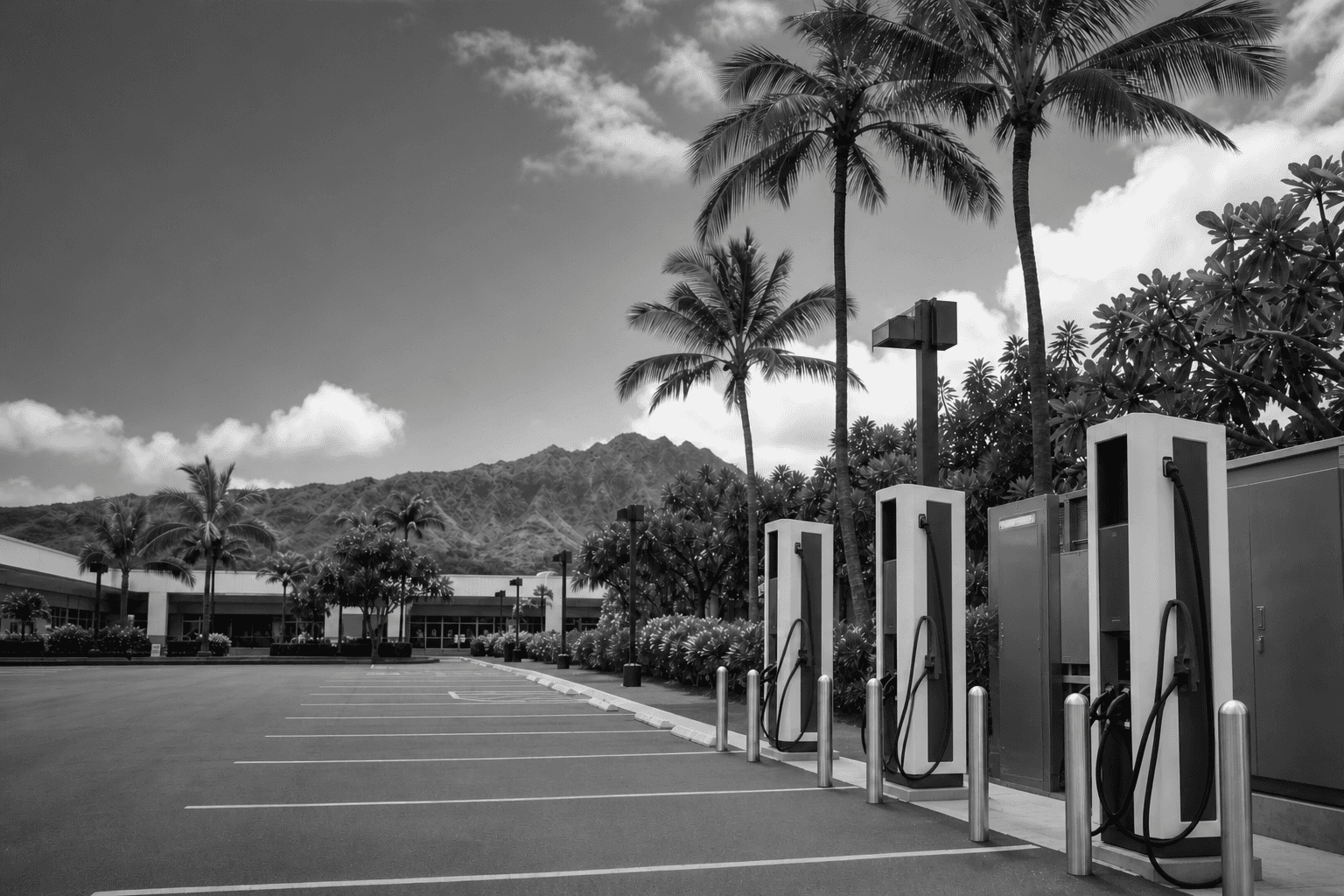
DC fast charging is for vehicles that must collect real energy during a short stop. It can add 100 to 200 or more miles of range in about 30 minutes. It also moves the conversion equipment out of the vehicle and onto your property, which is where transformer work, utility coordination, and demand charges arrive. Demand charges are usually set by the highest 15-minute average draw in a billing period, and fast charging is far more likely to trigger them.
Do the arithmetic before you pick power. Daily miles set the energy each vehicle needs, and parking hours set the delivery window. Add reserve for detours, aging batteries, and missed sessions, then decide how many vehicles charge at once.
Build the whole number
What belongs in an Atlanta charging budget
Keep the equipment separate from the work needed to power it and the cost of running it. That is what stops a low charger price from hiding an expensive trench, a service upgrade, or a network contract nobody planned to renew.
Do not buy the box first
Choose hardware after the site and the schedule are settled
A spec sheet cannot tell you whether your property has spare capacity, whether your vehicles will accept the advertised rate, or whether the stalls you want can be built without closing half the lot. Hardware should follow the duty-cycle math and a real site review, which is also what sets the EV charger installation scope. Buy first and you can end up with units too powerful for the service, too slow for the schedule, or missing an access feature the property needs.
Compare more than nameplate power. Look at connector compatibility, cable reach, pedestal or wall mounting, environmental rating, accessible-stall requirements, communications, payment options, load-management support, warranty terms, and how fast a cable, screen, modem, or contactor can be replaced. Some fleets do better with 240-volt receptacles and portable units than with a pedestal at every stall, because a portable unit is easy to swap when it fails. In Georgia that choice has a price: portable and mobile connectors are not eligible for the utility rebate.
Separate required features from optional ones before you write the specification. Public payment, employee billing, fleet authentication, energy reporting, remote reset, and uptime monitoring solve different problems and price differently. Paying for all of them adds cost. Leaving out the one operations genuinely needs forces a hardware or network change later.

The expensive path
Why two Atlanta properties price completely differently
Put four ports beside a panel with spare capacity and the route stays short. Move the same four ports across an occupied lot and you add trenching, traffic control, pavement repair, longer conductors, and voltage-drop analysis. The chargers did not change. The site did.
Lower-complexity site
Fewer building changes
• Spare breaker space and service capacity
• Short, accessible conduit route
• Chargers placed near existing power
• Little or no pavement restoration
Higher-complexity site
More infrastructure work
• Transformer or service upgrade
• Long underground run across parking
• Boring under drive aisles or fire lanes
• DC fast charging with high peak demand
Replace guesses with site facts
A site walk should answer the expensive questions before design starts
The first visit is not about counting parking spaces. The reviewer should locate the utility service, transformers, main switchgear, distribution panels, spare breaker space, and the practical routes between power and parking. That route is the EV make-ready work, and it usually carries more cost than the chargers. Nameplate ratings are only a starting point; interval data, demand history, and planned building projects decide whether apparent spare capacity is really available.
Outside the electrical room, mark proposed charger positions, accessible parking, pedestrian paths, vehicle circulation, drainage, and pavement types. A straight line on an aerial photo can cross a fire lane, a storm line, or an occupied loading dock.
Then ask what the drawing package has to contain before an engineer starts. Atlanta's Office of Buildings takes applications through its online permitting system and reviews new applications under the newly adopted State of Georgia building codes. The office has also suspended its review of structural drawings; structural documents still have to be submitted with the application and remain the responsibility of the Engineer of Record. If your chargers need pads, canopies, or bollards, settle early who is stamping that work.
A remote estimate is a range, not a construction number.
Photos, drawings, and twelve months of utility bills narrow the problem. A firm scope needs measured routes and verified electrical conditions, and the estimate should name every assumption still waiting on field confirmation.
Atlanta-specific money
Georgia Power and the federal credit change your net number
Georgia Power runs an EV Charger Plus rebate for business customers, and it is large enough to shape the design. Level 2 pays $250 per kilowatt, which the utility estimates at roughly $1,675 to $4,875 per charger. DC fast pays $150 per kilowatt, estimated at $9,300 to $30,000 per charger. Businesses can earn up to $30,000 per project and $60,000 per year. Multifamily properties can earn up to $50,000 per project and $150,000 per year, with Level 2 paid at $5,000 per charger. The rebate is capped at half of total project cost, including charger, installation, and materials, and it is paid while funds last. The federal 30C credit can separately cover up to 30% of purchase and installation cost at eligible locations, so check the address instead of assuming. That is why EV charging incentive paperwork belongs in the schedule, not at the end of it.
Design to the rebate rules
The rules reach into the specification: equipment must be new, NRTL certified, at least Level 2 at 208 or 240 volts, on a dedicated circuit, and installed by a licensed electrician. Portable and mobile connectors do not qualify. Pre-approval is optional but recommended, and chargers have to be installed within the calendar year.
After the ribbon cutting
The installation quote is not the cost of running chargers
Plan on maintenance of up to about $400 per charger per year, and know that extended warranties for DC fast chargers can run over $800 per charger per year. Level 2 units often carry a fixed-term warranty at lower cost, which means the owner picks up repairs once that term ends. Decide in writing whether the site host, the network, or the installer owns each repair, and make the maintenance agreement state a response time and an uptime requirement.
Electricity is the other half. Demand charges follow the highest 15-minute average in a billing period, so load management is worth real money when vehicles have dwell time to spare. Controls cannot create energy or add parked hours. They only decide which vehicle gets available power first.
You own the equipment
You keep the upside and the repairs
The rebate and the credit go to you, you set pricing, and you keep the utilization data. You also fund replacements, network renewals, and every service call after the warranty ends.
A third party owns it
Someone else carries the asset
A provider funds or operates the equipment and takes the revenue or a fee. Read who claims the incentives, who controls pricing, who owns the data, and what happens to the hardware when the term ends.
Build once, energize deliberately
Phasing can hold down the first budget without rebuilding the lot later
You do not have to install every future charger on day one. Complete the disruptive work — underground conduit, pull boxes, equipment pads, reserved panel space, communications pathways, and correctly sized distribution — and energize only the ports today's demand supports. That approach pays off when the parking area is hard to reopen or when fleet vehicles arrive on a known replacement schedule.
Phasing still needs a real plan behind it. "EV ready" means nothing if the conduit ends in the wrong place, the reserved gear cannot support the intended voltage, or the software cannot coordinate the later ports. Record the final port count, expected charging power, assumed diversity, and the trigger for each expansion, so the next reviewer does not have to reverse-engineer your intent.
Watch the permit clock while you phase. Under City Code, an expired Atlanta building permit is invalid, a new application is required, and the building permit fees based on construction cost have to be paid again. Reinstatement is possible only in narrow cases: the original permit issued within the past two years, unchanged ownership, unchanged approved plans, at least one qualifying inspection completed, and no open enforcement cases. Do not pull the permit until equipment lead times, utility scheduling, and your contractor's start date line up.
Before you compare bids
A useful quote shows the assumptions, not just the total
Ask every bidder to price the same port count, power level, conduit route, panel work, network term, pavement restoration, permit scope, and commissioning. If one quote excludes utility or civil work and another includes it, the totals are not comparable.
01
The charging use case, vehicle dwell time, and energy needed per session
02
Existing service capacity, the load calculation, and the load-management assumption
03
Exact charger locations with measured electrical and civil routes
04
Included permit, inspection, utility, network, and commissioning work
05
Rebate handling, plus an alternate for phased expansion so future ports do not start over
Keep planning locally
Related EV charging pages in Atlanta
Get a defensible number
Price the equipment and the building together.
Send the address, operating target, and target opening date. Flux will identify what must be verified before the project can be priced.
Price my chargersQuestions
Straight answers.
Is a per-port estimate enough to budget an Atlanta project?
Only for early planning. A construction budget also needs the measured electrical route, verified service capacity, civil work, permitting, networking, and commissioning scope. Those items move the total far more than the charger price does.
How much does the Georgia Power rebate actually cover?
Level 2 pays $250 per kilowatt and DC fast pays $150 per kilowatt for business customers, capped at 50% of total project cost and at $30,000 per project. Multifamily properties have their own tier, up to $50,000 per project. Funds are limited, so applying for pre-approval before you install is the safer path.
Can portable chargers cut the cost of a fleet installation?
Sometimes. Installing 120- or 240-volt receptacles and using portable units can lower project cost and makes a failed unit easy to swap. In Georgia, weigh that against the rebate, which excludes portable and mobile connectors of any kind.
Will DC fast charging raise our electric bill more than Level 2?
Usually, and not only through kilowatt-hours. Demand charges are typically based on the highest 15-minute average use in a billing period, and DC fast charging is much more likely to trigger them than Level 1 or Level 2.
Do we need permits and inspections for chargers in Atlanta?
Plan on a permitted, inspected electrical scope. The Office of Buildings issues permits and conducts inspections, applications go through the city's online permitting system, and new applications are reviewed under the newly adopted State of Georgia building codes.
Sources used for this guide
- [1]afdc.energy.gov — Alternative Fuels Data Center: Procurement and Installation for Electric Vehicle Charging Infrastructure
- [2]atlantaga.gov — Office of Buildings | Atlanta, GA
- [3]georgiapower.com — Electric Vehicle Charger Plus Rebate
- [4]afdc.energy.gov — Alternative Fuels Data Center: Operation and Maintenance for Electric Vehicle Charging Infrastructure
- [5]afdc.energy.gov — U.S. DOE AFDC Electric Vehicles for Fleets
- [6]atlantaga.gov — Online Permitting | Atlanta, GA