THE SHORT VERSION
What a commercial HVAC replacement actually covers
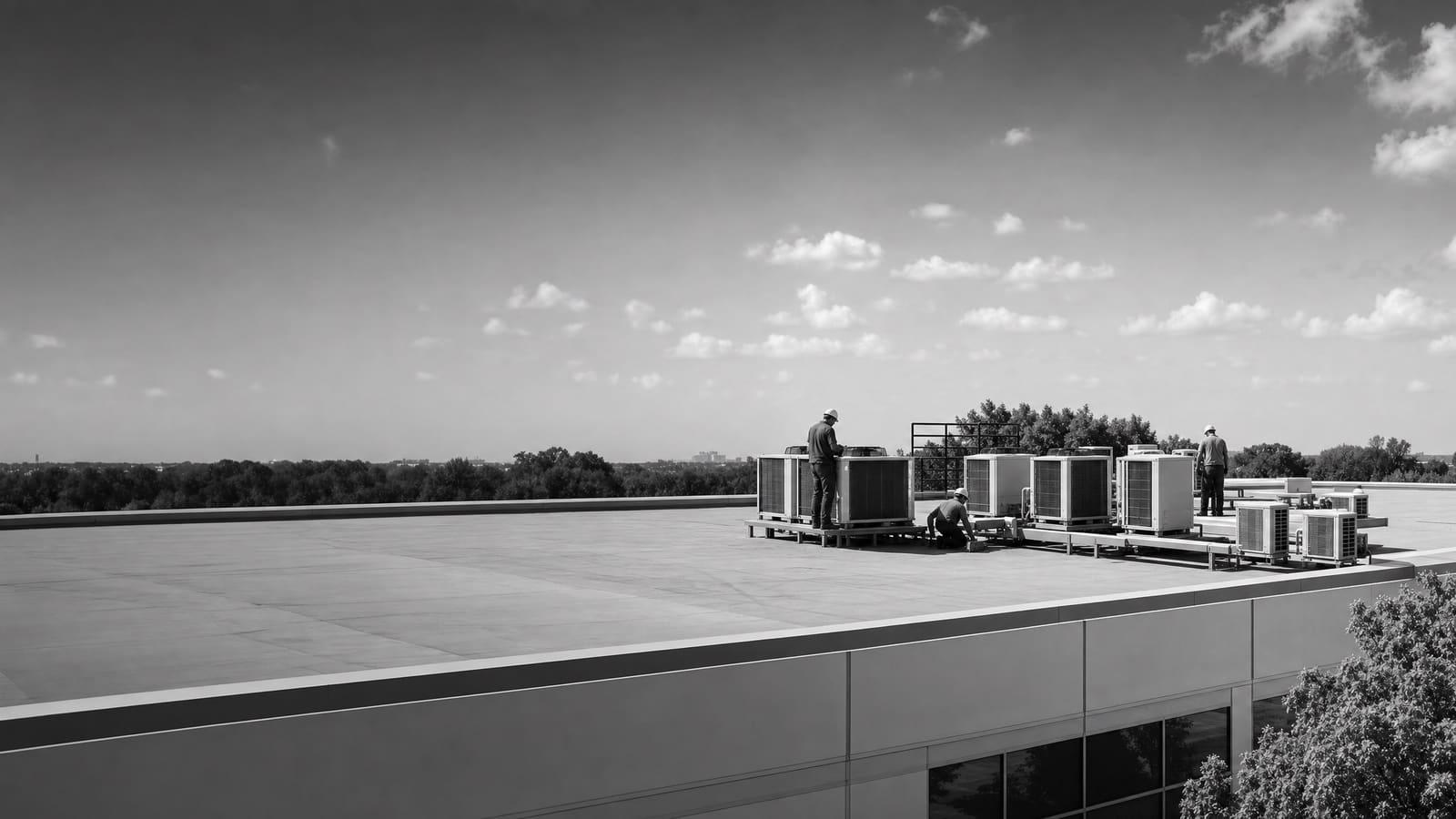
A commercial replacement covers a fresh load calculation, equipment chosen against real lead times, curb and rigging work, gas or electrical changes, certified recovery of the old refrigerant, controls integration, and a documented startup. Replacement beats another repair once a unit is past 15 years, once repairs start repeating, or once it can no longer hold the space. Old, inefficient rooftop units waste roughly $900 to $3,700 each per year in energy, so the quiet cost of waiting is often larger than the last invoice.
A site review still has to verify tonnage against how the space is used now, the condition of the curb and roof structure, available electrical capacity, and whether the existing connections match what the new unit needs.
THREE PATHS
Three equipment paths worth pricing
Most rooftop replacements come down to three equipment paths, and the right one depends on your heating load, your electrical service, and what your gas lines already do.
A straight air-conditioning unit with gas heat is the familiar choice. It is fastest to specify, simplest to permit, and usually the least disruptive below the roof. A heat pump rooftop unit adds reverse-cycle heating. It is technically close to the air-conditioning version and can cut operating cost, but heating efficiency falls as outdoor temperatures drop and trends toward parity with electric resistance heat. That is why the category splits further. Dual-fuel units let the heat pump carry the mild hours and hand the cold end back to gas. Cold-climate models are built to hold heating output further down the temperature curve.
Price at least two paths on the same roof before deciding. The real differences show up in the electrical panel, the gas line, and the annual utility bill, not in the crane day. Ask for estimated annual operating cost next to each installed price so the comparison means something.
WHAT MOVES THE NUMBER
Where the installed price actually comes from
No one can price a commercial roof from a nameplate photo. These are the lines that separate a clean morning swap from a multi-week project, and they are the ones worth pinning down before anyone commits to a number. The tag shows where the price risk sits.
BUYING GUIDANCE
How to buy this without overpaying
Start with the load, not the nameplate. A unit installed twenty years ago was sized for that building's occupancy, lighting, and equipment at that time. Lighting alone has changed since. If nothing about the space has changed, a like-for-like swap is honest and fast. If the use changed, resizing fixes complaints the old unit was never capable of fixing.
Then decide whether you are replacing on failure or on plan. Replacement on failure is the most expensive way to buy equipment. You take whatever is available, you pay for the emergency, and you give up the chance to compare efficiency tiers at all. Planned replacement lets you price two or three options, chase whatever incentives apply, and pick a week the building can absorb.
Efficiency is the part buyers most often leave on the table. High-performance rooftop units were designed to cut energy use by up to half against the older baseline, and more than twenty models now exceed that specification. Across the organizations that joined the federal upgrade campaign, over 43,000 units were replaced or retrofitted, with combined savings near $37 million a year. That is not a promise about your roof. It is a reason to make the contractor show operating cost beside purchase price.
SIDE BY SIDE
Simple swap or real project
Two roofs carrying the same tonnage can price very differently, and the gap is rarely the equipment. It is everything that has to change around it: the curb, the panel, the access, and the controls. Work out which side of this line your building sits on before you read the bids.
LOWER COMPLEXITY
Straight replacement
Same tonnage, a matching curb, electrical and gas already adequate, open lot for the crane, and controls that speak the same language as the new unit. Set and connected in a morning, inspected shortly after.
HIGHER COMPLEXITY
Change of system or size
A fuel switch, higher tonnage, added weight on an older roof, tight access, or a building automation system that needs new points mapped. Expect engineering, a longer approval path, and work split across phases.
SCOPING
What a real site review checks
The site review is where the price stops being a guess. A technician should get on the roof, read the nameplate, and then look past it. Age matters, but so does what has already been repaired, whether the curb is sound, and whether the last replacement carried an old sizing mistake forward.
Below the roof, the review follows the connections. Electrical capacity is the first gate on any heat pump or all-electric option, because a unit that draws more than the panel and feeders can deliver turns a swap into a service upgrade. Gas lines matter in the other direction. If gas heat comes out of one unit but the line still serves others, that gets planned, not discovered on install day.
The last part is scheduling, and it is the part buyers skip. Ask what the building does during the work: which stalls close and for how long, whether the space can run on temporary or reduced capacity, and what happens if the crane day gets weathered out. Equipment availability belongs in that same conversation. A unit that ships in eight weeks changes your plan more than a few points of efficiency ever will.
Ask for this before you sign
A written scope naming the tonnage and efficiency tier, the curb solution, the electrical and gas work included, who pulls permits and pays for them, and the commissioning readings that get documented at handoff.
OWNERSHIP
Two things owners settle too late
Two decisions shape the next decade more than the purchase price does. The first is how you plan to own the equipment once it is running. The second is how a new unit fits the equipment already sitting on the roof beside it.
Neither shows up on a quote unless you ask for it. Both are far easier to settle before the order is placed than after the crane leaves. A high-efficiency unit nobody services, and a new unit nobody on your service contract is set up to maintain, both end up costing more than the model you passed on.
MAINTENANCE
Service is part of the price
Efficiency ratings assume clean coils, correct charge, and working economizer dampers. Without a service plan, a high-efficiency unit drifts back toward the performance of the one you just removed.
MIXED FLEET
Refrigerant handling is regulated
Federal rules govern how refrigerant is recovered, recycled, and serviced in commercial equipment. On a roof with mixed vintages, that shapes who can service what and how the contract gets written.
PLANNING AHEAD
Phase the fleet instead of running fire drills
If the building carries several rooftop units, the useful question is not whether to replace the one that failed. It is what order the rest come off in. Units age together because they were installed together, so a roof that lost one this season is usually a season or two from losing another. Facility managers often wait until a unit stops conditioning the space, needs constant attention, or fails outright, and that habit is what makes each replacement more expensive than it needed to be.
Phasing gives you leverage. Ordering two units instead of one improves pricing and shortens the second lead time. It also lets you standardize: same manufacturer, same controls, same filter sizes, one set of spare parts. A facility team feels that every single month.
Lifetime cost is where the argument gets settled. Purchase price is one number, paid once. Energy, repairs, and downtime are numbers you pay every year the unit is on the roof. A unit quietly wasting a few thousand dollars a year in energy can outspend the gap between a baseline model and a high-efficiency one well before the equipment retires. Ask for both figures side by side. If a contractor cannot show estimated annual operating cost for the options being compared, the comparison is only about price.
THE CHECKLIST
Five things a comparable quote shows
Bids only compare when they describe the same work. When two numbers land far apart, the gap almost always sits in one of these five lines rather than in the equipment itself. Ask every bidder to put all five in writing before you compare price.
01
Equipment and efficiency tier
Model, tonnage, efficiency rating, and heating type, so two bids can be judged on the same basis.
02
Curb, structure, and roof work
Whether an adapter fits or the opening changes, plus any framing, flashing, or roofing repair included in the number.
03
Electrical, gas, and refrigerant scope
Panel capacity checked, feeders and disconnects named, gas work defined, and certified recovery of the old charge included.
04
Crane, access, and schedule
Rigging plan, which stalls close and when, the weather contingency, and the equipment lead time stated in writing.
05
Permits and commissioning
Who pulls and pays for permits, which inspections apply, and what startup readings are documented at handoff.
Keep planning locally
Related mechanical pages in Anchorage
Get a defensible number
Price the equipment and the building together.
Send the address, operating target, and target opening date. Flux will identify what must be verified before the project can be priced.
Get a free estimateQuestions
Straight answers.
When does replacement beat one more repair?
Once a unit is past 15 years and repairs start repeating, the math usually flips. An old, inefficient rooftop unit can waste roughly $900 to $3,700 a year in energy on its own, before you add the repair invoices or the cost of losing the space during a failure.
Is a heat pump rooftop unit the right choice for our building?
It depends on the winter heating load and the electrical panel. Heat pump units are most efficient in mild to moderate winters and lose efficiency as outdoor temperatures fall toward parity with electric resistance heat, which is exactly why dual-fuel and cold-climate models exist. Price a heat pump option and a gas-heat option on the same roof and compare operating cost, not just installed price.
What is the most common cost surprise?
Electrical capacity. Any all-electric or heat pump path depends on what the existing panel and feeders can carry, and a service upgrade discovered after the equipment is ordered is the most common reason a straightforward swap turns into a project.
Who handles the crane, permits, and old refrigerant?
The installing contractor should own the rigging plan, lot coordination, permits, inspections, and certified recovery of the old refrigerant charge as part of the installed price. Confirm all of it is written into the scope before you sign, not assumed.
Should we replace like-for-like or resize?
Confirm the load either way. If the space and its use have not changed, like-for-like is fast and honest. If occupancy, operating hours, or equipment loads changed, resizing fixes comfort complaints the old unit was never able to solve.
Sources used for this guide
- [1]betterbuildingssolutioncenter.energy.gov — DOE Advanced Rooftop Unit Replacement Guidance
- [2]betterbuildingssolutioncenter.energy.gov — DOE Commercial Heat Pump Rooftop Unit Replacement Guidance
- [3]betterbuildingssolutioncenter.energy.gov — DOE High-Efficiency Commercial Rooftop Unit Toolkit
- [4]energy.gov — DOE Efficient Commercial Rooftop Air Conditioner Program
- [5]epa.gov — EPA Stationary HVAC Refrigerant Management