THE SHORT VERSION
What a commercial HVAC replacement actually includes
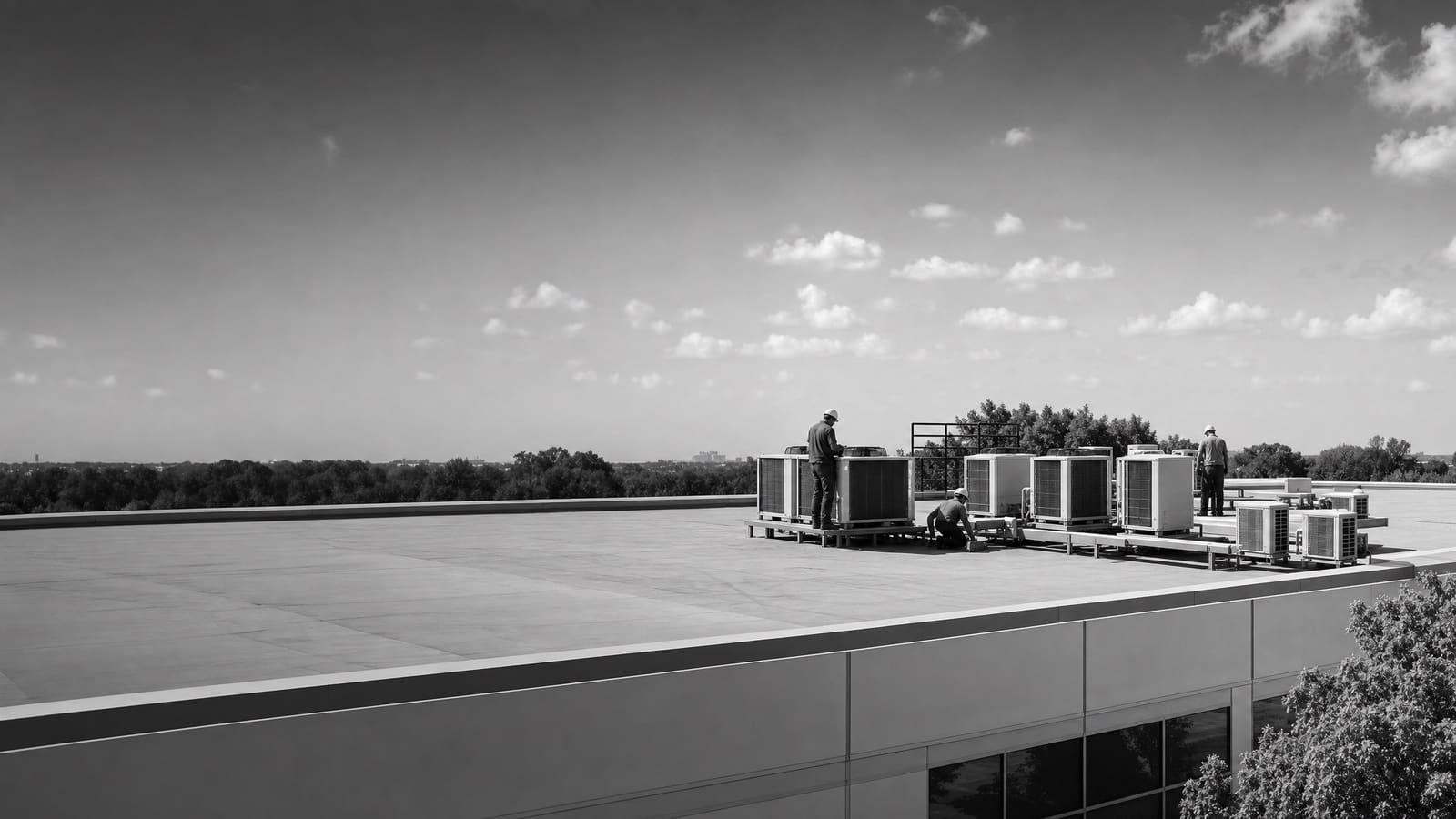
A commercial HVAC replacement means confirming the load the building carries today, selecting equipment that fits the curb and the available power, setting and connecting the unit, then commissioning it so it performs to spec instead of just turning on. Replacement beats another repair once a unit is past roughly fifteen years. Old rooftop units can waste $900 to $3,700 each per year in energy, and the next failure lands in season anyway.
A site review still has to verify curb size, roof structure, available electrical capacity, and existing gas service before any installed number means anything.
THREE WAYS TO GO
Three replacement paths worth pricing
Most buyers think the decision is which brand. It is really which of three paths the building takes, and each one prices differently.
Like-for-like keeps the same fuel and roughly the same capacity. It is the fastest path back to conditioned space and the cheapest to engineer. Right-sizing recalculates the load against how the space is used now, because twenty years of occupancy changes, added equipment, and envelope work rarely leave the original nameplate correct. A heat pump rooftop unit replaces the gas heating section with reverse-cycle electric heat, and it is technically similar enough to a standard air-conditioning unit that the swap itself is straightforward when the building supports it.
That third path carries the most homework. Electrical capacity, physical constraints on the roof, gas line changes, equipment availability, and how familiar the installer is with the technology all decide whether it fits a given site. Ask for all three priced side by side on the same roof.
WHAT MOVES THE NUMBER
Where the money actually goes
No two roofs price the same, so compare proposals line by line rather than on the bottom number. These are the lines that move most between two bids on the same building.
IN PRACTICE
Buy the equipment, not just the install
Equipment choice sets most of the lifetime cost, and it usually gets decided in about ten minutes if nobody plans for it. Rooftop units condition close to half of all commercial floor space in the country, so the market is deep. More than twenty models now exceed a high-efficiency specification written to cut rooftop energy use by up to half against the older standard. That range only helps you if the quote names the efficiency tier instead of just the tonnage.
The second decision is heat. A heat pump rooftop unit is mechanically similar to a straight air-conditioning unit and heats by running the refrigerant cycle backward. Its heating efficiency falls as outdoor temperature drops, and near the bottom it trends toward parity with plain electric resistance heat. That is why units built for real winter swings pair the heat pump with a gas section or use a cold-climate design. That is the entire dual-fuel argument in two sentences.
The third is timing. Replacing on failure means taking whatever unit is on a truck that week. Deciding before the unit quits lets you compare tiers, look at available incentives, and schedule the crane on a Sunday morning instead of a Tuesday at noon.
SCOPE CHECK
What makes one roof simple and the next one complicated
Two buildings on the same street can price a full tier apart. The difference almost always shows up before the equipment order, in what the roof and the electrical room will allow.
LOWER COMPLEXITY
Same fuel, same footprint
The new unit matches the existing curb, the fuel source does not change, the lot has room for the crane to set up away from tenant doors, and the controls connect point-for-point with what is already there.
HIGHER COMPLEXITY
New fuel or new capacity
Switching to electric heat, growing tonnage, or landing a larger footprint. Each one can pull in electrical service capacity, structural review, an adapter curb, and a longer equipment lead, and the crane may need a wider closure.
BEFORE YOU SIGN
What the site review has to settle
A quote written from a phone call is a guess with a number attached. The site review is what turns it into a price, and it should produce answers, not photos.
Start with the unit itself: nameplate tonnage, age, refrigerant type, and how the existing curb is built. Old equipment holds refrigerant that has to be recovered and handled by a certified technician rather than vented. That is a federal requirement, not a line item to negotiate away.
Then the building. Where does power come from, how much spare capacity is in the panel, and is there gas at the unit today? If an electric heating option is on the table, the capacity answer decides whether that option is real or theoretical. Physical constraints matter just as much: roof access, structural condition at the opening, and whether the crane can reach without closing the entire lot.
Last, the operating side. Who occupies the space, what hours the system can be down, and what the existing control system expects to talk to. A reviewer who leaves without those answers will be back, and the second visit usually arrives with a change order.
Ask for these in writing
Nameplate data, curb dimensions, measured electrical capacity, gas service status, the crane staging plan, and the controls the new unit has to join. Six answers. If a bidder cannot produce them, the number on the proposal is still an estimate.
OWNERSHIP
Two decisions that outlive the install
The crane leaves and two questions stay. Both are cheaper to answer now than to inherit later.
The first is the rest of the roof. Most buildings run several units of similar age, and once one fails the others are on the clock. Replacing them one panicked failure at a time costs more than sequencing them on purpose.
The second is service. New commercial equipment ships on newer low-GWP refrigerants, so a mixed roof carries two service realities at once: different charges, different parts, and technicians who need to be current on both. Neither is a problem. Both belong in the service agreement you sign after the install.
FLEET TIMING
Sequence, do not scramble
If three units went in the same year, they will fail in roughly the same window. A replacement schedule spread across budget years beats three emergencies and three rush premiums.
SERVICE PLANNING
Mixed refrigerants on one roof
Refrigerant handling on the old equipment is regulated, and the new unit will not share its charge type. Confirm your service provider stocks and is certified for both before the season turns.
OVER THE LIFETIME
Phasing, procurement, and the cost after year one
The purchase price is the easiest part of a rooftop replacement to compare and the least likely to decide the outcome. An aging, inefficient unit can waste $900 to $3,700 a year in energy on its own, and that number repeats every year the decision gets deferred. Across the organizations that upgraded through the federal rooftop campaign, more than forty thousand units returned a combined $37 million a year in energy savings. The point is not the total. The point is that the savings side of the ledger has been measured rather than assumed.
Procurement is where owners lose the most schedule. Equipment availability is a genuine constraint, especially on heat pump models and larger tonnage, so the order date matters as much as the install date. Ask for lead time in writing next to the price, and ask what the alternate unit is if the first choice slips.
Phasing is the last lever. Group the roof into what has to move this year and what can wait, then negotiate the whole group with one contractor instead of bidding each failure separately. One mobilization, one crane day, one set of permits, and a schedule you chose. It is the cheapest version of this project that exists.
THE QUOTE
Five things a comparable quote shows
Two proposals are only comparable when both spell out the same five things. If one leaves an item blank, that is not a cheaper bid. It is an open question you will pay for later.
01
Equipment, spelled out
Tonnage, efficiency tier, heating type, refrigerant, and model number. Not brand plus the words high efficiency.
02
Lead time beside the price
The order-to-delivery window for the exact unit quoted, and the fallback model if that one slips.
03
Curb, roof, and rigging
Adapter or new curb, patching, any structural work, crane size, staging area, and how long the lot is closed.
04
Electrical, gas, and controls
Panel and feeder work, gas capping or reconnection, certified refrigerant recovery, and the exact controls integration included.
05
Startup and documentation
Commissioning of charge, airflow, and control settings, with the report and warranty registration handed over at closeout.
Keep planning locally
Related mechanical pages in Amarillo
Get a defensible number
Price the equipment and the building together.
Send the address, operating target, and target opening date. Flux will identify what must be verified before the project can be priced.
Get a free estimateQuestions
Straight answers.
When is replacement a better call than one more repair?
Once a rooftop unit is past about fifteen years, it is usually wasting energy every hour it runs. Old, inefficient units have been measured wasting $900 to $3,700 each per year, and the next failure tends to land mid-season. Planned replacement buys equipment choice and a scheduled crane day. Replacement on failure buys whatever is in stock.
Should a gas rooftop unit be replaced with a heat pump?
Sometimes, and the answer is site-specific. Heat pump rooftop units are most efficient with mild to moderate winter heating, and their efficiency falls as outdoor temperature drops toward electric resistance parity. Texas has seen sharp winter cold snaps, so a dual-fuel or cold-climate unit is often the honest version of the electric option. Electrical capacity at the building decides whether it is on the table at all.
What happens to the refrigerant in the old unit?
It has to be recovered, not vented. Federal rules govern how refrigerant is handled in stationary air-conditioning and heat pump equipment, and the work belongs to a certified technician. Confirm recovery is written into the scope rather than assumed.
How long is the building without cooling?
The crane day is usually the shortest part of the project. What sets the calendar is equipment lead time and permitting, which is why availability for the exact unit quoted should sit next to the price on the proposal.
What about the other units on the roof?
If they went in around the same time, plan for them now. Sequencing replacements across budget years lets you negotiate one mobilization and one set of permits, and it keeps you from paying rush pricing three separate times.
Sources used for this guide
- [1]betterbuildingssolutioncenter.energy.gov — DOE Advanced Rooftop Unit Replacement Guidance
- [2]betterbuildingssolutioncenter.energy.gov — DOE Commercial Heat Pump Rooftop Unit Replacement Guidance
- [3]betterbuildingssolutioncenter.energy.gov — DOE High-Efficiency Commercial Rooftop Unit Toolkit
- [4]energy.gov — DOE Efficient Commercial Rooftop Air Conditioner Program
- [5]epa.gov — EPA Stationary HVAC Refrigerant Management