THE DIRECT ANSWER
What a commercial HVAC replacement actually covers
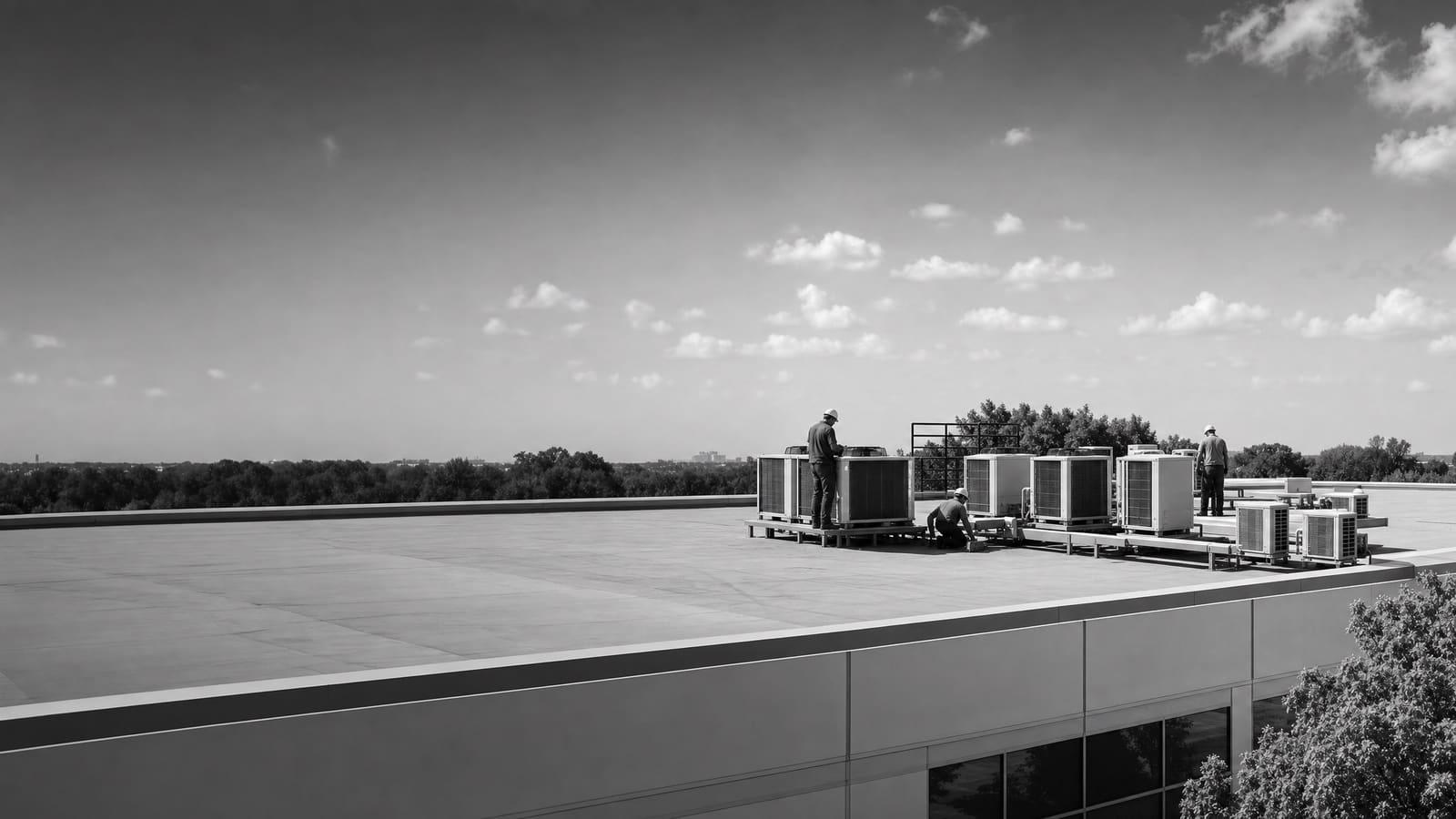
A commercial HVAC replacement covers a confirmed load calculation, equipment selection, removal and rigging of the old unit, curb adapter or structural work, gas, electrical, and refrigerant connections, controls integration, permits, and commissioning. Replacement beats one more repair once a unit is past fifteen years and burning energy: federal work on rooftop units found aging, inefficient equipment wastes roughly $900 to $3,700 per unit every year, which often exceeds the repair being debated.
A site review still has to verify roof structure, curb footprint, crane reach, and available electrical capacity before any of that price is real.
THREE WAYS TO GO
Three replacement paths for a unit at end of life
Most buildings choose between three moves when a rooftop unit is done. The cheapest one is not automatically wrong, and the most efficient one is not automatically right. What separates them is how much your space has changed since the old unit went in, how long you plan to hold the building, and whether the roof and the electrical service can carry something different. Federal guidance on rooftop replacement makes the point plainly: waiting for failure and installing whatever ships fastest usually costs more over the life of the unit than a planned replacement chosen on purpose. Decide which path you are on before the unit quits, so the decision is not made for you by a parts counter in August.
WHAT MOVES THE PRICE
The budget lines that actually swing the number
These are the lines that explain why two quotes on the same building look nothing alike. Ask for each one priced separately instead of folded into a single installed number, so you can see where the difference lives.
IN PRACTICE
How to buy the replacement instead of just ordering it
The habit worth breaking is buying by nameplate. A unit installed twenty years ago was sized for a floor plan, an occupancy, and a plug load that may no longer exist. If the building added server closets, removed walls, changed tenants, or cut its hours, the old tonnage is a guess carried forward. A fresh load calculation is a few hours of engineering that either confirms the size or saves you from paying to install the same comfort complaint a second time.
The second habit is buying on price with no lead time attached. Equipment availability is part of the decision, not a detail that appears after the deposit. A quote should name the model, the efficiency tier, and when the unit can actually be on your roof. If the fastest unit and the better unit are three weeks apart, that is a trade you should get to make with both numbers in front of you.
The third is treating commissioning as optional. Federal demonstration work measured real-world performance on high-efficiency rooftop units before owners would trust them, and the same logic applies to your building. Startup checks on charge, airflow, and control settings are what turn a nameplate rating into an actual utility bill.
SCOPE CHECK
What makes this project simple or hard
Two replacements at the same tonnage can be completely different projects. The difference is rarely the unit itself. It is what the roof, the electrical service, and the operating schedule demand around it.
LOWER COMPLEXITY
Same size, same curb, open lot
A matching packaged unit lands on the existing curb, gas and electrical stay where they are, and the crane has clear reach from the parking lot. Permitting is routine and the visible work fits inside one planned day.
HIGHER COMPLEXITY
New size, new fuel, tight site
Larger tonnage or a heat pump conversion pulls in structural review, electrical capacity work, and gas line changes. Add a constrained lot and a tenant load that cannot go down, and the project becomes phased.
BEFORE THE QUOTE
What a real site review has to confirm
A number written from a photo of the nameplate is a placeholder. The visit that makes it real is short, but it has to cover a specific list.
On the roof: curb dimensions and condition, structural capacity for the unit you are actually considering, clearances to walls and adjacent equipment, and how the existing ductwork lands. On the ground: where a crane can set up, what it can reach, how many parking stalls close, and whether the lift can happen outside business hours. In the electrical room: available capacity at the panel, since federal heat pump guidance names electrical capacity as one of the first things to check before a conversion is priced at all.
Then the operating questions, which are the ones owners forget. How many hours the space can go without conditioning, and on which days. Whether temporary cooling is needed to cover the gap. Whether the building automation system needs to see the new unit, and who owns that integration. Whether refrigerant from the old unit is recovered by a certified technician under EPA rules, which is not optional and should appear in the written scope.
A contractor who walks that list gives you a number that survives contact with the roof.
The one thing to check yourself
Walk the lot at the hour you would want the crane there. If tenant parking, a loading dock, or a drive aisle sits under the lift path, your real constraint is the schedule, not the equipment.
IN RIVERSIDE
Permits and heating loads change the plan here
Two local items shape a Riverside replacement more than the equipment brochure does.
First, permits. Published California building department guidance puts any electrical, plumbing, or mechanical upgrade or repair in the permit-required column, which means a rooftop replacement is permitted work rather than maintenance. Confirm the current mechanical and electrical requirements with the City of Riverside before the crane is booked, and have the contractor own the application and the inspection as part of the installed price.
Second, heating. Federal guidance concludes that across most of the U.S. South and West, today's heat pump rooftop units are fully capable of covering most or all of the winter heating demand. That makes the all-electric option a real candidate here instead of a stretch, as long as the service can carry it. The question to answer is capacity at the panel, not comfort in January.
Ask before you book the crane
Get the permit path and inspection timing in writing alongside the quote. A lift scheduled ahead of an approved permit is the most common way a one-day replacement turns into two trips.
OWNERSHIP MATH
Two questions that decide the spec
The spec you should buy depends on two things the equipment brochure cannot tell you: how long you plan to hold the building, and who actually pays the energy bill. Owners who skip those questions default to the cheapest unit that fits the curb, then pay for that choice in monthly increments for the next decade. Owners who over-correct buy the top efficiency tier for a building they are about to sell. Neither is a disaster, but both are decisions made by accident. Answer these two first and the rest of the spec — tonnage, efficiency tier, gas or all-electric — tends to fall out on its own.
HOLD PERIOD
How long you keep the building
Federal guidance flags rooftop units past fifteen years as substantial energy wasters. If you are selling in two years, the efficiency premium mostly benefits the next owner. If you are holding a decade, the $900 to $3,700 a year an inefficient unit burns is the entire argument.
WHO PAYS THE BILL
Owner-paid or tenant-paid energy
If tenants pay their own metered energy, a higher efficiency tier improves their bill and your leasing story more than your operating budget. If energy sits in base rent or a common-area charge, the savings come back to you directly and the upgrade justifies itself faster.
PLANNING AHEAD
Phasing a roof that carries more than one unit
If your roof carries several units, treat them as a fleet instead of a series of emergencies. Age them on paper, mark the ones past fifteen years, and rank them by what they cost to run and how much damage their failure would do. The unit over a server room and the unit over dead storage do not deserve the same urgency.
Phasing also buys leverage. Replacing three units on a planned schedule gives you one mobilization, one permit cycle where the scope allows, one crane day, and a pricing conversation that a 2 a.m. failure will never give you. It also lets you standardize on a platform, which makes filters, controls, and spare parts simpler for whoever maintains the building after the install crew leaves.
The place phasing gets complicated is refrigerant. Units of different ages hold different charges, and EPA Section 608 rules govern how refrigerant is recovered, handled, and recycled when equipment comes off the roof. That is a compliance line on every removal, and it is the reason your service contract and spare-parts plan should account for a mixed fleet for as long as the phasing takes.
QUOTE CHECKLIST
Five things a comparable quote shows
Two quotes are only comparable if they show the same five things. When one is missing, you are not comparing prices. You are comparing assumptions, and the gap between them will surface later as a change order.
01
Model, tonnage, and efficiency tier
Named equipment, not "a comparable unit." The efficiency tier is where quiet substitutions happen.
02
Availability and installed date
Lead time printed next to the price, so schedule is part of the decision instead of a surprise after the deposit.
03
Curb, structural, and rigging scope
Curb adapter, any framing, crane size, staging area, and how long the lot is affected.
04
Permits, inspections, and who pulls them
The contractor should own the application and the inspection, and the quote should say so in writing.
05
Commissioning and closeout documents
Charge, airflow, and control settings verified against spec, with the startup report handed over for the warranty file.
Keep planning locally
Related mechanical pages in Riverside
Get a defensible number
Price the equipment and the building together.
Send the address, operating target, and target opening date. Flux will identify what must be verified before the project can be priced.
Get a free estimateQuestions
Straight answers.
When does replacement beat one more repair?
Once a unit is past fifteen years, the math usually flips. Federal estimates put the annual waste from an old, inefficient rooftop unit at roughly $900 to $3,700 per unit, which frequently exceeds the repair being debated and repeats every year you defer.
Should you replace like-for-like or resize the unit?
Confirm the load either way. If the space and its use have not changed, like-for-like is often correct. If occupancy, equipment, or hours changed, resizing fixes complaints the old unit could never solve and stops you from installing a twenty-year-old assumption.
Does a Riverside rooftop replacement need a permit?
Plan on it. Published California building department guidance treats mechanical upgrades and repairs as permit-required work. Confirm the current mechanical and electrical requirements with the City of Riverside, and make permits and inspections part of the contractor's scope rather than yours.
Is a heat pump rooftop unit realistic here?
Often yes. Federal guidance finds that across most of the U.S. South and West, current heat pump rooftop units can cover most or all of the winter heating demand. The gating item is electrical capacity at the panel, which a site review should confirm before pricing.
What happens to the refrigerant in the old unit?
EPA Section 608 rules govern how refrigerant is recovered, handled, and recycled from stationary air conditioning and heat pump equipment. Recovery by a certified technician is a required line in the removal scope, not an optional service you can decline to save money.
Sources used for this guide
- [1]betterbuildingssolutioncenter.energy.gov — DOE Advanced Rooftop Unit Replacement Guidance
- [2]betterbuildingssolutioncenter.energy.gov — DOE Commercial Heat Pump Rooftop Unit Replacement Guidance
- [3]betterbuildingssolutioncenter.energy.gov — DOE High-Efficiency Commercial Rooftop Unit Toolkit
- [4]energy.gov — DOE Efficient Commercial Rooftop Air Conditioner Program
- [5]epa.gov — EPA Stationary HVAC Refrigerant Management
- [6]californiacity-ca.gov — HVAC Permits