THE SHORT ANSWER
What a commercial HVAC replacement includes
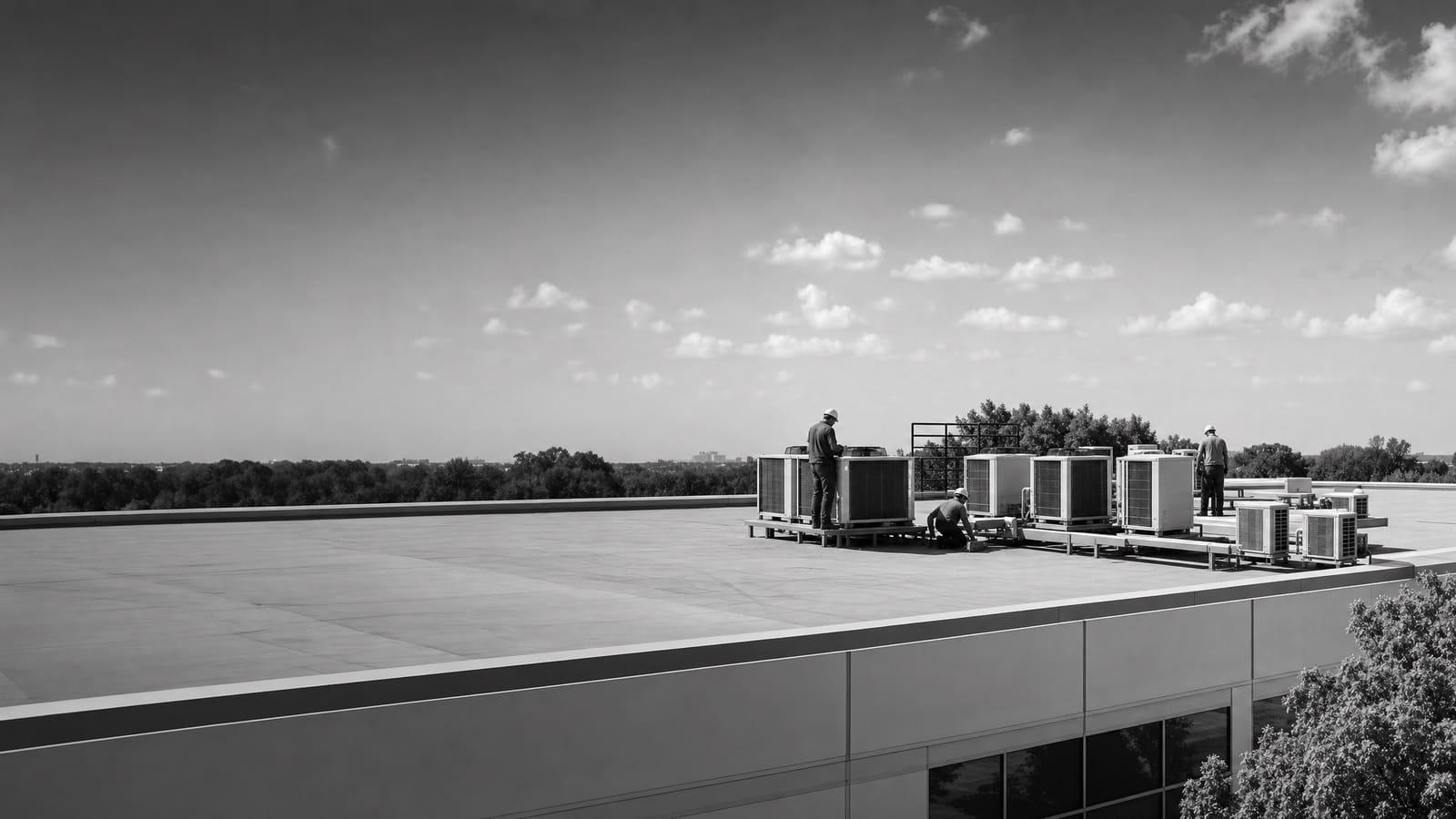
A commercial HVAC replacement covers the load calculation, equipment selection, removal and rigging of the old unit, curb and connection work, controls, regulated refrigerant handling, and commissioning. Replacement beats another repair once a unit is past about fifteen years and failing often. The Department of Energy reports that old, inefficient rooftop units waste roughly $900 to $3,700 per unit each year, so a second compressor repair on a tired unit often costs more than it protects.
A site review still has to confirm the actual load, the roof curb and structure, available electrical capacity, crane access, and whether the existing gas or refrigerant lines can stay.
THREE WAYS TO GO
Replace, upgrade, or retrofit the controls
Most buildings face the same three-way choice, and DOE frames it the same way: replace the unit, replace it with a higher-efficiency or heat pump unit, or keep the box and retrofit advanced controls. Which one wins is a financial question more than a technical one.
Age and failure history push toward replacement. DOE notes that units over fifteen years old waste substantial energy compared with newer models, and that many owners wait until the unit fails completely — which quietly removes every option except whichever one is available fastest.
Heating is the other fork. Heat pump rooftop units are technologically similar to air-conditioning units but add reverse-cycle heating. DOE finds they are best suited to mild-to-moderate winter heating, and that across most of the U.S. South and West today's units can handle most or all of the winter demand. If your building barely heats, the heating side of the decision is easy, and the real questions become electrical capacity and equipment availability.
WHAT MOVES THE NUMBER
Where the money actually goes
Installed price gets quoted per unit after someone looks at the roof, because most of the variation sits in the work around the equipment rather than the equipment itself. These are the lines that separate two quotes for the same tonnage.
IN PRACTICE
How to choose the unit, not just the price
Start with the load, not the nameplate. A twenty-year-old unit was sized for whoever occupied the space then, with the lighting, equipment, and envelope of that era. Reusing that number carries the old mistake forward for another two decades. A short load review either confirms the size or finally explains the comfort complaint you have been living with.
Then decide what the unit has to do. Rooftop units condition close to half of all commercial floor area in the country, so this is a well-mapped decision with real options behind it. DOE's high-performance specification pushed manufacturers toward units that use up to half the energy of the old standard, and more than twenty models now exceed that specification. That efficiency gap is what turns an operating cost into a payback argument.
Availability decides the rest. DOE lists equipment availability and contractor familiarity as core considerations, and neither one shows up on a spec sheet. A unit that is perfect on paper and twelve weeks out is a very different decision from one sitting on the ground next week, especially if the building is limping along on a failed unit right now.
COMPLEXITY CHECK
Simple swaps and harder ones
Two replacements of the same tonnage can be very different jobs. What separates them is usually infrastructure and access, not the equipment on the order.
LOWER COMPLEXITY
Same box, same connections
Matching tonnage on the existing curb, with adequate electrical service, clear crane reach, and no change in how the space is used. The on-site work is short and the scope is easy to price accurately.
HIGHER COMPLEXITY
Fuel switch or footprint change
Moving from gas heat to an all-electric unit, growing tonnage, or landing on a new footprint. DOE flags electrical capacity, physical constraints, and existing gas lines as the items that decide whether this is even feasible.
SCOPING THE JOB
What a site review has to answer
A good replacement quote starts on the roof and in the electrical room, not in an email thread. The reviewer is working through a short list of questions, and each one can change the equipment choice.
First, does the load match the unit that is up there now? Second, will the new unit land on the existing curb, and can the roof carry it? Third, is there electrical capacity for what you are considering — DOE calls this out specifically for anyone weighing a heat pump unit, because a fuel switch moves heating load onto the panel. Fourth, what happens to the gas line if it is no longer needed. Fifth, can a crane reach the location, and what does that close for a day.
The refrigerant question belongs on the same visit. EPA rules under Section 608 of the Clean Air Act govern how refrigerant is handled and recycled in stationary refrigeration, air-conditioning, and heat pump equipment. Recovery from the old unit is regulated work, and on a mixed roof the newer refrigerant in the replacement affects service planning and spare-parts strategy going forward.
Everything above is answerable in one visit. Skipping it is what produces change orders.
Ask for the answers in writing
A quote should name the tonnage and efficiency tier, state whether the existing curb and electrical service are adequate, and say who owns rigging, permits, refrigerant recovery, and commissioning. If those are missing, you are comparing two different jobs at the same price.
OWNERSHIP QUESTIONS
Two things owners weigh past day one
The equipment decision outlives the person who signs for it, and two considerations tend to matter more than the install price.
Operating cost is the first. DOE's estimate that an old, inefficient rooftop unit wastes $900 to $3,700 a year is the number to hold against the price difference between a base unit and a high-efficiency one. On a roof with several units, that gap compounds every year the decision gets deferred.
Timing is the second. DOE describes the common pattern of waiting until a unit fails completely, and finds that proactive replacement with a more efficient unit often beats replacement-on-failure, and can even beat a like-for-like swap at the end of service life. Planned work lets you choose the equipment, the crane day, and the price. Emergency work lets you choose whatever is in the warehouse.
OPERATING COST
The gap compounds
More than 200 organizations upgraded over 43,000 rooftop units through DOE's Advanced RTU Campaign and cut a combined $37 million a year from their energy bills. Portfolio math is where efficiency tiers earn out.
TIMING
Planned beats forced
Replacing before failure keeps the equipment choice, the schedule, and the negotiation in your hands. A unit that dies in season hands all three to whoever happens to have stock.
PHASING AND PROCUREMENT
Sequencing a roof with several units
Buildings rarely have one unit, and units rarely fail on a convenient schedule. The practical approach is to rank the roof by age, failure history, and the spaces each unit serves. Units past fifteen years old that serve the areas people complain about go first, because that is where energy waste and comfort risk overlap.
From there, phase against the calendar and not just the budget cycle. Doing two units on one crane mobilization usually costs less than two separate emergency calls, and it lets you standardize equipment across the roof. Standardization is quietly valuable: one parts inventory, one controls platform, one set of service habits.
Procurement follows the same logic. Ask for the base unit and the higher-efficiency option priced side by side, with lead times attached to both, and check incentives before you sign. DOE lists incentives as a standard consideration in the heat pump decision, and program offerings change, so confirm what is actually open at the time you buy rather than assuming last year's offer still stands.
The lifetime view is simple. The install price is paid once and the operating cost is paid every month the unit runs, which makes the extra day spent on load and options the cheapest part of the project.
COMPARING QUOTES
Five things a comparable quote shows
Two bids on the same roof can differ by a wide margin and both be honest, because they scoped different work. These five lines make them comparable.
01
Tonnage and efficiency tier
The exact model, its efficiency rating, and whether it is an air-conditioning or heat pump unit.
02
Equipment lead time
A committed availability date sitting next to the price, not a general estimate.
03
Curb, structural, and electrical work
Whether the existing curb and service are being reused, and what the price does if they cannot be.
04
Rigging, permits, and inspections
Who owns the crane day, the lot closure, the permit applications, and the inspection sign-offs.
05
Refrigerant recovery and commissioning
Certified recovery from the old unit, plus documented startup, charge, airflow, and controls verification.
Keep planning locally
Related mechanical pages in Honolulu
Get a defensible number
Price the equipment and the building together.
Send the address, operating target, and target opening date. Flux will identify what must be verified before the project can be priced.
Get a free estimateQuestions
Straight answers.
When is replacement better than another repair?
Once a unit is past about fifteen years and needing repeat repairs, replacement usually wins. DOE notes that units over fifteen years old waste substantial energy compared with newer models, and that old, inefficient rooftop units can waste $900 to $3,700 per unit each year. A second major repair often buys one more season at that same operating cost.
How much does commercial HVAC installation cost in Honolulu?
Installed price is quoted per unit after a real look at the roof, because tonnage, curb work, electrical capacity, and crane access move the number more than the equipment does. The figure worth comparing across bids is the installed price plus the operating cost of the efficiency tier you picked.
Should we switch to a heat pump rooftop unit?
It depends on heating demand, electrical capacity, and rates. DOE finds heat pump rooftop units are best suited to mild-to-moderate winter heating, and that across most of the U.S. South and West they can cover most or all winter demand. The gating items are usually panel capacity and equipment availability, not the technology itself.
What happens to the refrigerant in the old unit?
It has to be recovered under EPA Section 608 rules, which govern the handling and recycling of refrigerant in stationary refrigeration, air-conditioning, and heat pump equipment. That work belongs on the quote. New units also ship on newer refrigerants, which matters for service planning on a mixed roof.
Can we keep the existing unit and just improve how it runs?
Sometimes. DOE treats an advanced controls retrofit as a legitimate alternative to replacement when the unit still has service life, and frames the choice as whichever option makes better financial sense. A controls retrofit will not fix a failing compressor or a unit that was sized wrong to begin with.
Sources used for this guide
- [1]betterbuildingssolutioncenter.energy.gov — DOE Advanced Rooftop Unit Replacement Guidance
- [2]betterbuildingssolutioncenter.energy.gov — DOE Commercial Heat Pump Rooftop Unit Replacement Guidance
- [3]betterbuildingssolutioncenter.energy.gov — DOE High-Efficiency Commercial Rooftop Unit Toolkit
- [4]energy.gov — DOE Efficient Commercial Rooftop Air Conditioner Program
- [5]epa.gov — EPA Stationary HVAC Refrigerant Management