THE NUMBER
What commercial EV charging costs in Chula Vista
Hardware is the part with a published price. A single commercial Level 2 unit runs about $400 to $6,500, and a DC fast charger runs about $10,000 to $40,000. Installation is where the range widens. Fleet depots built for 10 to 100 vehicles have been priced between $250,000 and $4.5 million once trenching, panel work, and utility upgrades are counted. Most Chula Vista buyers land far below that top end, because most sites are adding ports, not building a depot.
These are planning benchmarks, not a Chula Vista quote. Distance from the panel, spare service capacity, pavement restoration, and how many ports you energize at once move the number the most.
PICK THE JOB FIRST
Three ways to charge, three different budgets
Cost follows the job the chargers do, not the brand on the box. Before pricing anything, decide who plugs in and how long they stay.
Workplaces and multifamily buildings usually need Level 1 and Level 2, because cars sit for hours and slower power is enough. Public-facing sites need Level 2 and DC fast, because drivers will not wait. Fleets need whatever covers the yard overnight, and overnight dwell is the cheapest condition in this whole category.
That one decision sets your power draw, and power draw sets the electrical work. It also sets your operating bill. DC fast charging is far more likely to trigger demand charges, which are billed on the highest 15-minute average use in a billing period. A site that buys fast charging it does not need pays for it twice: once in the install, and again every month.
THE LINE ITEMS
What actually shows up on the invoice
A charging quote is mostly not the charger. These are the lines that decide whether your project lands near the bottom or the top of the range, roughly in order of how much they tend to move.
HOW TO BUY IT
Buying charging without overbuying
The most expensive mistake in this category is buying power you never use. Charging gets sized to a peak most sites never hit, and every extra amp shows up twice: once in the conduit and panel work, and again in the monthly demand charge. Start from dwell time. If vehicles sit for six hours, slower ports serve more of them per dollar than fast ports do.
The second mistake is buying stall by stall. A pedestal at every parking space costs more than running receptacles and using portable Level 1 or Level 2 units that live in the vehicles. Portable units are also simpler to swap when one fails, and downtime is what turns a working charging program into a running complaint.
Bring the utility in before the design is finished, not after. The utility is the party that tells you whether your service can carry the load, what it will need to upgrade, and what that costs. A contractor can price conduit accurately. Only the utility can price what sits behind the meter, and that answer often decides whether this is a week of work or a six-figure build.
TWO SITES, TWO PRICES
What makes a site cheap or expensive here
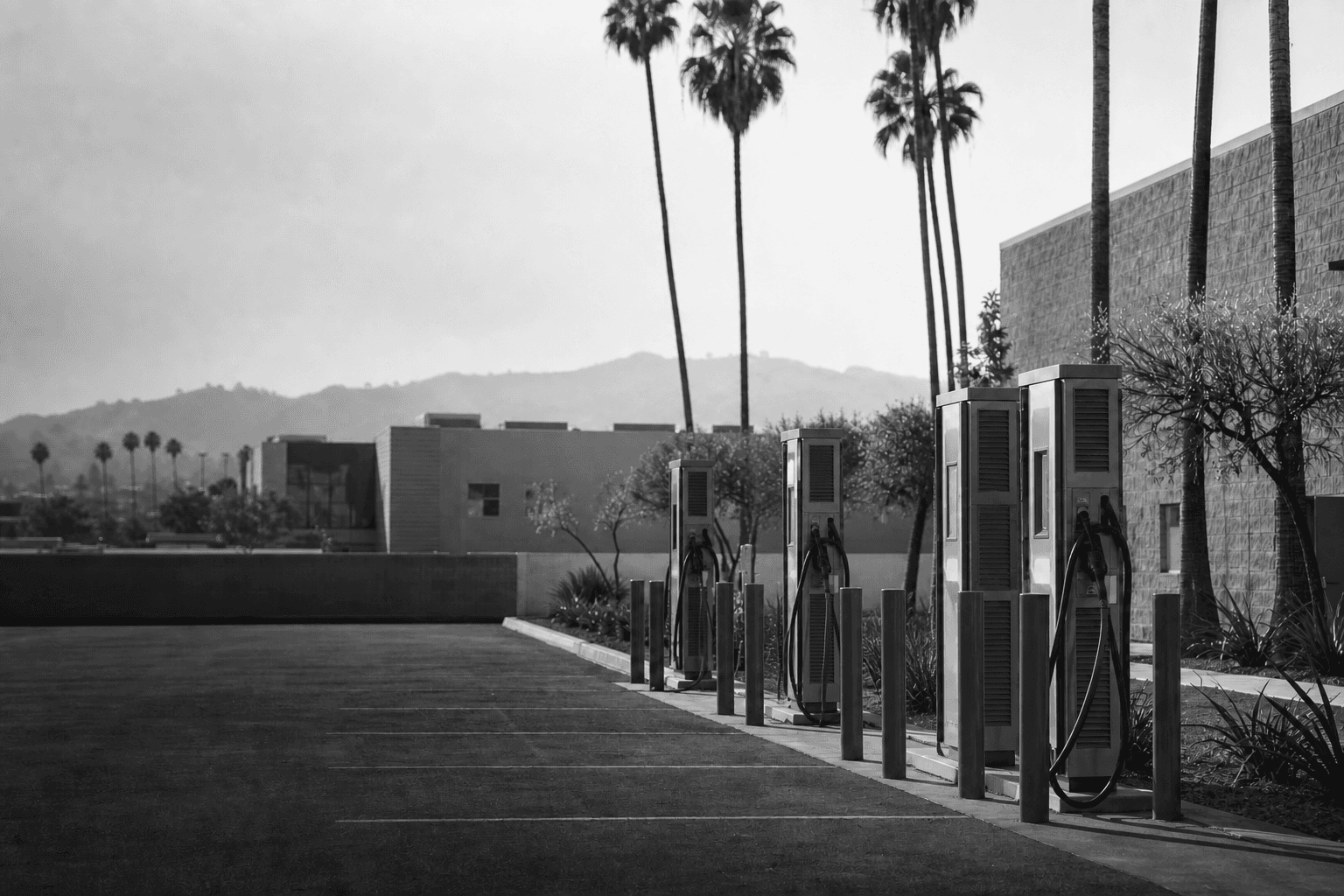
Identical chargers can cost three times more on one property than another. The difference is almost never the equipment. It is the distance to power, the capacity already sitting in the building, and what has to be cut open to connect the two.
LOWER COMPLEXITY
Short run, spare capacity
Stalls sit near the electrical room, the existing service has headroom, and conduit can follow a landscaped edge instead of a drive lane. Permits are routine and the utility signs off without adding equipment.
HIGHER COMPLEXITY
Long run, full panel
Stalls sit across the lot, the panel has no room, and the run crosses drive aisles that have to be cut and restored. Add a new panel or a service upgrade, and the utility's schedule becomes your schedule.
BEFORE YOU PRICE IT
The site walk that makes quotes comparable
A useful quote starts with a walk, not a web form. The walk confirms four things: where the incoming service lands, how many spare amps the panel actually has, the path from that panel to the stalls you want, and what is buried under that path. Everything else in the budget follows from those four answers.
Bring your load profile with you. If the building already runs close to its service limit during business hours, adding charging is a capacity conversation before it is a charging conversation. The project can still work, but the honest version of it includes either a service upgrade or controls that keep charging out of the building's peak.
Settle the ownership question at the same time. Equipment you buy outright costs less over its life and gives you full control of pricing and access, but you carry every repair and every warranty term. Equipment owned by a network or provider costs more per year and moves that burden off your staff. Neither answer is wrong. What is wrong is finding out which one you wanted after the chargers are in the ground.
Four answers that set the budget
Where the service enters, how many spare amps the panel has, the route from panel to stall, and what is buried along it. A quote written without those four is a placeholder, not a price.
IN CHULA VISTA
What the local picture changes
Chula Vista sits inside the San Diego metro, and that shapes a charging project in a few practical ways.
The first is the cost of the work itself. Labor rates in large California metros sit at the high end of the national range, and installed equipment pricing in the state reflects that. Benchmarks pulled from national averages tend to read low here.
The second is the utility. Every commercial charging project runs through utility coordination for service capacity, metering, and any upgrades on their side of the connection. That step, combined with permits and inspections, sets your in-service date more often than construction does.
Rates are the third. Commercial power is billed with demand charges tied to the highest 15-minute average use in the period, so how you schedule charging can matter more than what you paid to install it. Ask about time-of-use and charging-specific rate options before you size anything.
Talk to the utility first
Engage them before the design locks. They confirm service capacity, name any equipment they need to upgrade, and tell you which rate your chargers will land on. That conversation moves the budget more than any hardware choice you make.
AFTER THE INSTALL
The costs that keep going
Installation is the headline, but it is not the whole spend. A charging program has a running cost, and the two biggest pieces are electricity and upkeep.
Electricity is not a flat number. It moves with the equipment installed, the time of day, and how long the ports are in use, and DC fast charging is the most likely to push a site into demand charges. Upkeep is smaller but real: cables stored properly so they do not get damaged, parts checked, hardware kept clean, and the occasional repair.
You can recover part of it. More than a fifth of public charging is still free to use, but hosts who want to cover costs charge by kWh, by session, by length of time, or through a subscription. Session and time-based pricing exist partly because some states limit who is allowed to sell electricity by the kilowatt-hour.
OWN IT
You buy, you control
Equipment you own outright reduces overall cost and gives you full control of access and pricing. You also carry every repair, every warranty term, and every uptime problem yourself.
OUTSOURCE IT
Provider owns the hardware
A network or provider owns and maintains the units for an annual fee. Write response time, repair time, and a stated uptime requirement into the contract, or that fee buys you very little.
PHASING AND PROCUREMENT
Build for the ports you will need later
The cheapest second charger is the one you planned for during the first install. Trenching is the expensive part of this work, and the trench is open exactly once. Pulling spare conduit, sizing the panel for the stalls you expect in three years, and stubbing out toward a future row costs a fraction of coming back to cut the same pavement again.
That does not mean energizing everything now. Make-ready first and chargers later is a legitimate strategy. You pay for the underground work once, then add ports as demand shows up, and your peak demand does not jump before there are vehicles to justify it.
On procurement, decide early whether you need a formal solicitation. Public agencies and larger institutions usually do, and an RFP adds months to the timeline. Either way, get the utility, the electrical contractor, and the equipment vendor into the same conversation before the drawings are final. Each one holds a piece of the cost the others cannot see, and the projects that blow past budget are almost always the ones where those three met for the first time at the permit counter.
Two money notes. Incentive programs generally do not pay backward, so apply before construction starts. And the federal 30C charger credit, worth up to 30% of purchase and installation in eligible census tracts, no longer applies to property placed in service after June 30, 2026. Chargers remain depreciable business property, which is where the federal benefit sits now.
QUOTE CHECKLIST
Five things a comparable quote shows
Two quotes are only comparable when they price the same scope. Ask every bidder to break out these five, and the cheapest bid often stops being the cheapest bid.
01
Equipment, by model and port count
Make, model, power rating, connector type, and whether mounting and activation are included.
02
The electrical run, itemized
Trench length, conduit, wire, pavement cutting, and surface restoration as separate lines.
03
Panel and service scope
What the panel work covers, and what happens to the price if the utility requires an upgrade.
04
Permits, inspection, and utility coordination
Who files, who schedules inspections, and how many rounds the price covers.
05
Networking, warranty, and maintenance terms
Annual fees, warranty length, response time, repair time, and the uptime the contract guarantees.
Keep planning locally
Related EV charging pages in Chula Vista
Get a defensible number
Price the equipment and the building together.
Send the address, operating target, and target opening date. Flux will identify what must be verified before the project can be priced.
Price my chargersQuestions
Straight answers.
How much does a commercial Level 2 charger cost in Chula Vista?
The unit itself runs roughly $400 to $6,500 depending on power, connectors, and networking. Installation is the variable half. A short run to a panel with spare capacity is inexpensive. A long run across pavement with a panel upgrade behind it is not.
Why does DC fast charging cost so much more?
The hardware alone runs about $10,000 to $40,000 per unit, and the electrical service behind it is a different class of work. It is also the equipment most likely to trigger demand charges, so the monthly bill rises along with the install.
Is there still a federal tax credit for EV chargers?
The 30C credit covered up to 30% of purchasing and installing charging equipment in eligible census tracts, but it no longer applies to property placed in service after June 30, 2026. Projects in service by that date still claim it at filing. Chargers are still depreciable business property.
What does it cost to keep commercial chargers running?
Plan on up to $400 per charger per year for maintenance, plus networking fees if the units are connected. Extended warranties on DC fast chargers can exceed $800 per charger per year, and out-of-warranty repairs are the expensive surprise.
Should we install fewer fast chargers or more Level 2 ports?
Dwell time decides it. If vehicles park for hours, Level 2 serves more of them per dollar and draws far less power. If drivers stop for minutes, you need fast charging and the electrical work that comes with it.
Sources used for this guide
- [1]afdc.energy.gov — Alternative Fuels Data Center: Procurement and Installation for Electric Vehicle Charging Infrastructure
- [2]irs.gov — IRS Alternative Fuel Vehicle Refueling Property Credit
- [3]winsparking.com — Fleet EV Charging in Denver, CO | Wins Parking
- [4]promatcher.com — EV Charging Station Cost - Los Angeles, California
- [5]afdc.energy.gov — Alternative Fuels Data Center: Operation and Maintenance for Electric Vehicle Charging Infrastructure
- [6]afdc.energy.gov — U.S. DOE AFDC Electric Vehicles for Fleets