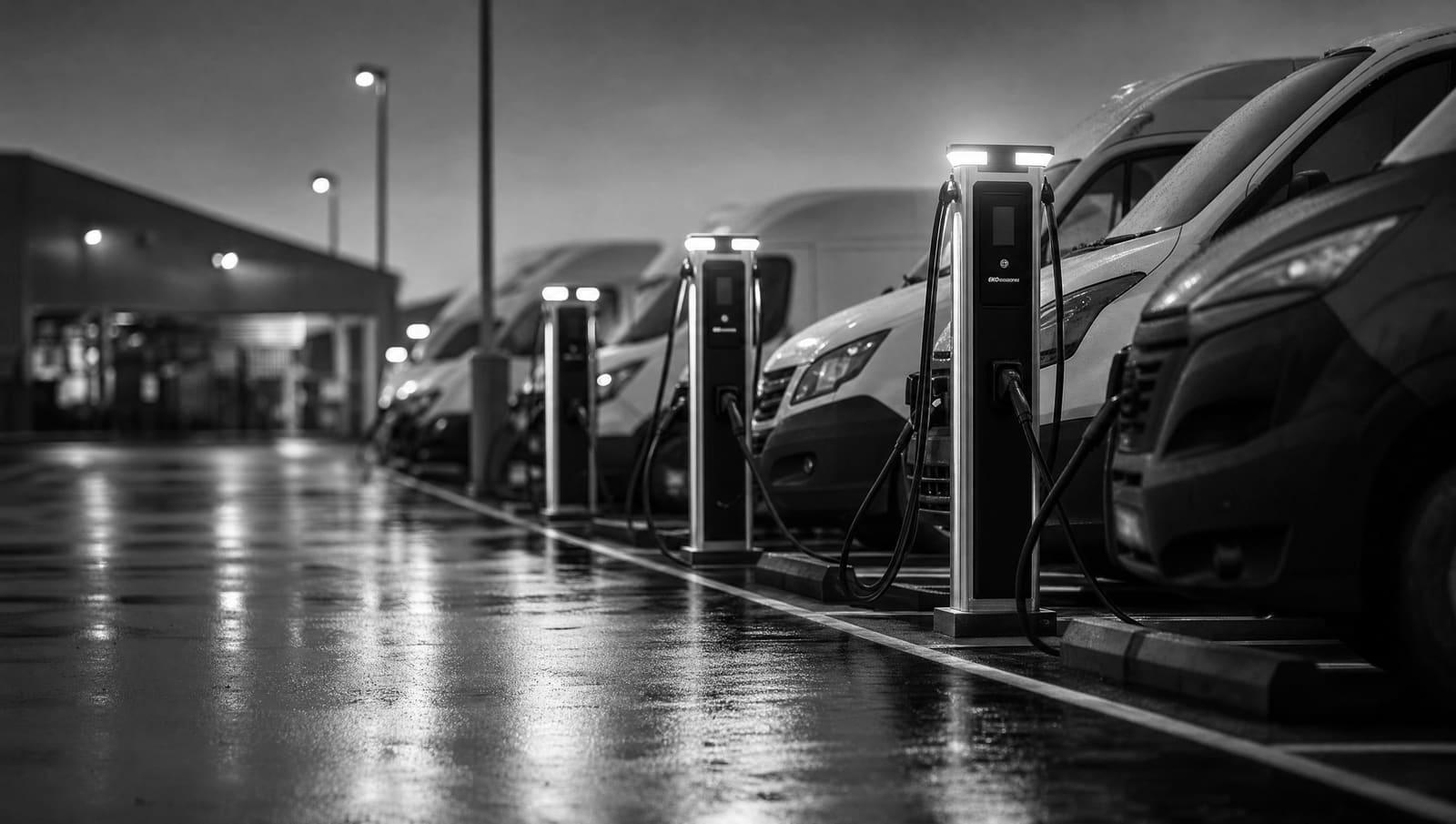
Direct answer
Commercial EV charger installation in Boise.
A complete commercial installation includes a site and electrical assessment, charger selection, utility coordination, design, permitting, construction, network setup, testing, and turnover. Level 2 often serves vehicles parked for hours. DC fast charging supports shorter stops but can require larger electrical equipment, more utility work, and a longer development plan.
The site review must verify vehicle demand, dwell time, panel and service capacity, cable routes, parking access, communications, and future expansion.
Start with operations
Choose the charging job before choosing the charger
The best charger is not always the unit with the highest output. It is the unit that delivers enough energy before each vehicle must leave. Start with the users, their arrival times, their departure times, and the energy each vehicle needs. Then decide who may charge, whether drivers will pay, and how the stations will be managed.
Level 2 is often a practical match for workplace, tenant, overnight, and other long-dwell parking. DC fast charging may fit public turnover or fleet routes with short charging windows. A mixed design can also work. It may place Level 2 ports in long-stay spaces and faster equipment where vehicles must return to service sooner.
These choices affect electrical demand, parking layout, network features, utility discussions, and the construction budget. Set them before requesting equipment prices.
Budget structure
What belongs in the installation budget
Compare the whole installed scope, not the charger price alone. Each quote should separate known work from allowances and possible upgrades.
Equipment choice
Level 2 and DC fast charging create different projects
Level 2 equipment uses AC power, while the vehicle handles the conversion needed by its battery. Commercial Level 2 equipment can have different output ratings, mounting styles, cable arrangements, and network features. It often suits vehicles that remain parked long enough to receive the energy they need at a moderate rate. A larger group of Level 2 ports may also use managed charging to limit the combined load.
DC fast equipment converts power outside the vehicle. It serves drivers or fleets that need more energy in a shorter stop, but the installation can be much more demanding. The design may involve larger conductors, switchgear, transformers, cooling needs, equipment pads, protective barriers, and close utility coordination. The charger location must also support safe traffic flow and cables that reach the intended vehicles.
Do not compare equipment by nameplate output alone. Confirm connector support, simultaneous charging behavior, environmental rating, network compatibility, warranty terms, replacement support, and what happens if communications fail. The selected model must work with the site's electrical design and the vehicles expected to use it.
Complexity check
What makes an installation simpler or harder
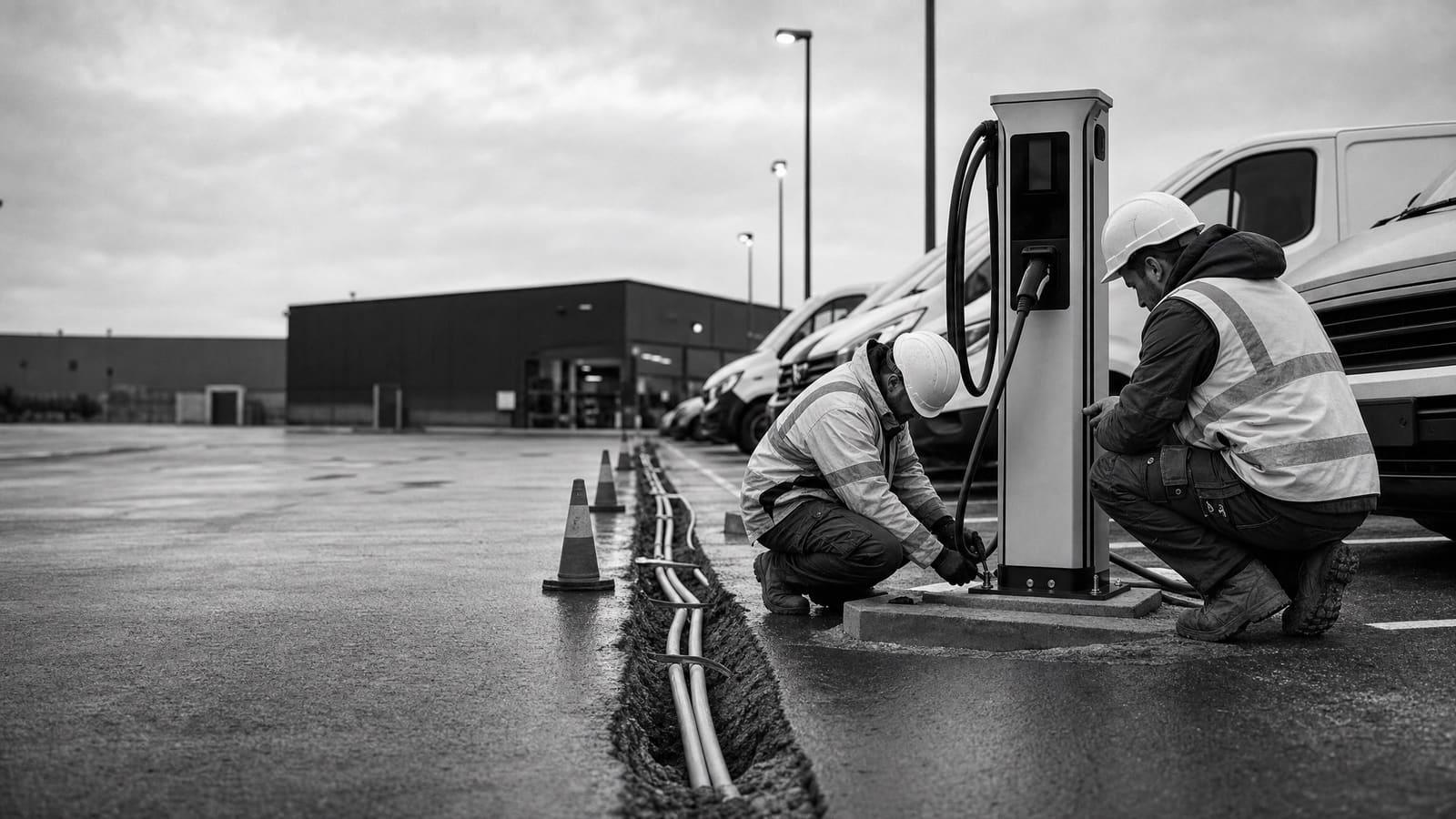
Two sites using the same chargers can require very different work. Existing capacity, distance to parking, pavement, communications, and utility involvement often matter more than the equipment count.
Lower complexity
Available power near the spaces
A project is easier to plan when verified panel capacity is close to parking, conduit has a clear route, communications are reliable, and the intended charger load does not trigger major service work.
Higher complexity
New capacity or difficult construction
Complexity rises when work crosses pavement, reaches detached parking, changes the service, adds major distribution equipment, requires utility construction, or must be phased around active traffic and business hours.
Site assessment
A useful site review turns assumptions into a buildable scope
Begin at the electrical service and trace the full path to the charging spaces. Record service and panel information, available breaker space, connected loads, meter locations, possible equipment areas, and the condition of existing distribution gear. A qualified electrical team should complete the load analysis rather than treating an empty breaker position as proof that capacity exists.
Next, inspect the parking field. Measure realistic conduit routes and note pavement, landscaping, drainage, curbs, walls, fire lanes, vehicle circulation, snow or maintenance activity, and places where equipment needs protection. Check whether charging cables can reach the intended inlet without crossing walking paths or driving lanes. Public or shared charging also needs a deliberate plan for accessible use, signs, lighting, security, and enforcement.
Finally, confirm communications and operations. Networked stations may need dependable cellular or wired service. The owner should define access groups, pricing, idle rules, reporting, support, and who responds when a port fails. These findings should appear in the drawings and proposal, not remain informal notes.
Ask for a documented basis of design
It should state vehicle demand, assumed charging schedule, charger output, simultaneous load, available capacity, routing, network needs, utility assumptions, and expansion provisions.
Boise planning
Treat permits, utility review, and funding as separate checks
A Boise project should not order equipment until the team has confirmed the applicable permit path, inspection steps, and utility requirements for the actual address and load. Those items are time-sensitive and can change the design or schedule.
An Idaho Department of Environmental Quality EV charging application guide also shows the level of detail public charging plans may need: equipment type, charger output, quantity, expansion capability, point-of-sale equipment, fee structure, schedule, and line-item costs. Use that as a useful procurement checklist, not as evidence that funding is currently available. Any incentive or tax credit should be verified for the site, owner, equipment, labor rules, and current deadline before it enters the budget.
Make approvals an early project task
The proposal should name who contacts the utility, prepares permit documents, answers review comments, schedules inspections, and closes approval conditions before energization.
Ownership and operation
Decide who controls the stations after turnover
Installation is only the start of the operating life. Before procurement, assign responsibility for the hardware, software account, electricity, pricing, driver support, repairs, warranties, and data. A networked station can support access control, payment, reporting, and remote monitoring, but it may add subscription costs and dependence on the network provider.
The operating plan should also cover routine inspection, damaged cables, blocked spaces, failed payment sessions, software updates, and replacement parts. If public drivers will depend on the site, set a clear support path. If fleets will depend on it, define what happens when a vehicle misses its planned charge. These decisions belong in the procurement package because they affect equipment and network selection.
Owner operated
More control, more responsibility
The facility can control access, rates, branding, and service vendors, but it must manage accounts, maintenance, support, warranties, and operating costs.
Third-party services
Simpler administration, added dependencies
A provider may handle networking, payments, monitoring, or support. Review contract length, fees, data access, equipment compatibility, response terms, and the exit plan.
Phasing and procurement
Build the first phase without trapping the next one
A phased project can control near-term spending while protecting the long-term plan. The drawings should show both the installed phase and the expected future condition. That lets the team consider larger conduit, spare pathways, reserved panel space, equipment-pad area, communications capacity, and a distribution layout that can accept more ports. Do not oversize every part by default. Compare the added work now with the cost and disruption of reopening finished surfaces later.
Procure chargers only after the basis of design is stable. Confirm that the quoted model, output, port configuration, connector, mounting hardware, network service, warranty, and delivery schedule match the drawings. Approved substitutions should receive an electrical and operating review because a different unit may change breaker sizing, conductor requirements, cable reach, communications, or simultaneous output.
Evaluate lifetime cost alongside the installed scope. Include software, payment processing, communications, electricity-rate effects, inspections, preventive care, repairs, replacement parts, and eventual equipment replacement. For a separate discussion of cost structure, see commercial EV charging costs.
Quote comparison
Five items every comparable quote should show
A low total is not useful if major work is excluded. Require each bidder to price the same basis of design and state assumptions, allowances, exclusions, and owner responsibilities.
01
A complete equipment schedule
Show manufacturer, model, output, ports, connectors, mounts, cables, network service, warranties, and delivery assumptions.
02
Electrical and civil scope
Identify panels, breakers, conductors, conduit, trenching, pads, protection, restoration, striping, signage, and accessible-use work.
03
Utility and permit responsibility
State who prepares applications, coordinates reviews, pays listed fees, answers comments, schedules inspections, and manages energization.
04
Commissioning and turnover
Require testing on every port, network activation, payment or access checks, training, closeout documents, and warranty contacts.
05
Price boundaries and schedule
Separate fixed work, allowances, alternates, recurring fees, exclusions, milestones, dependencies, and change-order triggers.
Keep planning locally
Related EV charging pages in Boise
Get a defensible number
Price the equipment and the building together.
Send the address, operating target, and target opening date. Flux will identify what must be verified before the project can be priced.
Price my chargersQuestions
Straight answers.
What does commercial EV charger installation include?
A complete scope covers site assessment, load analysis, charger selection, design, utility coordination, permits, electrical and civil construction, mounting, networking, inspections, commissioning, training, and closeout documents.
Should a Boise commercial site use Level 2 or DC fast charging?
Use the vehicles and parking schedule to decide. Level 2 often fits vehicles parked for hours. DC fast charging may fit short stops or fleet turnaround, but it can require substantially more electrical and utility planning.
Can the existing electrical service support EV chargers?
A load analysis must answer that question. The review should check service and panel capacity, existing demand, charger output, simultaneous use, and whether managed charging can keep the combined load within a practical limit.
When should the utility be contacted?
Contact the utility early when the planned load may affect service capacity, metering, transformers, or other utility equipment. Do not wait until chargers have been purchased.
Do commercial EV chargers need a network?
Not always. Networking is useful for payment, access control, reporting, monitoring, and managed charging. The owner should compare those benefits with recurring fees, communications needs, and dependence on the provider.
How should incentives be handled in the proposal?
Treat every incentive and tax credit as time-sensitive. Verify the address, owner, equipment, eligible costs, labor conditions, application sequence, and current deadline. Keep unconfirmed funding outside the committed project budget.
What should happen before the project is accepted?
Every port should complete a test session. The team should also verify networking, payment or access rules, labels, safety functions, reporting, and owner training, then provide drawings, warranties, settings, and support contacts.
Sources used for this guide
- [1]afdc.energy.gov — Alternative Fuels Data Center: Procurement and Installation for Electric Vehicle Charging Infrastructure
- [2]betterbuildingssolutioncenter.energy.gov — DOE Better Buildings Commercial EV Charging Infrastructure Guide
- [3]driveelectric.gov — Public electric vehicle charging infrastructure playbook · Joint Office of Energy and Transportation
- [4]energy.gov — DOE Federal Workplace Charging Program Guide
- [5]www2.deq.idaho.gov — Microsoft Word - EVSE Application and Guide.docx