THE DIRECT ANSWER
What a commercial HVAC replacement includes
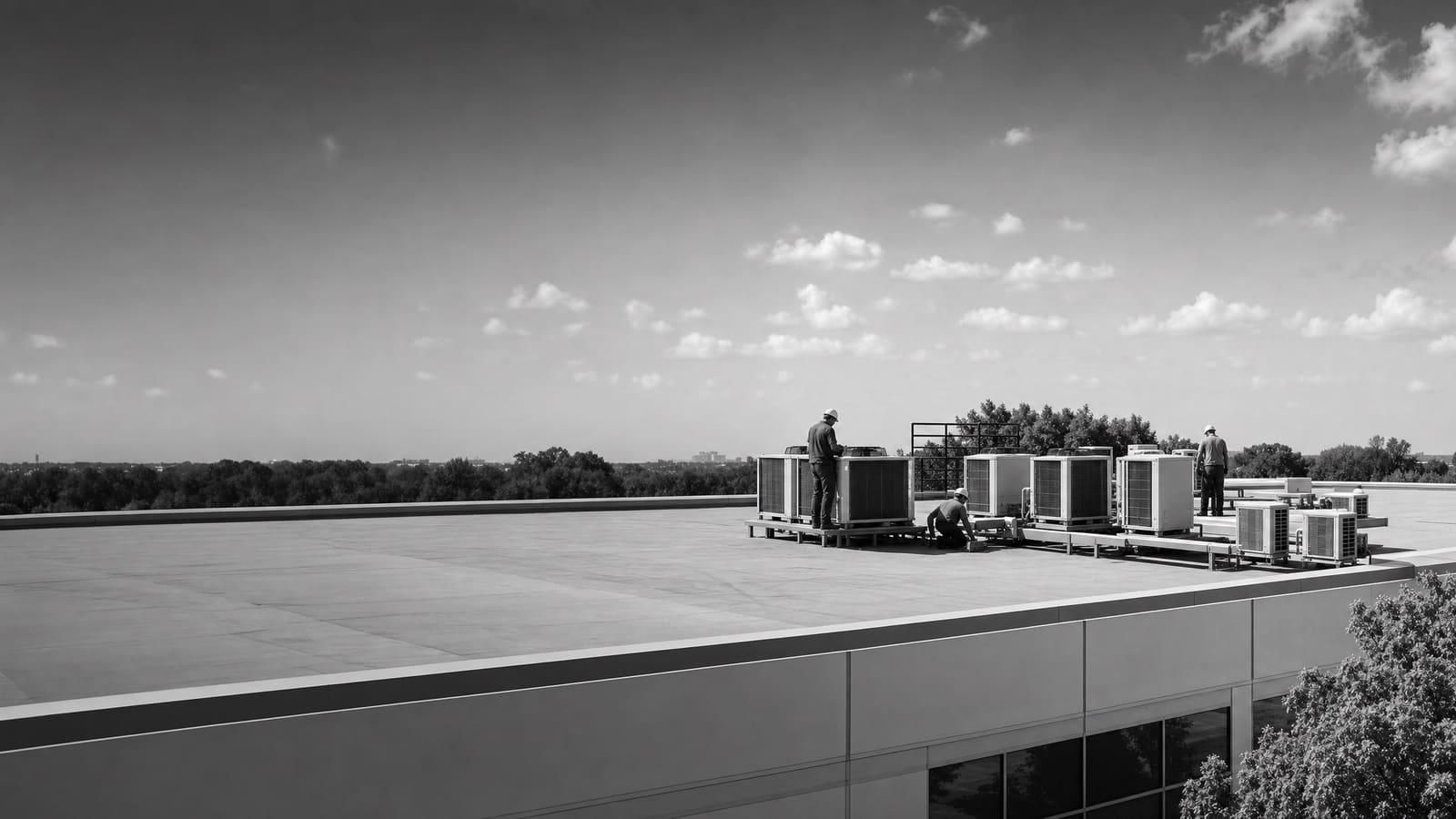
A commercial HVAC replacement covers a load check against how the building is used now, equipment selection against real lead times, permits and inspections, rigging and the crane set, curb or structural work, gas, electric, and refrigerant connections, and commissioning at startup. Replacement beats another repair once a rooftop unit is past about fifteen years, since units that old can waste roughly $900 to $3,700 each in energy every year while the service calls keep stacking up.
A site review still has to confirm tonnage against the current load, curb and roof structure, available electrical capacity, and crane access before any of that becomes a firm price.
THREE WAYS TO GO
Repair again, swap like-for-like, or upgrade
Most buyers are choosing between three moves, and the honest deciding factor is the age and history of the unit rather than the size of the last invoice. Rooftop units cool close to half of the commercial floor area in this country, so this same decision repeats across almost every building type. Once a unit passes fifteen years it usually costs more to run than a new one costs to finance, and waiting for total failure hands the timing to the equipment instead of to you. Federal work with manufacturers pushed high-efficiency rooftop units to cut energy use by up to half against the older standard, which is why the upgrade path is worth pricing even when a like-for-like swap looks simpler on paper.
WHAT MOVES THE NUMBER
The line items that decide your price
No two roofs price the same. These are the items that separate a tidy quote from a change order, and it is fair to ask which of them your bidder actually walked and measured.
IN PRACTICE
How to buy the replacement, not just the box
The quote that ages well names the equipment and the work around it in the same document. Start with the load. Sizing off the old nameplate carries forward every mistake the last twenty years baked in, and buildings change — occupancy shifts, plug loads climb, a wall of glass gets added or shaded. A short load check tells you whether the replacement should match the old tonnage or step away from it.
Then price availability next to price. Lead time is the variable that decides whether a summer failure costs you two days or two months, so ask each bidder what is actually sitting in a regional warehouse and what has to be built. A slightly different model that ships now often beats the perfect model that ships in two months.
Last, settle the fuel question before the order goes in. A gas-heat unit and a heat pump unit sit on the same curb but need different things underneath: one needs its gas line, the other needs electrical capacity you may not have spare. Southern California winters are mild, and federal guidance places today's heat pump rooftop units well within range for the South and West, capable of carrying most or all of the winter heating load.
SIDE BY SIDE
A simple swap or a project with moving parts
Two replacements can carry the same tonnage and still price thousands apart. The difference is almost always what has to change under the unit and how hard the roof is to reach.
LOWER COMPLEXITY
A straight swap
Same tonnage, the existing curb takes a standard adapter, power and gas are already sized, the lot is open with clear crane reach, and the roof is low. One planned morning, one inspection, tenants notice the cones.
HIGHER COMPLEXITY
A real project
Tonnage changes, the curb has to be rebuilt, electrical capacity has to be added for an all-electric unit, the crane has to reach over a building or close a busy drive aisle, or the space cannot lose cooling at all and needs temporary equipment.
THE SITE REVIEW
What has to be verified before a price is real
The site review is where a quote becomes a number someone can be held to. Federal guidance for rooftop replacements points at the same short list every time: climate and heating load, utility bill impact, building type and how the space is used, equipment availability, and infrastructure — meaning electrical capacity, physical constraints on the roof, and the gas line.
Walk each one. Electrical capacity surprises people most often, because an all-electric unit can need more amperage than the panel has spare, and learning that after the order is placed turns a clean swap into a service upgrade. Physical constraints mean the boring items: curb dimensions, roof structure, clearances to parapets and neighboring units, and whether a crane can actually reach the spot. Availability means a real ship date, in writing.
The last piece is the unit coming off. Refrigerant has to be recovered and handled under federal rules by a certified technician rather than vented, and that work should appear on the quote instead of surfacing later.
Ask for the checklist back
A serious bidder can answer in writing what tonnage the load calls for, what the panel has available, whether the curb fits, how the crane gets in, and when the unit ships.
IN ANAHEIM
Permits, inspections, and roof sequencing
Anaheim runs its own building department, and mechanical work sits squarely in permit territory. California city permit lists put mechanical upgrades and repairs right alongside electrical and plumbing work — and re-roofing with them. Two practical consequences follow. First, the permit needs to be moving before a crane date is worth booking, so ask your contractor to submit early and to own the inspection, not just the install. Second, if the roof membrane is near end of life, sequence it with the unit replacement. Tearing off and re-roofing around a brand-new curb costs more than planning both trips through the counter at once.
Check the quote's last page
Confirm the price includes permit fees, submittal, and the inspection visit. A quote that stops at "equipment installed" can leave you chasing a sign-off after the crew has moved on to the next job.
OWNERSHIP QUESTIONS
Who pays, and who lives with it
Who owns the building changes what a good decision looks like. A capital line a landlord will hold for fifteen years is not the same as an expense a tenant carries through three more years of a lease. Both are legitimate positions; they just point at different equipment.
The second question is the fleet. One replacement is a purchase. Five replacements is a standard — a model, an efficiency tier, a controls platform, and a parts list your service tech can stock. Deciding that once, at the first replacement, is usually worth more than optimizing any single unit.
IF YOU OWN AND HOLD
Buy for the run
You pay the utility bill for the whole service life, so efficiency and controls earn their keep. This is where the higher-efficiency tier and the heat pump option deserve a real look at the numbers.
IF YOU LEASE OR PLAN TO SELL
Buy for the exit
Recovery speed and pass-through terms matter more than a ten-year payback. Check what the lease actually lets you recover, and keep the permit and startup documentation clean for whoever comes next.
THE LONGER VIEW
Phasing a roof full of units
If you have more than two units on a roof, treat them as a fleet instead of a queue of emergencies. Pull the nameplates, note the install years, and sort by age and duty. Anything past fifteen years belongs on a replacement plan with a date on it, because that group is where the wasted energy and the after-hours calls concentrate.
Phasing gives you leverage. Replacing three units in one planned window shares a single crane mobilization, one permit trip, and one round of controls work across all three, and it lets you standardize on a model your service tech already stocks parts for. Organizations that ran their rooftop upgrades this way — more than two hundred of them, across forty-three thousand units — have pulled tens of millions of dollars a year out of their combined energy bills.
Lifetime cost should decide it. A cheaper unit that runs hard through a long cooling season can cost more across its service life than the efficient one you passed on. Ask each bidder to show the efficiency rating and the expected annual energy use, then compare the two quotes over ten years rather than on the day of the invoice.
BEFORE YOU SIGN
Five things a comparable quote shows
Two quotes are only comparable when both show the same five things. If one is missing an item, that is not a cheaper bid — it is an unpriced item you will pay for later.
01
Tonnage, efficiency rating, and model number
The exact unit being proposed, not a category, so you can price the same thing twice.
02
Lead time in writing
When the unit ships and from where, plus what happens to your schedule if that date slips.
03
Curb, structural, and roof scope
Adapter or new curb, any framing work, and how the roof membrane gets flashed back in.
04
Crane day and site plan
Rigging, stall closures, hours on site, and who notifies tenants before the lot loses parking.
05
Permits, recovery, and startup report
Permit fees and inspection, refrigerant recovery on the old unit, and documented startup readings at handoff.
Keep planning locally
Related mechanical pages in Anaheim
Get a defensible number
Price the equipment and the building together.
Send the address, operating target, and target opening date. Flux will identify what must be verified before the project can be priced.
Get a free estimateQuestions
Straight answers.
When is replacement better than one more repair?
Once a rooftop unit is past about fifteen years, repairs stop being a good trade. Units that old can waste roughly $900 to $3,700 each in energy every year, and a failure in August takes the timing decision away from you.
How long does a commercial HVAC installation take?
The set itself is usually one planned morning per unit. The real schedule is driven by equipment lead time and permit review, which is why both belong on the quote next to the price.
Does a heat pump rooftop unit make sense in Anaheim?
Often, yes. Heat pumps work best where winters are mild to moderate, and federal guidance says today's units can carry most or all of the winter heating load across the South and West. The deciding factor is usually spare electrical capacity at the panel.
What happens to the refrigerant in the old unit?
It has to be recovered and handled under federal Clean Air Act rules by a certified technician rather than vented. Recovery and disposal of the unit coming off should show up as a line on your quote.
Should units be replaced one at a time or together?
If several are the same age, phasing them into one window shares the crane, the permit trip, and the controls work. It also lets you standardize on one model your service tech stocks parts for.
Sources used for this guide
- [1]betterbuildingssolutioncenter.energy.gov — DOE Advanced Rooftop Unit Replacement Guidance
- [2]betterbuildingssolutioncenter.energy.gov — DOE Commercial Heat Pump Rooftop Unit Replacement Guidance
- [3]betterbuildingssolutioncenter.energy.gov — DOE High-Efficiency Commercial Rooftop Unit Toolkit
- [4]energy.gov — DOE Efficient Commercial Rooftop Air Conditioner Program
- [5]epa.gov — EPA Stationary HVAC Refrigerant Management
- [6]californiacity-ca.gov — HVAC Permits