THE NUMBER
What commercial EV charging costs in Huntsville
Budget $2,500 to $7,000 per Level 2 port installed at a Huntsville commercial property. The charger is the smaller half: single-connector Level 2 hardware runs $400 to $6,500, and DC fast units run $10,000 to $40,000 before any electrical work. Add that work and a DC fast installation commonly lands between $40,000 and $150,000 per unit. Distance from the panel moves the price more than the brand of charger does.
These are planning benchmarks, not a Huntsville quote. Panel capacity, trench length, pavement restoration, transformer work, and how many ports you build at once all move the number.
WHAT YOU'RE BUYING
Three charging projects hide inside one cost question
The cost question has three different answers, because three different jobs are hiding inside it. Charging built for people who park all day is a different machine, and a different budget, than charging built for people who park for twenty minutes.
Start with dwell time. If vehicles sit four hours or more — offices, apartments, hotels, hospital staff lots — Level 2 does the work and the project stays in the low thousands per port. If vehicles sit twenty minutes, only DC fast charging is useful, and you are buying a small electrical service along with the charger.
Then decide who plugs in. Public access raises the bar on payment, signage, lighting, and uptime, and it opens doors to grant money that private charging cannot touch. Employee-only or tenant-only charging is cheaper to build and simpler to run, but it earns nothing back at the plug unless you meter it.
THE LINE ITEMS
Where the money actually goes
Two quotes for the same chargers can differ by a factor of three, and the reason is almost never the hardware. These are the lines that move, ordered roughly by how much they can surprise you after the contract is signed.
SIZING IT RIGHT
Get three numbers before you compare bids
The cheapest commercial charging project is the one sized correctly the first time. Before you look at a single price, pull three numbers from your own building: the spare capacity on your electrical service, the distance from that service to the stalls you want to use, and the number of vehicles you honestly expect to plug in during a normal week.
Spare capacity decides whether this is an electrical project or an electrical rebuild. Distance decides how much of the budget goes into the ground. Expected demand decides how many ports you build now versus later, and building for later is where most of the savings live.
Charging levels are a tool, not a status symbol. Level 1 equipment is enough for plug-in hybrids and for fleet vehicles that sit overnight, and portable Level 1 or Level 2 units plugged into 120- or 240-volt receptacles can replace a pedestal at every stall. That one choice takes a large slice out of a fleet budget, and portable units are simpler and cheaper to swap when one fails. Fixed pedestals still make sense in public lots, where the charger has to be obvious, durable, and hard to walk off with.
SAME CHARGERS, DIFFERENT PRICE
The two sites, side by side
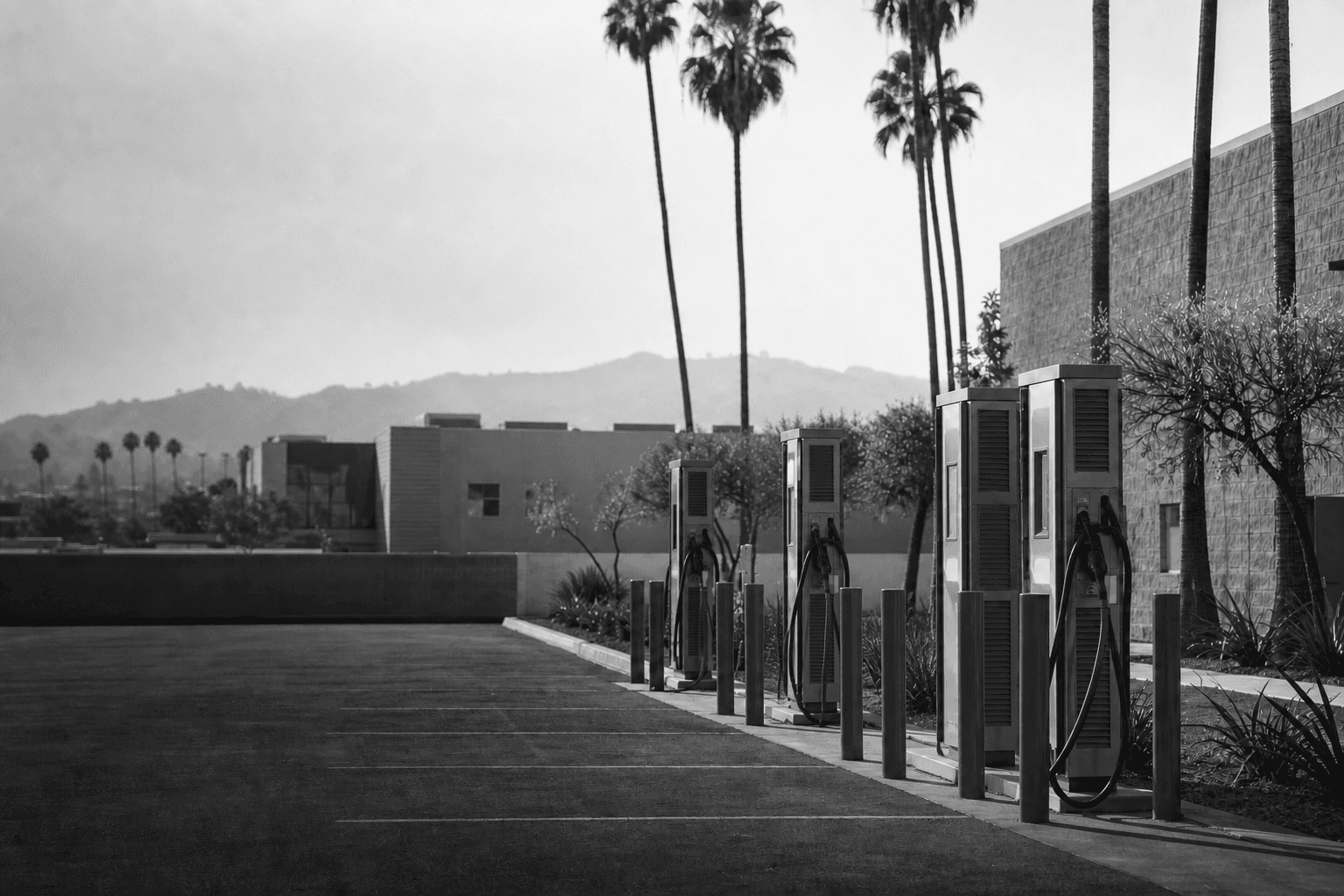
The same two chargers can be a two-day job or a six-week job. Nothing about the equipment changes between these two properties. Everything about the price does.
LOWER COMPLEXITY
Short run, spare capacity
The stalls sit within sight of the electrical room. The panel has open breaker positions and real headroom on the service. Conduit runs along a wall or under landscaping, and no pavement gets cut.
HIGHER COMPLEXITY
Long run, loaded panel
The stalls are across the lot, the service is already near its limit, and a drive aisle has to be trenched and repaved. Add a panel or a transformer and the electrical work outgrows the charger cost several times over.
SCOPING
What a real site review looks at
A site walk is not a formality. It is where the price comes from. A contractor who quotes off a photo and a stall count is guessing, and the guess gets corrected later at your expense.
Expect the walk to start in the electrical room. Someone should open the panel, read the service size, count spare breaker positions, and ask for a load study or recent utility bills to judge real headroom. From there the route matters: where conduit can run, what it has to cross, whether an existing pathway is usable, and what surface has to be restored afterward.
Then come the details that only show up on foot. Where water drains across the lot. Which stalls stay usable during construction. Whether the wireless signal reaches the chargers, if they will be networked. How the parking layout survives losing two stalls for a week. Whether there is room to add four more ports in three years without opening the same trench twice.
Bring the utility into that conversation early. Service capacity, metering, and the rate you land on are utility decisions, and they set both the install cost and the operating cost.
Ask before the walk ends
Get three things in writing: the service size and measured spare capacity, the trench length with every surface to be crossed, and whether the utility has confirmed the service can carry the new load without an upgrade.
ALABAMA CONTEXT
What state program rules add to a Huntsville project
Alabama's state-funded EV charging program, administered by ADECA, comes with strings that change what your project has to be. DC fast stations funded through it must be open to the general public twenty-four hours a day, seven days a week, year-round. Level 2 stations must be open to the public at least during the host's business hours; the only way to restrict them to employees or customers is to make charging permanently free.
The program has also drawn a clear line on electrical work. Permits are reimbursable when they are necessary to the installation. So is on-site service equipment like a meter, transformer, or switchgear, when the charging station is the sole reason for it. Major grid work such as long line extensions or substation upgrades is not.
One geographic wrinkle: a site within one mile of a designated federal EV charging corridor routes to the NEVI program instead, which ADECA also administers.
Check the map before you check the budget
Corridor proximity, public-access hours, and free-versus-paid charging are program-defining choices, not details. Settle them before you design the site, and confirm which Alabama funding round is actually open when you apply.
AFTER THE INSTALL
Who owns the chargers, and who pays when one breaks
Capital cost is one decision. The other is what happens on day 400, when a connector stops latching and a tenant calls you about it.
You can buy and own the equipment outright, which costs more up front and gives you full control of pricing, data, and repairs. Or a network or equipment provider can own the hardware and carry the maintenance, which lowers the entry price and hands over some of the upside. Neither is wrong. What is wrong is leaving it unsaid — plenty of stations sit dead because nobody agreed in advance whether the site host, the network, or the installer owns the fix.
Whichever you choose, put a response time, a repair window, and an uptime requirement in the contract.
OWN IT
Site host owns the equipment
You pay for the hardware, the installation, and every repair once the warranty ends. In exchange you set pricing, keep the utilization data, and answer to nobody about access rules.
OPERATE IT
Budget the running costs
Plan up to $400 per charger per year for maintenance. Extended warranties on DC fast chargers can run over $800 per charger per year, and networked stations add a software fee on top.
LIFETIME COST
Build once, expand cheaply
The most expensive mistake in commercial charging is trenching the same ground twice. If there is any chance you will add ports later, oversize the conduit and pull the extra capacity now. Empty conduit is cheap. Reopening a drive aisle in three years is not.
The same logic applies to the panel. Leaving room for future circuits costs a little today and saves a service upgrade later. A four-port project designed as phase one of twelve looks nearly identical on paper and costs far less over its life than four ports designed as a finished job.
Then plan the operating side, because that is where money moves after year one. Electricity is billed partly on demand, typically the highest fifteen-minute average draw recorded in the billing period, and DC fast charging triggers those charges far more readily than Level 2 does. Some utilities offer time-of-use rates or other rate options for charging owners. Ask what is available in Huntsville before you finalize the design, because rate structure can change the operating budget more than charger selection does.
Finally, sequence the money. Incentive programs generally do not pay backward, so apply before construction starts, not after the crew leaves.
COMPARING BIDS
Five things a comparable quote must show
If two bids do not itemize these five things, you are not comparing them, you are comparing formatting. Ask every bidder for the same breakdown so the real differences become visible.
01
Service capacity and load calculation
The measured spare capacity on your existing service, and exactly what the new chargers add to it.
02
Trench length and restoration scope
Linear feet of conduit, which surfaces get cut, and who puts them back to what finish.
03
Electrical scope, itemized
Panel, breakers, switchgear, transformer, and whether a utility upgrade is assumed or actually confirmed.
04
Hardware, network, and activation
Charger model and port count, the software contract term, and any first-year activation fees.
05
Warranty, maintenance, and uptime terms
Coverage length, response time, repair window, and who is responsible once the warranty expires.
Keep planning locally
Related EV charging pages in Huntsville
Get a defensible number
Price the equipment and the building together.
Send the address, operating target, and target opening date. Flux will identify what must be verified before the project can be priced.
Price my chargersQuestions
Straight answers.
How much does one commercial Level 2 charger cost in Huntsville?
Plan $2,500 to $7,000 installed per port. The hardware alone runs $400 to $6,500 for a single-connector unit; the rest is trenching, panel work, permits, and restoration.
Why does DC fast charging cost so much more?
The unit itself runs $10,000 to $40,000, and the electrical service behind it is a different class of work. Installed, DC fast projects commonly land between $40,000 and $150,000 per unit.
Is the federal 30C tax credit still available?
No. It covered up to 30% of purchase and installation cost for property in an eligible census tract, but it ended for property placed in service after June 30, 2026. Projects in service by that date still claim it at filing.
What ongoing costs should I budget after installation?
Up to $400 per charger per year for maintenance, plus network software fees. Extended warranties on DC fast chargers can exceed $800 per charger per year, and demand charges can dominate the electricity bill.
Sources used for this guide
- [1]afdc.energy.gov — Alternative Fuels Data Center: Procurement and Installation for Electric Vehicle Charging Infrastructure
- [2]irs.gov — IRS Alternative Fuel Vehicle Refueling Property Credit
- [3]adeca.alabama.gov — adeca.alabama.gov
- [4]afdc.energy.gov — Alternative Fuels Data Center: Operation and Maintenance for Electric Vehicle Charging Infrastructure
- [5]afdc.energy.gov — U.S. DOE AFDC Electric Vehicles for Fleets