Direct answer
Commercial Level 2 lands between $3,500 and $15,000 per port.
Plan on $3,500 to $15,000 per port for a commercial Level 2 station in North Carolina, equipment and installation together. DC fast charging runs $18,000 to well over $350,000 per port. Equipment alone is the smaller piece: $400 to $6,500 for a Level 2 unit and $10,000 to $40,000 for a DC fast unit. Everything between those two numbers is the electrical and civil work your site demands.
These are planning benchmarks, not a Fayetteville quote. Spare panel capacity, trench distance, pavement restoration, permitting, and the charging speed you actually need can move a port thousands of dollars in either direction.
Start with the schedule
Dwell time decides the charger, and the charger decides the budget
The cheapest charging project is the one that uses time instead of power. Level 2 equipment delivers 3.3 to 19.2 kW, which is plenty when vehicles sit for a full shift or overnight. Workplaces, multifamily properties, and take-home fleets almost always start here, and depot fleets without rapid turnaround do too.
DC fast charging delivers 50 to 500 kW and exists for one reason: vehicles that have to leave again soon. Travel centers, high-traffic public sites, and fleets on tight turnaround need it. That speed shows up in the electrical service behind the charger, not just the box, which is why the per-port range climbs by a factor of ten or more.
Run the math on operations before anyone quotes hardware. Daily miles set the energy each vehicle needs. Parking hours set the window to deliver it. If the window is wide, buy time. If it is narrow, buy power and budget for what feeding it costs.
Build the whole number
The lines that belong in a Fayetteville charging budget
A per-port range is a starting point, not a budget. Separate the equipment from the work needed to power it, or a low charger price will hide an expensive trench. The tag on each line is how much it can move once the site is measured.
Choose the hardware last
What to compare once you know what the site can feed
Charger brochures compete on power, and power is the one number your site may not be able to grant. A 48-amp Level 2 unit needs a dedicated 60-amp circuit, because the code sizes EV circuits at 125 percent of continuous load. Multiply that by six ports and the question stops being which charger and becomes whether the panel can carry it. Ask your electrician for a load calculation before you shortlist equipment, not after.
Once capacity is known, compare the things that decide the next ten years. Connector type and cable reach determine whether a driver can actually park and plug in. Enclosure rating and mounting decide how the unit survives a parking lot. Listing and labeling for EV use is required, so confirm it rather than assume it. Then look at the boring parts: warranty length, parts availability, who diagnoses a dead port, and how fast a replacement cable arrives.
Networking is a separate decision from hardware. Decide first whether you need utilization data, driver authentication, or paid sessions. If chargers are free to employees or tenants, a non-networked unit removes a subscription and a failure point. If you plan to bill by the kilowatt-hour to the public, that is a different conversation with different rules attached. Buy the features the operation needs and skip the rest, because every added feature is also something that can go down.
Same chargers, different price
What separates a cheap Fayetteville install from an expensive one
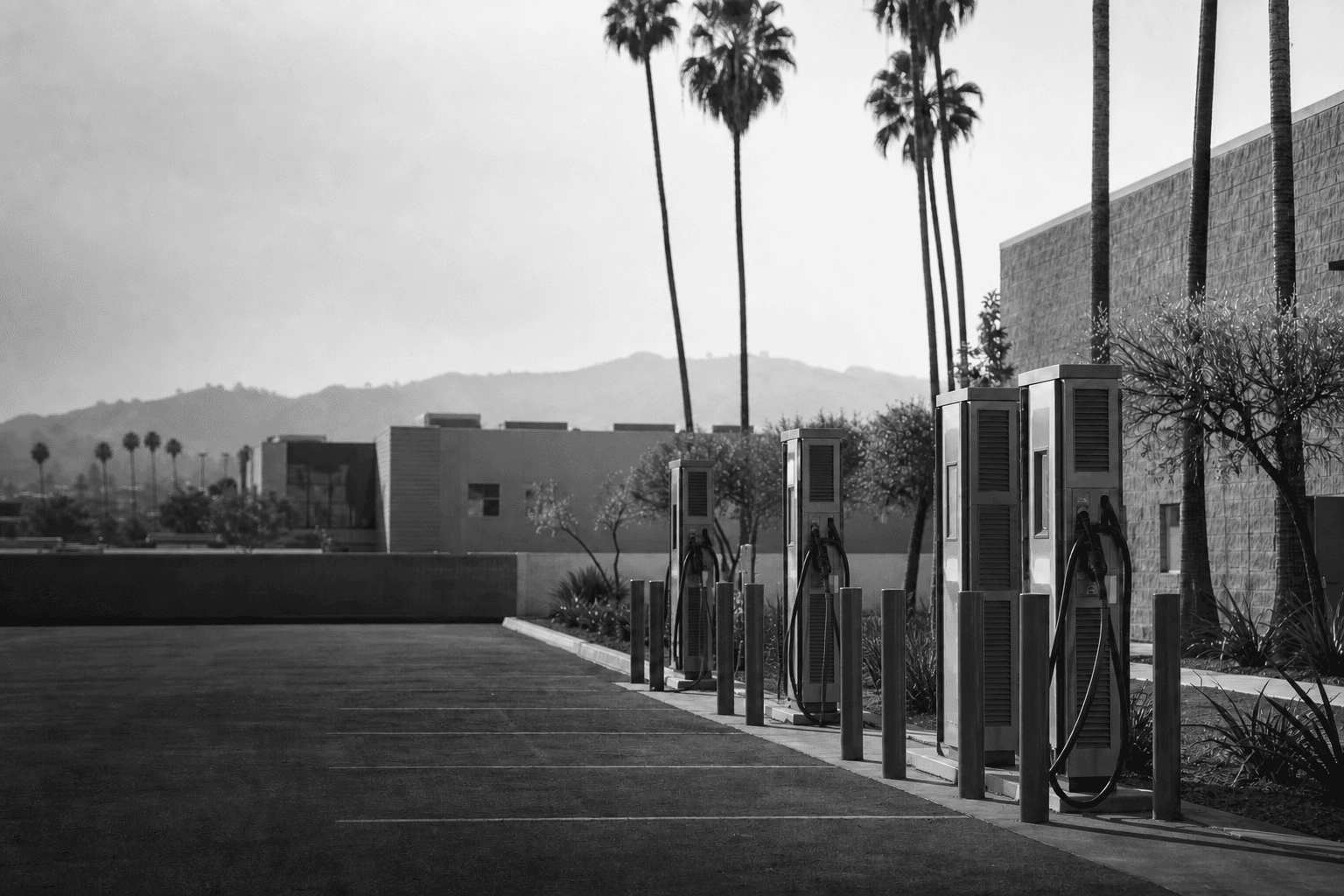
Four Level 2 ports beside the electrical room is a short run of work. The same four ports on the far side of an occupied lot add trenching, a pavement cut, traffic control, longer conductors, and a restoration line nobody budgeted. The equipment invoice is identical. The project is not.
Lower complexity
Power is already close
Spare capacity in the existing panel. Chargers within a short, accessible run of the electrical room. A landscaped or gravel route instead of pavement. No structural mounting, and Level 2 power the service can absorb without a utility conversation.
Higher complexity
The service has to grow
A panel upgrade or new transformer to add capacity. Long underground runs and boring under drive aisles. New posts, canopies, or a charging structure. DC fast power that pulls the utility, the demand charge, and a longer inspection sequence into the project.
Scope it in the field
The site walk is where the price stops being a guess
A useful site visit starts in the electrical room, not the parking lot. The reviewer should find the service entrance, the transformer, the main gear, the distribution panels, and the spare breaker positions, then trace the practical routes from there to the stalls you want. Nameplate capacity is only the opening claim. Recent demand history and any existing load calculations tell you what is genuinely available for charging once the building's own equipment is running.
Outside, walk the route rather than drawing it on an aerial photo. Mark the proposed stalls, the accessible spaces and the routes serving them, pedestrian paths, drive aisles, drainage, irrigation, and every change in pavement type. Commercial charging has to meet accessibility standards, so the accessible stall is a design input, not a detail added after the trench is dug. A straight line on a map often crosses a fire lane, a storm line, or a loading dock that turns the cheap route into the expensive one.
Then interview operations. When do vehicles arrive, how long do they stay, who is responsible when a port goes dark, and what happens when someone parks a gas truck in a charging stall? Those answers change port count and placement more often than any spec sheet does.
A remote estimate is a range, not a number.
Photos, a panel schedule, and twelve months of utility bills narrow the range considerably. A firm price still needs measured routes and verified capacity. Any estimate you accept should list, in writing, every assumption still waiting on field confirmation.
Fayetteville and North Carolina rules
Permits, zoning, and the code that sizes your circuits
North Carolina builds its electrical requirements on the NC State Building Code, which adopts the National Electrical Code and is enforced through local government inspections. Article 625 governs EV charging systems: circuits sized at 125 percent of continuous load, GFCI protection, listed and labeled equipment, and specific disconnect requirements for DC fast installations. If the panel cannot carry the new load, a separate panel upgrade permit is required, and that adds both cost and calendar.
Commercial and multifamily charging may also trigger zoning review, especially where parking lot standards or EV-ready ordinances apply. Check with the local planning and zoning office before the permit application goes in, not after. If you intend to sell electricity to the public by the kilowatt-hour, the NC Utilities Commission is the body whose rules apply. And if your site sits on a designated alternative fuel corridor, NEVI-funded stations carry federal requirements including a 150 kW minimum output.
The Fayetteville takeaway
Sequence matters more than speed. Get the load calculation done, confirm whether zoning review applies, and settle the accessible stall locations while chargers can still move on paper. Moving a charger in a drawing costs nothing. Moving it after the trench is open costs real money.
After the ribbon cutting
The install price is not the cost of running chargers
Two recurring costs surprise owners. The first is demand: utility bills include a charge based on the highest 15-minute average draw in the billing period, and DC fast charging is far more likely to trigger it than Level 2. One vehicle plugging in at the wrong moment can reset your peak for the month. Several North Carolina utilities offer time-of-use rates, which reward moving charging into off-peak hours. That is a scheduling problem, not an equipment problem, and a good reason to confirm your rate before you size the system.
The second is maintenance. Plan on up to $400 per charger per year, plus network fees if the units are connected. Extended warranties on DC fast chargers can run over $800 per charger annually, and repairs on out-of-warranty equipment get expensive quickly. Settle in writing who owns maintenance: you, the installer, or the network. A maintenance contract worth signing names a response time, a repair time, and an uptime requirement.
Decide before signing
Who owns uptime
Name the party responsible for repairs, the guaranteed response time, and the uptime the contract requires. A cheap port that sits dark for three weeks costs more than a better-supported one.
Decide before pricing
Whether drivers pay
More than 20 percent of public charging is still free to use. Free is simpler and removes payment hardware and fees. Charging by kWh, by session, by time, or by subscription each carries different rules and different overhead.
Build once, energize gradually
Phasing protects the first budget without redoing the lot
You do not have to energize every future port on day one. The expensive, disruptive work — trench, conduit, pull boxes, equipment pads, reserved panel space, and correctly sized feeders — can be done once, while only the ports today's demand justifies actually get hardware. That is the strongest argument for phasing: reopening a parking lot costs far more the second time.
Phasing only works with a written plan behind it. “EV ready” means nothing if the conduit ends in the wrong corner, the reserved gear cannot support the voltage you will eventually need, or the software cannot coordinate ports added later. Record the final port count, the assumed charging power, the diversity you are counting on, and the trigger that starts the next phase. The person who reads that file in four years should not have to reverse-engineer your intent.
Then price both ways. Ask each bidder for the immediate project and at least one expansion alternate, so you can see exactly what flexibility costs. Some work is genuinely cheaper per port when done all at once. Other equipment is better bought later, when the vehicles arrive. Federal charger credits under Section 30C no longer apply to property placed in service after June 30, 2026, so build the budget on capital cost and whatever utility or state programs you can confirm in writing before construction starts.
Before you compare bids
Five things a comparable quote has to show
Bids are only comparable when they price the same scope. If one includes trenching, pavement restoration, and the panel upgrade while another quietly excludes them, the lower total is not the lower price. Ask every bidder to show these five.
01
Port count, power level, and the dwell time they assume
The operating case behind the design, written down.
02
A load calculation against your actual service
Capacity available today, and what a panel upgrade would add if it is short.
03
Measured conduit routes and exact charger locations
Trench length, pavement type, and who restores the surface.
04
Permits, inspections, accessibility, and zoning review
Which are included in the price and which get billed later.
05
Networking terms and year-one operating costs
Subscription length, renewal pricing, maintenance responsibility, and uptime commitment.
Keep planning locally
Related EV charging pages in Fayetteville
Get a defensible number
Price the equipment and the building together.
Send the address, operating target, and target opening date. Flux will identify what must be verified before the project can be priced.
Price my chargersQuestions
Straight answers.
How much does one commercial Level 2 port cost in Fayetteville?
Budget $3,500 to $15,000 per port for equipment and installation together. Sites with spare panel capacity and stalls near the electrical room land at the low end. Long conduit runs, pavement cuts, or a panel upgrade push toward the high end quickly.
Why does DC fast charging cost so much more?
Two reasons. The equipment runs $10,000 to $40,000 per unit instead of a few thousand, and the electrical service behind it is a different class of work. Installed per port, DC fast ranges from $18,000 to over $350,000, and it is also far more likely to trigger utility demand charges once it is running.
Do I need a permit to add EV chargers to a commercial lot in Fayetteville?
Yes. North Carolina enforces the state building and electrical codes through local government inspections, and commercial EV work requires an electrical permit. Trenching for underground conduit and any new post, canopy, or carport adds scope. If the panel needs upgrading, that is a separate permit with its own cost and timeline.
What will the chargers cost us every year after they are installed?
Plan on up to $400 per charger annually for maintenance, plus network fees if the units are connected. Extended warranties on DC fast chargers can exceed $800 per charger per year. Electricity is the other half: per-kWh charges plus demand charges based on your highest 15-minute average draw, which time-of-use rates can help you manage.
Sources used for this guide
- [1]afdc.energy.gov — Alternative Fuels Data Center: Procurement and Installation for Electric Vehicle Charging Infrastructure
- [2]irs.gov — IRS Alternative Fuel Vehicle Refueling Property Credit
- [3]permitbystate.com — EV Charger Permit Requirements in North Carolina
- [4]qmerit.com — North Carolina EV Rebates, Incentives & Tax Credits
- [5]afdc.energy.gov — Alternative Fuels Data Center: Operation and Maintenance for Electric Vehicle Charging Infrastructure
- [6]afdc.energy.gov — U.S. DOE AFDC Electric Vehicles for Fleets