THE NUMBER
Commercial EV charging installation cost in Arlington
Plan on $3,500 to $18,000 per Level 2 port installed for commercial work in the Dallas–Fort Worth–Arlington market. The charger itself is the smaller half of that: single-connector Level 2 units run $400 to $6,500, and DC fast units run $10,000 to $40,000 before anyone digs. Fully installed, DC fast dispensers commonly land between $75,000 and $350,000 each.
These are planning benchmarks, not an Arlington quote. Panel capacity, trench distance, pavement restoration, utility service work, and port count move the number far more than the charger brand does.
THREE PATHS
Decide what the chargers are for before you price them
The cheapest commercial charging project is the one sized to how the parking is actually used. Start with dwell time. Cars that sit for hours do not need fast charging, and buying speed you cannot use is the most common way commercial sites overspend.
National guidance splits it about the way you would expect. Workplaces and multifamily buildings should look at Level 1 and Level 2. Public-facing hosts should consider Level 2 and DC fast. Fleets get one more option worth knowing: instead of a pedestal at every stall, some yards install 120/240-volt receptacles and use portable Level 1 or Level 2 units stored in the vehicles. That trims project cost and turns a failed unit into a swap instead of a service call.
Pick the row that matches your parking, then compare hardware.
LINE BY LINE
What belongs in the budget
A complete Arlington quote prices these separately. When a bid shows one lump sum for "installation," you cannot tell whether the site work was scoped or guessed — and site work is where commercial charging budgets actually move.
BUYING GUIDANCE
Why two honest quotes can be six figures apart
Two quotes for the same six ports can land six figures apart and both be honest. The variable is rarely the charger. It is the distance from the electrical service to the stalls, the condition of the pavement in between, and whether the building has spare capacity left to give.
The federal 30C credit is no longer part of the math for new work. It covered up to 30 percent of qualifying equipment and installation, capped at $100,000 per item, and only in eligible census tracts — and only for property placed in service on or before June 30, 2026. If your chargers energized by that date, your tax advisor can still claim it. Anything breaking ground now should pencil without it.
That puts the utility layer in front. Oncor runs commercial make-ready and sustainable energy programs in this territory that pay toward the expensive part: the service, conduit, and wiring between the meter and the stall. Apply before construction, because these programs do not reimburse work already done, and confirm current funding, since program budgets open and close. Charging equipment bought for a business is also depreciable property, so bring your accountant into the capital plan early.
SITE CONDITIONS
What makes a site cheap or expensive
Two properties can order identical chargers and get very different prices. Before you compare bids, figure out which of these two descriptions matches your site — it explains most of the spread.
LOWER COMPLEXITY
Short runs and spare capacity
Stalls near the electrical room, a panel with amps to spare, and a landscaped or gravel path for conduit. The work stays inside the building's existing service, so no transformer and no utility upgrade enters the schedule.
HIGHER COMPLEXITY
Long runs, full panels, fast charging
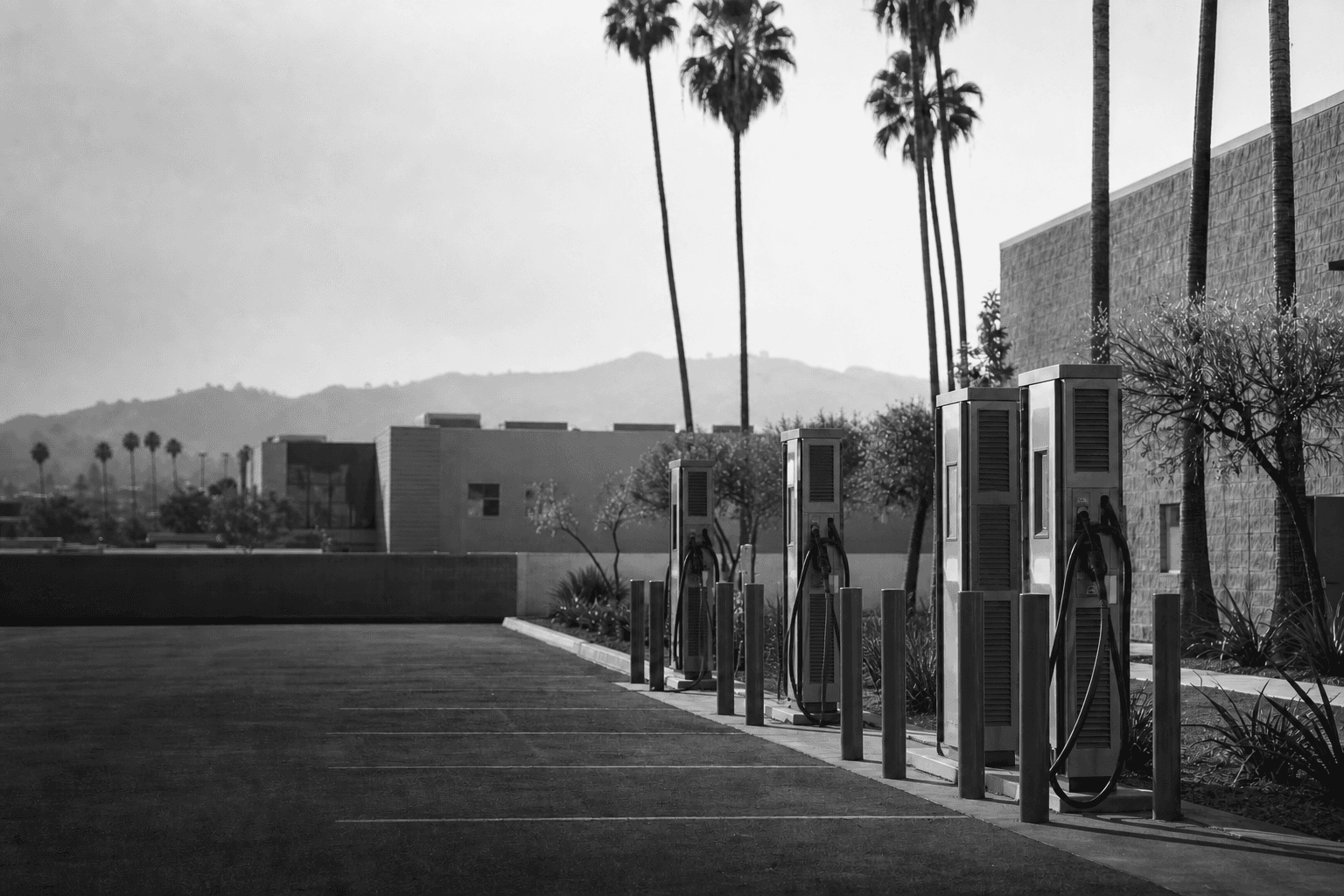
Stalls across the lot, a panel already at capacity, and pavement that has to be cut and restored. DC fast pushes it further with new service, possible transformer work, and a utility timeline you do not control.
SCOPING
The site walk that sets the price
Nobody can price commercial charging from a phone call, and you should be wary of anyone who tries. The number comes out of a site walk with three specific findings.
First, the electrical service. What is the panel rated at, what is the measured load today, and how many amps are genuinely available for new continuous load? That answer decides whether you are adding a subpanel or starting a utility conversation.
Second, the path. Someone has to walk the route from the electrical room to the proposed stalls and measure it. Concrete, asphalt, landscaping, and buried utilities each change what it costs to get conduit across a lot, and restoration is a real line item rather than a rounding error.
Third, the stalls. Charger placement has to work with parking geometry, accessible routes, signage, and protection from vehicles. It should also account for weather exposure, since extreme weather is one of the more common reasons a charger ends up needing service.
A contractor who has done all three can commit to a number. One who has not is quoting a hardware catalog.
What to hand the contractor
Bring a current one-line diagram, a recent utility bill showing peak demand, a site plan marking the stalls you want, and your three-year port target. Those four documents cut a week of guessing out of the estimate.
IN ARLINGTON
What Arlington and Oncor change
Arlington sits inside the Dallas–Fort Worth–Arlington metro of roughly 8.1 million people, and it is served by Oncor Electric Delivery. Texas splits the utility in two, and the split matters for budgeting: Oncor owns the poles, the service, and the upgrade queue, while your retail electricity provider is a separate contract that sets what you pay per kilowatt-hour. Service work goes through Oncor no matter who sends the bill.
Permitting here commonly runs 10 to 18 weeks for a commercial site plan plus electrical permits, and full projects run four to nine months from contract to energized chargers — longer when a service upgrade is in the path. Contractors in this market routinely coordinate across Arlington, Fort Worth, and neighboring jurisdictions, so confirm early which review desk your address falls under.
Start the utility conversation first
Engage Oncor before you lock equipment counts. The service review and any upgrade set your real schedule, and make-ready funding has to be applied for before construction begins — it does not pay backward.
OWNERSHIP
Who owns the chargers and the operating cost
Ownership decides who carries the running cost, and the running cost is not trivial. Beyond electricity, plan for network software, payment processing, maintenance, and demand charges.
Demand charges deserve their own line. Utility billing typically prices demand off the highest 15-minute average use in a billing period, and DC fast charging is far more likely to trigger it than Level 1 or Level 2. Load management — limiting how much power the ports can pull at once — is the cheapest defense, and it belongs in the original design rather than a retrofit. Some utilities also offer time-of-use rates that reward off-peak charging.
On the revenue side, retail charging in this metro tends to price between $0.35 and $0.65 per kilowatt-hour, though more than 20 percent of public charging nationally is still free to use. Decide whether your chargers are an amenity or a business before you sign a network contract.
OPTION ONE
Own the equipment
You buy, install, and maintain it. That lowers total cost and gives you full control over pricing and access, but you also own every repair once the warranty ends. Put responsibility for service in writing before the first invoice.
OPTION TWO
Let a provider own it
A network or vendor owns the hardware and carries the operational risk. You trade margin for accountability on uptime. Read the contract for who pays when a unit fails and how long the site waits for a replacement part.
PHASING
Dig once, add ports later
The cheapest port you will ever install is the second one, if you plan for it now. Trenching and pavement restoration cost about the same whether you pull wire for two ports or stub conduit for eight. Sizing the conduit, the panel, and the mounting bases for a larger future build costs a fraction of coming back to open the same asphalt in three years. Ask every bidder to price the build you want today and the build you might want by 2029.
Phasing works best when the expensive, disruptive work happens once. Service capacity, trench, conduit, and pads go in during the first mobilization. Chargers get added as demand shows up, which is also how you avoid paying monthly network fees on ports nobody uses.
Lifetime cost, not sticker price, should settle the hardware decision. A cheap unit with a short warranty and slow parts support costs more over five years than a well-supported one, because a dead port earns nothing and still sits on your property as a broken amenity. Write the uptime requirement, the response time, and the repair time into the contract, and name who is responsible for each.
QUOTE CHECK
Five things a comparable quote shows
Bids are only comparable when they break out the same way. Ask every contractor for these five items in writing, then compare line to line instead of bottom line to bottom line.
01
Hardware priced by unit
Make, model, connector count, and power level, with the unit price separated from labor.
02
The electrical run, measured
Trench footage, conduit path, wire size, and pavement cut and restoration priced as their own line.
03
Capacity findings
Amps available today, the load calculation behind that number, and whether a panel or service upgrade is required.
04
Permits, utility, and schedule
Which permits get pulled, who files with Oncor, and a dated timeline that includes inspection.
05
Year-one operating costs
Network subscription, maintenance and warranty terms, uptime commitment, and who responds when a port goes down.
Keep planning locally
Related EV charging pages in Arlington
Get a defensible number
Price the equipment and the building together.
Send the address, operating target, and target opening date. Flux will identify what must be verified before the project can be priced.
Price my chargersQuestions
Straight answers.
How much does one commercial Level 2 port cost in Arlington?
Plan on $3,500 to $18,000 installed per port in this market. The hardware is only $400 to $6,500 of that. Sites with stalls near the electrical room and spare panel capacity land low; long runs, pavement cuts, and panel work push toward the top.
Why is DC fast charging so much more expensive?
The hardware alone runs $10,000 to $40,000 per unit, and installed dispensers commonly land between $75,000 and $350,000. The electrical service behind them is a different class of work, and fast charging is far more likely to trigger utility demand charges once it is running.
Are there still incentives for commercial EV charging?
The federal 30C credit applied only to property placed in service on or before June 30, 2026, so it is history for new construction. Oncor's commercial make-ready and sustainable energy programs now do the heavy lifting. Apply before construction — they do not reimburse completed work.
How long does a commercial charging project take here?
Commercial site plan and electrical permitting commonly runs 10 to 18 weeks, and full projects take four to nine months from contract to energized chargers. A utility service upgrade extends that, which is why the Oncor conversation should start before you order equipment.
What should I budget for after the chargers go live?
Electricity including demand charges, network software at roughly $15 to $40 per port per month, payment processing, and maintenance of up to $400 per charger per year. Extended warranties on DC fast units can exceed $800 per charger annually.
Sources used for this guide
- [1]afdc.energy.gov — Alternative Fuels Data Center: Procurement and Installation for Electric Vehicle Charging Infrastructure
- [2]irs.gov — IRS Alternative Fuel Vehicle Refueling Property Credit
- [3]winsparking.com — EV Charging Station Installation in Dallas, TX | Wins Parking
- [4]echoelectricalservices.com — EV Charging Station Installation Fort Worth & Arlington | Echo Electrical Services, Inc.
- [5]afdc.energy.gov — Alternative Fuels Data Center: Operation and Maintenance for Electric Vehicle Charging Infrastructure
- [6]afdc.energy.gov — U.S. DOE AFDC Electric Vehicles for Fleets